It’s been a while since we last checked in on the esports industry or discussed any milestones it has reached. For a while there, we were seeing new ground broken on a nearly monthly basis, particularly during the height of the COVID-19 pandemic. Despite all of that growth, we did mention that it was also time for the industry to grow up a bit, namely in terms of recognizing that individual players, teams, and their personalities are what is going to ultimately drive the greatest interest in these leagues, no different than any other professional sports league. Basketball is a great sport, but Michael Jordan was a driver of interest in it.
Which makes it all the more prickly to see Riot dealing with a players’ strike for its North American League of Legends league. The motivation for the strike is Riot’s plans to consolidate the current N.A. Challenger’s League by essentially eliminating more than half the teams and, consequently, paid jobs for the league.
The LCS Players Association, the body representing the region’s professional players, say the plans will see an estimated 70 people—players, coaches, etc—lose their jobs. Riot, meanwhile, say the cuts were necessary to ensure the North American leagues remain “sustainable [and] economically viable”.
Tensions escalated a day later when news emerged that pro teams had been actively looking “to field scab players”, a move that the LCSPA rightly say would “put all players’ futures at risk”, as “crossing the line undermines player negotiating power”.
Now, for its part, Riot met with the LCSPA after rumors of scabs became public and its subsequent statement on the matter doesn’t carry any indication that scab players would be sought for use. It’s actually much worse than that. First, Riot admonishes the players for seeking to establish greater salary pools for player salaries, suggesting that its “Tier 2 leagues” are getting by just fine without those larger salaries overseas. That is typical sports management talk and it doesn’t make a great deal of sense. Lower tier leagues bring in less revenue typically and therefore are provided lower salary pools. Major League Baseball serves as a prime example of this sort of thing.
But the second key takeaway from Riot’s statement is that if the players don’t move off of their demands to something Riot wants to agree to within 2 weeks, then Riot will simply shutter the league for the year entirely.
Delaying beyond the two-week window would make it nearly impossible to run a legitimate competition, and in that case, we would be prepared to cancel the entire LCS summer season. Carrying this forward, if the LCS summer season is canceled, this will also eliminate LCS teams qualifying for 2023 Worlds. I want to be clear: That is not an outcome we’d want, but it’s unfortunately the reality of ensuring we run a fair, competitive global system.
It’s all worded to sound profoundly reasonable, but it isn’t. Labor negotiations under the gun of a 2 week timeline feels self-evidently silly. But timelines like this are a common sports league vs. labor negotiating tactic. And, helpfully for the players, this transitions things from a clear players’ strike, which fans generally blame players for, and into a combination strike and owner’s lockout, which fans generally blame the owners for in other sports.
But I guess if nothing else, esports continues to mature. A big boy labor dispute is a mile marker of sorts, after all.
We’ve noted repeatedly that as the streaming sector grows and consolidates, it’s revealing many of the same problems we saw inherent in traditional, shitty, cable TV. As in the need to provide Wall Street improved quarterly returns at any cost has them doing the sort of things common in the traditional cable sector they used to criticize and disrupt (see Netflix’s password sharing cash grab).
Elsewhere, we’re seeing the byproduct of mindless consolidation results in other problems. Such as with the AT&T/Time Warner/Discovery mess, a series of utterly pointless mergers that have made the end product decidedly worse, while resulting in thousands of layoffs, price hikes, companies too cheap to pay artist residuals, writer strikes, and widespread annoyance and angst.
Warner Brother Discovery has been too cheap to pay artist residuals, resulting in a lot of popular shows being pulled from the company’s HBO Max streaming platform. We’re seeing the same thing over at Disney+, which apparently has proven unable to keep shows they’ve just recently produced — like Willow — online and available to a handful of customers via streaming.
The reason we’re given is that the same giant media conglomerates that spent hundreds of billions of dollars on pointless megamerger sprees, and received tens of billions of dollars in tax breaks for doing absolutely nothing, suddenly can’t afford to pay their writers a living wage, or keep shows like Willow available to consumers:
Streamers like Disney+ have to pay rights-holders and content creators continually in many cases to keep their content on their platforms, but often that content is being viewed by too few people and isn’t driving new subscriptions. As such, these businesses see cuts as obvious ways to save money during turbulent times.
The cuts are occurring at the same time that corporations are once again flexing their muscles in the wake of a brief shift of power toward labor during peak COVID. As the narrative goes, this kind of belt tightening is only wise given the “turbulent times” and a purported recession (?) waiting in the wings. You’re lucky to have a job. Sit down and shut up.
So who decides which shows should get the boot? Bean counters, mostly, who consider the cost of carrying library content based on how much is paid toward residuals, participations and royalties. That is weighed against viewership and a title’s ability to lure more subscribers — like The Office on Peacock, for example — and create less churn. Ahead of Showtime dumping titles, Chris McCarthy, President/CEO, Showtime and Paramount Media, said that “we will divert investment away from areas that are underperforming and that account for less than 10% of our views.”
But again, it’s not just less popular shows like Willow getting the axe. Sesame Street and other popular kids’ programming have been shown the door. Mad Magazine was an early casualty of merger mania. There’s logic-driven belt tightening, and then there’s just being fucking cheap.
Routinely lost in the conversation is all the endless promises of “untold synergies” that accompanied decades of mindless media consolidation. Synergies that were supposed to have made these companies lean and resilient long ago. In reality, that consolidation instead created a massive, wasteful mess fraught with consistent managerial incompetence that’s increasingly catching up to the industry:
On Tuesday morning, subscribers took to social media to complain that they were having problems logging in to Max, which is replacing the three-year-old HBO Max service. As reported by users, the issues spanned the Max.com website as well as mobile apps including iOS and connected-TV apps on Roku and Samsung TV.
It’s growth for growth’s sake. Change for change’s sake. And dealmaking for dealmaking’s sake. Usually simply to generate tax write offs and let incompetent media executives fail upwards while pretending they’re savvy dealmakers.
You’ll notice that how much money gets wasted in mindless consolidation, pointless megadeals, and sustained managerial incompetence kind of gets lost in the weeds when it comes time to explain why streaming catalogs are shrinking, prices are rising, writers can’t get paid, and layoffs abound. But harmful and often pointless consolidation remains a primary reason streaming is slowly turning into the terrible cable TV sector it used to make fun of.
Despite years of cable industry executives claiming that cord cutting (ditching traditional cable TV) was either a fiction or a fad, that wound up being… not true. Executive claims that cord cutting was finally slowing down and would soon effectively stop? Also, surprisingly, not true.
When I’d write about the cord cutting trend I’d get snotty missives from cable and broadcast PR people genuinely annoyed that I was pointing out an obvious trend. Needless to say, most of those folks aren’t all that vocal any more.
Variety notes that U.S. cable, satellite and internet TV providers saw their biggest drop in paying customers in TV history during the first quarter of 2023. Collectively, they lost 2.3 million subscribers in just one quarter; either to streaming alternatives, old fashioned antennas, or services like TikTok or YouTube. All told, there haven’t been this few pay TV subscribers since 1992:
With the Q1 decline, total pay-TV penetration of occupied U.S. households (including for internet services like YouTube TV and Hulu) dropped to 58.5% — its lowest point since 1992, two years before DirecTV launched as a new rival to cable TV, according to Moffett’s calculations. As of the end of Q1, U.S. pay-TV services had 75.5 million customers, down nearly 7% on an annual basis.
And again, the Wall Street analysts who track the sector for a living say there’s really no evidence this trend is going to slow down anytime soon:
“The picture is not one that suggests that a plateau in the rate of decline is coming any time soon,” Moffett wrote.
Those same analysts say we’re now entering a “doom cycle” for traditional pay TV services. Is that bad? It sounds bad.
Of course as the traditional cable TV industry dies off, the streaming industry that replaced it is going through its own growing pains. Many of which directly reflect many of the same problems inherent in the cable sector they disrupted. Mindless consolidation and endless prices hikes driven by Wall Street’s demand quarterly returns at any cost have many streaming giants making some very similar errors as they attempt to scale, please investors, and maintain customer loyalty simultaneously.
Streaming seems intent on becoming the industry it disrupted because the same underlying mechanisms are still at play. Still, with the lower costs, improved bundle flexibility, better customer service, increased competition, and ability to cancel service without getting a migraine, the overall shift from traditional cable to streaming has still been a net improvement for end users from the Comcast-dominated days of old.
Last month there was a lot of attention paid to Frank Ocean’s performance at Coachella, which has been described as “so bizarre.” Apparently there was supposed to be an elaborate ice rink involved in the set, which was scrapped at the last minute, and then everything about the actual performance, including that it was difficult to see Ocean, went off… weirdly.
Destined to make waves, it was Ocean’s first live performance in six years, three years after he was slated to headline Coachella 2020. Hours before Ocean was set to take the stage, the internet was already buzzing after the revelation that the official Coachella live stream wouldn’t be airing Ocean’s set, after both YouTube and Coachella promoted the stream. Meanwhile, Coachella attendees sat patiently through an hour delay until the artist finally arrived. Fans’ bafflement continued though, with Ocean out-of-sight for a portion of the performance, unexpected DJ interludes, and remixed songs that disappointed those wanting to sing along.
Ocean made his intentions of the set clear, to honor his memories at Coachella with his late, younger brother, Ryan Breaux. He told the crowd(opens in a new tab), “I want to talk about why I am here…my brother and I, we came to this festival a lot…and one of my fondest memories was watching Rae Sremmurd with my brother…I know he would have been so excited to be here with all of us. I want to say thank you for the support and the ears and the love over all this time.”
The end of his set was as lackluster as its delayed start. After a stunning cover of “At Your Best (You Are Love),” he announced, “Guys, I’m being told it’s curfew, so that’s the end of the show.”
The whole thing about how it was promoted by YouTube and Coachella for the livestream, and then… not livestreaming it seemed notable. But, of course, in this day and age, there are still tons of people with high quality cameras in their pockets, so lots of people recorded portions of the Ocean set and posted them online.
So, film editor Brian Kinnes decided to download more than 450 such videos that he could find, from about 300 different attendees, and stitched pieces of about 150 videos together into a concert film that many people say was quite good. For sound, he apparently found the two best recordings for sound quality, and had a sound engineer friend of his clean them up and stitch them together.
Except, two hours after it was uploaded to YouTube, Coachella owner AEG sent an angry, legalistic cease-and-desist letter ordering him to take it down and destroy all copies of the video and remove any mentions of Coachella.
Now, I can understand (maybe?) why Coachella wanted to do this, especially after it refused to livestream the show. But… I’m perplexed as to what basis it has to do this, beyond pure legal bluster. The Variety article that broke this story notes the same thing:
But the copyright and intellectual property laws surrounding Kinnes’ film are actually quite murky, as there are many layers of copyright interests at play, including but not limited to Ocean’s music and lyrics, the graphics and video elements, the festival’s signage and trademarks, the people who took the videos and the social media platforms to which they uploaded them. After all, copyright protects any original form of expression that is fixed in a tangible medium.
But while the cease and desist letter warns, “You cannot use our logo, our artwork, our imagery, or any of our other intellectual property for your own commercial benefit,” Kinnes says he is not making any money off of his concert film, and he never expected to. For that reason, he says may have a fair use defense. But legal experts say AEG could still make a trademark dilution claim even if Kinnes is not held liable for infringement — an idea the company alludes to in the letter: “The contents of your social media posts, use of our Festival name, use of our Festival content, and other circumstances clearly indicate that you are using the Intellectual Property with intent to trade on the Festival’s name and reputation.” Attorneys say even sharing or promoting links to re-uploaded versions of his video could potentially land Kinnes in legal trouble for contributory infringement.
And, yes, it’s possible the film infringes on someone’s copyright, but it’s not AEG’s (at all). At best, as noted above, AEG might have a trademark claim, but that seems hard to justify as well, considering that Kinnes wasn’t using this in commerce, as is required for there to be a trademark violation. Also, it seems that Kinnes has been quite clear all along that he’s not associated with Coachella, and no one watching the film is likely to think he is. It’s difficult to see how there’s a legit trademark claim here at all either.
Coachella does have rules for attendees about not broadcasting live audio, but… Kinnes didn’t attend the show, and never agreed to such rules.
In the end, Kinnes did comply because big scary legal letters often work to intimidate and silence people who don’t want to deal with the hassle of a lawsuit. But it’s really a shame. And even Kinnes seems to recognize that:
Upon receiving the cease and desist, Kinnes says he consulted a lawyer and feels confident that AEG does not have a “legitimate complaint.” He adds, “It feels like a massive overreach of power by a corporation that is struggling with their image.”
Kinnes emphasizes that the film is a passion project, which he worked on during his off-hours from his job as a professional film editor, without the intent or expectation of compensation. “Frank Ocean has had a massive amount of influence on my life,” he says.
At least the film is getting Kinnes apparently well deserved positive attention:
In addition to being shocked by AEG’s legal letter (it hasn’t followed up since), Kinnes found himself surprised by a wealth of new professional opportunities. He has received emails from film directors with scripts, as well as from agents.
“Hollywood was always the end goal, but there was never a way for me to break through those doors. The situation is just so silly. In a matter of 72 hours, working on this little music film in my bedroom is the thing that helped open those doors for me.”
That’s great for him, but it’s not great for culture. AEG/Coachella was able to legally bully a guy into pulling down a film based on highly questionable legal bullying. And that’s not great for the public or culture.
It’s not at all surprising why tons of people, including journalists, are sticking around Twitter even if they shouldn’t. Part of it is inertia. People were settled into what worked before, and change is difficult. Partly because of that, people are loathe to switch. Even those who have switched over to alternatives like Mastodon in the Fediverse find it difficult to do so. There’s a bit of a chicken-and-egg problem in which, when people first sign up, it feels “empty” because there’s no algorithm pumping their feed full of content (though I’ve found Mastodon to be quite engaging, to an almost overwhelming degree that I can’t keep up). You have to do a little bit of work, and that can feel like a lot.
But still.
There are so, so, so many reasons to not think this is a good state of affairs. The events of the last few years should demonstrate why relying on any centralized social media is inherently risky. This goes beyond just Twitter, but Elon has been turning that site into a ridiculous plaything in which he makes decisions based on which of his dumbest (but most loyal) fans he thinks will get the biggest kick out of them, rather than any sense of what’s best for the site’s users.
Last week, the pseudonymous Chance from the Chancery Daily publication suggested that we start embracing a concept of “Fedi Friday,” in which even people who feel that they’re going to stick around on Twitter for a while at least just spend one day a week exploring alternative social media, just so they have a general knowledge of it, and experience with it, in case they’re targeted in the next “look at me, I’m in charge now” purge from an insecure, whiny billionaire.
Seeing how Elon has handled the whole NPR situation should be instructive. His pettiness in the whole thing, including yesterday tweeting “defund NPR” should highlight why relying on Twitter is dangerous.
And, even if you think you support and agree with Musk, he’s shown little to no problem with stabbing his supporters in the back the second they push back even the slightest bit. He’ll even publish their private communications just to win a slap fight. So even if you think that Musk is magically “saving” Twitter, it still makes sense to find a space that isn’t controlled by him.
You don’t have to commit to leaving Twitter. You just need to spend a little time each week testing out the alternatives, of which there are many. The ActivtyPub-based “fediverse” is much vaster than people realize, going beyond just Mastodon (though they all interact in some ways). Larger companies such as Medium, Mozilla, and Flipboard are all embracing ActivityPub in one way or another, and others are poking around the edges as well.
There are, of course, a variety of other, centralized platforms, and you can test them out as well, but all of those run the same risk of what’s happened with Twitter: they can be run by a thin-skinned, whiny, out-of-touch billionaire with the maturity of a 15-year-old and the vindictiveness of a pre-school child who has had his ball taken away.
There are some other decentralized platforms worth checking out as well. Nostr is an incredibly simple and lightweight decentralized protocol that keeps improving. Bluesky, which was initially funded by Jack Dorsey to create an independent decentralized protocol that Twitter could adopt, is now in beta with its own AT Protocol. Both are decentralized and worth exploring, through not as widely adopted as the larger Fediverse.
If some of the specifics of Mastodon trouble you, you can look at some various ActivityPub-compatible forks like Calckey or Qoto that include many of the features that people sometimes feel are lacking from vanilla Mastodon (like quote tweets).
There is no one right way to do things. The point is that rather than settling for continuing to feed into a system you know is bad and problematic, at least spend some time on just one day a week (why not Friday) to explore the alternatives. Spend a bit of time find more active accounts to follow, interacting with some of the many people who use these services, and just prepare yourself for the future, rather than pretending there’s nothing to do but be the plaything for a childish billionaire who delights in making you suffer, so long as it pleases his fans.
We’ve noted in detail how the AT&T/Time Warner/Discovery mergers have been an apocalyptic mess that aptly demonstrates the U.S. obsession with utterly pointless megadeals and the “growth for growth’s sake” mindset. Hundreds of billions of dollars later and the companies have produced a product that’s notably shittier than when they started, laying off thousands of people, cancelling popular shows, and leaving the company’s catalogs with new, weird gaps due to a refusal to pay residuals.
You’ll recall that this all began with AT&T’s disastrous $200 billion acquisition of Time Warner and DirecTV in a clumsy bid to dominate the video ad space. When that failed, AT&T spun off Time Warner, which was quickly merged with Discovery in yet another deal that’s been almost as bad for employees, consumers, and creators.
“Dropping HBO from the name is cementing that ‘we’re not just a home for premium programming,’” Ms. Alexander said. “‘We’re the home for anything you want to watch.’”
The HBO brand has been synonymous with quality for fifty years. But the shift away from quality to low quality mass consumable dreck began under AT&T in 2018 and continues here. Just a continuing array of strange branding and marketing from a team of executives that have, at absolutely no point, indicated that they have any idea what they’re doing or what users want. And it shows in the ratings:
According to Nielsen, 1.3 percent of the total minutes spent by Americans using television was with HBO Max in February, a fraction of what YouTube (7.9 percent), Netflix (7.3 percent), Hulu (3.3 percent) and Amazon Prime (3 percent) garnered. HBO Max instead finds itself in the same neighborhood as Comcast’s Peacock and the Fox Corporation’s free advertising-supported streaming service, Tubi.
Keep in mind, that under AT&T this company integrated so many different dumb streaming branding names that they confused even the company’s own support employees. Now, what’s left of the company is further distancing itself from the popular HBO brand, launching a $16 a month streaming service just called “Max” sometime in May or June. HBO will continue to exist as a cable channel, for however long cable channels continue to exist.
It can’t be repeated often enough that this entire megamerger saga, from AT&T to now, involved companies spending burning hundreds of billions of dollars to make a worse product, fire untold people, cancel numerous popular programs, and even kill Mad Magazine.
Now maybe this whole gambit works out, and offering lower-quality dreck (I think often about the “Ow, my balls” TV show in Idiocracy for some reason) really works out for them. But I still tend to think its a lovely demonstration of the idiocy of pointless megadeals, which routinely harm consumers and creators so some unremarkable MBAs can get a tax break and put “savvy dealmaker” on their resumes.
Those of you who have followed the game jams over the years will surely recognize that name, because this is David’s fourth straight win, and the third in this category. In the past his winning games have all shared a common purpose: guiding players in an exploration of one or more paintings that had just entered the public domain that year. But this time we’ve got something very different. Tower Tree Stories isn’t based on a famous painting or an artist, but rather on something a little more low-key: the 1927 yearbook of Greensburg High School in Indiana, a full copy of which is the backbone of the game.
If you’ve ever flipped through an old yearbook, you surely know the feeling that powers this game: all those faces, all those little slices of people’s experience, every one of them providing just the slightest hint of the fully lived life underneath. It’s a sort of mystery, but one you can’t solve, so the imagination runs wild — and what better starting point for a storytelling game? In Tower Tree Stories, players will surmise and invent the relationships between the students who look out at them from the pages of the yearbook, flesh out details about their personalities and the school’s activities, and ultimately confer awards on them at an end-of-year ceremony.
Rather than put each player in the shoes of a single student, the game gives you a more bird’s eye perspective as it moves through a series of rounds. The rules are surprisingly robust without being overwhelming: first, players set up the game by inventing some facts about the class president; next, they collaborate to place random students on a relationship map and improvising the connections between them; finally, they nominate students for awards and cast their votes. Along the way, players must make narrative presentations about specific students, though the amount of first-person roleplaying required is very flexible, meaning different groups could find very different styles in which to approach a session.
The key to it all, though, is the yearbook itself. Players must make use of the many details it contains (clubs, awards, activities, and all kinds of scattered breadcrumbs) while also adding additional inventions of their own. This is the magic of the game: the way it weaves the real-life facts on the yearbook’s pages and all the mystery they hold together with the imaginative flights of fancy they are sure to inspire. In addition to the core rules, there’s a marvelous set of additional “special rules” to be invoked as needed, which are designed to keep play snappy and fun and full of variety: players can find themselves delivering a dramatic reading of a class poem, improvising advertisements for the yearbook’s sponsors, and creating canonical details about the more enigmatic clubs and students.
By the end of the game, players will have built an entire world based on this small slice of student life in 1927. No two results could possibly be the same, and it would be fascinating to compare notes across sessions and between groups. David Harris’s past games always impressed us by offering rules of play that subtly harmonize with the artwork being explored, demonstrating real understanding of both the subject matter and the power of game design. Tower Tree Stories shows that this ability doesn’t end with the visual arts, as it brings the same level of elegant and insightful design to something so completely different. We’re thrilled to name it this year’s Best Analog Game.
And with that, we’re all done for this year’s jam. Thanks again to all the designers who submitted games and to everyone who took the time to play them. Stay tuned for next year when we’ll be back with Gaming Like It’s 1928!
Italians who use English and other foreign words in official communications could face fines of up to €100,000 ($108,705) under new legislation introduced by Prime Minister Giorgia Meloni’s Brothers of Italy party.
Fabio Rampelli, a member of the lower chamber of deputies, introduced the legislation, which is supported by the prime minister.
While the legislation encompasses all foreign languages, it is particularly geared at “Anglomania” or use of English words, which the draft states “demeans and mortifies” the Italian language, adding that it is even worse because the UK is no longer part of the EU.
“Demeans.” “Mortifies.” Holy hell. This sounds like those border dwellers who stubbornly insist everyone should speak American despite being able to track their roots back to non-English speaking countries like Norway, Germany, and probably Lichtenstein.
It’s apparently demeaning for Italian citizens (and especially their elected reps) to casually drop E-bombs during conversation. But of course that makes sense to these legislators, who have formed a far right party far more concerned with excising anything not strictly Italian than solving actual problems, all while pretending to be the representative voice of millions of apparently disenfranchised Italians. Basically, it’s the Republican party but with better fish options during fundraising banquets.
The “Brothers of Italy” have received plenty of labels from political opponents, onlookers, journalists, and outside observers. They’re the ones you expect: “nationalist,” “neo-fascist,” “anti-immigrant,” “nativist.” And now they’re making laws. Extremely stupid laws.
The first article of the legislation guarantees that even in offices that deal with non Italian-speaking foreigners, Italian must be the primary language used.
Article 2 would make Italian “mandatory for the promotion and use of public goods and services in the national territory.” Not doing so could garner fines between €5,000 ($5,435) and €100,000 ($108,705).
The law would turn over language enforcement to the Culture Ministry, which would be able to levy fines to anyone using another language or, as CNN points out, incorrectly pronouncing Italian words. Anyone running for office would have to prove their Italian language bona fides [is Latin still ok?] before being allowed to participate in this ongoing backslide into national socialism.
Meanwhile, the same ruling party has introduced another bill targeting synthetically produced food under the theory that moving towards more sustainable food supplies presents a threat to the “nation’s heritage.”
I assume some readers will see this and find nothing wrong with it. Why not preserve native languages and cultures? Even if there’s a downside (WWII), there’s also an upside, as is stated in this classic Italian adage:
Sicuramente questo farà funzionare i treni in orario.
Maybe?
I would like to say this legislation is going nowhere but I also made it clear in the years 1974-2016 that there was no way Donald Trump could win a presidential election. Nothing is beyond the realm of imagination at this point. A bunch of dipshits playing to an even dipshittier base are in power. All bets are off. Stupid people will be harming innocent people just to score internet points with 8chan regulars. That’s the way the world operates now. Enjoy your illegal English while you can, Italians.
Look, we all knew that there was going to be a lot of fuss about the upcoming public domaining (finally!) of Mickey Mouse nine months from now on January 1, 2024. I mean, we’ve already been talking about what next year’s public domain game jam is going to look like with Mickey as one of the options.
If you somehow have been living under a rock and never read anything on Techdirt before, let’s get you up to speed. Mickey Mouse debuted as Steamboat Willie in 1928. The character was a blatant animated copy of Steamboat Bill, a Buster Keaton silent film that came out… the same year. Disney, of course, also built up much of its success by taking public domain stories and animating them.
But, of course, once Disney became the Walt Disney Corporation, it chose to lock up everything it could. Disney has been absolutely famous for its aggressive copyright lawyering for years, which included what we’ve referred to as the Mickey Mouse curve: every time Mickey Mouse started to get near the public domain, a purely coincidental thing happened where Congress would (totally unrelatedly) extend copyrights:
The last extension, the 1998 Sonny Bono Copyright Term Extension Act was quite frequently referred to as the Mickey Mouse Protection Act.
Over the last few years there remained concerns that Disney would try to extend copyrights once again, but I think once the public rose up against SOPA in 2012, Disney and most of the rest of the copyright legacy players realized that there was no chance they were going to extend terms again. Hell, even Maria Pallante, one of the more extreme copyright maximalists (currently trying to kill libraries) while she was head of the Copyright Office, suggested that maybe it was time to cut back on copyright terms, rather than extend them.
And so, everyone has more or less accepted as fact that the Steamboat Willie version of Mickey becomes public domain next year. Even leaving aside the weird series of articles that showed up in the middle of last summer whining about how awful it is that Disney will “lose” Mickey, there are still some concerns about Disney lawyer fuckery on the way.
Again, many of you know this already, but just to be clear: the only thing that’s going into the public domain is the 1928 version of Mickey, which you can see here:
It’s not quite the iconic version of Mickey from today, though it’s not that far off. But, Disney will still hold the trademark on Mickey, which could limit how it’s used in commerce (in theory, it should only limit uses where someone is confusing people into believing their Mickey-related product is from or endorsed by Disney, but theory doesn’t always match reality when these things go to court).
But, as we discussed earlier this month, Disney has already been quietly making some moves that suggest it’s going to try to use trademark law as ridiculously as it can:
In 2007, Walt Disney Animation Studios redesigned its logo to incorporate the “Steamboat Willie” mouse. It has appeared before every movie the unit has released since, including “Frozen” and “Encanto,” deepening the old character’s association with the company. (The logo is also protected by a trademark.) In addition, Disney sells “Steamboat Willie” merchandise, including socks, backpacks, mugs, stickers, shirts and collectibles.
Either way, we expected that there’d be some legal shenanigans worth paying attention to next year. I also thought that maybe some people or small companies without good lawyers might accidentally jump the gun a bit and do something in December.
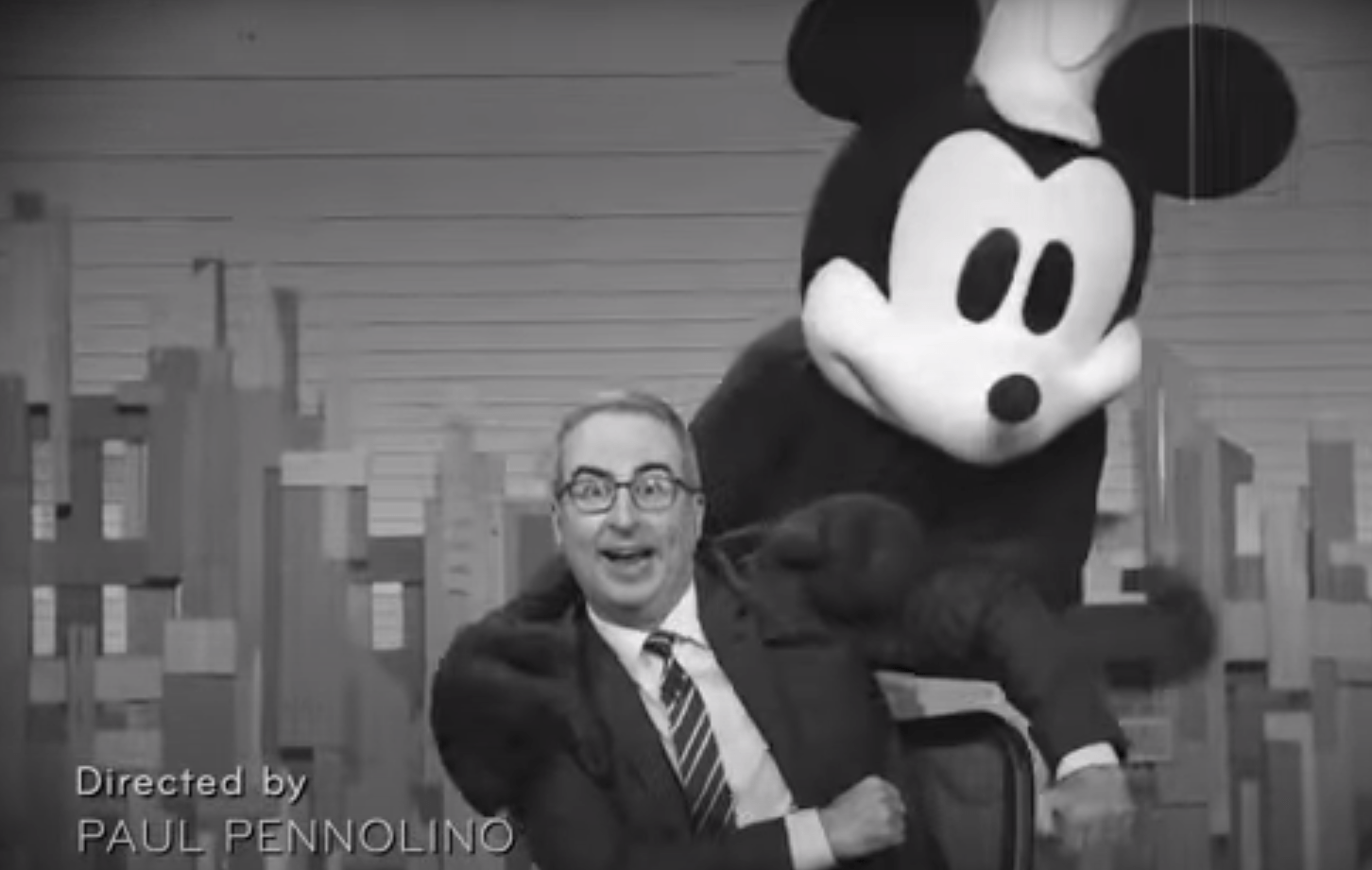
But… what I did not expect was that John Oliver and the folks at Last Week Tonight, an HBO show currently owned by cost-cutting Warner Bros. Discovery would say “fuck it” and start using Mickey Mouse… now.
I mean, I shouldn’t be surprised. Half the time I think Oliver’s show is basically Techdirt-but-if-funny,-entertaining,-and-clever, with the way he seems to cover the same topics we’re always covering, but, you know, better (mostly). And, Oliver has become somewhat famous for poking the eye of his own corporate masters (quite gleefully).
It absolutely would not have taken me by surprise if Oliver had done this nine months from now once Mickey is officially in the public domain. But… jumping the gun like this? That still surprised me.
The bit is, as you’d expect, hilarious. It starts with a discussion of the horror film, Winnie the Pooh: Blood and Honey, which, as you know, is building on a work that entered the public domain last year. But then moves on to Mickey. He talks about Mickey going into the public domain next year, highlights the litigiousness of Disney over Mickey (including legal crackdowns on a gravestone and a daycare center using images of Mickey) before noting he’s not going to wait to use it himself.
On top of which Disney has registered trademarks related to Disney, which don’t expire. In fact, some have speculated that might be why Disney redesigned its animation studios opening logo to incorporate the Steamboat Willie Mickey Mouse.
And it does feel like a tactical legal move. Basically, they may argue that this early Mickey image is so closely associated with their company, that people will automatically assume that any image of him was produced or authorized by them, and still take legal action.
So the fact is, anyone wanting to use the Steamboat Willie Mickey Mouse, will probably still be taking a risk.
But… if you know anything about this show by now… you know, we do like to take a risk every now and then. And there’s a lot to be said for beating the rush to capitalize on Mickey that will be starting next year.
So, tonight, I’d like to preview for you, our brand new character on this show, Mickey Mouse
He introduces some new, um, catch phrases for Mickey including “where’s Shelly Miscavige?” (a running… sorta… joke on the show about the missing wife of Scientology leader David Miscavige), “Jeffrey Epstein didn’t kill himself,” and “I hope Henry Kissinger dies soon!”
As Oliver says:
You know, the nice thing about characters entering the public domain is that you can do new, interesting things with them.
This is true. It’s why we celebrate the public domain every chance we can (psst, have you checked out the entries in this year’s public domain game jam?)
Mickey then asks John about the fact that he’s not actually in the public domain yet, and John doesn’t seem too concerned:
Mickey Mouse: I thought I wasn’t public domain until next year!
John Oliver: That’s actually true, buddy, we are pushing the limit a bit here. Actually, come to think of it, is your voice public domain yet?
Mickey: I guess you’ll find out!
John: Yeah! I guess we will!
He then decides to provoke Disney even more.
And I know, Disney’s lawyers might take the trademark angle and argue that this Mickey is closely associated with their brand. Although they should know that he’s pretty closely associated with our brand now too. And not just because I have a general vibe that screams 95-year-old rat-faced idiot, but also, because the Steamboat Willie Mickey has actually been in our opening credits since the first show of this season…
And then… even more.
And I don’t doubt that Disney has some other legal arguments up their sleeve, but we’re only likely to find out what they are if, and when, then sue. So, you know what? Let’s take this up a notch. Come say ‘hi’ Mickey!
And… out comes a Steamboat Willie Mickey in a costume to say his catch phrases to Oliver:
And, from there, he promises that as of January 1st, this costume will be available for all sorts of events (“birthday parties, theme park openings, funerals, sex dungeons, whatever you want.”)
So… now the question… does Disney actually do anything? Do they call up Warner Bros. Discovery and say WTF? Or do they send in the lawyers? I guess we’ll find out!
Oh, and John, if they do send in the lawyers, your own lawyers might want to look more deeply into reports that turned up 15 years ago that Disney’s lawyers, way back in the early days, fucked up the registration and don’t actually hold any copyright on Mickey Mouse at all. That’ll be fun.
The first three Hardy Boys novels were some of the higher-profile works to enter the public domain this year, and it’s a bit surprising that we didn’t get more entries based on the iconic characters. But that void is capably filled by Escape From 1927, which turns the first book (The Tower Treasure) into a fully realized point-and-click adventure/hidden object game. At first glance, you might think it was slapped together with minimal effort — the graphics especially look sloppy and perfunctory at first. But as you start to play, you realize that the game is aware of this, and its tone harmonizes with these elements to make the whole thing funny and charming. The time constraints of game jams force designers to make sacrifices, especially on things like graphical polish, and the best designers find ways to turn that sacrifice into an opportunity. This game’s tongue-in-cheek attitude is a prime example.
And, indeed, later in the game there’s a joke in the dialogue that directly acknowledges this, but I don’t want to spoil it. In fact there are several funny lines and jokes that I don’t want to spoil, and the best of them are on a subject that is a surefire way to our heart: copyright and the public domain. Better still, one such joke is actually woven into one of the game’s puzzles in an excellent marriage of narrative and mechanics. I can’t describe that puzzle in full without spoiling it — you should just go play it for yourself — so instead I’ll just tell you that at one point you’re interrupted by a copyright maximalist ghost:
Overall, the gameplay and the puzzles are all very simple and straightforward, and it only takes a few minutes to get through the game. But this, too, is made to feel appropriate as part of the overall package. The game is constantly winking at you, knowing that it’s going to make you crack a smile. As a complete, original, memorable, and entertaining game that speaks directly to the themes of copyright and the public domain, Escape from 1927 is a deserving winner of Best Digital Game.