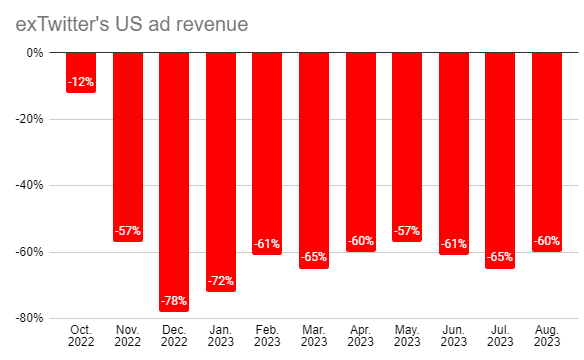
At this point you need to assume that organizations still advertising on exTwitter know that they’re supporting a new fascist movement… and are okay with it. Yes, many advertisers on exTwitter have pulled the plug on advertising on the site. And even the ones that Linda Yaccarino has been able to coax back appear to be spending a fraction of what they spent before.
But the problem is not the advertising tools. It’s the guy who owns the site. And Yaccarino should know this, because the way she ended up in this job was that she interviewed Musk on stage back in April in a pitch to advertisers, and it was revealed that in email discussions beforehand over what she should ask him about, advertisers made it abundantly clear to her that the problem was Elon Musk himself.
This week, he’s demonstrated that again by wholeheartedly embracing an antisemitic claim that Jews are somehow “anti-white” and are “pushing” a “hatred against whites” (a version of the nonsense “replacement theory” concept that is popular among white supremacists).
And now Media Matters has found that some of those “top advertisers” that Yaccarino promised wouldn’t have their ads show up next to neo-nazis… are… (you know where this is going…) having their ads show up next to neo-nazis.
But that certainly isn’t the case for at least five major brands: We recently found ads for Apple, Bravo, Oracle, Xfinity, andIBM next to posts that tout Hitler and his Nazi Party on X. Here they are:
And, yes, sometimes people claim that merely garden variety bigotry is “neo-nazi” content, but the tweets above are flat out neo-nazi, Hitler-praising content. There’s not even an attempt at subtle bigotry. Why bother, when Elon is willing to endorse the blatant stuff?
And, yes, it’s impossible to promise that no bad content will appear next to ads. That’s a promise no one can make (and Yaccarino never should have made). But when you have a company that has an owner/boss who not only actively invited back onto the platform multiple known neo-nazis, and repeatedly seems to endorse their messages (some coded, some not even remotely coded), is it any wonder that the site is flooded with neo-nazi content, making it that much more likely that your ads will show up next to such content?
As for how management has responded? Elon called Media Matters an “evil organization” for… pointing out literal factual information.
Yaccarino, as is her standard practice, put out a bland meaningless corporate-speak statement about how the company is combating antisemitism and believes there’s “no place for it.” Except, Linda, there is. And it comes from your boss. And everyone knows it. You saying otherwise doesn’t change that. Just about every reply to Yaccarino’s tweet, even from the blue checks, is some variation of “have you told Elon?”
Honestly, at this point, you have to think that companies still advertising on the platform are willing to say they, too, endorse such content.
Back in March of this year, Elon Musk effectively admitted that he had set fire to more than half of Twitter’s value in telling employees that they’d be getting stock grants with the company valued around $20 billion. That’s a pretty steep discount from the $44 billion he paid for the company. Now, some would say it wasn’t actually worth $44 billion at the time (the stock before he bought in was valued around $33 billion), but valuation is based on the last price someone actually paid. Of course, even if we go with the $33 billion number, Musk admitting that it would only be valued at $20 billion so soon after taking the company over is kind of embarrassing.
Last week the company finally revealed its new employee equity compensation plan, which actually values the company at $19 billion, even below what Musk had suggested in March. That’s a 56% haircut in just one year. Of course, that fits with exactly how Musk has set the company’s business model on fire as well:
This new valuation comes a year after Musk purchased the platform for $44 billion, and recent reporting claims that the banks involved with financing the deal are still grappling with efforts to mitigate the adverse impact on their financial standings, expecting to lose roughly $2 billion, the Wall Street Journal reported. In July, Musk posted that X is “still negative cash flow” due to a “50% drop in advertising revenue plus heavy debt load.”
Of course, last month, we explained how there was a reasonable calculation to argue the company is worth closer to $8 billion than $19 billion. And… that may be a problem for the remaining employees that Musk is hoping to retain. If the stock grants are completely underwater and have no hope of ever being worth anything close to what they’re being granted at, why stick around?
And there is some evidence that outsiders view the company worth noticeably less. As has been chronicled quite a lot over the last year, the financial firms that stupidly ponied up the $13 billion to help Musk close the deal have been desperate to unload the loans from their books, and despite discounting them repeatedly, have been unable to find any suckers dumber than themselves to purchase the loans.
Right around the time that the story of the $19 billion internal valuation came out, it was also revealed that Fidelity has marked down the value of its own Twitter holdings by 65%, which is a significantly bigger haircut than what exTwitter is valuing itself at:
Mutual fund giant Fidelity wrote down the value of its shares in Twitter/X by another 8% during the month of September, according to a new disclosure.
…Fidelity, which contributed over $300 million to Elon Musk’s $44 billion takeover, decreased the value of its investment by nearly 65% over the first eleven months.
That would put the valuation around $15 billion. And Fidelity has actually been more bullish on the value of exTwitter than the other banks. As Axios reported, over the summer, Fidelity actually bumped up the value of its exTwitter shares, as it seemed hopeful that Linda Yaccarino would bring some measure of fiscal responsibility to the company. Apparently, someone at Fidelity began to realize that wasn’t… uh… working out too well.
We noted that exTwitter CEO-in-name-only Linda Yaccarino had just gone on stage at the Code Conference to try to dismiss the idea that the ad revenue was in trouble, claiming that reports of a 60% decline were “months and months old” information, even though it came from Elon Musk directly just weeks earlier:
The other thing that Yaccarino said to try to convince everyone that the clown car wasn’t veering completely off the track was that “90% of the top 100 advertisers have returned to the platform.” As we noted at the time, the wording of this is kinda strange, and seems purposely designed to mislead people into thinking the the company’s advertising was coming back to old levels.
Except… that’s clearly not true. Media Matters has been using ad tracking tools to see how much advertisers are spending on exTwitter, and even the ones that are coming back are basically spending nothing. Some embarrassingly so. So, when Yaccarino crows that “Visa” has come back to advertising on the platform, she leaves out that they spent $10 according to the analysis.
What’s more, during Yaccarino’s tenure as CEO, the majority of Twitter’s top 100 advertisers pre-Musk have spent just a fraction — at least 90% less — of what they spent in the 12 weeks prior to Musk’s acquisition.
During the September 27 interview, Yaccarino also claimed, “In the last 12 weeks alone, about 1,500 [advertisers] have returned. So whether it is small business or big brands, right? Like AT&T, Visa, Nissan, all returning.” Of those three companies she specifically mentioned, AT&T is the only one that was a top advertiser pre-Musk, and the company has spent just $781 in the last 12 weeks — 99.96% less than the more than $1.77 million it spent during the 12 weeks before Musk’s acquisition.
Visa and Nissan are similarly spending just a fraction of what they spent pre-Musk. Visa spent just $10, and Nissan spent just $687, in the last 12 weeks — 99.99% and 99.77% less than they respectively spent during the 12 weeks before Musk’s acquisition.
According to a June report from Reuters, Yaccarino similarly boasted to investors that Walmart had resumed advertising. But Walmart spent just over $100,000 on X ads in the last 12 weeks — 91% less than the $1.1 million it spent during the 12 weeks pre-Musk.
Even the company’s top advertiser pre-Musk, HBO, spent only nearly $23,500 in the last 12 weeks — 99.9% less than the $28.3 million it had spent during the 12 weeks before Musk’s acquisition.
It sure sounds like part of Yaccarino’s strategy is to pretend that everything is coming back by convincing big name advertisers to “just try us out again” at a tiny, tiny ad spend (perhaps heavily discounted as well), just so she can tell the media and other advertisers that all these advertisers are “coming back,” while leaving out the details of how little they’ve committed.
From very early on in Elon Musk’s ownership of exTwitter a few things became clear regarding his understanding of the FTC. First, he clearly had no idea that the company has a consent decree with the FTC (the kind of thing you learn about during due diligence, which he waived in the purchasing process) and once he learned about it, he assumed he could just ignore it.
Currently, Musk is fighting with the FTC to try to stymie their investigation, claiming (ridiculously) that the FTC’s consent decree doesn’t really apply to him and also that the current investigation is politically motivated, and not because he’s been publicly ignoring everything the company agreed to in the latest version of the consent decree. In response, the US government has had to point out that there are all sorts of reasons why this investigation is happening because Musk continually seems to put user data at risk, with little concern about the impact of his action (which is par for the course for Musk, who seems to assume that putting others at risk is the best way to do business).
Of course, now there’s one more thing for the FTC to investigate. Last week, people started noticing that there was a new format of ads on exTwitter, and they appear to violate some fairly basic FTC guidelines regarding making sure users know they’re seeing sponsored content. Traditional exTwitter ads look and act more or less like regular tweets, but have a notification that they are sponsored ads or “promoted” content. You can still respond to them, retweet them, or even block the user.
Multiple X users have reached out to Mashable over the past few days to report seeing a new type of ad in their For You feed that they had not previously come across on the platform. These new X ads don’t allow users to like or retweet the ad posts. In fact, the new ad format also doesn’t disclose who is behind the ad or that it is even an advertisement at all.
Mashable has confirmed this ad format with numerous users from across X and have seen a variety of different ads running this bizarre new format that just consists of written copy text, a photo, and a fake avatar that’s sole purpose is to make the ad look like an organically posted tweet.
And exTwitter is certainly allowed to remove the ability to treat ads like tweets, and take away the blocking/replying/etc features. But what they really can’t do (because no one can do this without violating some FTC rules) is hide the fact that they’re ads.
This isn’t some new thing either. The FTC’s power to go after unfair and deceptive practices has been in place for ages, and they’ve made it clear that this applies to the lack of disclosures for digital ads many, many, many times.
It sounds like these ads are not being run through exTwitter’s usual ad engine, but rather the company signed up with a chumbox provider. If you’re unfamiliar with chumboxes, we’ve written about them before (to tell you why Techdirt won’t use them, even though the companies reach out to us daily, and we’ve heard from other publishers that they’re actually surprisingly lucrative). They’re often seen at the end of news articles and promote extremely clickbaity headlines saying things like “the secret energy companies don’t want you to know” or “the one trick to losing weight.”
They’re awful.
And now they’re on exTwitter.
And they’re appearing without the required disclosures.
Given the entirely new format, one hopes that the lack of disclosure is simply an oversight (which is the most likely situation), but that doesn’t necessarily mean the FTC will simply give them a pass for it, as it’s still likely to be considered deceptive.
It seems clear that exTwitter is getting pretty desperate for ad revenue since its own ad revenue is in free fall, almost entirely because of ridiculous actions by Elon. In the past, Elon insisted that he hated ads (which, you know, is not a bad thing), and he wanted to diversify exTwitter’s revenue (which is also a good idea). But then he YOLOd the whole process by pissing off a huge percentage of the company’s advertisers while his grand revenue scheme to charge users has been a complete and utter disaster.
Also, just before the chumboxes showed up, exTwitter also cut a deal with Google to have Google sell some of its ad space as well. Basically, Elon has dismantled what had been a decent internal ads system, driving away 60% of the revenue almost entirely because of the terrible shit he did that puts brands at risk, and has been forced to sign up with the bottom feeder ad companies to try to generate something (anything) to bring in some ad revenue (while only making the experience of using the platform worse).
And whatever they bring in may just end up going to lawyers who will be needed to respond to the FTC’s investigation of how these ads are presented.
Last week, exTwitter’s CEO-in-name-only Linda Yaccarino gave what is the cringiest interviews I’ve ever seen at the Code Conference. Multiple people told me they couldn’t watch more than a few minutes of it. It’s so bad. She is barely listening, extremely dismissive of important questions, and acting as if people are lucky to hear her. It’s awful.
It’s also embarrassing. Her whole thing is that she’s supposed to be the adult in the room, and it was clear that she was wholly unprepared for a series of fairly basic questions that anyone in her position had to know were going to be asked. She deflected, she acted cagey, she went off on weird tangents, and seemed almost entirely unaware of her audience.
Anyway, at one point in discussing the fact that ad revenue on the platform has collapsed, she suggested that advertisers were coming back. She said that reports of about 60% of ad revenue going away were “months and months old information,” and that “90% of the top 100 advertisers have returned to the platform.” That’s… weird in its own way. If you’re talking about 100 advertisers, you can just say “90 of the top 100.” You don’t need to say percent. It’s the same.
Then she claimed “in the last 12 weeks alone, about 1500 have returned.”
So, anyway, the “months and months old information” came directly from Elon Musk himself literally a month ago in (falsely) blaming the ADL.
That’s September 4th. Yaccarino’s interview was September 27th. That’s not “months and months old information.”
I mean, you can argue that after December and January things got… better? Slightly? But, basically, they start dropping again every time Elon embraces some fringe crackpot, and raises up bigotry. See how things were getting slightly better in February before dropping in March? At the end of February was when Elon supported Dilbert creator Scott Adams’ ignorant racist tirade.
Then things started trending slightly upwards (though still way down from last year) in April and May before dropping drastically in June and July. In May was when Elon went after George Soros, using antisemitic tropes.
It’s almost as if (as we’ve noted) advertisers directly view Elon Musk himself as a liability. Given that Musk has continued to embrace more ignorant bigotry in September, I imagine that there may be another downturn, no matter what Yaccarino says.
And, again, literally all of this was avoidable. Elon could have kept revenue on the platform effectively constant, just by… not being an ignorant bigot and not supporting other ignorant bigots. It’s not difficult.
Meanwhile, Yaccarino has to take these terrible numbers and convince the banks who lent Elon $13 billion of the $44 billion he needed that their investment is still good, even though Elon himself has admitted the value has cratered by at least 50% and newer estimates say the real valuation may be closer to $8 billion. When a news organization as vanilla as Reuters is now running headlines saying “Elon Musk’s X is a black hole of value,” and has a credible explanation of how the company might be lucky to have a valuation of $8 billion, people have to start to realize what a colossal fuckup this whole thing has been, entirely because Elon literally has no one around him he can listen to that will tell him he has no clue what he’s doing and just keeps making everything worse.
There is no doubt that it’s not always easy to figure out what social media websites should do about election disinformation. There are those who believe that websites need to very actively remove such content, but there’s little evidence that straight removal does very much productive, which is why it wasn’t that surprising that YouTube (for example) has stopped policing lies about the 2020 election (the last Presidential election, which doesn’t mean they won’t pay attention to upcoming election).
That said, even if you think that removing content (even election disinformation) is counterproductive, that doesn’t mean there isn’t a clear role for election integrity teams at various platforms. Remember, the main way that old Twitter handled election misinformation in 2020 was to focus on providing more information (that is, adding to the marketplace of ideas) which some people, very wrongly, called “censorship.” Adding more information is not censorship, it’s enabling the so-called marketplace of ideas to function better.
Indeed, reports show that the only times Twitter was actually removing information regarding elections was in the most extreme circumstances, such as cases where you had people impersonating election officials on Twitter in an attempt to mislead voters into not voting (such as by telling them the election was on a different day), or where there were out and out frauds.
That kind of thing is still really important.
But apparently not to Elon Musk. Earlier this week it was reported that exTwitter had disabled the feature that let users “report” election misinformation as part of its reporting tools. That already got some people worried about how a Musk-run exTwitter would handle many upcoming elections.
As if to confirm this was absolutely intentional, that same day, the Information revealed that Elon fired half of the remaining “Election Integrity Team” at exTwitter. This is despite him recently promising to expand that effort. Rolling Stone has way more info on all of this, including details about what likely happened here and it’s dumber than you could have imagined.
It began, as so much nonsense does these days, with gullible Elon falling for complete and utter nonsense peddlers on his own site. A month ago, Aaron Rodericks, who worked on the “threat disruption” team, and is a holdover from pre-Elon Twitter, announced that he was hiring 8 new people for civic integrity and elections work:
Again, this work is not about “censoring,” but about actually understanding various threats to actual elections (not just garden variety political misinfo) and figuring out ways to counter them.
But the nonsense peddlers on exTwitter that have Elon’s ear convinced him that it was a sneaky plot behind Elon’s back… supported with “evidence” that Aaron had, at times, liked some tweets that mocked Elon and Linda Yaccarino. From the Rolling Stone piece:
In a quote tweet, Benz replied to Raichik’s sarcastic question: “No, it’s being run by Yoel Roth’s former colleague, who still somehow works at X despite appearing to think Musk is a ‘f*cking dipshit’ — His name is Aaron Rodericks.” In the post, Benz shared screenshots of his many recent criticisms of Rodericks on the platform. In those tweets, Benz called Rodericks one of CEO Linda Yaccarino’s “censorship shills” and noted that Rodericks had apparently liked another user’s tweet using the aforementioned epithet to describe Musk.
Again, remember that for all of Elon’s talk about “free speech” on his platform, and a promise to fund any lawsuit for someone fired for their activities on exTwitter, he has a thing where he is very quick to fire any employee who even hints at not wanting to lick his boots. And thus he fired Roderick and many of his team despite having approved expanding his team, almost certainly because someone called his attention to Rodericks once liking a tweet that called Musk a fucking dipshit.
Aaron Rodericks, who is the co-lead of Threat Disruption at X, the social media formerly known as Twitter secured the order against his employer.
He claims that he is being subjected to a process that is “a complete sham” over allegations that he “demonstrated hostility” to the company for allegedly liking tweets by third parties that are critical of X, Mr Musk and the firm’s CEO Linda Yaccarine.
That RTE article notes, correctly, that Rodericks feels unfairly targeted for using the platform that he’s been told stands for free speech:
Shortly afterwards he claims he was the subject of a meetings and a disciplinary process that has seen him suspended from his job for allegedly liking disparaging posts about X, Mr Musk, and Ms Yaccarino.
He said that he was very surprised over the allegations, as the company had adopted a strong position on the freedom of speech on the platform, and is not aware of any requirement the precludes employees from liking material posted on X.
Rodericks should, you know, share this tweet, and ask Elon to pay for his lawyers.
No limit!
Anyhoo, Elon can’t now publicly admit that he fired Rodericks for like a tweet calling him a fucking dipshit, so he’s now trying to retcon in some fucking nonsense that Rodericks was undermining election integrity. Which is nonsense, based on nothing but the say-so of a known political operative with a history of nonsense.
It seems pretty clear that Musk was embarrassed by Rodericks’ liking of a tweet and fired him, and then likely fired a few remaining employees in the department who were there from pre-Elon days.
Hours later, when asked about all of this at the Code Conference, CEO-in-name-only Linda Yaccarino lied through her teeth and said that the election integrity team was “growing.” On stage she claimed that “It’s an issue we take very seriously. And contrary to the comments that were made, there is a robust and growing team at X that is wrapping their arms around election integrity.”
It’s not growing when you fire half the team for recognizing the emperor has no clothes.
Over the last few months, Elon Musk and Linda Yaccarino keep trying to claim that exTwitter is actually growing and more used than ever. Yaccarino has talked about “largest usage days” without defining the term, and Elon says it’s “user-seconds per day of phone screentime as reported by iOS & Android” even though that’s not actually a stat that anyone uses.
Meanwhile, multiple other reports have suggested otherwise. Similarweb has repeatedly noted that its stats show exTwitter’s traffic trending downward. Apptopia, which tracks app usage, has said that the actual time spent on the Twitter app has tracked downward all year since there was an initial post-Elon bump:
And a new report, again from Apptopia, is saying that its app downloads have sunk to new lows as well. Looking at Data.ai’s app download charts, the exTwitter app… is barely in the top 100 downloads. At last look, it was 96th. Which is embarrassing. More people are downloading the Jersey Mike’s app and “GeometryDash” than exTwitter.
That’s for downloads. What about usage? Well, according to Data.ai, exTwitter is now 25th in active users… right after the Samsung Clock.
But… even more notably, Elon Musk may have accidentally revealed how much exTwitter usage had dropped himself — mainly by hoping that people won’t notice how he changed the metrics being used. You see, at the same time that Elon was talking about potentially putting exTwitter behind a paywall, he also claimed that he site now has 550 million users who generate “100 million to 200 million posts per day.”
During the livestream, Musk also divulged some new metrics from X, saying it now has 550 million “monthly users,” who generate 100 million to 200 million posts per day.
Some people took that to mean that his running of exTwitter was a success, since when he took it over, the ex-Twitter (as opposed to exTwitter) management were reporting 237.8 million users. But, that’s wrong. The two things are being measured very differently, and when you break it down, Musk seems to be admitting a pretty big drop in exTwitter usage.
The 237.8 million was “mDAU” or monetizable daily active users and the first two words there are important in how Musk’s number and old Twitter’s numbers are different. As we explained (and which Musk never seemed to understand), mDAU was actually a much more conservative estimate on users, because it excluded anyone they could not monetize (meaning bots, some foreign countries, etc.). The whole point of mDAU was to be more accurate in telling advertisers how large the potential audience reach is.
Second, Twitter’s number is daily active users. Musk’s number was monthly active users. DAU/MAU ratios are actually a useful tool in determining just how sticky an app is (basically it’s looking at what percentage of your monthly users visit every day). Years ago, Sequoia Capital noted that the “industry standard” for DAU/MAU is between 10% and 20% with it being very rare for a company to be over 50%. Andrew Chen from Andreessen Horowitz has shared similar numbers, noting that if you’re DAU/MAU is 20% that’s good. And “World Class” is 50%.
Of course, this differs based on the type of app, and exTwitter is more likely to be an app that people come back to use more regularly than something like Uber or whatever. So, it seems at least somewhat likely that its DAU/MAU is somewhere closer to 50% than 20% (giving exTwitter the benefit of the doubt here!). The last stats that I found that determined a DAU/MAU for Twitter came in 2020 from The Audience Project, which put Twitter’s DAU/MAU at about 52%.
But, remember, mDAU is significantly lower than just DAU, as mDAU excludes bots and other unmonetizable accounts (remember, Musk’s big complaint was that mDAU OVER counted bots, which is why it’s hilarious that the numbers he’s now trotting out don’t even try to exclude bots). So if we assume that mDAU is 80% of DAU (which is well below Musk’s own estimate of 33% bots!), that would mean that the DAU would basically be 300 million, and if we have a 50% DAU/MAU that would put the MAU pre-Musk at around 600 million.
And now he’s bragging about… 550 million (which isn’t even in any official report, so who knows how accurate it is, given his propensity to exaggerate).
That suggests a noticeable decline in users.
Even if the mDAU/DAU ratio is closer, the MAU was at a minimum somewhere close to the 550 million he’s now claiming.
When they looked in January, Twitter’s AdManager said that there were 556 million user accounts that could be reached via ads. In April… it said 177.2 million! DataReportal knew that was too steep a drop, and reached out to Twitter, only to see that number disappear from the AdManager tool. exTwitter re-enabled the tool later in April, again with MUCH LOWER figures on accounts: 373 million. DataReportal charted all of this, and it’s… eye opening:
They note that there are many possible explanations for this change, including problems with the data, human error, and other things as well. The report goes on to conclude that traffic appears to be “slipping” but not in freefall. This would be consistent with my back of the envelope calculation above that exTwitter at 550 million monthly users is likely somewhat below the pre-Elon high of around 600 million.
But… we’re not done yet. Because the other data point Musk revealed: “100 million to 200 million posts per day” also tells us something.
That is… below what Twitter used to have. Way below. A study in 2019, that had tracked tweets per day from 2012 through 2019 showed that in 2019 tweets per day were between 320 and 340 million per day. Or… somewhere around twice what Musk is claiming today.
If Musk is accurate in saying that there are between 100 and 200 million “posts” per day (he no longer calls them tweets), that would mean not only are users dropping by some amount, and download dropping by a noticeable amount, but the number of posts per day has fallen off a cliff.
None of this speaks well to exTwitter’s chances at survival. Beyond the advertising revenue, which the company already admits is down by 50%, downloads are dropping, users appear to be dropping, and the usage by the remaining users may be significantly down as well, based on Musk’s own statements.
To date Yaccarino has shown a talent for… using buzzwords to say absolutely meaningless nonsense that everyone knows is laughable. And not much else. The latest example was in an interview where Yaccarino continued to throw out a bunch of buzzwords that add up to nothing, combined with obvious lies. I mean…
“The rebrand really represented a liberation from Twitter, a liberation that allows us to evolve past a legacy mindset and to reimagine how everyone … around the world is going to change how we congregate, how we transact, all in one place,” Yaccarino said, adding that users would soon be able to make video calls and payments through the platform.
“It’s developing into this global town square that is fueled by free expression, where the public gathers in real time,” she said.
This is exactly the kind of empty platitude, meaningless business jargon, nonsense speech that Elon Musk himself would mock mercilessly if it came from a competing platform’s CEO.
“There’s also a lot of hate and a lot of vitriol and conspiracy theories and those attract a lot of eyeballs too,” Eisen countered. “And so, if you’re a brand and a business, why would you feel safe advertising?”
Conceding that it was an “appropriate question,” Yaccarino then claimed some of these “headline comments and phrases need to be continually brought to light and debunked.” Referencing her time as a top ad executive for NBCUniversal, she noted that Twitter was “our number one social partner” and was always considered safe.
“A lot of brands have left,” Eisen shot back.
“I hear you,” Yaccarino replied. “I want to take that last 10 years and put it in perspective, because by all objective metrics, X is a much healthier and safer platform than it was a year ago.”
There is no rational human being on earth who believes this.
Meanwhile, around the same time, exTwitter rolled out its new “brand safety sensitivity settings.” In theory, if the platform were really as safe as Yaccarino claims, why does it need these tools?
Of course, all of this is basically begging folks to go looking at where ads are appearing on exTwitter, and Media Matters came up with quite a scoop on that front, showing that major advertisers had their ads appearing next to a verified account that praises Hitler.
Under the leadership of CEO Linda Yaccarino, X (formerly known as Twitter) has been placing ads for brands like The New York Times Co.’s The Athletic, MLB, the Atlanta Falcons, Sports Illustrated, USA Today, Amazon, and Office Depot on a verified pro-Adolf Hitler account that encourages antisemitic harassment. The company continues to monetize the openly antisemitic account despite reportedly acknowledging it had violated the platform’s “rules against violent speech.”
The link includes some more details about the account, New American Union, and the pro-Hitler memes it posted. We’re not posting them here, but anyone looking at that account will come away thinking “boy, that account sure likes Hitler.” And it’s verified.
Soon after the Media Matters article started to go viral, the account was finally suspended. But, as Media Matters notes, the account had been “verified” since April, had amassed many thousands of followers, and had been posting pro-Hitler rhetoric for a while.
CNN later reported that some advertisers whose ads were appearing next to that account have paused all advertising on exTwitter. So, good going, Linda Yaccarino. Your job was to attract advertisers to come back, and somehow you’ve instead convinced more to leave by trying to bullshit them about how the site was safer for brands.
Of course, most of the attention on this story was focused on the big name advertisers and where their brands were appearing. But as Jason O. Gilbert noted on Bluesky, it kinda seems like that story should be secondary to the fact that exTwitter had a VERIFIED pro-Hitler account:
Of course, I kinda see both sides to this. If the focus were just on the neo-Nazi account, people would shrug and say “yeah, well, we already know that Elon is cool with platforming Nazis, what’s the story?” But if you talk about the advertisers, well, they might just pull their ads. The “marketplace of ideas” at work.
Anyway, I look forward to Yaccarino excitedly announcing next week how X has expanded its sensitivity settings to include a “don’t show my ads next the neo-Nazis that are core to the platform” setting.
It’s no secret that Elon Musk is desperate for advertisers to return to the platform. He just recently admitted that the company is still cashflow negative and that around 50% of advertisers have left (other reports say the number is bigger). This is despite his earlier claims that the company would break even on a cashflow basis in Q2 (not to mention, despite not paying a bunch of bills).
Basically ever since he took over and lots of advertisers bailed out, directly in response to Elon’s self-created liability, the company has made a few desperate moves to lure them back. Back in February, we wrote about the company promising $250,000 in free ads if companies would spend $250,000 in ads. It didn’t seem to work.
Hell, it’s pretty obvious that the reason Elon hired Linda Yaccarino to play the role of Chief Marketing Officer (but with a shiny-if-misleading CEO title) was her strong relationships with big advertisers.
But, as the Wall Street Journal is reporting, it appears that the “carrot” approach of deeply discounted advertising isn’t working well enough on its own. Ex-Twitter is now breaking out some sticks to try to pressure companies into advertising:
X also warned advertisers that beginning Aug. 7, brands’ accounts will lose their verification—a gold check mark that indicates their account truly represents their brand—if they haven’t spent at least $1,000 on ads in the previous 30 days or $6,000 on ads in the previous 180 days, according to the email.
So, look, we know already that Elon simply cannot wrap his mind around the purpose of Twitter verification. I mean, the Twitter Blue debacle is well understood by everyone but Musk. The whole thing was so dumb, and so disastrous to trust and brand safety on the platform that it drove away plenty of companies, leading the company to make a hasty change and bring back some form of the old verification in the form of “gold checkmarks” for “some” businesses.
It seemed transparently obvious that these gold checkmarks were going to companies that Twitter wanted to appease so they would continue advertising.
And, when looked at through that lens, you can totally understand why the company is frustrated that the companies they “gifted” gold checkmarks to aren’t returning the favor by advertising. Hence this little shakedown.
“Nice gold check mark you got there. You wouldn’t want anything to, uh, happen to it, y’know?”
But, really, this seems like the kind of move likely to drive away advertisers than retain them. It’s just yet another reason not to trust the platform or Elon, who will change the terms of whatever he agrees to to benefit himself in the end.
Of course, the WSJ article also notes that Twitter is, once again, drastically discounting ad buys:
It is offering 50% off any new bookings of those ads until July 31, among other discounts. “The goal of these discounts is to help our advertisers gain reach during crucial moments on Twitter such as the Women’s World Cup,” one of the emails read.
As a separate point, I’ll just note that, back in February, they were talking about 50% off ads for $250,000 spends. Now they’re trying to cajole and coax companies into spending… $1,000.
Our most popular post last year was my post attempting to help Elon Musk “speedrun” the content moderation learning curve. People still talk to me about that post to this day. What’s been somewhat surprising to me, however, is that while nearly every other social media site eventually figures out the basics of the content moderation learning curve, Musk has a Sisyphean ability to slide back down that curve again and again and again.
But I had a realization over the weekend: it’s not the content moderation learning curve that he’s speedrunning. It’s the Enshittification learning curve.
As you’ll recall from Cory Doctorow’s excellent coinage, enshittification happens through the following process:
first, companies are good to their users; then they abuse their users to make things better for their business customers; finally, they abuse those business customers to claw back all the value for themselves.
The key element here is fucking over your users and customers to try to claw back as much value for themselves as possible. When viewed through that lens, the events of the past few days on Twitter make some kind of sense. Because, without that framing, Elon’s moves make zero sense at all.
It started late on Thursday, when Twitter suddenly made it so you could only see tweets if you were registered and logged in. There are other sites where this is true, but it was fundamentally against Twitter’s entire ethos for years. Indeed, Twitter’s early success was driven by that open ability to access the content, and (while people no longer remember this), Mark Zuckerberg’s paranoia about Twitter eating Facebook’s lunch in the early days caused him to pivot the entire company and effectively push more people to publicly revealing their Facebook info in response to Twitter’s openness policy (as an aside, this created one of Facebook’s first big privacy scandals, but… that’s another story).
As has become standard practice, this change was made with no notice or explanation, but a day after it began, Elon explained it in a random reply on Twitter, claiming that “several hundred organizations (maybe more) were scraping Twitter data extremely aggressively, to the point where it was affecting the real user experience.”
This made Twitter a pain to use for many people. It also broke a bunch of things, and even pulled tons of tweets out of Google search. Meanwhile, sometime last night or this morning, it appears that Twitter (again with no explanation and no announcement) rolled back this entire thing and quietly started letting non-logged in users view tweets again.
But, either way, Elon was just getting started. On Saturday, tons of people got messages noting that they were “rate limited” and had exceeded the number of tweets they were allowed to read.
Most people assumed that Twitter had just broken down (again) and was popping out that error. No one actually thought that anyone could possibly be so stupid as to limit the number of tweets that you could see. But, alas, Elon Musk runs Twitter and sees things… um… differently. Hours after tons of users were confused by this, Elon tweeted (not just a reply this time!) that it was all on purpose and most accounts would now be limited to viewing just 600 tweets per day.
If you were willing to pay $8/month, that would be 6000. New accounts could only see 300 tweets. Once again, Musk argued this was because of “data scraping.”
However, multiple people I’ve spoken to, both current and former employees, said that excuse is bullshit. Twitter can easily handle the scraping it’s receiving. It is apparently true that scraping Twitter has increased, but due to Musk’s own policies killing off its API. That move means that many who formerly relied on the API to get data have now resorted to scraping instead. But the actual impact on Twitter from that scraping is not a problem.
Separately, some people noticed that around the same time that all of this was going down, Twitter introduced a very stupid error that meant Twitter was literally DDoSing itself, though it’s not clear if that’s the cause of Musk’s panic either (it is more plausible than scraping, however).
Again, though, if you look at this through the framing of enshittification, it makes more sense. Musk is focused solely on trying to extract all the value of Twitter for himself, not for its users. That this is a ridiculously short-term view, one that drives away those users in the long term, does not seem to have yet occurred to him. But, you know, sometimes he seems a bit slow on the uptake.
Cutting off anything that screams of “freebies” fits well within the enshittification process, because people who get stuff for free need to be mined for value.
Of course, even Elon’s biggest fans seemed to complain that these limits were ridiculous, so he began slowly upping them. A few hours after the initial announcement he upped the limits from 6,000 for people who pay, 600 for most users, and 300 for new users to 8,000/800/400. And a few hours after that, it bumped up again to 10,000/1,000/500.
Amusingly, days later, I’m still seeing tons of people assuming it’s the lower numbers, because this is not how you do product announcements if you actually want people to understand what the fuck you’re doing. I’ve also seen friends insist that he removed all limits, when that does not appear to be the case.
Instead, days later, Twitter put out a ridiculously useless “Update on Twitter’s Rate Limits” that is full of corporate speak nonsense and clarifies literally nothing:
To ensure the authenticity of our user base we must take extreme measures to remove spam and bots from our platform. That’s why we temporarily limited usage so we could detect and eliminate bots and other bad actors that are harming the platform. Any advance notice on these actions would have allowed bad actors to alter their behavior to evade detection.
At a high level, we are working to prevent these accounts from 1) scraping people’s public Twitter data to build AI models and 2) manipulating people and conversation on the platform in various ways.
Currently, the restrictions affect a small percentage of people using the platform, and we will provide an update when the work is complete. As it relates to our customers, effects on advertising have been minimal.
While this work will never be done, we’re all deeply committed to making Twitter a better place for everyone.
At times, even for a brief moment, you must slow down to speed up.
We appreciate your patience.
Literally none of that makes any sense at all. First of all, a couple weeks ago we were being told (falsely) that spam and bots had been already eliminated. How many times is Elon planning to go back to that well as an excuse for his own incompetence?
Second, “any advance notice” of this particular change wouldn’t have made one bit of difference. And, on top of that, even if you don’t give “advance notice,” Twitter put out this statement literally 4 or 5 days after the changes were made, which suggest this wasn’t so much about not giving “advance notice,” it was about no one within Twitter knowing what the fuck is actually going on.
But, the “new CEO” has to pretend this all sensible and normal.
Of course, none of this helps with bots or spam. All it really does is drive down usage of Twitter. The main thing left on Twitter that had mostly kept me on the site was some sports accounts, but just trying to follow tweets about a single baseball game would make me lose access in half an hour or so.
What Elon has done with this rationing of tweets is introduce even more friction. Not just in the fact that some people get limited, but in making users have to think about whether or not it’s worth visiting the site at all, as every tweet you see (and each time you load the page, you get about 20 tweets) is worth cutting into your daily allotment.
It’s a mental transaction cost, on top of everything else. That just makes the entire site way, way, way less valuable. And that includes for advertisers (whose tweets appear to count in the tweet ration limit). And those Musk fans who moved their video programs to Twitter as well. Making your site much more difficult to view is just galaxy brain nonsense, unless you’re so focused on trying to squeeze existing users for cash that you forget what made your site valuable in the process.
Oh, and Musk and co weren’t even done.
Over the weekend, power users who rely on Tweetdeck (which always presented Twitter in a much more useful interface) realized that it wasn’t working. Again, many initially chalked this up to “Elon breaking shit” (which has happened a few times now), but then suddenly it was announced that Twitter had shut down the old Tweetdeck, forced everyone to the “new” Tweetdeck (which has been around since the pre-Elon days, but so many users hated it that it was possible to switch back to the old one). And, on top of that, the company announced that the new, much crappier Tweetdeck would only be available to TwitterBlue subscribers.
If you’re not familiar with Tweetdeck, it was a very nice multi-column view for Twitter, allowing you to follow lists, notifications, searches, and more in a single screen, rather than having to pop through a bunch of different pages to find each thing. It was especially popular with professionals and social media managers. And, now it is way worse than it was and costs money, whereas before it was free.
Again, this will drive down usage of the site, especially by Twitter’s most committed users, and those who provide tons of content to the site.
Of course, none of this makes any sense if you’re trying to build a sustainable business and attract more users. It only makes sense if you’re desperate for cash, have no idea why your own site is valuable, and feel the need to go on a rent seeking expedition to try to capture any and all value that the site provides, even if doing so kills off a significant percentage of that value.
No wonder both Mastodon and Bluesky surged in new users over the weekend. Either way, given that he paid no heed to my attempt to help him better run the content moderation learning curve, I have little doubt he’ll also ignore my recommended steps to avoiding enshittification as well.