In Baltimore County, Maryland on Oct. 20, 2025, a 17-year-old student named Taki Allen was sitting outside his high school after football practice when an artificial intelligence-enhanced surveillance camera falsely identified the Doritos bag in his pocket as a gun. Within moments police cars arrived, officers drew their weapons and Allen was forced to his knees and handcuffed while they searched him. All they found was a crumpled bag of chips. The AI’s misidentification and the human decisions that followed turned a normal evening into a traumatic confrontation.
On Dec. 24, 2025, Angela Lipps, a Tennessee grandmother, was released after spending five months in jail because facial recognition software had incorrectly connected her to fraud crimes in North Dakota, a state she had never visited. Police had arrested her at gunpoint while she was babysitting her four grandchildren.
These are unfortunate examples of how AI can lead to mistreatment of people because of technical flaws as well as misplaced human faith in the technology’s supposed objectivity. These cases involve different tools, but the underlying issue is the same. AI systems produce probabilities, and people treat them as certainties.
We are researchers who studythe intersection of technology, law and public administration. In researching how police departments use AI and how digital technologies operate in a democratic society, we have seen how quickly the shift from probabilistic prediction to operational certainty happens in practice.
AI policing tools are used in dozens of U.S. cities, although no public registry tracks the full footprint. The tools ingest historical crime data and score neighborhoods on predicted risk so officers can be routed toward the resulting hot spots. The mechanism is straightforward, but its consequence is not. Once a system signals a possible threat, the question is no longer how certain the prediction is but what to do about it. A statistical output turns into a deployment decision, and the uncertainty that produced it gets lost on the way.
A matter of probabilities
When generative AI models such as ChatGPT or Claude respond to human requests, they are not searching a database and pulling out facts. They are predicting the most likely answer based on patterns in data they have been trained on. When asked, “Who invented the light bulb?” the models do not go to a source or fact-check a finding. They generate a statistically probable answer which is “Thomas Edison.” The reply might be right, but it might not capture the full story – such as Joseph Swan’s parallel invention at the same time as Edison’s. The danger arises when people believe that the model is retrieving truth rather than generating likelihoods.
This distinction matters. The most probable response is not the same as a factually verified answer, complete with context.
Police handcuffed teenager Taki Allen at gunpoint after an AI camera system incorrectly indicated he had a gun.
This reality can be highly problematic for policingand law. For example, when law enforcement agencies use AI systems trained on geographical data to estimate where criminal activity is likely to occur, the algorithms analyze historical crime data and geographic patterns. These systems generate statistical risk scores or heat maps for locations based on prior incidents. But such predictions may have little bearing on who was involved in a new crime in the area, even if an algorithm generates information that sounds authoritative.
Some researchers have argued that predictive policing systems do not increase the likelihood that racial minorities will be arrested more often relative to traditional policing practices. The broader concern, however, is not limited to measurable disparities in arrest outcomes alone. It is about how probabilistic predictions can become standardized operational decisions absent further verification.
Artificial intelligence researchers caution against using these models in isolation for crime and legal proceedings or decision-making. Research at the University of Virginia’s Digital Technology for Democracy Labwith police chiefs shows that some law enforcement groups follow strict policies that dictate when technology is used in tandem with, or in place of, human discretion, while others have no such policy.
What most users do not realize is that AI systems rarely produce binary answers: yes or no, a positive identification or a negative one. They generate probabilities. Some systems assign scores that assess the system’s confidence in a prediction. In those cases, engineers set a confidence threshold, a level of certainty that determines when the system should trigger an alert about a possible threat. You can think of this threshold as settings on a control knob. A 95% confidence level, for example, indicates that the model considers its interpretation to be highly likely.
A low threshold catches more potential threats but increases false alarms. A high threshold reduces mistakes but risks missing real dangers. Either way, these algorithmic thresholds are often invisible to the public and are set quietly by vendors or agencies, even though they shape when police action begins.
Angela Lipps was unjustly jailed for more than five months based on a mistake by a facial recognition system.
Where to draw the line
In medicine, these kinds of trade-offs are explicit. Diagnostic tools are calibrated on the relative harm of different errors. In infectious disease settings, for instance, systems that detect infections are often designed to accept more false positives to avoid missing contagious individuals. Then medical professionals look into the human cases. And the algorithm-based decisions are subject to professional standards, ethics reviews and regulatory oversight.
In policing, an AI system must balance false positives, where the system flags a threat that does not exist, and false negatives, where it fails to detect a real danger. The trade-off carries significant consequences. A lower threshold may generate more alerts and allow officers to intervene earlier, but it also increases the risk of mistaken identifications, which happened to Angela Lipps, or escalated encounters like the one Taki Allen experienced. A higher threshold may reduce wrongful interventions but could allow legitimate threats to go undetected.
Some law enforcement agencies argue that acting on imperfect signals is preferable to missing serious risks. But lowering the bar for algorithmic alerts based on probabilistic estimates effectively expands the number of people subjected to police attention. It is important to realize that these thresholds are not neutral features of the technology; they are choices embedded by the creators in the model’s code. Decisions about where to draw the line determine when an algorithmic suspicion becomes a real-world police action, even though the public rarely sees or debates how those thresholds are set.
Limits of optimization
Developers often use several methods to determine where to set a confidence threshold. Techniques such as “receiver operating characteristic curve analysis” examine how changing the threshold for an alert alters the balance between correctly identifying real events and mistakenly flagging harmless ones. Precision–recall analysis examines a similar trade-off, asking how accurate the system’s alerts are relative to the number of incidents it successfully detects.
These approaches could help calibrate systems more responsibly by testing how often an algorithm wrongly flags people or locations. Fine-tuning can improve system performance. But the techniques cannot resolve the underlying question of how much algorithmic uncertainty society is willing to tolerate.
In law, legal standards of proof determine how convincing evidence must be before a judge or jury can rule in favor of a plaintiff or defendant. Courts use formal standards of proof depending on the stakes, such as probable cause, preponderance of the evidence and beyond a reasonable doubt. These standards reflect a societal judgment about how much uncertainty is acceptable before exercising legal authority. A court does not accept a guess or a prediction; it follows a process to weigh evidence. Unlike humans, an AI model does not usually say, “I’m not sure.” A model typically has confidence in its reply, even when the answer is incorrect.
Stakes are rising as AI enters the courtroom, law enforcement, the classroom, the doctor’s office and the public sector. It is important for people to understand that AI does not know things the way many assume it does. It does not distinguish between “maybe” and “definitely.” That is up to us. We believe that technologists should design systems that admit uncertainty and need to educate users about how to interpret AI outputs responsibly.
The National Guard soldiers in desert camo piled out of unmarked vans in East Los Angeles last June, cordoning off East Sixth Street, a residential street lined with single family houses, and blocking a nearby road leading to an elementary school.
A squad of federal agents moved in flinging flash-bang grenades — explosives designed to disorient — into a small home before storming inside. They’d come for Alejandro Orellana, a Marine Corps veteran and UPS employee accused of being a central figure in a secret confederacy of insurrectionists. A news video had shown the 30-year-old distributing water, food and face shields to people protesting the Trump administration’s immigration roundups in Los Angeles.
Bill Essayli, a former state legislator who leads the federal prosecutor’s office in Los Angeles, joined the raid along with a Fox News crew.
With cameras rolling, Orellana, his parents and brothers were led out in handcuffs as agents searched their home.
On Fox News, Essayli, sporting a blue FBI windbreaker, hyped the arrest of Orellana, a quiet, wiry man with a long mane of coal-black hair. “It appears they’re well-orchestrated and coordinated, and well-funded,” he said. “And today was one of the first arrests — first key arrests — that we did.”
Essayli would charge Orellana with conspiracy — under a federal statute typically used to build cases against drug traffickers and organized crime — and with aiding and abetting civil disorder.
Within weeks, the prosecutor’s marquee case would quietly fall apart. Agents who searched Orellana’s house found little that could be considered incriminating, and prosecutors never charged anyone else as part of the supposed conspiracy. By late July, they moved to have the charges dismissed.
It wouldn’t be the only such case.
Over the past 10 months, President Donald Trump’s administration has made much of its success in sweeping through U.S. cities, capturing unauthorized immigrants and arresting people who publicly oppose the operations, routinely accusing dissenters of being domestic terrorists or extremists. Federal agents have arrested hundreds of U.S. citizens like Orellana — including protesters, activists observing the immigration enforcement operations, bystanders and, in some cases, the family members of people targeted for deportation.
Less clear to the public is what has happened to those charged.
To find out, ProPublica and FRONTLINE combed through social media, court records and news stories. Reporters identified more than 300 protesters and bystanders who were arrested by federal agents during immigration sweeps and were accused of crimes such as assaulting or interfering with law enforcement.
But over and over those accusations fell apart under scrutiny. Our reviews of court files found that statements made by the arresting officers were repeatedly debunked by video footage. In more than a third of the cases, prosecutors quickly dismissed charges that couldn’t be substantiated, refused to file charges at all, or lost at trial. The tally of cases that end this way will likely climb as many of the arrests remain unresolved.
“What’s happening now is not comparable to anything that’s happened in the past,” said
Cuauhtémoc Ortega, the chief federal defender for the Central District of California, who personally represented Orellana and other protesters. “We’ve never had a situation where it seems like you arrest first and then try to justify the reasons for the arrests later.”
The Department of Homeland Security, which includes Border Patrol and Immigration and Customs Enforcement, did not respond to repeated requests for comment on the arrests and declined to answer detailed questions from ProPublica and FRONTLINE.
But in a statement in response to an earlier story, DHS said, “The First Amendment protects speech and peaceful assembly — not rioting. DHS is taking reasonable and constitutional measures to uphold the rule of law and protect our officers.”
Watch FRONTLINE and ProPublica’s Documentary: “Caught in the Crackdown”
Given the unprecedented nature of the urban sweeps, it is difficult to compare the rate of failed cases to another time period or context. But current and former federal prosecutors and other legal experts said having that number of arrests come to nothing is particularly striking in the federal system, where U.S. attorneys usually secure convictions or guilty pleas in more than 90% of the cases they bring; only 8.2% of federal criminal cases were dismissed in 2022, according to data compiled by that court system.
The failures highlight the challenges of sending large numbers of federal agents into major cities to conduct roving immigration sweeps: They aren’t accustomed to dealing with crowds of angry protesters
Border Patrol agents are typically stationed at the border where their day-to-day work entails scooping up people who have crossed illegally. ICE agents, who often work in urban settings, had little prior experience handling hostile crowds. And FBI agents, who have aided in the immigration sweeps, would normally spend months or years painstakingly amassing evidence before making arrests.
That lack of experience in street policing and crowd control, coupled with the Trump administration’s demand for huge numbers of deportations, led agents to make a wave of unjustified arrests, legal experts say.
To be sure, protesters have often engaged in hostile behavior, hurling expletives, getting in agents’ faces and occasionally becoming violent. A woman in Minnesota is accused of biting off part of an agent’s finger during a scuffle after the killing of Alex Pretti in late January; in Los Angeles, an officer outside an immigration detention facility suffered a dislocated finger after a protester allegedly grabbed his bulletproof vest and shook him.
“The agents, they don’t know how to operate in these situations,” said Christy Lopez, a former Justice Department attorney who spent years investigating misconduct by law enforcement. Their behavior, she said, “is on par with the worst protest policing and just law enforcement that I’ve seen from any department, even in their worst days.
In its earlier statement, DHS said that “rioters and terrorists” have repeatedly attacked immigration agents, but ICE and Customs and Border Protection personnel “are trained to use the minimum amount of force necessary to resolve dangerous situations to prioritize the safety of the public and themselves.”
The arrests are not without consequence. Even unsuccessful prosecutions can be costly and emotionally taxing for defendants, said Jared Fishman, a former career prosecutor in the Department of Justice’s Civil Rights Division. The aggressive tactics of the agents and the gleeful social media posts by DHS accusing protesters of serious crimes, Fishman said, affect people’s willingness to publicly challenge the mass deportation policies.
“If the goal of the Trump administration is to keep people out of the streets, then it doesn’t matter if the people are getting convicted,” said Fishman, now the executive director of the Justice Innovation Lab, a nonprofit focused on creating a more equitable and effective justice system. “I’m sure it’s having a chilling effect.”
After reviewing data and some court records for ProPublica and FRONTLINE, Fishman said, “The numbers seem to indicate a pattern and practice of illegal arrests.”
“We Must Identify Him”
The crackdown on protesters began in June of 2025, when the Department of Homeland Security launched its wave of major immigration sweeps in Southern California. The campaign was led by Gregory Bovino, a veteran Border Patrol chief who normally presided over a remote stretch of sand and scrub deep in the state’s Imperial Valley.
Bovino from the start encouraged his agents to shut down or arrest protesters.
“Arrest as many people that touch you as you want to. Those are the general orders, all the way to the top,” Bovino told his officers, footage from an agent’s body-worn camera shows. “Everybody fucking gets it if they touch you.”
He went on to remind them that their actions should be “legal, ethical, moral” while encouraging them to use so-called less lethal weapons on protesters.
“We’re gonna look at shipping tractor trailers full of that shit in here,” he said.
Bovino’s aggressive tactics sparked intense opposition from Angelenos, including those gathered in the streets in front of the sprawling federal office complex in downtown Los Angeles on June 9.
That day Orellana drove his Ford F-150 pickup truck loaded with bottled water, snacks and cardboard boxes containing Uvex brand face shields — clear plastic masks designed to protect industrial workers from flying debris and chemical splashes — to the protest.
When he arrived in front of the federal building, another person hopped into the bed and began handing out the supplies to protesters gathered outside the entrance.
Orellana told FRONTLINE and ProPublica that he decided to help distribute the supplies after watching federal agents fire tear gas and rubber bullets into crowds at an earlier demonstration.
“A bunch of us took it upon ourselves to, you know, go downtown and give out these resources — the food, water and of course the PPE,” he said, referring to personal protective equipment.
Video and photos quickly made their way onto social media. An X user with more than 30,000 followers posted a photo of Orellana. “A photograph of the man delivering boxes of gas masks to the rioters has emerged,” wrote the poster. “We must identify him, so we can track down who is funding this coordinated attack.”
From there the thread was picked up by the conspiracy theorist Alex Jones, who has a vast audience on the platform. Jones, who repeatedly claimed that financier and philanthropist George Soros was funding the protests, eventually named Orellana as the driver of the pickup. More than two million people saw the post.
Within 48 hours, the soldiers and federal agents arrived to arrest Orellana.
Over the next five months, they arrested more than one hundred U.S. citizens in Los Angeles and other cities in Southern California — most of them demonstrators — charging them with assaulting federal law enforcement personnel or interfering with agents’ activities. Others were accused of damaging government property. At least 16, like Orellana, were charged with conspiracy, which can carry a sentence of up to six years in prison.
ProPublica and FRONTLINE found that more than a third of those cases crumbled. In eight instances, juries acquitted defendants at trial. But more frequently, prosecutors dropped charges when the claims made by immigration officers and agents didn’t match video evidence or other inconsistencies emerged. In several cases, prosecutors declined to file charges at all.
There have been some successful prosecutions: 32 of the 116 people whose arrests in California we reviewed have been convicted, many pleading guilty to misdemeanor charges. And in late February, jurors convicted two activists on stalking charges after they livestreamed themselves following an immigration agent to his home; the pair were acquitted of conspiracy.
Today 38 cases are still pending.
Essayli has stated on social media that his office brought more than 100 cases and secured convictions in more than half of them. When asked about the discrepancy between his claims and the data compiled by ProPublica and FRONTLINE, he declined to comment.
“The U.S. attorney’s office does not lose cases because they’re bad lawyers,” said Carley Palmer, who spent eight years as a federal prosecutor in the office Essayli now runs. “They are excellent trial attorneys. So if they’re losing a case, it may mean that the evidence isn’t there, or it may mean that the community doesn’t believe it should be a federal crime.”
Palmer, who is now in private practice, said the glut of protest and low-level criminal immigration cases have shifted resources away from the complex prosecutions the DOJ is uniquely equipped to handle: environmental crimes, public corruption, financial fraud, cyberscams, civil rights violations.
Essayli declined to be interviewed for this story or an accompanying FRONTLINE documentary set to air Tuesday. He was appointed by the Trump administration in early 2025, but he has never been confirmed by the Senate, raising ongoing questions about the legality of his role as top prosecutor for the region. His office did not respond to detailed questions sent by email.
Like Orellana, Julian Pecora Cardenas, 31, was charged with conspiracy last summer after following a convoy of federal agents in his car.
On the morning of July 5, Pecora Cardenas followed vans full of Border Patrol agents after they left a Coast Guard station in San Pedro, south of Los Angeles, livestreaming their movements on Instagram. “It’s every citizen’s duty to conduct oversight of their government,” he said. “I was within my First Amendment rights.”
After roughly 30 minutes, the agents stopped, pulled Pecora Cardenas from his Hyundai and slammed him to the pavement. “I honestly thought it was going to be like a George Floyd moment,” Pecora Cardenas recalled in an interview, alleging that multiple agents pinned him to the asphalt with their knees. He suffered a concussion, needed stitches over his left eye and wore an orthopedic collar to stabilize his injured neck.
Federal prosecutors charged Pecora Cardenas and another activist with conspiracy to impede the federal agents, saying that they “were illegally maneuvering their vehicles through traffic, stop lights, and stop signs to stay behind the agent’s vehicles,” that they tried to block the Border Patrol vehicles, and that they created “hazardous conditions on the road.”
Pecora Cardenas’ own video of the day’s events told a different story. The footage, which ProPublica and FRONTLINE have reviewed, contradicts the claims that the men had interfered with the agents. Within days of seeing the images, Essayli’s office jettisoned the charges “in the interest of justice.”
Pecora Cardenas hasn’t tried to observe federal agents or participate in a protest since his arrest. “I don’t want to be assaulted again. I don’t want to wind up back in federal prison for something that I didn’t do.”
“They Were Just Randomly Grabbing People”
When Bovino, the Border Patrol chief, left California and took his forces to Illinois last fall, their focus on protesters intensified.
In roughly one month, federal agents arrested more than a hundred American citizens, many of them activists participating in demonstrations or documenting the movements of immigration agents as their convoys of rented SUVs rolled through the streets of Chicago and surrounding communities.
On the morning of Oct. 3, 2025, about two hundred demonstrators gathered near the ICE facility in Broadview, a small town in the western suburbs of Chicago. Tucked away in a quiet industrial park, the nondescript building had become the locus of ongoing protests since Bovino and his forces had arrived in Illinois.
Then-Homeland Security Secretary Kristi Noem, accompanied by a DHS video team, was on site that day wearing a baseball cap and a black ballistic vest.
Also present was Benny Johnson, a prominent podcaster and online influencer who is close to the Trump administration. Johnson, who had brought his own camera crew to shoot video for his YouTube channel and other social media accounts, was effectively embedded with Noem, Bovino and the immigration agents.
At about 9 a.m., Bovino and a phalanx of heavily armed agents in combat gear began striding down Harvard Street toward the protesters. “Walk slowly,” Bovino told his men.
Without a bullhorn or any sort of amplification, Bovino informed the crowd that they were being dispersed. Then he and his colleagues began shoving people to the ground and arresting them.
In a matter of minutes, a dozen protesters had been handcuffed. Three arrestees interviewed by ProPublica and FRONTLINE told us they were confused because they’d been standing in a “free speech zone” set up by state officials.
“I felt somebody grab my shoulder and pull me to the ground,” said Juan Muñoz, a business owner and elected leader in nearby Oak Park Township. “And once I fell onto my back, that’s when I saw it was Greg Bovino.”
Kyle Frankovich, a Harvard data scientist and Chicago resident, was also arrested. “They were just randomly grabbing people,” he recalled. “There was nowhere to go, people were falling all over the place, and several of the people they arrested simply had the misfortune of tripping over all of the other protesters” as federal agents surged into the crowd.
Frankovich said FBI agents who questioned him asked who had paid for him to participate in the demonstration and who “covered the transportation cost for you to be here today.”
Johnson’s video team and a DHS camera crew filmed the arrested protesters as they were lined up outside the ICE building, while Noem looked on. DHS posted photos of Frankovich in handcuffs on X and Facebook with the message, “We will NOT allow violent activist to lay hands on our law enforcement.”
Johnson, who has more than more than 4 million followers on X and more than 6 million subscribers on YouTube, posted a video on X panning across the arrested protesters and wrote: “I saw dozens of Democrat domestic terrorists arrested today for VIOLENT ASSAULT on federal law enforcement. Every activist here attacked ICE agents in broad daylight just for enforcing American law.” He made the same claim in a nearly 13-minute-long YouTube video.
Such social media content had become a central feature of the Trump administration’s deportation campaign. DHS, Border Patrol and a raft of allied social media influencers regularly produced slick videos showing agents in action: riding in helicopters, striding through city streets clutching rifles, breaking down doors, and apprehending immigrants and activists.
But on that day in Chicago, DHS had strayed far from the facts. And so had Johnson, a 38-year-old former journalist who turned to social media after being embroiled in plagiarism scandals at BuzzFeed and the Independent Journal Review.
After about eight hours in custody, Frankovich, Muñoz and nearly all the others were released without charges. In the end, only one person would be prosecuted.
Neither DHS nor Johnson have taken the posts down. Johnson did not respond to emailed requests for comment.
The lone person charged with a crime that day was Cole Sheridan, who was accused of attacking Bovino and sending him to the hospital with an injured groin muscle.
Sheridan spent three and a half days in jail — “probably the most unpleasant thing I’ve ever had to experience,” he said in an interview with FRONTLINE and ProPublica — before being released.
In court, a prosecutor said that Sheridan had thrown a punch at Bovino and pushed him, transcripts show.
The evidence presented by the Justice Department, though, was slim. Bovino didn’t wear a body camera, so prosecutors relied on video from the body camera of Border Patrol agent Jason Epperson. But it didn’t show Sheridan assaulting anyone — though he did call Bovino “a fucking idiot.” In statements to investigators, Bovino and Epperson had offered conflicting accounts of the encounter.
About a month after Sheridan was arrested, prosecutors moved to dismiss the case after a bystander video surfaced showing clearly that Sheridan hadn’t assaulted Bovino.
“I don’t know if I’ve ever experienced something truly that bizarre and absurd as, like, seeing a law enforcement agent concoct a narrative to arrest me, to press charges against me,” said Sheridan, who describes himself as intensely private and was initially reluctant to talk publicly about his arrest. “That was extremely unnerving.”
He remains worried that he’ll be harassed or even physically attacked because of the inflammatory social media posts about him. “What a farce. Every element of it felt staged,” he said.
In a statement to ProPublica and FRONTLINE, Chicago U.S. Attorney Andrew Boutros said, “Our willingness to be open-minded and dismiss cases — or not file charges in the first place — reflects our commitment to do the right thing even in those cases where a crime was committed and the conduct in question clearly falls outside any protected First Amendment activity.” He declined to comment directly on Sheridan’s case.
FRONTLINE and ProPublica showed video of Sheridan’s arrest to Lopez, the former Justice Department attorney. “It’s just a gross abuse of power,” she said. “And we’ve almost normalized that this is how federal law enforcement behaves now. They just arrest people.”
Of the 109 arrests that ProPublica and FRONTLINE documented in the Chicago area, federal prosecutors dropped charges in at least 75 cases.
Felony Charges Downgraded
When Bovino and his forces arrived in North Carolina last November, they were greeted by protesters opposed to the deportation sweeps, as they had been in previous cities.
Heather Morrow was one of them. She had joined a small group of demonstrators, chanting and banging on metal dishes outside an immigration facility in Charlotte when ICE officers confronted the group.
They handcuffed Morrow, 45, and another activist, stuffed them in the back of a federal vehicle and, according to Morrow, kept them there for hours before finally taking her to jail.
“I was so traumatized,” Morrow, a school bus driver and dog boarder, said in an interview. “I didn’t expect them to be so overly aggressive. I really showed up there expecting conversation, making them come to their senses.”
After a full day and night in custody, she was released to face federal felony assault charges. A Department of Justice press release accused her of attacking an ICE officer just as he showed up for his work shift, grabbing his shoulders and trying to jump on his back.
But a shaky phone video circulating on social media showed what appeared to be a very different scene. In it, an officer comes from behind and abruptly tackles Morrow to the pavement. The video doesn’t show her assaulting anyone.
When prosecutors saw the video, they dumped the felony charges. But they promptly filed a new misdemeanor case against Morrow and the other activist, alleging the pair impeded ICE officers and failed to follow their orders. It took a month for Morrow to get her phone back from federal custody, while her other confiscated possessions, including her keys, have been lost, Morrow’s attorney said. Because she’s on pretrial probation, the federal government has seized her passport. Morrow has pleaded not guilty, and her case is ongoing.
In Handcuffs and Intimidated
In early January, Bovino arrived in Minneapolis with his social media team. Within weeks, two activists — Renee Good and Alex Pretti — were shot and killed by immigration agents. The Trump administration immediately portrayed Good as an extremist; Bovino claimed that Pretti was planning to kill federal personnel when he was shot to death.
The killings, which sparked national outcry, would prompt the administration to recalibrate. By Jan. 26, Bovino had been demoted and sent back to his home station in the California desert.
But immigration agents continued to roam the Twin Cities, and activists continued to get arrested.
Civil rights attorneys from around the country gathered in a Minneapolis conference room on Jan. 30 to discuss those arrests.
During a break for lunch, Jon Feinberg, president of the National Police Accountability Project, stepped out of the room and spoke to reporters. “To be charged with a federal crime is something that is life-altering,” said Feinberg, who is based in Philadelphia. “The consequences of being accused and possibly convicted of a federal offense are devastating, especially when people have not engaged in criminal conduct from any reasonable person’s perspective.”
ProPublica and FRONTLINE have identified nearly 80 arrests stemming from the Minnesota immigration sweeps. Most of the cases are still ongoing, though a handful have been dismissed.
Daniel Rosen, the U.S. attorney for Minnesota, did not respond to requests for comment.
One of those arrested was Rebecca Ringstrom, who lives in Blaine, a quiet suburb north of Minneapolis.
Ringstrom, 42, is a member of an activist group that tracks immigration agents as they move around Blaine. “There was a vehicle with four agents inside that I could see. All four were in tactical gear,” she said in an interview with ProPublica and FRONTLINE. “I was able to look at the plate and see that it was a confirmed ICE vehicle.”
Behind the wheel of her Kia, she began following them; Ringstrom insists her driving was safe and lawful. But in a matter of minutes, she’d been arrested and accused of interfering with federal law enforcement.
Ringstrom said an agent at the Bishop Henry Whipple Federal Building, where she was briefly held after her arrest, said he wished he’d arrested her — because he would’ve made the experience more unpleasant and violent. “There was no reason to say that. I’m already here. I’m in handcuffs. It’s just a way to intimidate,” she recalled.
She was charged with interfering with a federal agent and issued a notice of violation — essentially a ticket — for the misdemeanor offense. Since then, Ringstrom has lined up a pro bono lawyer, but she has also lost her job, “likely due to the ongoing coverage” of her arrest.
She is scheduled to make her first court appearance later this month.
Call me crazy, but I don’t think it’s a good thing when political leaders go around calling for the arresting or punishing of people for their speech, even when that speech is terrible. But apparently, former Clinton cabinet member Robert Reich feels differently.
Indeed, it would be nice if the leadership of either major political party in the US didn’t think that censoring people they disagreed with was a great idea, but it seems to keep happening. Republicans love to censor all sorts of speech they dislike. But Democrats are similarly super quick to push for the silencing of all kinds of speech they dislike. Tragically, neither party has any sort of moral superiority here.
Sometimes it gets beyond stupid. For example, former Secretary of Labor (under Clinton), Robert Reich’s latest angry screed in the Guardian freaking about Elon Musk and suggesting a host of ridiculous ways to “rein in” Musk. Half of his suggestions are either obviously unconstitutional censorship, or just disgustingly censorial.
The column first calls out Musk for his partisan shift (which hasn’t actually been much of a shift at all), though it makes it clear that Reich thinks part of the reason why Elon is “out of control” is because of his political views. I may agree that Musk is out of control, but not because of his political views.
As ridiculous a character as Musk may be these days, and as silly and cynical his support of Donald Trump may be, calling for silencing someone over their political views is pretty fucking authoritarian. Yes, Trump himself does it, but that doesn’t mean others should follow Trump’s lead.
After spending a bunch of words to basically say that Musk’s support of Trump and other right-wing causes means he’s “out of control,” Reich then suggests “six ways to rein in Musk.” The first two are pretty straightforward versions of boycotting his businesses like ExTwitter and Tesla. And, sure, yeah, those are perfectly fine ideas, but as I write this, I see Reich himself has posted ten times to ExTwitter himself in the past 24 hours.
Be the change you want to see in the world, Robert.
But then the column goes completely off the rails with two obviously nonsense ideas. First, threats of jailtime:
3.Regulators around the world should threaten Musk with arrest if he doesn’t stop disseminating lies and hate on X.
Global regulators may be on the way to doing this, as evidenced by the 24 August arrest in France of Pavel Durov, who founded the online communications tool Telegram, which French authorities have found complicit in hate crimes and disinformation. Like Musk, Durov has styled himself as a free speech absolutist.
So, technically, this might not be a First Amendment violation, as he’s asking regulators “around the world” to do this, and outside of the US, they are obviously not bound by the First Amendment. But, also, holy shit, is this an authoritarian nonsense suggestion.
Note that Reich does not outline any actual crimes from around the world for which Musk should be threatened with arrest. He just compares it to Telegram and Durov, where the actual details still remain unclear, but from what’s been revealed so far, they appear to suggest actions that are not at all similar to what Musk is doing with ExTwitter (e.g., refusing to even respond to law enforcement requests regarding child sexual abuse material).
That is, potentially (again, details are not fully known!) very, very different than “complicit in hate crimes.” Threatening to arrest social media CEOs because “hate crimes” happen on their platforms is a very, very stupid and dangerous idea. It would lead to much less speech allowed online overall as the risk of criminal liability for speech you had no say in appears on your site.
Even worse, note that Reich includes at the end of this that “Like Musk, Durov has styled himself as a free speech absolutist.” Neither are actually free speech absolutists. We’ve written many words on Musk’s free speech hypocrisy (which, I guess, is similar to the politicians mentioned above). Durov just seems like he doesn’t care, not that he’s taking any sort of principled stance.
But either way, Reich seems to be implying that styling yourself a free speech absolutist is an arrestable offense. What the actual fuck is he thinking?
While the conservative media has (for once) rightly gone apeshit over this part of Reich’s column, I think his second suggestion is potentially even worse:
4.In the United States, the Federal Trade Commission should demand that Musk take down lies that are likely to endanger individuals – and if he does not, sue him under Section Five of the FTC Act.
Musk’s free-speech rights under the first amendment don’t take precedence over the public interest. Two months ago, the US supreme court said federal agencies may pressure social media platforms to take down misinformation – a technical win for the public good (technical because the court based its ruling on the plaintiff’s lack of standing to sue).
While the “rest of the world’s” regulators aren’t bound by the First Amendment, US officials absolutely are. And, no, the FTC cannot (under the First Amendment) demand that Elon remove “lies” from ExTwitter. Reich tries to cover himself with “lies that are likely to endanger individuals,” and there is a very narrow exception in extreme cases, but most lies that are likely to endanger individuals are still protected speech.
And, while some will likely disagree, this remains important. Because lots of people will falsely claim that any sort of speech is a “lie that endangers individuals.” In this very column, Reich is lying in a way that some could argue could “endanger” Elon Musk. Should the FTC be able to order it be taken down?
Would Reich be okay with a Donald Trump-controlled FTC ordering websites to take down content it deems likely to “endanger” people? That could include information on diversity, equity, and inclusion. It could include information on LGBTQ rights and medical support. It could include information on climate change. Or abortion. And Reich is suggesting that the FTC should have the ability to order the removal of it all.
Reich then is also pointing to the Supreme Court’s ruling in the Murthy case, though it’s clear he has no idea what that case was about or what the court actually said. He claims that it made it okay for federal agencies to “pressure social media platforms to take down information,” but that’s not fully accurate. It does say they can try to persuade. “Pressure” is a bit amorphous, as pressure could violate the First Amendment if it crosses over into coercion.
And, um, demanding content be removed with a threat of a Section Five lawsuit very much crosses the very, very, very obvious line beyond persuasion into coercion. Apparently, in Reich’s skimming of First Amendment cases from the Supreme Court, he completely skipped over the Vullo case that was heard the same day as Murthy and was decided a few weeks earlier. The Vullo case made it clear that outright threats of legal action over speech clearly violate the First Amendment.
Reich’s next suggestion is that the US government should terminate its contracts with SpaceX. There are many actual reasons to consider doing this, though it’s a lot more complicated than Reich makes out, in part because SpaceX is simply way further advanced than any other option.
But, the fact that Reich is suggesting that this be done in response to Musk’s political activity reveals that he wants it done for unconstitutional reasons. There are legitimate reasons to look for alternatives, around national security and redundancy. But since this whole column is about how the real problem with Musk is his support of right wing causes, Reich is saying the quiet part aloud: he wants to punish Musk for his political speech.
And that shouldn’t be how any of this works, no matter your feelings on Musk, Trump, or the current MAGA GOP.
I guess the feeling was that some protesters needed to be arrested. And when most protesters are protesting cops, it’s probably a whole lot easier to go after those that aren’t.
That’s how this lawsuit got started. Following the murder of George Floyd by Minneapolis police officer Derek Chauvin, protests against police violence began all over the nation. In Washington D.C. — which has statutes against “defacing” public property — this took the form of “chalking,” i.e. writing out protest messages in chalk on public sidewalks.
Whether or not the law is right (or even essential), the law exists. Sidewalk chalking by anti-police violence protesters often contained the phrase “Black Lives Matter.” Pro-life protesters decided to do some protests of their own (but against what exactly in this context?) by writing the phrase “Black Pre-Born Lives Matter” on DC sidewalks. While it’s nice to see anti-abortion protesters at least tentatively agreeing that some black lives matter (at least up until they’re born), this was basically an opportunistic hijacking of a message to cops by people who generally don’t have a problem with cops.
I mean, right up until they do. This is from the DC Circuit Court of Appeals decision [PDF]. (h/t Short Circuit)
In the summer of 2020, thousands of protesters flooded the streets of the District to proclaim “Black Lives Matter.” Over several weeks, the protesters covered streets, sidewalks, and storefronts with paint and chalk. The markings were ubiquitous and in open violation of the District’s defacement ordinance, yet none of the protesters were arrested. During the same summer, District police officers arrested two pro-life advocates in a smaller protest for chalking “Black Pre-Born Lives Matter” on a public sidewalk.
The organizers of the smaller protest, the Frederick Douglass Foundation and Students for Life of America (collectively “the Foundation”), sued. The Foundation alleged violations of the First and Fifth Amendments, conceding the defacement ordinance was facially constitutional, but arguing the District’s one-sided enforcement of the ordinance was not.
The lower court said these protesters were wrong. It said both allegations (under the First Amendment and Equal Protection Clause) were roughly the same and this unequal enforcement violated neither of the two ideals it decided should be considered a single claim.
The appeals court says they’re not the same. While it may be true the officers’ actions in these enforcement efforts may not have violated the Equal Protection Clause (given the lack of evidence demonstrating a discriminatory stance by the DC PD), it’s far more likely this violated the First Amendment rights of the abortion protesters.
The District seemed to decide it was better to let (certain) people speak, rather than create any additional reasons for residents to be unhappy with law enforcement.
The District all but abandoned enforcement of the defacement ordinance during the Black Lives Matter protests, creating a de facto categorical exemption for individuals who marked “Black Lives Matter” messages on public and private property. The complaint offers a number of examples. The day after Mayor Bowser’s street mural was revealed, protestors added an equal sign and “Defund the Police,” so the message read “Black Lives Matter = Defund the Police.”
Police officers watched as the alteration took place and did nothing to stop it. Although the Black Lives Matter advocates did not seek a permit or otherwise receive consent, they were neither arrested nor charged under the defacement ordinance. In fact, the District left the addition in place for months, eventually removing it in mid-August.
Selective enforcement is never a good idea. And it’s an especially bad idea when it’s immediately clear to those being arrested the enforcement of a statute is highly selective.
In a conversation about the permit, a police officer gave the Foundation verbal permission to paint its “Black Pre-Born Lives Matter” message on the street. The officer explained that he believed Mayor Bowser had effectively opened up the District’s streets for political markings. The Foundation also sent a letter to Mayor Bowser asking to paint a mural and declaring it a constitutional right to do so. Mayor Bowser did not respond.
When the pro-life advocates arrived for their rally on August 1, six police cars and many police officers were waiting. The officers said the advocates could assemble in accordance with the Foundation’s permit, but if they painted or chalked their message on the sidewalk, they would be arrested for violating the defacement ordinance. Two students began to chalk “Black Pre-Born Lives Matter” on the sidewalk anyway. Despite the message being written in small, faint letters with washable chalk, the two students were arrested. The entire event was caught on video.
This was not the only incident. The Foundation planned to hold another rally on March 27, 2021, to proclaim “Black Pre-Born Lives Matter” and write their message on the public street. The Foundation sought a permit and was allowed by the District to assemble with a bullhorn and a music stand. The District again denied the Foundation’s request to paint or mark on the street or sidewalk.
And that’s a First Amendment violation, says the DC Appeals Court. Selective enforcement is just a pretty term for viewpoint discrimination, which the government definitely isn’t allowed to engage in.
The government may not enforce the laws in a manner that picks winners and losers in public debates. It would undermine the First Amendment’s protections for free speech if thegovernment could enact a content-neutral law and then discriminate against disfavored viewpoints under the cover of prosecutorial discretion. […]Neutral regulations may reasonably limit the time, place, and manner of speech, but such regulations cannot be enforced based on the content or viewpoint of speech.
That’s how the First Amendment works, and always has, especially in cases like these where the subject matter given selective enforcement is political speech. When the DC government took a hands-off approach to certain protests but showed up in force to police others, it got into the business of picking winners. That’s just not allowed.
The First Amendment prohibits the government from favoring some speakers over others. Access to public fora must be open to everyone and to every message on the same terms. The District may act to prevent the defacement of public property, but it cannot open up its streets and sidewalks to some viewpoints and not others.
The case returns to the lower level to address the plaintiffs’ First Amendment claims. The District will now have to present better arguments than “well, one protest was bigger than the other protest” (yeah, that’s the actual argument) to avoid losing this lawsuit.
And that has always been the case. The First Amendment isn’t that difficult to understand. If cops understood the mayor as “opening the streets” to defacement of public property, that “opening up” applied to everyone, not just those the mayor may have sympathized with.
This is always going to be a thing with facial recognition. Hundreds of algorithms have been tested. Pretty much every single one does worse “recognizing” minorities than it does recognizing the predominant deployers of facial recognition tech: white males.
In 2020, the Detroit PD managed to rack up consecutive false arrests by relying far too heavily on the conclusions (badly) drawn by its facial recognition tech. This PD will rack up more false arrests in the future, seeing as its tech is wrong nearly 100% of the time.
Cops in New Jersey did the same thing later that year, arresting a man who voluntarily showed up at the station after being surprised to learn there was a warrant out for his arrest. The victim spent 10 days in jail and then the rest of his personal savings clearing his name.
[A] recent attempt by the Jefferson Parish Sheriff’s Office to nab a high-end purse thief via facial recognition ended badly for a Georgia man who was jailed for almost a week over a false match, his lawyer says.
A detective took the algorithm at face value to secure a warrant to arrest Randal Reid, 28, in the June theft of luxury purses from a Metairie consignment shop, attorney Tommy Calogero said.
A Baton Rouge Police Department detective then adopted JPSO’s identification of Reid to secure an arrest warrant alleging he was among three men involved in another luxury purse theft the same week at a shop on Jefferson Highway, court records show.
This “adoption” of a mismatch made its way into the hands of Georgia law enforcement. Officers in Dekalb County, Georgia pulled over Reid and surprised him with the news he was wanted for robberies committed in a state he’d never visited. He was booked into the county jail on November 25. He was finally released on December 1, after the Jefferson Parish Sheriff’s Office “rescinded” the warrant.
Now, Reid’s lawyer does admit the facial match was pretty close, calling his client a “spitting facial image.” But it’s not just faces that need to match. The rest of the description should match as well. And that’s where things diverge. The suspect captured on store cameras was at least 40 pounds heavier. The suspect also did not have a mole on his face, like Reid does. Unless officers were inclined to believe Reid lost 40 pounds in five months while growing a mole on his face, Reid should have been released immediately.
But that didn’t happen. And it shows yet another problem with relying solely on facial recognition tech to obtain arrest warrants: the only thing this tech looks at is faces. There’s a lot more to a person than the set of physical features residing above the neck.
Then there’s the rest of the ridiculousness surrounding this screw up. Law enforcement officers don’t mind being wrong. That’s just another attack vector for warrantless searches and cash seizures. They just hate it when everybody else finds out that they’re wrong. That’s when they go into lockdown mode, preventing the press from accessing anything that might further expose their careless patterns and practices.
Sheriff Joe Lopinto’s office did not respond to several requests for information on Reid’s arrest and release, the agency’s use of facial recognition or any safeguards around it. That office also denied a formal request for the July 18 arrest warrant for Reid and copies of policies or purchases related to facial recognition, citing an ongoing investigation.
Baton Rouge police also did not respond to questions about its warrant for Reid’s arrest.
When cops score a win, they can’t stop talking about it. When things go badly, they refuse to engage with the same press they rely on to reprint press releases touting their latest triumph over evil. It’s always the same and it never gets any less annoying or stupid.
However, NOLA did manage to obtain something that’s probably going to be useful to Reid and his ongoing lawsuit.
The warrant, signed by 19th Judicial District Judge Eboni Rose, does not say how Lopinto’s office identified Reid.
That looks like a pretty serious omission. It’s going to be pretty difficult for officers to claim they acted in good faith when the warrant was obtained in bad faith. And it may get worse for the JPSO if future document releases show the agency plays fast and loose with facial recognition matches, considering nearly every tech provider warns law enforcement agencies matches should never be used as the sole basis for arrests.
Occasional failures by facial recognition tech shouldn’t just be brushed aside as the inevitable outcome of widespread use. These tools are touted as being better than fallible humans at identifying suspects. But cases like these show the tech is little better than the officers using it, who far too often decide most black men look alike so why not just arrest the next one officers come across. We need tools that make police better, more accurate, and less likely to default to their biases. So far, though, facial recognition tech is just playing into the preconceptions of officers, but allowing them to blame the machine, rather than their own impulses for blown calls.
In the pantheon of aggressive intellectual property bullies, Disney certainly would be one of the companies that would be competing to be Zeus. Disney has simply never seen an opportunity for IP enforcement that it hasn’t acted upon, be it copyright, trademark, or anywhere in between. More to the point for this post, Disney also has this fun mindset that even if it isn’t going to use an IP it owns, it doesn’t like it if anyone else does, either. On the topic of copyright specifically, this would represent a full departure from the purpose of copyright law: to encourage the creation and release of content in exchange for a temporary monopoly on that content.
Remember Club Penguin? That was the name of an online game/community, once independent, which Disney acquired in 2007 and spent the following decade running directly into the ground. The site and service, once beloved by the public, was fully shut down in 2017. Disney attempted to use the Club Penguin name by releasing a mobile app version of Club Penguin called Club Penguin Island. That mobile app was panned by Club Penguin fans and was shut down in 2018, a little over a year after its release.
But fans of the original independent Club Penguin lived on. In 2020, a group of fans released Club Penguin Online, run by fans in a completely unlicensed scenario. Disney fired off DMCA notices and got CPO taken down. To be fair to Disney, many at the time postulated that these actions were due to some extremely gross and illegal predatory behavior that was being conducted upon children on the CPO servers by some users. But to be fair to the law, that isn’t what copyright is for. There are already other laws designed to deal with such predators.
Besides, it’s 2022 and here we are all over again, with Disney working with City of London police not only to get another Club Penguin fan-run site shut down, but to actually get three individuals running it arrested.
In an emailed statement to TechCrunch, Detective Constable Daryl Fryatt from the Police Intellectual Property Crime Unit (PIPCU) at City of London Police said:
“Following a complaint under copyright law, PIPCU have seized a gaming website as part of an ongoing investigation into the site.Three people were arrested on April 12 on suspicion of distributing materials infringing copyright and searches were carried out.They have been released under investigation and to aid with the police investigation, they agreed to sign over the website to the control of PIPCU.”
Note the total lack of any accusation of racism, terrorism, or child predatory behavior in that statement. By all accounts, there doesn’t seem to be any indication here that this has anything to do with anything beyond Disney enforcing its copyright for Club Penguin. A copyright that, by the by, it has done absolutely nothing with for several years now.
In other words, Disney isn’t going to use this IP, and the public can’t use it either. So who gets to play the beloved Club Penguin in any form? Nobody, that’s who. Why? Because Disney would rather choose to enforce its copyright on a moldy piece of culture rather than let anyone else enjoy the meal.
And, we shouldn’t let the City of London police off the hook here either. Their actions have been well documented on Techdirt’s pages before. As everyone will remind you, this is not the Metropolitan Police Service in London. This is a law enforcement arm of “the City of London” which is a one-square mile chunk in the middle of London, where that police force long ago decided that it was going to become Hollywood’s personal thugs. They have a long history of overly aggressively attacking the internet, assuming everyone is a criminal. They have literally claimed that 90% of the internet is a risk to society. They’ve been able to inject “this website has been reported to the police” onto websites with no due process. They’ve arrested people on sketchy logic before. They’ve tried to argue that domain registrars are criminally liable for actions done by websites. And they’ve had some of their previous fever dream arrest cases over copyright fall apart.
Basically, they’re the police force that Hollywood has always wanted, and they’re happy to oblige, without ever recognizing that the world isn’t what they think it is, and some fans remembering a community they loved, even one owned by Disney, is not a criminal offense.
Again, this is the opposite of the intention of copyright law. Copyright wasn’t designed to refuse the public access to culture. It was designed to promote more access to culture by the public. It seems that this is yet another example of a design flaw within the law — and it’s sad that the City of London Police are so happy to abuse their power to lock people up to continue to pervert the intention of copyright law.
Putting cops in schools is never a good idea. It only encourages school administrators to hand over discipline problems to the “proper authorities,” which is what administrators used to be until the addition of law enforcement on campus.
Having cops on tap also appears to encourage parents to demand a law enforcement response to disciplinary problems. That’s what happened at a school in Hawaii, where a 10-year-old student was arrested over a drawing another student’s parent didn’t like. The school — and the police department that performed the arrest — are on the verge of being sued by the student and the ACLU.
On the morning of January 10, 2020, a parent complained to school officials about a sketch N.B. and other students had drawn in response to another student bullying N.B. The parent unreasonably insisted that school officials call the police.
After arriving on school grounds, police interrogated 10-year-old N.B., handcuffed her with excessive force, arrested her without probable cause, and transported her to the police station—all without letting N.B. see or speak with her mother. The police and school officials took these traumatizing actions despite the fact that N.B. was cooperative and did not pose any danger to any person or herself—and without accommodating N.B.’s disability, which was documented with the school.
The demand letter [PDF] from the ACLU goes into greater detail about the incident, including police officers keeping N.B.’s mother, Tamara Taylor, from speaking to her daughter until after the 10-year-old had been cuffed and transported to the police station. The school did not notify Ms. Taylor that her daughter was being questioned by police and made no effort to ensure the student had any counsel (legal or otherwise) advocating for her or ensuring her rights weren’t violated.
Everyone involved in this acted like it was out of their hands, an inevitable series of events stemming from one parent’s complaint.
On January 10, 2020, Ms. Taylor received a phone call from Honowai Elementary Vice Principal, Ms. Terri Runge, at 8:42 am about N.B. being in a dispute with another student. N.B. had allegedly participated in drawing an offensive sketch of a student in response to that student bullying her. Ms. Runge asked Ms. Taylor to come to the school, because “they are thinking about calling the police.” Ms. Taylor implored Ms. Runge to not do so and told her she would be shortly on her way.
A Honowai staff member and Honolulu Police Officer Ford greeted Ms. Taylor when she arrived at Honowai Elementary and took her to the school office. Officer Ford then began explaining his presence at school by saying that “some parents take things out of proportion and make things bigger than what they are,” apparently referring to the parent who had insisted that the police be called that day.
Here’s an inadvertent demonstration of how terrible law enforcement officers are at de-escalation. Rather than seek a resolution that didn’t involve use of force, the officers acted like it was beyond their power to placate an angry parent without arresting a pre-teen over a drawing.
And we are still talking about a drawing — one that targeted a student who had been bullying N.B. The drawing was apparently a collaborative effort with other students. N.B. did not want the drawing shown to the alleged bully, but another student decided to bring it to their attention. The “target” of the drawing was apparently unmoved by it. Neither were their parents. It was the parent of another child that had seen the drawing that had contacted the school and “asked the school to call 911 on N.B.”
Meanwhile, as N.B. continued to be separated from her mother by police officers, everyone with the power to shut this down shrugged around the place bemoaning the apparent impossibility of the situation.
A female officer then entered the room and stated that the parent was going to press charges. Ms. Taylor then asked what the charges were for, explained that she would also stand behind her daughter, and that she did not understand what was going on. Instead of answering these questions, Officer Ford stated that he is a father to an 11-year-old and he did not understand why the parent was acting the way she was acting about the situation. The female officer stated that she has a 7- year-old and did not understand either. Vice Principal Runge appeared and described the complainant parent as being “difficult” and that she had never seen a parent act in such way.
No one could understand why a parent could act this way. Well, maybe the parent acted this way because they knew school administrators and police officers could be weaponized this way. So, instead of anyone stepping up to shut this down, N.B. and her mother found themselves surrounded by a bunch of people with a lot of power claiming they were powerless to do anything but what one parent demanded.
When Ms. Taylor asked why they had called the police when she had specifically asked that they not do so, Ms. Runge responded: “Well, it’s the parent’s right if she wants us to call the police for her.” When Ms. Taylor pushed back, arguing that the school had the discretion not to call the police, Ms. Runge simply reiterated that it was the parent’s right to ask the school to do so.
Yes, the parents have that right. And Ms. Taylor is right, the school has the discretion to reject their requests. No one felt like exercising their discretion that day. So, Taylor’s daughter was cuffed, put in a police car, and taken to the PD for processing.
Then there’s the racial element. Statements were made by administrators and officers that suggest they would have handled this differently if N.B. wasn’t black.
Officer Ford confided to Ms. Taylor that they thought it was best for her not to see N.B. because they did not want Ms. Taylor to “beat [N.B.] at the school.”
[…]
Ms. Taylor also expressed dismay about being forced to stay in the room, to which Ms. Runge explained that they had to stop Ms. Taylor because they saw “fire in her eyes.”
[…]
Ms. Runge also explained that she had prevented Ms. Taylor from leaving the room that day because she was concerned that Ms. Taylor would get arrested for intervening and attacking the other parent or the police.
A bunch of powerful people violated rights because they were too powerless to deny a parent’s demand for police involvement and too afraid of what an Angry Black Woman might do if allowed to see her child or confront another parent, despite both Ms. Taylor and her child being fully cooperative during this string of rights violations.
The end result was this:
Even assuming the complaining parent wanted to press charges—and assuming there were valid charges that could be brought against N.B.—N.B. could have easily been surrendered to her mother who was at the school. No one else involved in the drawing incident was arrested or interrogated. No charges were ever brought against N.B., who as a ten year old did not intend to commit a crime with a drawing she did not draw alone and did not even want to deliver. N.B.’s detention and false arrest without probable cause violated her rights to be free from unreasonable seizures under the Hawai?i and U.S. Constitutions.
[…]
Ms. Taylor and N.B. were singled out because of their race, both perceived and treated as “more dangerous,” less rational, and less worthy of respect for their rights than the non-Black students and parents involved.
Right now, the ACLU and Taylor are only demanding a raft of changes to school and PD policy when it comes to detaining, questioning, and arresting minors. They’re also demanding $500,000 in damages. That demand will presumably increase if the city and PD decide they’d rather defend themselves in court rather than make some common sense changes to policy and put another $500k on the taxpayers’ tab.
This all could have been avoided if any one of these very powerful people had actually used their power wisely and deployed the discretion they so often claim is necessary to prevent outcomes like this. If this parent really felt police should be involved, they should have made that call themselves. Instead, they chose to weaponize two bureaucracies to achieve their ends: the punishment of a 10-year-old for offending them with a drawing.
When the First Amendment meets a law enforcement officer’s ability to be offended on the behalf of the general public, the First Amendment tends to lose.
The ability to be a proxy offendee affords officers the opportunity to literally police speech. They’re almost never in the right when they do this. But they almost always get away with it. That’s why a Texas sheriff felt comfortable charging a person sporting a “FUCK TRUMP” window decal with disorderly conduct. That’s why a Tennessee cop issued a citation for a stick-figures-in-mid-coitus “Making my family” window decal.
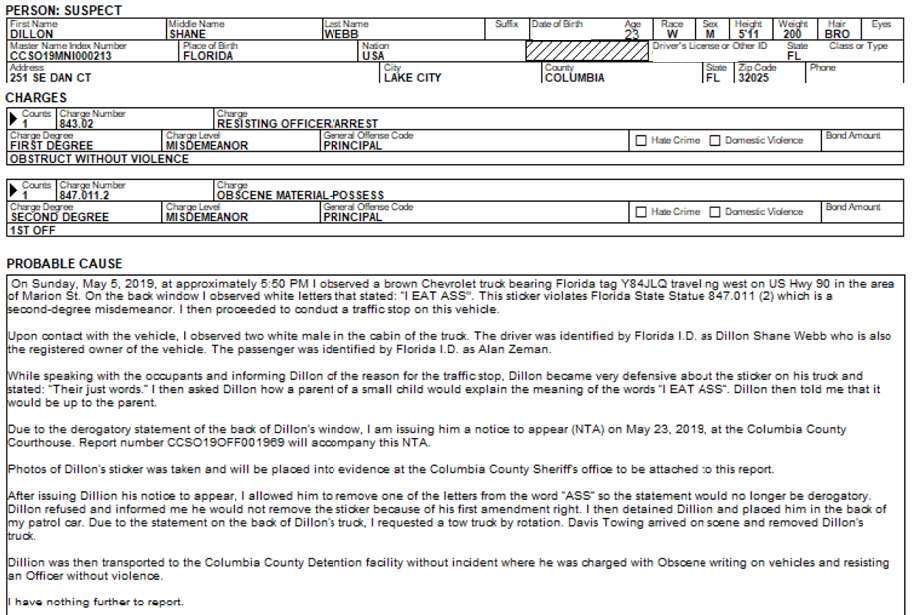
And that’s why a Florida law enforcement officer pulled over and arrested a man for the “I EAT ASS” sticker on his window. According to Deputy Travis English’s arrest report, he noticed the sticker and assumed it violated the state’s obscenity law. He was, of course, wrong about this. But he called his supervisor for clarification and was assured (wrongly) that this sticker violated the law.
He offered to let the driver, Dillon Webb, be on his way if he removed the word “ASS” from the decal. Webb refused, (correctly) asserting his First Amendment right to publicize his non-driving activities. English’s report is full of dumb things (and, ironically, some incorrect English). Here’s what he had to say about the stop and the driver’s assertion of his Constitutional rights. (All errors in the original.)
While speaking with the occupants and informing Dillon of the reason for the traffic stop, Dillon became defensive about the sticker on his truck and stated: “Their just words.” I then asked Dillon how a parent of a small child would explain the meaning of the words “I EAT ASS”. Dillon then told me that would be up to the parent.
[…]
Dillion was then transported to the Columbia County Detention facility without incident where he was charged with Obscene writing on vehicles and resisting an Officer without violence.
One count of Obscene writing. And one count of Contempt of Cop, as expressed in the form of advocating for one’s own rights. Here’s what awaited Dillon following his arrest:
Among other things, Officer Dampier performed a thorough pat-down search of Webb and was present when Webb was required to strip naked and put on the clothes provided by the Jail.
CCSO Officers placed Webb in a cell while his mother worked with a bail bondsman to secure his release. Although the exact length of time Webb spent in the Jail is in dispute, suffice it to say Webb was incarcerated for more than an hour. Webb paid approximately $225.00 to retrieve his truck from the tow company, $250.00 to the bail bondsman, and a $15.00 Jail fee.
That’s from the decision [PDF] issued by a Florida federal court, which unfortunately allows these officers to exit the lawsuit early because it wasn’t clearly established that misreading a state statute to support a stop, search, arrest, vehicle seizure, temporary jailing (following another search), and the issuance of criminal charges was the wrong thing to do when confronted by an “I EAT ASS” decal. (via Volokh Conspiracy, h/t Andrew Fleischmann)
The court says qualified immunity applies because it’s not immediately clear an “I EAT ASS” decal is protected speech, at least not under Florida law. Even if the officers were incorrect in their reading of the law, they’re shielded from further litigation because they both subjectively believed the decal violated the law.
As an initial matter, it is undisputed that Deputy English and Corporal Kirby subjectively interpreted the Sticker as depicting a sexual act and believed that the Sticker violated Florida’s obscenity statute. While Webb denies the Sticker was in fact obscene, in interviews he repeatedly acknowledged the sexual nature of his Sticker, albeit couched as an attempt at humor, showing that the notion that an erotic message was more than hypothetical—it could reasonably be viewed as the predominant message being communicated. Indeed, others in the videos similarly acknowledged, both directly and indirectly, that the Sticker described a sexual act. Given this evidence, including Webb’s own statements, it is beyond dispute that reasonable officers possessing the same knowledge as Deputy English and Corporal Kirby could have thought the Sticker depicted a sexual act, and as such arguably violated Florida Statute section 847.011(2).
The speech might have been protected, even given its “sexual nature,” if it contained any “serious artistic, literary, political, or scientific value.” The judge says this sticker doesn’t, or, if it does, it was not immediately apparent to Deputy English and his direct supervisor.
Here, Deputy English and Corporal Kirby’s determination that the Sticker lacked serious value under Florida law was not inherently unreasonable under the circumstances. As such, the Court finds reasonable officers in the same circumstances and with the same knowledge as Deputy English and Corporal Kirby could believe Webb’s Sticker was obscene, making it an arrestable offense under Florida law.
Using that logic, the court waves away his challenge of the resisting arrest charge.
Because the Court finds Webb’s arrest was arguably justified under Florida’s obscenity law, the Court need not separately address his arrest for resisting without violence.
So, even if the first charge may have been a misreading of the law, Dillon’s “resistance” (which was little more than refusing to alter the sticker and stating he had a First Amendment right to display it — and that’s according to the Deputy’s arrest report), the second charge can’t be challenged because… one of the charges was close enough to lawful to make everything lawful? Maybe it’s more nuanced than that, but if it is, the court didn’t feel like sharing its thought process. That additional charge is accepted in whole because the obscenity charge was close enough to legit to justify the arrest.
As for the trickier part of the case — determining whether or not the sticker actually violated law and/or whether or not Webb’s First Amendment rights were actually violated — the court decides it doesn’t need to do much thinking about that issue either.
Here, in evaluating the applicability of the doctrine of qualified immunity, the Court need not determine whether genuine issues of fact exist as to the question of whether Deputy English and Corporal Kirby violated Webb’s right to be free from First Amendment retaliation because the constitutional rights Webb alleges the Defendants violated were not clearly established at the time of his arrest.
Since the court is unwilling to make any determination on the applicability of the law to the speech in question, the question remains open. And an open question is just more unsettled law — the sort of thing that allows officers to violate rights and avoid facing the consequences because the qualified immunity doctrine not only short-circuits civil rights lawsuits, it almost always preempts any legal discussion of the government’s alleged rights violations. Going forward, Florida law enforcement remain free to misread laws involving possibly-protected speech to punish people for words they subjectively find offensive.
A proposed state law that could make it a crime to shoot cell phone video of police got the green light by lawmakers to move forward following a statehouse committee hearing Thursday in Columbus.
Members of the House Criminal Justice Committee voted to approve the measure despite more than 100 civil rights, first amendment groups and individuals testifying against the measure since it was first introduced.
It seems like this would be a bad thing to do, considering the state of the room these legislators have failed (or chosen) not to read. For one thing, it would target First Amendment protected activity: the filming of public servants. Second, it gives police more power to make “contempt of cop” arrests which, despite the colloquial name, does nothing to make cops less likely to be viewed with contempt.
This isn’t a bipartisan effort to ensure cops are left unharassed when harassing the public. This is a one-sided affair where the “us v. them” attitude has carried over from the cop shop to the legislative branch of the Ohio government.
Of course, the bill has its supporters. And they’re all of one (blue) stripe.
The bills sponsors say it would protect both police and the public from harm when police are attempting to clear crime scenes, make arrests or maintain order and is supported by the Ohio Prosecuting Attorney’s Association, Buckeye Sheriff’s Association, Ohio Highway Patrol and the Fraternal Order of Police.
The opponents of the bill have pointed out the law’s broadness, which could be read to could outlaw filming police officers. Or interacting with them in any way when they’re handling a stop or effecting an arrest.
Here’s what the bill [PDF] adds to existing obstruction of justice laws. First, it criminalizes this act of civil disobedience.
(7) Fail to follow a lawful order from a law enforcement
Then it piles on all of this:
(B) No person shall do any of the following to a law enforcement officer in the performance of the law enforcement officer’s duties with reckless disregard as to whether the action diverts or obstructs the law enforcement officer’s attention:
(1) Use force or threaten the immediate use of force against the law enforcement officer;
(2) Interfere with or obstruct a law enforcement officer in a manner that does any of the following:
(a) Inhibits or restricts the law enforcement officer’s control of a subject or detainee;
(b) Deprives the law enforcement officer of control of a subject or detainee;
(c) Without the consent of the law enforcement officer, enters, or places an object or substance into, a space around the law enforcement officer that is large enough that the law enforcement officer cannot reach a person outside of the area.
(C) No person with the intent to distract a law enforcement officer engaged in the performance of the law enforcement officer’s official duties shall throw any object or substance at or onto a law enforcement officer.
The good news is this caveat has been thrown in at the last minute — a bone thrown to the 100+ rights groups and activists that read the bill’s intent for what it was:
(F) Nothing in this section shall be construed to prohibit a person from using video or audio recording equipment to record a law enforcement officer in the performance of the law enforcement officer’s duties.
Yes, but nothing in the law appears to prevent an officer from deciding some of the other forbidden acts are inseparable from the actions of someone filming police officers. An officer could claim the person’s presence made it more difficult to control a detainee. An officer could claim the presence of witnesses with phone cameras rolling presents some sort of threat. An officer could claim they told bystanders with active cameras to disperse and they refused to obey a lawful order. So, this exception is great on its own, but it’s terrible in conjunction with everything else tossed into the bill.
And, as if we really needed the true point of this bill spelled out for us, the police officer who was the epicenter of this seismic shift in public opinion about police officers and their abuses of power made it perfectly clear who cops feel the real threat is when deploying excessive force:
Derek Chauvin’s defense attorney argued those surrounding police, taking cell phone video, were a distraction that helped cause Floyd’s death.
Chauvin’s lawyer isn’t the only one to have expressed this sentiment. Following the killing of Eric Garner by NYPD officer Daniel Pantaleo, one of the NYPD’s police unions said the real problem was bystanders with cameras and suspects wanting to “put on a show.” And FBI director James Comey blamed a half-dozen spikes in violent crime around the nation following the Ferguson protests on people with cellphone cameras “taunting” officers into behaving badly.
If this bill becomes law, it won’t make things easier for police. It might make it easier to effect bogus arrests, but it won’t make the actual job of policing any easier. This will just widen the divide between the police and the policed. Disrespect can be earned much faster than respect. With police refusing to meet their employers halfway — and being given the blessing to keep citizens at arms’ length — the problems people have been protesting about are never going to go away. This bill encourages officers to indulge their worst impulses. And this unwillingness to utilize self-control is a big part of why we’re at the point people are burning down precinct houses in response to acts of police violence.
A snitch app called Citizen is angling for the position of Local Law Enforcement®. Going a step further than hotbeds of bigotry like Ring’s Neighbors or Facebook-but-for-racism Nextdoor, Citizen is actually trying to create a private law enforcement agency that provides “security” and other services for app users.
A marauding cop-like patrol vehicle emblazoned with the Citizen logo (and some branding for another private security company) was spotted roaming Los Angeles last week. The desire to create a private cutout in public law enforcement space was confirmed by current and former Citizen employees, as well as documents shared with Motherboard and Joseph Cox.
It’s not just theoretical. It appears some employees of this private company really want to convert Citizen into a law enforcement agency. (Supporters of this move may also contain members of the Los Angeles Police Department, which called Citizen’s move towards patrolling the streets a “game changer.”) Then there’s this new twist, which indicates Citizen’s partner in patrolling — Los Angeles Professional Security Services — really would prefer to be an actual law enforcement agency, rather than the private security company it actually is.
In a self-described “documentary” on the Los Angeles Professional Security YouTube, the company’s CEO and founder James Caspari explains after detaining two tresspassers that the company wants the power to make arrests and take people to jail.
“We’re going to waste police resources because we can’t drive them to the police station,” he said. “The security guard manual says we have to wait and a peace officer has to take them. That’s just a waste. If we’ve already cleared it… why can’t we just take ‘em to jail?”
Flow my tears, the fake policeman said. Why? WHY?? Because you’re a goddamn rent-a-cop. You’re not the real thing. You don’t get to start depriving people of freedom just because you’re dressed in black cop-adjacent garb and employed by a private security firm. No one has granted you the right to arrest people because that’s limited to publicly-funded government agencies that are (in theory) more accountable to taxpayers than a private company that only answers to paying customers.
“Private security has zero authority on a public space,” he later laments.
Go be a cop then. If it’s killing you that you can’t violate rights as a private citizen, go get an actual cop job where you can violate rights on the taxpayers’ dime. Sure, this seems a bit backwards but that’s how it works. The government gets to do certain things with the implicit consent of the governed. Los Angeles citizens have not agreed to allowing private citizens to start throwing other private citizens into faux cop cars in order to take them to jail. What standard is LAPS applying to itself when it affects an arrest? There are rules in place, backed by the Constitution. And, while these rules may be violated with alarming frequency by government agencies, they’re still rules. Private companies don’t have to adhere to the Constitution. And that’s why they shouldn’t be getting into the business of violating the rights of others. (And, before certain commenters start trying to turn this statement into something about social media, no one’s rights are violated when a company refuses to provide you a platform for expressing yourself.)
Going from bad to arguably worse, the CEO of a private security firm actually believes it’s capable of responding to mental health calls with its staff of people who apparently couldn’t cut it as real cops or first responders.
Caspari explains in the video that LAPS believes it can remove trespassers and respond to mental health calls. “We are in a position to respond in force to effectively anywhere in the city to remove any negative element that a client of ours is threatened with,” Caspari said in the video.
And even in its own video, which it had the chance to edit before publishing it, the private security company’s employees are given the “what even the fuck” treatment by the partners Citizen and LAPS really want to have on board: the Los Angeles Police Department.
After searching an abandoned building, LAPS employees cuff the two people they find there and wait for the LAPD to arrive. Caspari explains this is all cool and legal: a “private person arrest” supported by California law. After lamenting the “waste of time” that is waiting for actual law enforcement to show up, he’s greeted with LAPD officers wondering why the private security firm is patrolling abandoned buildings that appear to be outside of its contractual obligations with its customers.
At one point, the LAPD does turn up. A seemingly surprised LAPD officer asks Caspari, “Is that your normal protocol, you guys just go search the building?”
“On your own, or? Just curious, I’ve never dealt with you guys before,” the LAPD officer continues.
It’s a legitimate question. If the private security company wasn’t asked by the owners (and “abandoned” suggests no real owner exits) to patrol the building, why the hell are they entering it? At that point, the security personnel are just as guilty of trespassing as the people they detained.
Since there are no good answers to that question, the CEO moves on to complain the LAPD doesn’t have enough resources to harass the homeless, leaving people “pushing two shopping carts down the road” free to annoy Caspari.
If nothing else, Caspari has the right mindset for law enforcement. The people who should be rounded up first are hanging out in abandoned buildings or irritating the locals with their homelessness. Nothing in the video suggests the security firm is stumbling across serious or violent criminal activity that’s not being handled by the LAPD. Instead, the CEO complains his company has its hands tied, unable to remove homeless people, trespassers, and the mentally ill from the street without having to bring the LAPD into it.
If the LAPD has to use its resources to handle more serious crime and leave this sort of “crime” unaddressed, good. But that’s not an invitation for private companies to fill this perceived void. Providing security for paying clients is fine, but wanting to be a cop just so you can round up a bunch of non-threatening, non-violent people makes you worse than the actual cops. This is just a bunch of people cosplaying and wishing their cardboard props were real. And it’s going to do serious damage to Los Angeles residents if companies like this continue to believe they should have the right to violate the rights of others.