Adidas is not exactly unknown in the seven circles of trademark insanity hell. The company most famously is a jealous defender of its vaunted “3 slanted stripes” branding. It takes that protective stance to ridiculous extremes, including going after an eSports league for having the “E” in question be three stripes, or suing to hell other brands that have dared to sell apparel or shoes with a number of stripes that doesn’t equal 3.
It was only a few years ago that Adidas was actually looking to expand its trademark rights on its very, very creative 3 parallel lines branding such that it would hold the mark for them if “applied to the product in whichever direction.” And most recently, the company made the very masochistic decision to oppose a trademark application for the Black Lives Matter Global Network Foundation, despite that group’s proposed mark being nothing like Adidas’.
Adidas had told the trademark office in a Monday filing that the Black Lives Matter Global Network Foundation’s yellow-stripe design so closely resembles its own famous three-stripe mark that it is “likely to cause confusion”.
It sought to block the group’s application to use the design on goods that the German sportswear maker also sells, such as shirts, hats and bags.
Now, lest you think Adidas has some super valid reason to be this concerned about a trademark application for an organization that in no way competes with it commercially, well, here is the proposed mark from the BLM organization.
Those three stripes you see at the bottom of that logo are what Adidas said was so similar to its own trademarks that it would cause confusion in the public. Now, if you can look at that logo and tell me you think it has anything at all to do with Adidas, then see me after class because it’s high time you saw a therapist.
Which is why it is entirely unsurprising that Adidas dropped the entire thing and ran away at the slightest bit of pushback.
A source close to the company said the rapid about-turn was triggered by concern that people could misinterpret Adidas’ trademark objection as criticism of Black Lives Matter’s mission.
I mean, maybe? But only because, again, the trademark claim was so completely weak to begin with. If the BLM movement had put together a trademark application that essentially mimicked the Adidas logo, the company would be well within its rights, and I would cheer it on, in defending its trademarks through an opposition.
But in this case, it appears that the company was being fairly over-protective of those same rights and then decided to blame fear of the BLM movement for its retreat. Which is cowardice, in my view.
In both Canada and the U.S., there’s no shortage of evidence that consolidation in telecom and media hasn’t been great for telecom and media — or employers, competition, or consumers.
That’s not really stopping regulators in either country, who continue to approve massive harmful megadeals with only the pretense of meaningful review. Canada’s just approved the massive $16-$25 billion merger between two of its biggest telecom, wireless, and media behemoths: Shaw and Rogers.
The review took two years, with regulators particularly concerned about how the merger would impact wireless competition. Not so concerned that they’d be willing to block the merger, however. The deal was approved, but Shaw was required to offload its wireless arm, Freedom Mobile, to Videotron:
That final approval came from Canada’s Minister of Innovation, Science and Industry, which approved the transfer of Shaw’s spectrum licenses to Videotron. These license transfers are necessary because as part of the deal, Shaw was required to divest its Freedom Mobile wireless business. Shaw is selling Freedom Mobile to Videotron, which is a wholly-owned subsidiary of Quebecor.
The problem with megadeal conditions in both countries is several fold. One, regulators are comically captured, so accountability for when companies break their promises are fleeting at best. And two, the consolidation created by such deals further offsets an already muted incentive to meaningfully compete on price, expand access to broadband, or generally, you know, try.
Antitrust oversight now routinely fails to function in the U.S. and Canada. Softball mainstream media coverage provides cover for deal shortcomings, with any real criticism relegated to underfunded fringe outlets, while mainstream outlets push stories featuring quotes from industry officials claiming the deal will be an “exciting new chapter” and create a “rising star” in media and telecom.
The 5,000 to 10,000 lost jobs become an afterthought. The fact that Canadians already pay some of the highest prices in the world for wireless data (directly due to past consolidation) becomes an afterthought. Data showing looming price hikes become footnotes. And the regulators who approve such deals soon enter the revolving door, and the entire approval process gets memory holed.
Earlier this year, a federal court dismissed almost all of a far right troll’s challenge to the criminal case brought against him by the DOJ. “Ricky Vaughn” is a notorious social media presence — one who’s been repeatedly suspended and banned for his never-ending string of shitheelishness.
I don’t sympathize with Douglass Mackey, better known as “Ricky Vaughn.” He’s the kind of person who gives actual conservatives a bad name. He’s the kind of person who takes perverse joy in being as awful as possible. But rather than just offend everyone, Mackey/Vaughn has a demographic he prefers to target: the “libs.”
During the run-up to the 2016 presidential election, Mackey convinced a bunch of his social media followers to start spreading disinformation. This was a particular form of disinformation, though. Namely, Mackey and his acolytes made a concerted effort to convince certain voters they could vote by phone. They even provided a phone number for voters to text their votes to.
It worked, to a certain extent. Mackey’s online accounts had thousands of followers. According to the DOJ, nearly 5,000 people fell for his ruse.
So, the DOJ charged him with election interference. Whether or not a 5,000 vote swing would have mattered is besides the point, especially when the Electoral College has the final say. And the DOJ admitted this prosecution was unique: every prior election interference prosecution involved political candidates or government officials interfering with the voting process. Prior precedent — as the court noted — involved ballot stuffing or deliberate miscounting of votes by election officials. To date, no one had been prosecuted for attempting to dupe people out of their votes via social media posts.
The court came down on the side of the law, at least as represented by the DOJ. According to the court, preventing election interference is clearly something that is both the best interest of the government and the people they serve. So, if there are some incursions on free speech rights when it comes to free and fair elections, they’re justified by the compelling interest of the government:
This compelling interest undoubtedly includes making sure voters have accurate information about how, when, and where to vote. Prosecutions such as the one before this court are one of the few tools at the Government’s disposal for doing so. Counter speech, a typical mode of countering false speech, is unlikely to be of much use in the context of tweets spread across the far reaches of the internet in the days and hours immediately preceding an election.
A lot of this is true. But this relies on a lot of the court’s other conclusions, including its assumption Mackey knew he was committing a crime when he started trolling. And an arrest that didn’t occur until 2020 hardly seems like a deterrent against future, similar acts by others. It doesn’t appear any of Mackey’s followers have been charged, despite this being called a criminal conspiracy.
This post provoked a very lively discussion between Techdirt readers, almost all of which disagreed with my assessment of this ruling. Several very good points were raised, enough that I have seriously rethought my take on the decision. I think the prosecution (which the DOJ admits is the first of its kind) does raise some First Amendment issues, as does the decision supporting it. But, thanks to Techdirt readers, I also think I may have overlooked the more serious implications of Mackey’s disinformation campaign, which is the sort of thing that can become concerted voter suppression very easily if there are no judicial/criminal justice guardrails applied.
A land of contrasts as they say, only I’m inclined to be less sympathetic to Mackey’s arguments after reading this excellent comment thread.
Douglass Mackey, also known as “Ricky Vaughn,” was convicted today by a federal jury in Brooklyn of the charge of Conspiracy Against Rights stemming from his scheme to deprive individuals of their constitutional right to vote. The verdict followed a one-week trial before United States District Judge Ann M. Donnelly. When sentenced, Mackey faces a maximum of 10 years in prison.
Suppression is what the DOJ’s attempting to prevent. That this went before a jury is a limited testament to the functionality of the criminal justice system, which rarely finds jurors essential to the process. It also notes in the release that Mackey and his followers made deliberate efforts to deceive voters by using Hillary Clinton’s official campaign logo and font in their misleading social media posts encouraging voters to stay home and vote by phone.
I still have reservations about this whole thing, although those reservations are a bit more reserved after reading through the original article’s discussion. What’s not clear is when protected speech strays into election interference. A concerted campaign utilizing a candidate’s trademarks and hashtags is enough to trigger prosecution. But what if people do what they always do around election day and start telling people the wrong day or date to vote? At what point does it cross the line from being trollish to being criminal? And if it does cross the line, will the DOJ handle these cases consistently?
I do think this was a deliberate attempt to trick people out of voting. And that is suppression, even if Mackey’s army of 58,000+ followers only managed to result in 4,900 futile texts. It’s depriving someone of their right, even if — in a nation of hundreds of millions — only a very small number of people fell for it. An extreme amount of caution needs to exercised in the future. This isn’t a problem that’s going to go away. And the government — all three branches — need to take care to address the issue without further diminishing the rights they swore to uphold.
Look, we all knew that there was going to be a lot of fuss about the upcoming public domaining (finally!) of Mickey Mouse nine months from now on January 1, 2024. I mean, we’ve already been talking about what next year’s public domain game jam is going to look like with Mickey as one of the options.
If you somehow have been living under a rock and never read anything on Techdirt before, let’s get you up to speed. Mickey Mouse debuted as Steamboat Willie in 1928. The character was a blatant animated copy of Steamboat Bill, a Buster Keaton silent film that came out… the same year. Disney, of course, also built up much of its success by taking public domain stories and animating them.
But, of course, once Disney became the Walt Disney Corporation, it chose to lock up everything it could. Disney has been absolutely famous for its aggressive copyright lawyering for years, which included what we’ve referred to as the Mickey Mouse curve: every time Mickey Mouse started to get near the public domain, a purely coincidental thing happened where Congress would (totally unrelatedly) extend copyrights:
The last extension, the 1998 Sonny Bono Copyright Term Extension Act was quite frequently referred to as the Mickey Mouse Protection Act.
Over the last few years there remained concerns that Disney would try to extend copyrights once again, but I think once the public rose up against SOPA in 2012, Disney and most of the rest of the copyright legacy players realized that there was no chance they were going to extend terms again. Hell, even Maria Pallante, one of the more extreme copyright maximalists (currently trying to kill libraries) while she was head of the Copyright Office, suggested that maybe it was time to cut back on copyright terms, rather than extend them.
And so, everyone has more or less accepted as fact that the Steamboat Willie version of Mickey becomes public domain next year. Even leaving aside the weird series of articles that showed up in the middle of last summer whining about how awful it is that Disney will “lose” Mickey, there are still some concerns about Disney lawyer fuckery on the way.
Again, many of you know this already, but just to be clear: the only thing that’s going into the public domain is the 1928 version of Mickey, which you can see here:
It’s not quite the iconic version of Mickey from today, though it’s not that far off. But, Disney will still hold the trademark on Mickey, which could limit how it’s used in commerce (in theory, it should only limit uses where someone is confusing people into believing their Mickey-related product is from or endorsed by Disney, but theory doesn’t always match reality when these things go to court).
But, as we discussed earlier this month, Disney has already been quietly making some moves that suggest it’s going to try to use trademark law as ridiculously as it can:
In 2007, Walt Disney Animation Studios redesigned its logo to incorporate the “Steamboat Willie” mouse. It has appeared before every movie the unit has released since, including “Frozen” and “Encanto,” deepening the old character’s association with the company. (The logo is also protected by a trademark.) In addition, Disney sells “Steamboat Willie” merchandise, including socks, backpacks, mugs, stickers, shirts and collectibles.
Either way, we expected that there’d be some legal shenanigans worth paying attention to next year. I also thought that maybe some people or small companies without good lawyers might accidentally jump the gun a bit and do something in December.
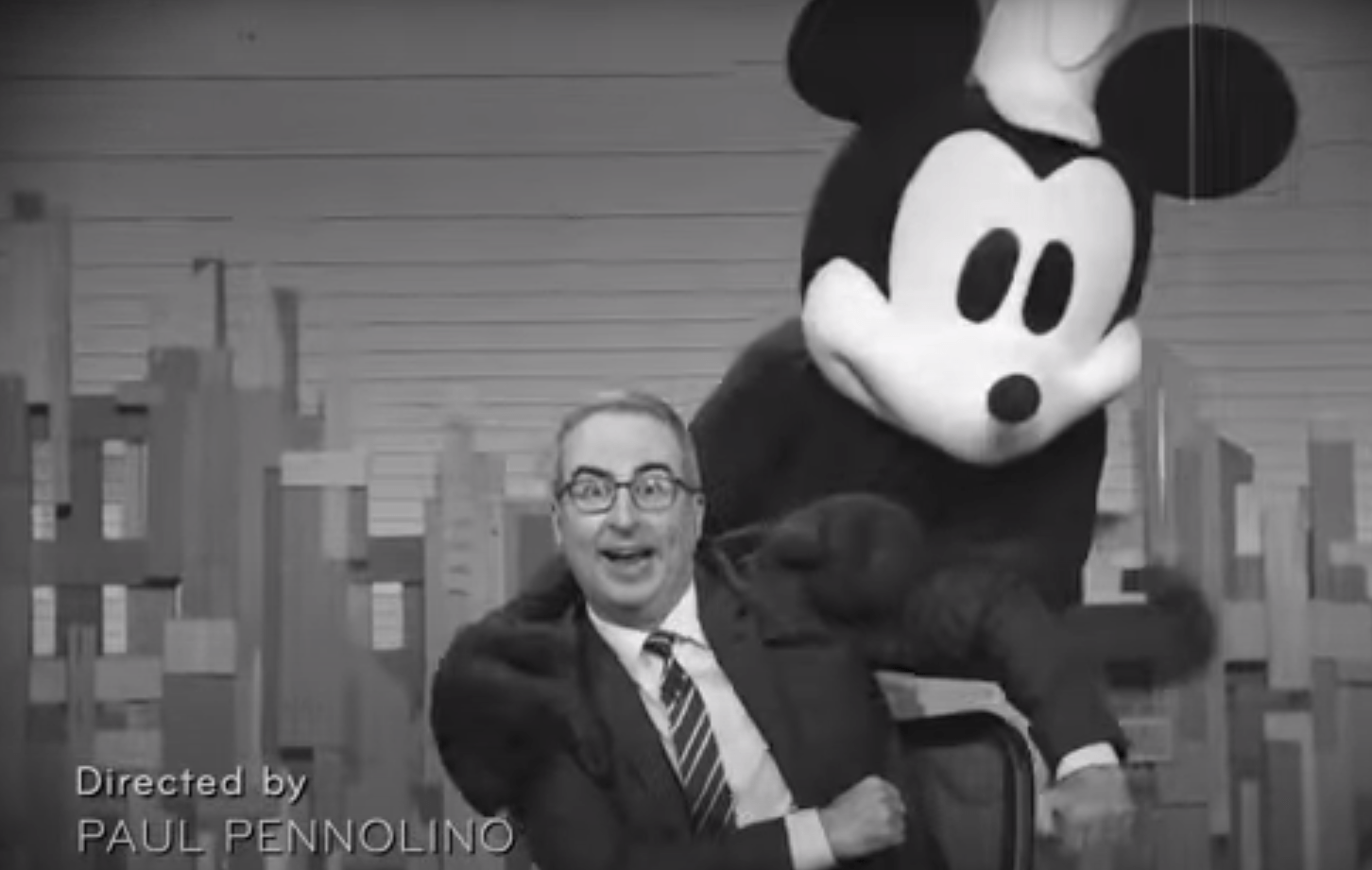
But… what I did not expect was that John Oliver and the folks at Last Week Tonight, an HBO show currently owned by cost-cutting Warner Bros. Discovery would say “fuck it” and start using Mickey Mouse… now.
I mean, I shouldn’t be surprised. Half the time I think Oliver’s show is basically Techdirt-but-if-funny,-entertaining,-and-clever, with the way he seems to cover the same topics we’re always covering, but, you know, better (mostly). And, Oliver has become somewhat famous for poking the eye of his own corporate masters (quite gleefully).
It absolutely would not have taken me by surprise if Oliver had done this nine months from now once Mickey is officially in the public domain. But… jumping the gun like this? That still surprised me.
The bit is, as you’d expect, hilarious. It starts with a discussion of the horror film, Winnie the Pooh: Blood and Honey, which, as you know, is building on a work that entered the public domain last year. But then moves on to Mickey. He talks about Mickey going into the public domain next year, highlights the litigiousness of Disney over Mickey (including legal crackdowns on a gravestone and a daycare center using images of Mickey) before noting he’s not going to wait to use it himself.
On top of which Disney has registered trademarks related to Disney, which don’t expire. In fact, some have speculated that might be why Disney redesigned its animation studios opening logo to incorporate the Steamboat Willie Mickey Mouse.
And it does feel like a tactical legal move. Basically, they may argue that this early Mickey image is so closely associated with their company, that people will automatically assume that any image of him was produced or authorized by them, and still take legal action.
So the fact is, anyone wanting to use the Steamboat Willie Mickey Mouse, will probably still be taking a risk.
But… if you know anything about this show by now… you know, we do like to take a risk every now and then. And there’s a lot to be said for beating the rush to capitalize on Mickey that will be starting next year.
So, tonight, I’d like to preview for you, our brand new character on this show, Mickey Mouse
He introduces some new, um, catch phrases for Mickey including “where’s Shelly Miscavige?” (a running… sorta… joke on the show about the missing wife of Scientology leader David Miscavige), “Jeffrey Epstein didn’t kill himself,” and “I hope Henry Kissinger dies soon!”
As Oliver says:
You know, the nice thing about characters entering the public domain is that you can do new, interesting things with them.
This is true. It’s why we celebrate the public domain every chance we can (psst, have you checked out the entries in this year’s public domain game jam?)
Mickey then asks John about the fact that he’s not actually in the public domain yet, and John doesn’t seem too concerned:
Mickey Mouse: I thought I wasn’t public domain until next year!
John Oliver: That’s actually true, buddy, we are pushing the limit a bit here. Actually, come to think of it, is your voice public domain yet?
Mickey: I guess you’ll find out!
John: Yeah! I guess we will!
He then decides to provoke Disney even more.
And I know, Disney’s lawyers might take the trademark angle and argue that this Mickey is closely associated with their brand. Although they should know that he’s pretty closely associated with our brand now too. And not just because I have a general vibe that screams 95-year-old rat-faced idiot, but also, because the Steamboat Willie Mickey has actually been in our opening credits since the first show of this season…
And then… even more.
And I don’t doubt that Disney has some other legal arguments up their sleeve, but we’re only likely to find out what they are if, and when, then sue. So, you know what? Let’s take this up a notch. Come say ‘hi’ Mickey!
And… out comes a Steamboat Willie Mickey in a costume to say his catch phrases to Oliver:
And, from there, he promises that as of January 1st, this costume will be available for all sorts of events (“birthday parties, theme park openings, funerals, sex dungeons, whatever you want.”)
So… now the question… does Disney actually do anything? Do they call up Warner Bros. Discovery and say WTF? Or do they send in the lawyers? I guess we’ll find out!
Oh, and John, if they do send in the lawyers, your own lawyers might want to look more deeply into reports that turned up 15 years ago that Disney’s lawyers, way back in the early days, fucked up the registration and don’t actually hold any copyright on Mickey Mouse at all. That’ll be fun.
Apple tried to create something useful and ended up empowering awful people. Meant to help its users keep an eye on things that were important to them, the small tracking devices known as AirTags were soon exploited by stalkers to track and harass their targets, leading to a class action lawsuit against the company by victims of AirTag-enabled stalking.
To decrease the risk of manipulation by malicious people, Apple introduced a few safety features. If the target was an iPhone user, the phone would warn them if an unknown AirTag was active in their immediate vicinity. The AirTags also now emit beeps when separated from the deployer for an extended period of time.
Those features meant to prevent people from stalking and malicious tracking apparently aren’t enough to deter use by federal law enforcement agencies. As Thomas Brewster reports for Forbes, the DEA has, on at least one occasion, decided AirTags are preferable to its normal GPS gear.
In May last year, border agents intercepted two packages from Shanghai, China. Inside one was a pill press, a machine used to compress powders into tablets, in the other some pill dyes. Believing that they were destined for an illegal narcotics manufacturer, the Drug Enforcement Agency was called in. DEA investigators inspected the devices but rather than cancel the shipment or pay a visit to the intended recipient, they tried something they’d never been known to try before: they hid an Apple AirTag inside the pill press so they could track its movements.
Maybe the AirTag was smaller than the DEA’s other options. Maybe the agents felt the discovery of an AirTag might lead the target to suspect something other than law enforcement surveillance. All the warrant says is that the agent requesting the warrant felt the AirTag could provide “precise location information” on the pill production products’ final destination.
Maybe the tracking worked. Both the DEA and Apple refused to comment on this novel AirTag deployment. While Apple may have considered the law enforcement implications of its tracking device, it’s powerless to prevent deployments intended to track persons or objects that don’t belong to the AirTag’s owner. And the DEA had to be aware Apple had added features meant to deter exactly this sort of tracking, but chose to go with the AirTag anyway.
Whatever the case, it appears this test run (if that what it was) worked, at least to some extent.
According to court records the intended recipient of the pill press was not charged in federal court. The DOJ, however, confirmed that he had been charged by the state.
If it can be used (or misused) by regular people, it can be used/misused by the government. If stalkers have a new toy, rest assured the government has already considered the advantages (and, maybe, even the constitutional implications) of deploying it to engage in its own form of stalking. It’s whatever the government-involved version of “buyer beware” is.
Sure, you want to keep an eye on your luggage as it makes its way into the airline industry’s less-than-predictable logistical machinery. The government might want to keep an eye on your bags as well, even if it might be less willing to reunite you with your luggage once you’ve both arrived at your destination. Tracking is tracking, and Apple may have managed to produce a better version of whatever the DEA’s relied on for years.
Deepstash is a platform for finding and organizing the ideas that matter to you. It helps you become more inspired and productive through bite-sized ideas. In Deepstash, you find ideas on topics like personal development, art and culture, mindfulness, and more. These ideas are represented as little cards you can read at a glance. All ideas have a source: a book, an article, a podcast, etc. A 2-year subscription is on sale for $79.99.
Note: The Techdirt Deals Store is powered and curated by StackCommerce. A portion of all sales from Techdirt Deals helps support Techdirt. The products featured do not reflect endorsements by our editorial team.
Stop me if you’ve heard this one before: the NY Post tweets a link to one of its own news stories, and Twitter decides that it violates the company’s rules (perhaps very questionably so), and in response, locks the NY Post’s Twitter account. Also, as part of the same “crackdown” on sharing certain media, Twitter also suspends Rep. Marjorie Taylor Greene’s account.
Can’t wait for the House subcommittee investigation into this one. Oh, and the Twitter Files on this are going to be lit.
The details here are… kind of a mess, and I almost hate to get into them for fear it will derail the conversation. Basically there were a bunch of tweets about a protest to highlight the importance of the rights of transgender people. The name of the protest was a “trans day of vengeance.” As with so many culture war topics, this one was then weaponized by anti-trans people who were tweeting about it as well (and misrepresenting it, but that’s a separate issue).
And, because content moderation at scale is impossible to do well, and because Twitter trust & safety seems to be managed by people who haven’t completed their speed run of the learning curve yet, they decided to delete all tweets from everyone on all sides that were showing a poster promoting the event. Around the same time, the company also suspended Rep. Marjorie Taylor Greene’s account over her own tweet regarding the event.
Twitter’s, um, explanation of this was confused and didn’t make much sense:
Twitter’s trust & safety boss, Ella Irwin, also explained the reason for taking down all those tweets was that “vengeance does not imply peaceful protest,” though I’d argue the context of the event (1) suggests otherwise and (2) suggests that, contrary to Elon’s claims, this is yet more moderation that goes way beyond the 1st Amendment. And, of course, this is all allowed (and perhaps even understandable under the true content moderation guiding light of “please, for the love of anything, just stop being jerks on our platform”).
Anyway, the NY Post wrote about the account suspensions, and apparently, the tweet about that article then resulted in the NY Post account being suspended and the account locked:
Hours later, however, Twitter reversed course and reinstated the NY Post’s account.
Again, all this is perfectly within Twitter’s rights, but I have difficulty seeing how it’s even one iota different from what happened in October of 2020. At that time, Twitter also applied a policy badly in the heat of the moment as things were moving quickly, suspended the NY Post’s account, and then admitted they were wrong and reinstated the account.
Mistakes sometimes happen. But people are still talking about the October 2020 version. Even this guy had something to say about it, as part of his justification for his attempt (at the time) to purchase Twitter:
That’s Elon Musk directly saying: “Suspending the Twitter account of a major news organization for publishing a truthful story was obviously incredibly inappropriate”
Note that there’s no caveat there. There are no conditions. No suggestion that maybe it was a mistake that was corrected a few hours later (as happened in both cases). Just a flat out that “suspending the Twitter account of a major news organization for publishing a truthful story was obviously incredibly inappropriate” even though the identical thing happened under Musk’s watch as well.
But, in this case, people seem willing to let it slide by and Musk seems to think that he should be judged on a totally different standard. I mean, it’s almost as if he and his fans use different standards to judge Musk’s actions vs. the actions of the old leadership.
An intellectually honest response might lead to a recognition that perhaps the October 2020 actions were a similar type of mistake and correction, and should be forgiven just as this latest mistake and correction are being forgiven. But that would require some intellectual honesty and not rooting for one team to win and another to lose. And, apparently, that’s too much to ask for.
In case you’d missed it, the EU is currently proposing a telecom-industry backed plan to effectively tax Big Tech companies, and throw that money at Big Telecom companies for broadband expansion.
On the surface, the proposal is part of the EU’s efforts to craft digital policies for the next few decades, with an eye on shoring up lagging broadband access.
In reality, the effort is a lobbying gambit by telecom giants looking to offload their network deployment and maintenance costs onto somebody else. All being pushed by EU Internal Market Commissioner Thierry Breton, himself a former CEO of France Telecom.
It’s effectively an extension of the net neutrality wars, in which telecom monopolies insisted they should be paid even more money if you want to access their networks — for no coherent reason.
We’ve repeatedly noted there are several problems with the proposal. One, the whole effort is based on the lie that Big Tech companies “don’t pay their fair share” for broadband (in reality they pay countless billions for bandwidth, cloud storage, CDNs, transit, and even undersea cables). Two, it’s being driven by telecom monopolies with long, rich histories of bullshit on this subject (not to mention subsidy fraud).
It’s effectively yet another effort by the telecom lobby to “double dip,” dressed up as a serious, adult policy proposal. But throwing billions of dollars at telecom monopolies (without reforming existing broadband subsidy programs) in the hopes that this just magically fixes the digital divide this time is a fool’s errand. Yet here we are, having learned nothing from decades of policy experience.
Both Google and Netflix have come out swinging against the EU’s Big Tech tax, pointing out how the claim they “don’t pay their fair share” and should be directly responsible for paying to bridge the digital divide is telecom industry nonsense.
And now Meta’s Kevin Salvadori, VP of Network, and Bruno Cendon Martin, Senior Director of Wireless Technologies, have issued a blog post also pointing out that Facebook has spent more than $100 billion of capital expenditures and operational expenditures on global digital infrastructure:
proposals by some European telecom operators to impose network fees on Content Application Providers (CAPs) such as Meta are not the solution. Network fee proposals are built on a false premise because they do not recognise the value that CAPs create for the digital ecosystem, nor the investments we make in the infrastructure that underpins it.
While broadband subsidy programs in the U.S. and EU do need shoring up, that shouldn’t necessarily be the job of Big Tech companies. Especially given that, in both the EU and U.S., telecom monopolies have routinely driven up the cost of essential broadband access for everyone through regulatory capture and relentless attacks on disruptive competition.
When it comes to telecom monopolies, nobody gets a “free ride.”
Some groups have warned that the EU’s telecom industry’s plan to tax Big Tech giants would simply drive up online costs for consumers, given Big Tech companies would just pass these added costs on to users already paying an arm and a leg for bandwidth. Some groups have warned the internet could also become less stable as online companies try to reroute their traffic around such fees.
And in South Korea, where telecoms convinced regulators to implement a similar tax on Big Tech companies, ISPs have taken to suing Netflix simply because Squid Game was popular with consumers and that resulted in a bandwidth consumption spike.
Content companies and consumers already pay an arm and a leg for bandwidth due to corruption, regulatory capture, and monopolization. It’s the telecoms’ responsibility to use that money — in addition to the billions in taxpayer subsidies they already get — to ensure their networks are ready for customer bandwidth demands. Suggesting it’s Netflix’s fault because you weren’t prepared is preposterous.
Forcing tech giants to pay telecom giants billions of dollars for no coherent reason isn’t actually a solution for the digital divide, but telecom lobbyists have convinced many captured regulators otherwise. And if the push in the EU is successful, you can be absolutely assured it will see a renewed push in the U.S. by the likes of AT&T and Comcast, with captured regulators like the FCC’s Brendan Carr at the fore.