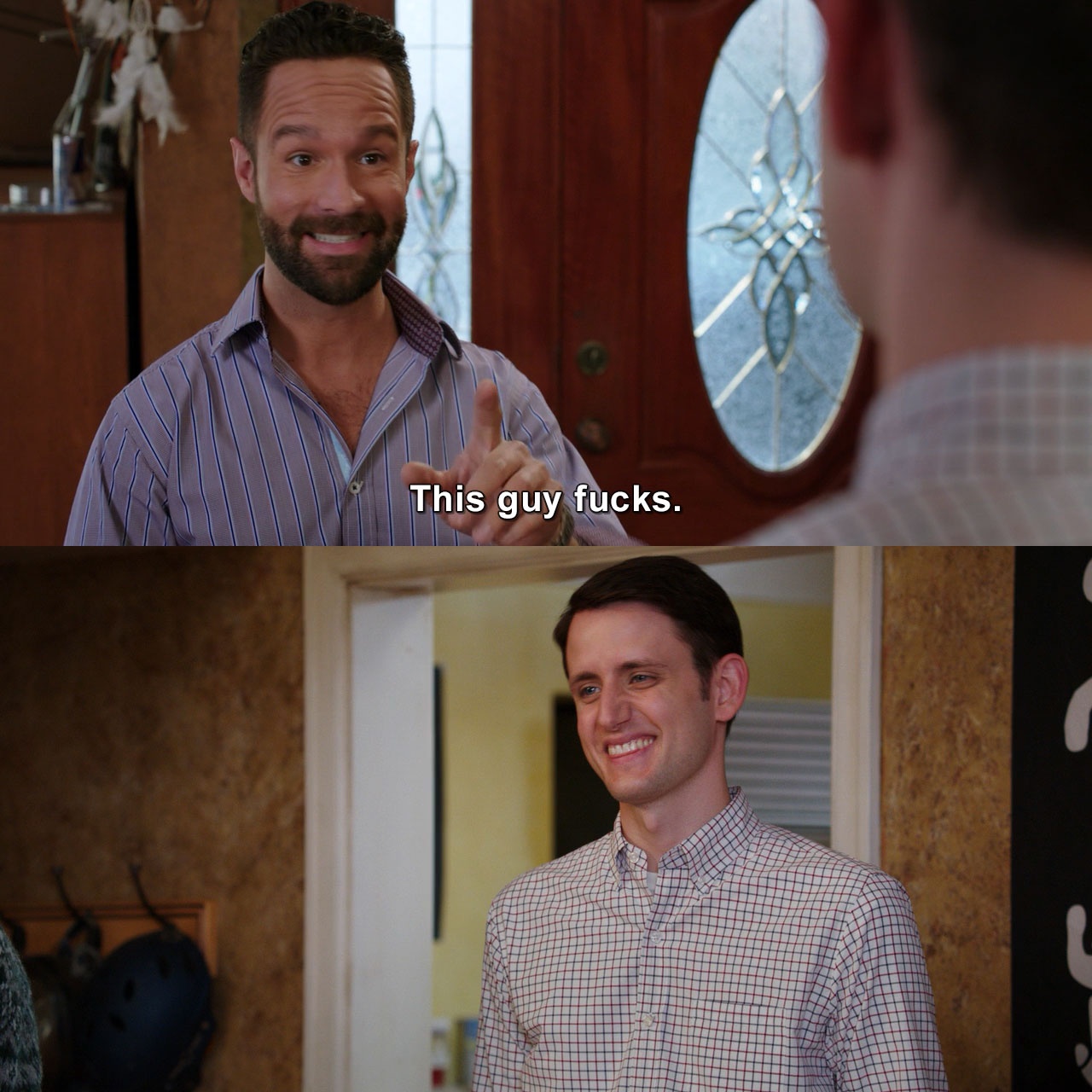
Before you read this post, I want you to try to recall the stupidest thing you’ve ever heard someone say. Go ahead and hold that memory in the back of your head.
Perhaps by now you’re tiring of all of these posts on America’s measles problem that we’ve endured for over a year now. This is so passe, you might be thinking. So, you know, 1990s. And you would have been right before 2025 and the installation of a gravel-mouthed anti-vaxxer as the Secretary of HHS. Sadly, 2025 saw more cases of measles in America than at anytime in the previous several decades and a current outbreak in South Carolina, one which is already spreading to far-flung states across the country, has been left unaddressed.
In my last post on this topic, I complained that those in charge of these agencies are “barely talking about this.” Now that one of those leaders has talked about it publicly, however, I think I understand why they were kept in silence previously.
After a year of ongoing measles outbreaks that have sickened more than 2,400 people, the United States is poised to lose its status as a measles-free country. However, the newly appointed principal deputy director at the Centers for Disease Control and Prevention, Ralph Abraham, said he was unbothered by the prospect at a briefing for journalists this week.
“It’s just the cost of doing business with our borders being somewhat porous for global and international travel,” Abraham said. “We have these communities that choose to be unvaccinated. That’s their personal freedom.”
Okay, where to begin? Let’s just start by pointing out that Abraham is a long-time anti-vaxxer. He has advocated for alternative treatments to all kinds of diseases for which we have actual medicine. He has also advocated for natural immunity over vaccines on the regular. Now that this clown is nominally running the CDC, while America is facing its worst measles crises in over thirty years, the response is as flippant as, “Shit happens because, you know, immigrants.”
“When you hear somebody like Abraham say ‘the cost of doing business,’ how can you be more callous,” said pediatrician and vaccine specialist Paul Offit, in an online discussion hosted by the health blog Inside Medicine on Jan. 20. “Three people died of measles last year in this country,” Offit added. “We eliminated this virus in the year 2000 — eliminated it. Eliminated circulation of the most contagious human infection. That was something to be proud of.”
That would be idiotic even if Abraham were right. But he’s not right. As CBS points out in its post, we’ve always had occasional infections from foreign visitors and sources in America, but nothing like these outbreaks. Only 10% of infections over the last year or so came from outside the country. The rest were domestic spread. And while border policy surely has ebbed and flowed over the past 30 years, there wasn’t some drastic change made in the last year that would explain any of this away.
Now, in all fairness, Abraham has also added that getting two doses of the MMR vaccine is the most effective way to prevent a measles infection. I’m sure saying it was painful for him, but he did it. Still, because the stupidest possible people are running our country right now, the CDC is also studying the genomic makeup of measles infections from different parts of the country. But Timothy, you’re surely saying, that sounds like good science and something they’d use to help fight the disease.
Nope, wrong. They’re desperately trying to show that the outbreaks are from disparate strains to argue that it hasn’t been 12 months of continuous spread of a single strain to claim that we shouldn’t lose our elimination status.
If the CDC’s genomic analyses show that last year’s outbreaks resulted from separate introductions from abroad, political appointees will probably credit Kennedy for saving the country’s status, said Demetre Daskalakis, a former director of the CDC’s national immunization center, who resigned in protest of Kennedy’s actions in August.
And if studies suggest the outbreaks are linked, Daskalakis predicted, the administration will cast doubt on the findings and downplay the reversal of the country’s status: “They’ll say, who cares.”
Indeed, at the briefing, Abraham told a reporter from Stat that a reversal in the nation’s status would not be significant: “Losing elimination status does not mean that the measles would be widespread.”
The phrase “criminal negligence” leaps to mind. That appears to be the work product of our public health officials at the moment. Neglect and attempts to coverup for that neglect on technicalities.
Welcome back, measles. I guess you’ll be staying with us a while.
Let’s start with Flock, the company behind a number of automated license plate reader (ALPR) and other camera technologies. You might be surprised at how many Flock cameras there are in your community. Many large and small municipalities around the country have signed deals with Flock for license plate readers to track the movement of all cars in their city. Even though these deals are signed by local police departments, oftentimes ICE also gains access.
Because of their ubiquity, people are interested in finding out where and how many Flock cameras are in their community. One project that can help with this is the OUI-SPY, a small piece of open source hardware. The OUI-SPY runs on a cheap Arduino compatible chip called an ESP-32. There are multiple programs available for loading on the chip, such as “Flock You,” which allows people to detect Flock cameras and “Sky-Spy” to detect overhead drones. There’s also “BLE Detect,” which detects various Bluetooth signals including ones from Axon, Meta’s Ray-Bans that secretly record you, and more. It also has a mode commonly known as “fox hunting” to track down a specific device. Activists and researchers can use this tool to map out different technologies and quantify the spread of surveillance.
There’s also the open source Wigle app which is primarily designed for mapping out Wi-Fi, but also has the ability to make an audio alert when a specific Wi-Fi or Bluetooth identifier is detected. This means you can set it up to get a notification when it detects products from Flock, Axon, or other nasties in their vicinity.
One enterprising YouTuber, Benn Jordan, figured out a way to fool Flock cameras into not recording his license plate simply by painting some minor visual noise on his license plate. This is innocuous enough that any human will still be able to read his license plate, but it completely prevented Flock devices from recognizing his license plate as a license plate at the time. Some states have outlawed drivers obscuring their license plates, so taking such action is not recommended.
Jordan later went on to discover hundreds of misconfigured Flock cameras that were exposing their administrator interface without a password on the public internet. This would allow anyone with an internet connection to view a live surveillance feed, download 30 days of video, view logs, and more. The cameras pointed at parks, public trails, busy intersections, and even a playground. This was a massive breach of public trust and a huge mistake for a company that claims to be working for public safety.
Other hackers have taken on the task of open-source intelligence and community reporting. One interesting example is deflock.me and alpr.watch, which are crowdsourced maps of ALPR cameras. Much like the OUI-SPY project, this allows activists to map out and expose Flock surveillance cameras in their community.
Another interesting project documenting ICE and creating a trove of open-source intelligence is ICE List Wiki which contains info on companies that have contracts with ICE, incidents and encounters with ICE, and vehicles ICE uses.
People without programming knowledge can also get involved. In Chicago, people used whistles to warn their neighbors that ICE was present or in the area. Many people 3D-printed whistles along with instructional booklets to hand out to their communities, allowing a wider distribution of whistles and consequently earlier warnings for their neighbors.
There is also EFF’s own Rayhunter project for detecting cell-site simulators, about which we have written extensively. Rayhunter runs on a cheap mobile hotspot and doesn’t require deep technical knowledge to use.
It’s important to remember that we are not powerless. Even in the face of a domestic law enforcement presence with massive surveillance capabilities and military-esque technologies, there are still ways to engage in surveillance self-defense. We cannot give into nihilism and fear. We must continue to find small ways to protect ourselves and our communities, and when we can, fight back.
EFF is not affiliated with any of these projects (other than Rayhunter) and does not endorse them. We don’t make any statements about the legality of using any of these projects. Please consult with an attorney to determine what risks there may be.
You might recall how Republicans (with help from Democrats) suffered a three year embolism over the national security, privacy, and propaganda problems inherent with TikTok — only to turn around and let Trump sell the platform to his technofascist billionaire friends. Who are now already hard at work preparing to do all of the stuff they claimed the Chinese were doing. And probably worse.
“Before this update, the app did not collect the precise, GPS-derived location data of US users. Now, if you give TikTok permission to use your phone’s location services, then the app may collect granular information about your exact whereabouts.”
That’s not great in a country that’s too corrupt to pass even a baseline privacy law, or to regulate dodgy data brokers that hoover up this sensitive location data and then share it with pretty much any nitwit with two nickels to rub together (including domestic and foreign intelligence agencies).
The “new U.S. TikTok” is already seeing a bunch of weird technical problems. And there are already influencers saying that their criticism of ICE is more frequently running afoul of “community standards guidelines,” though I’ve yet to see a good report fleshing these claims out yet.
As we noted last December, this latest TikTok deal is kind of the worst of all worlds. The Chinese still have an ownership stake in the app, and the companies and individual investors who’ve taken over the app have a long, rich history of supporting authoritarianism and widespread privacy violations.
These Trump-linked billionaires clearly didn’t buy TikTok to protect national security, fix propaganda, or address consumer privacy. They clearly don’t support the kind of policies it would take to actually address those issues, like meaningful privacy laws, media consolidation limits, data broker regulation, media literacy education funding, or kicking corrupt authoritarians out of the White House.
And they didn’t just buy TikTok to make money or undermine a competitor they repeatedly failed to out-innovate in the short-form video space (though that’s certainly a lot of it). They did it to expand surveillance. And, as Musk did with Twitter, to control the modern information space in a way that will coddle their ideologies and marginalize or censor opposition voices they disagree with.
As men like Larry Ellison and Marc Andreessen have made abundantly clear to anyone paying attention, their ideologies are unchecked greed and far right wing anti-democratic extremism. Billionaires attempting to dominate media to confuse the public and protect their own, usually selfish best interests is a tale as old as time. And that is, contrary to their claims, the play here as well.
With a new board full of foundationally terrible people, it’s only a matter of time before they, like Elon Musk before them, inevitably start fiddling with the platform and its algorithms to shut down debate and ideology they don’t like. Larry Ellison in particular is clearly attempting to buy up what’s left of crumbling U.S. corporate media and turn it into a safe space for the planet’s unpopular autocrats.
It’s worth reiterating that this was all built on the back of four years of fear mongering about TikTok privacy, propaganda, and national security issues by Republicans who couldn’t actually give the slightest shit about any of those subjects. And aided by the bumbling Keystone Cops in the Democratic party, who actively helped Trump offload the platform to his billionaire buddies.
Then propped up by a lazy corporate press that’s increasingly incapable of explaining to the public what’s actually happening, especially if it involves rich right wingers trying to dominate media.
I suspect the company will try very hard for a year or so to insist that nothing whatsoever has changed to avoid a mass exodus of TikTok users. Especially in the wake of the promise of new, performative hearings by lawmakers who helped the whole mess happen in the first place.
But the ownership won’t be able to help themselves. Steadily and progressively things will get worse, driving users to another new pesky social media upstart, at which point the billionaire quest for total information control will start all over again.
Gregory Bovino has been removed from his role as Border Patrol “commander at large” and will return to his former job in El Centro, California, where he is expected to retire soon, according to a DHS official and two people with knowledge of the change.
Get your popcorn, but only because (hopefully) there’s nothing more to see here:
CBP Commander Gregory Bovino made his bones as a Trump soldier before Trump even took office. He went rogue while still working for the Biden administration, engaging in an anti-migrant sweep that no one in the DHS chain of command had signed off on.
Bovino launched “Return to Sender,” the mission to California’s Central Valley earlier this year, without approval from the Biden administration, the Atlantic magazine reported.
Bovino apparently has always desired to take his work inland, which is pretty much the exact opposite of what you’d expect from anyone working for the US Border Patrol.
But these inland incursions apparently caught Trump’s eye. Shortly after Trump decided the federal government should be in the business of invading cities, Bovino popped up in Chicago and then Minneapolis.
Scapegoating sucks. But if anyone deserves to be thrown under the bus by an administration that suddenly senses it may have gone too far, it’s a guy who thinks the bus is just another power he doesn’t need to answer to.
Bovino’s sudden demotion is the clearest sign yet that the Trump administration is reconsidering its most aggressive tactics after the killing Saturday of 37-year-old Alex Pretti by Border Patrol agents under Bovino’s command.
Earlier today, President Trump appeared to signal in a series of social-media posts a tactical shift in the administration’s mass-deportation campaign. Trump wrote that he spoke with Minnesota Governor Tim Walz—whom the White House has blamed for inciting violence—and the two men are now on “a similar wavelength.” Tom Homan, the former ICE chief whom Trump has designated “border czar,” will head to Minnesota to assume command of the federal mobilization there, Trump said.
Homeland Security Secretary Kristi Noem and her close adviser Corey Lewandowski, who were Bovino’s biggest backers at DHS, are also at risk of losing their jobs, two of the people told me.
[Head’s up: lots of jpegs and sports metaphors upcoming.]
I can only hope these two unnamed people are right. As great as it is to see Bovino get demoted, it would be Christmas nearly a year early to see Kristi Noem kicked to the curb. If all of this does actually happen, it would be the equivalent of involuntary LASIK surgery. (You know, to expediently fix the optics.) My fingers remain crossed.
Meanwhile, Bovino is going to suffer the relative humiliation of being sent down to the minors. Sure, his pitch-perfect blend of Cap Anson and John Rocker may have played well early on, but now that dudes with more money than training are killing US citizens on nearly a weekly basis, the time has come to reconsider this dance with the whitest of white devils. (To be fair to John Rocker, at least he expressed remorse for the things he said. Anson never did. And I suspect Bovino never will either.)
Bovino has become the JaMarcus Russell to Trump’s Al Davis [switching to football if you’re scoring at home]{and if you’re scoring at home, high five! NICE!}] — someone who looked like a sure thing early on but swiftly proved himself to be an embarrassment of historic proportions.
Or maybe it’s just some sort of professional jealousy. Trump likes to be the focal point for media bullshitting and Bovino has periodically made Trump look almost rational.
Or… maybe it’s something else. Maybe Trump has decided there can only be one prominent official with completely improbable hair and it certainly won’t be this cocky upstart from the California border.
Bovino repeatedly claimed that Border Patrol agents, not Pretti, were the victims.
Hmmm. I thought we were supposed to blame the victims when federal officers execute people. If the real victims are the federal po-po, maybe they shouldn’t have been where they were when they were there. If they knew what was good for them, they would have stayed away from areas where they might trip over each other in their haste to pump a full clip into someone who already wasn’t moving.
Bovino will have to go back to pomading his hair plugs closer to the border. While that will certainly suck for the recipients of whatever abuse Greg “hell hath no fury like a tiny man with anger issues scorned” Bovino inflicts in response to getting benched, it’s at least a trailing indicator that the “might means we’ve righter than any country has been in history historically, you should read the books about it they’re magnificent” administration may finally be recognizing there’s only so far you can push Americans before even the people who are fully MAGA cooked will turn on you.
Disclosure: I’m on the board of Bluesky, which was inspired by my “Protocols, Not Platforms” paper. But this post isn’t about Bluesky the app. It’s about the underlying protocol and what it enables for anyone who wants to build technology (even competitive to Bluesky) that actually respects users.
Last month, I helped release the Resonant Computing Manifesto, which laid out a vision for technology that empowers users rather than extracting from them. The response was gratifying—people are genuinely hungry for an alternative to the current enshittification trajectory of tech. But the most common piece of feedback we got was some version of: “Okay, this sounds great, but how do I actually build this?”
It’s a fair question. Manifestos are cheap if they don’t connect to reality.
So here’s my answer, at least for anything involving social identity: build on the ATProtocol. It’s the only available system today that actually delivers on the resonant computing principles, and it’s ready to use right now.
The Resonant Computing Manifesto laid out five principles for building technology that works for people:
Private: In the era of AI, whoever controls the context holds the power. While data often involves multiple stakeholders, people must serve as primary stewards of their own context, determining how it’s used.
Dedicated: Software should work exclusively for you, ensuring contextual integrity where data use aligns with your expectations. You must be able to trust there are no hidden agendas or conflicting interests.
Plural: No single entity should control the digital spaces we inhabit. Healthy ecosystems require distributed power, interoperability, and meaningful choice for participants.
Adaptable: Software should be open-ended, able to meet the specific, context-dependent needs of each person who uses it.
Prosocial: Technology should enable connection and coordination, helping us become better neighbors, collaborators, and stewards of shared spaces, both online and off.
If you’re building anything that involves users having identities, connecting with other users, or creating content that belongs to them—which describes basically every interesting app—you need infrastructure that makes these principles achievable rather than aspirational.
ATproto delivers all five.
Private and Dedicated come down to who controls your data. In the current paradigm, you’re rows in somebody else’s database, and they can do whatever they want with those rows. Dan Abramov, in his excellent explainer on open social systems, describes the problem perfectly:
The web Alice created—who she follows, what she likes, what she has posted—is trapped in a box that’s owned by somebody else. To leave is to leave it behind.
On an individual level, it might not be a huge deal.
Alice can rebuild her social presence connection by connection somewhere else. Eventually she might even have the same reach as on the previous platform.
However, collectively, the net effect is that social platforms—at first, gradually, and then suddenly—turn their backs on their users. If you can’t leave without losing something important, the platform has no incentives to respect you as a user.
With ATproto, your data lives in your own “personal repository” (the PDS)—think of it as your own storage container on the social web. You can host it with a free service (like Bluesky), a paid provider, or on your own server. If your current host turns evil or just annoys you, you pack up and move without losing your identity, your connections, or any of your content. The protocol handles the redirection automatically.
This isn’t theoretical. People are doing it right now. The infrastructure exists. You can literally move your entire social presence from one host to another and nobody who follows you needs to update anything (or even realize that you’ve moved).
You don’t need to figure out ways to extract data from an unwilling billionaire’s silo. It’s already yours.
And that’s beneficial for developers as well. If you’re trying to build a system, setting up the identity and social connections creates all sorts of challenges (and dangerous temptations) regarding how you deal with other people’s data, and what games you might play to try to juice the numbers. But with ATproto, the incentives are aligned. Users control their own data, their own connections, and you can just provide a useful service on top of that.
Plural is baked into the architecture. Because your identity isn’t tied to any single app or platform, you can use multiple apps that all read from and write to your personal repository. Abramov explains this clearly in that same post:
Each open social app is like a CMS (content management system) for a subset of data that lives in its users’ repositories. In that sense, your personal repository serves a role akin to a Google account, a Dropbox folder, or a Git repository, with data from your different open social apps grouped under different “subfolders”.
When you make a post on Bluesky, Bluesky puts that post into your repo:
When you star a project on Tangled, Tangled puts that star into your repo:
When you create a publication on Leaflet, Leaflet puts it into your repo:
You get the idea.
Over time, your repo grows to be a collection of data from different open social apps. This data is open by default—if you wanted to look at my Bluesky posts, or Tangled stars, or Leaflet publications, you wouldn’t need to hit these applications’ APIs. You could just hit my personal repository and enumerate all of its records.
This is the opposite of how closed platforms work. You’re not locked into any single company’s vision of what social software should be. Different apps can disagree about what a “post” is—different products, different vibes—and that’s a feature, not a bug. Your identity travels with you across all of them.
Indeed, we’re seeing some really cool stuff around this lately, such as with the new standard.site lexicon for long form publishing on ATproto. It’s been adopted by Leaflet, Pckt, and Offprint, with others likely to come on board as well.
Tynan Purdy, writing via the brand new Offprint (itself an ATproto app), captures the mindset shift that I think more developers need to internalize:
I have no more patience for platforms. I’m done.
Products come and go. This is a truism of the internet. Do not expect any particular service to exist forever, or you will be burned. It can be a depressing thought. So much of our lives are lived online. Communities and culture are created online. The play is performed on stages we call “social media”. But then they go away.
We make our homes on these platforms. Set up shop. Scale a business. Connect with our friends. Build a following. Then something changes. A change in corporate strategy. An IPO. A private equity takeover. A merger with AOL. And it’s never the same after that. All that work, all that culture, now painted in a different light. Sometimes locked away entirely.
His solution? Never build on closed platforms again:
I write to you now on a new kind of place on the internet. This place is mine. Or rather, what I create here is mine. This product (a rather fine one by @btrs.coif I say so myself), belongs to @offprint.app. They might go away. Someday they will. But this, my words, my creation. The human act of creating culture. This is mine. It lives in my personal folder. I keep my personal folder at @selfhosted.social. They will go away someday too, and that’s okay. I’ll move my folder somewhere else. You’ll still be able to read this. Offprint is just an app for reading a certain kind of post I publish to the ATmosphere. When Offprint inevitably dies, hopefully a long time from now, this post will still just be a file in my personal folder. And when that day comes, perhaps even before, there will be other ways to read this file from my personal folder. You can even do so right now.
That’s not idealism. That’s how ATproto actually works today.
Purdy mentions above his “personal folder” and in another post Abramov digs deeper into what that means:
This might sound very hypothetical, but it’s not. What I’ve described so far is the premise behind the AT protocol. It works in production at scale. Bluesky, Leaflet, Tangled, Semble, and Wisp are some of the new open social apps built this way.
It doesn’t feel different to use those apps. But by lifting user data out of the apps, we force the same separation as we’ve had in personal computing: apps don’t trap what you make with them. Someone can always make a new app for old data:
Like before, app developers evolve their file formats. However, they can’t gatekeep who reads and writes files in those formats. Which apps to use is up to you.
Together, everyone’s folders form something like a distributed social filesystem:
This is a fundamentally different relationship between users and services. And it breaks the economic logic that makes platforms turn against their users.
It’s an enshittification killswitch.
Cory Doctorow’s framing of enshittification notes that the demands (often from investors) for companies to extract more and more pushes them to enshittify. Once they have you in their silo, they can begin to turn the screws on you. They know that it’s costly for you to leave. You lose your contacts. Your content. Your community. The switching costs are the leverage.
ATproto breaks that leverage.
Because you control your data, your identity, and your connections, whichever services you’re using have strong incentives to never enshittify. Turn the screws and users just… leave. Click a button, move to a different service, take everything with them. The threat that makes enshittification profitable—”where else are you gonna go?”—has no teeth when the answer is “literally anywhere, and I’m taking my stuff.”
Paul Frazee, Bluesky’s CTO, talks about how this works in a post he recently did on the concept of “Atmospheric Computing.”
Connected clouds solve a lot of problems. You still have the always-on convenience, but you can also store your own data and run your own programs. It’s personal computing, for the cloud.
The main benefit is interoperation.
You signed up to Bluesky. You can just use that account on Leaflet. Both of them are on the Atmosphere.
If Leaflet decides to show Bluesky posts, they just can. If Leaflet decides to create Bluesky posts, they just need to use the right schema. The two apps don’t need to talk to directly to do it. They both just talk to the users’ account hosts.
Cooperative computing is possible.
The most popular algorithm on Bluesky is For You. It’s run by Spacecowboy on *squints* his gaming PC.
He ingests the firehose of public posts and likes and follows. Then the Bluesky app asks his server for a list of post URLs to render. The shared dataset means we can do deeply cooperative computing. An entirely third party service presents itself as first-party to Bluesky.
Because Tangled is Atmospheric, your self-hosted instance would see all of the same users and user activity as the first instance would.
The garden is unwalled.
SelfHosted.social is an account hosting service. The self-hosted users show up like any other user. If I had to guess, most of them started on Bluesky hosts, and then used something like PDS Moover to migrate.
It’s an open network.
In the Atmosphere, it does make sense to run a personal cloud, because your personal cloud can interoperate with other people’s personal clouds. It can also interoperate with BobbyCorp’s Big Bob Cloud, and the corner pie shop’s Pie Cloud, and on it goes.
There’s no silo to lock you in, and thus trying to turn the screws on users should backfire. Instead, services built on ATproto have “resonant” incentives, to keep you happy, to keep you feeling good about using the service, because it enables a plurality of other services as well.
In many ways it’s a rethinking of the entire web itself and how it can and should work. The web was supposed to be interoperable and buildable, but all our data and identity pieces got locked away in silos.
ATproto breaks all that down, and just lets people build. And connect. And share.
Adaptable is where the developer ecosystem comes in. Because the protocol is open and the data formats are extensible, anyone can build whatever they want. We’re already seeing this explosion right now: Bluesky for microblogging, Leaflet for long-form publishing, Tangled for code collaboration, Offprint for newsletters, Roomy for community discussions, Skylight for shortform video, Semble for organizing research, teal.fm for music scrobbling and dozens more. Some of these are mere “copycats” of existing services, but we’re already starting to see some others that are branching out beyond what was even possible before.
The key: these apps don’t just coexist—they can actively benefit from each other’s data. Abramov again:
Since the data from different apps “lives together”, there’s a much lower barrier for open social apps to piggyback on each other’s data. In a way, it starts to feel like a connected multiverse of apps, with data from one app “bleeding into” other apps.
When I signed up for Tangled, I chose to use my existing @danabra.mov handle. That makes sense since identity can be shared between open social apps. What’s more interesting is that Tangled prefilled my avatar based on my Bluesky profile. It didn’t need to hit the Bluesky API to do that; it just read the Bluesky profile record in my repository. Every app can choose to piggyback on data from other apps.
An everything app tries to do everything the way they tell you to do it. An everything protocol-based ecosystem lets everything get done. How you want. Now how some billionaire wants.
It’s becoming part of the motto of the Atmosphere: we can just do things. Anyone can. For years I’ve written about how much learned helplessness people have regarding social systems—thinking their only option is to beg billionaires or the government to fix things. But there’s a third way: just build. And build together. That’s what ATproto enables.
And it’s doable today. Yes, there are reasonable concerns about the hype machine around AI and vibe coding—but the flip side is that in the last couple of months, I, a non-professional coder, have built myself three separate things using ATproto. Including a Google Reader-style app that mixes RSS and ATproto together. That’s what “adaptable” actually means: tools malleable enough that regular people with little to no experience can shape them to their needs. The vibe coding revolution will enable even more people to just build what they want, and they can use ATproto as a foundational layer of that.
This used to be close to impossible. The big centralized platforms learned to lock everything down—sometimes suing those who sought to build better tools. ATproto doesn’t have that problem. We don’t need permission. We can just do things. Today. And with new AI-powered tools, it’s easier than ever for anyone to do so.
Prosocial is where this all comes together. Not “social” in the Zuckerbergian sense of harvesting your social graph to sell ads, but social in the human sense: enabling connection and coordination between people, without a controlling body in the middle looking to exploit those connections. The identity layer handles the hard problems—authentication, verification, portability—so developers (or, really, anyone—see the adaptable section) can focus on building things that actually help people connect.
Remember why people flocked to social media in the early years? They got genuine value out of it. Connecting with friends and family, new and old. But once the centralized systems had you trapped, those social tools became extraction tools.
The open social architecture of the Atmosphere means that trap can’t close. We can engage in prosocial activities without fear of bait-and-switch—without worrying that the useful feature we love is just bait to drag our data and connections into someone’s locked pen.
The protocol itself is politically neutral infrastructure, like email or the web. The point isn’t any particular app—it’s that we finally have a foundation for building social tools that don’t require users to surrender control of their digital lives.
If you’re building an app that needs user identity, or user-generated content, or any kind of social graph, you don’t have to build all that infrastructure yourself. You don’t have to trap your users’ data in your own database (and worry about the associated risks). You don’t have to make them create yet another account and remember yet another password. You can just plug into ATproto’s identity layer and get all of the resonant computing principles essentially for free.
Your users keep control of their identity. Their data stays under their control, but available to the wider ecosystem. Your app becomes part of that larger ecosystem rather than just another walled garden, meaning you’ve also solved part of the cold start problem. Over 40 million people already have an account that works on whatever it is that you’ve built. And if your app dies—let’s be honest, most apps die—the data and connections your users created don’t die with it.
The Resonant Computing Manifesto talked about technology that leaves people “feeling nourished, grateful, alive” rather than “depleted, manipulated, or just vaguely dirty.” That kind of technology can’t exist when the fundamental architecture treats users as resources to be extracted. But it can exist when users control their own data, when developers can build without permission, when leaving doesn’t mean losing everything.
That’s not a future we need to wait for. That’s ATproto. Today.
So when people ask “how do I actually build resonant computing?” this is a key part of the answer. Stop building on platforms. Stop begging billionaires to be better. Stop waiting for regulators to save you.
The tools are here. The infrastructure exists. We can just do things.
Visual Studio Professional 2022 is a fully featured development environment. Their first 64-bit IDE makes it easier to work with even bigger projects and more complex workloads. Enhance your productivity, write high-quality code, and re-imagine collaboration with an advanced suite of tools and built-in integrations to tackle the most challenging development workflows and deliver innovative apps. Get this and 15 courses covering Python 3, C++, MySQL, OpenAI, and many more topics. The Microsoft Visual Studio Professional 2022 + The Premium Learn to Code Bundle is on sale for $49.97 for a limited time.
Note: The Techdirt Deals Store is powered and curated by StackCommerce. A portion of all sales from Techdirt Deals helps support Techdirt. The products featured do not reflect endorsements by our editorial team.
The thing with an invasion is that it makes enemies of everyone being invaded, even those who may nominally support the end goal. Law enforcement officers and officials are no exception, especially when they see the invading force creating problems they shouldn’t be expected to solve.
Trump has treated multiple American cities like war zones. Of course, they’ve always been cities overseen by members of the Democratic party, which actually makes this a lot worse, since it shows everyone — including local law enforcement — that this isn’t actually about enforcing laws.
This dates all the way back to Trump sending National Guard troops to Los Angeles to assist with handling what the administration constantly referred to as “violent protests,” despite all evidence to the contrary. Law enforcement officials made it clear they could handle the protests that were happening and that adding National Guard units to the hundreds of federal officers would only make things worse.
And, of course, that’s exactly what happened. This has repeated itself in every city this regime has invaded. When local cops bristle at the incursion or officials make it clear they don’t feel obligated to finish the fights the fed’s roving gang of kidnappers pick, the administration claims the representatives of the cities it’s invaded just don’t love America enough.
None of that ultimately matters. The administration will continue to treat every complaint as sedition and every protester as a terrorist. Its officers will go far beyond what any pack of rogue cops would dare to do — past bending or breaking rules to simply acting as though there are no rules at all.
Some local and state law-enforcement leaders who have seen the agency’s tactics up close are voicing concerns that agents have strayed from the administration’s stated focus on public-safety threats.
In Maine, Sheriff Kevin Joyce was among the local law-enforcement officials who met with border czar Tom Homan nearly a year ago to hear the Trump administration’s immigration-enforcement priority: the removal of people with serious criminal records.
It was a mission the 39-year law-enforcement veteran could support.
But on Thursday, Joyce publicly issued blistering criticism of federal agents, accusing ICE of “bush-league policing” after he said they detained one of his corrections officers, a migrant authorized to work in the U.S., on a roadside in Portland, Maine.
In Minnesota, it’s even worse. Federal officers have executed two Minneapolis residents in broad daylight (and wounded another). In both cases, local law enforcement was told it was not allowed to investigate these shootings.
After a federal agent shot and killed a man on Saturday, Minneapolis Police Chief Brian O’Hara said he was told over the radio his local officers weren’t needed.
O’Hara ordered his officers not to leave the crime scene. He then requested the state’s top criminal investigators take the case, but when Minnesota Bureau of Criminal Apprehension investigators arrived they were blocked by federal Homeland Security officers, the bureau said.
[…]
It was the first time Evans could recall state investigators with jurisdiction over a crime scene being denied access by federal officers.
“We’re in uncharted territory here,” he said. The Department of Homeland Security didn’t immediately reply to a request for comment.
That’s fucked up. This isn’t any better:
Regular citizens aren’t the only ones complaining to police about ICE. On Tuesday, several police chiefs in the Minneapolis-St. Paul area held an unusual press conference: They said federal agents had stopped, along with local residents, some off-duty police officers “for no cause” and asked them to prove their citizenship.
Mark Bruley, the police chief of Brooklyn Park, a Minneapolis suburb, said chiefs had received “endless complaints” and that off-duty police officers—all people of color—had experienced the same treatment. In one case, he said, one of his officers was stopped as she drove past ICE. The agents boxed her in, knocked her phone from her hand when she tried to record them, and had their guns drawn, he said.
“If it’s happening to our officers, it pains me to think of how many of our community members it is happening to every day,” Bruley said.
Even if the administration can see what’s happening, it’s fifty-fifty whether it recognizes the danger of what it is and just doesn’t care or is simply too brutish to see the future it’s creating.
The administration complains about sanctuary cities and demands every law enforcement agency serve its needs, no matter what nastiness it chooses to engage in. But not every law enforcement official (along with many of the people who work for them) is interested in damaging whatever long-term relationships they might have built with the communities they serve just because the federal government wants some fuck buddies while it’s in town.
And none of this is going to go away, no matter how many times violent stooges like (suddenly former) Border Patrol head Greg Bovino says blatantly untrue things during press conferences:
“Everything we do every day is legal, ethical, moral, well-grounded in law.”
Not a single word of that is true. And the cops you expect to back you up when you engage in illegal, immoral, or unethical actions aren’t interested in helping you dig yourself out of your own holes. DHS components no longer engage in good faith with law enforcement when hunting down migrants. Nor do they cooperate with the locals when they have questions about agents’ actions.
Administration leaders think the country serves the federal government, rather than the other way around. And as often as cops can be just as awful as these federal interlopers, at least there’s a modicum of oversight still in operation that might occasionally deter, if not actually punish, wrongdoing by officers. None of that exists at the federal level. Federal officers aren’t expected to answer to anyone and they know it. That much is obvious from their everyday behavior.
But the federal government needs the support of local law enforcement, especially one that thinks it’s going to be able to oppress its way out of any situation it puts itself in. Losing the rank-and-file is something a lot of GOP legislators can’t afford, not with the midterms coming up. This party is poison and even those you’d expect to have the administration’s back are beginning to back away from America’s most toxic asset as quickly as possible.
For more than fifty years the U.S. right wing has accused academia, journalism or science of having a “liberal bias” if it reveals absolutely anything the right wing doesn’t like. It’s an easy way to quickly discredit any critics of your worldview without having to engage in thinking, introspection, or debate, and it’s been on display for longer than many of us have been alive:
Media scholars will tell you that U.S. media is, indisputably, center-right and corporatist. As it consolidates, it increasingly serves billionaire and corporate ownership, not the public interest. Layer on fifty years of bullying over nonexistent “liberal bias,” and you get the kind of journalistic fecklessness that was on proud display last election season as the country stared down the barrel of authoritarianism.
A media that routinely coddles Republicans and corporate power and refuses to cover them honestly isn’t enough for folks like FCC boss Brendan Carr, who has been busy trampling the First Amendment during Trump’s second term. Whether it’s his bungled attempt to censor comedians, or his bullying of news outlets that tell the truth, Carr and his ilk demand absolute fealty by the entirety of modern culture and media.
Clearly, Carr is disinterested in learning from his stupid mistakes. In a post to the X right wing propaganda website last week, he took a break from destroying consumer protection standards to once again issue vague and baseless threats against talk shows that refuse to coddle Republicans:
If you can’t read it, Carr is threatening to leverage the “equal time” rule embedded in Section 315 of the Communications Act to take action against talk shows that don’t provide “equal” time to Republican ideology. Carr’s goal isn’t equality; it’s the disproportionate coddling and normalization of an extremist U.S. right wing political movement that’s increasingly despised by the actual public.
The “equal time” rule is a dated relic that would be largely impossible for the Trump court-eviscerated FCC to actually enforce. Republicans like Carr historically despised the equal time rule — an offshoot of the long-defunct Fairness Doctrine, a problematic effort to ensure media fairness (specifically on broadcast TV) that Republicans have long complained was unconstitutional.
The rule was originally created to apply specifically to political candidate appearances on broadcast television, since back then, a TV appearance on one of the big three networks could make or break and politician attempting to run for office.
In the years since, the rule has seen numerous exemptions and, with the steady evisceration of the regulatory state by the right wing, is not something viewed as seriously enforceable. Enter Carr, who is distorting this rule to suggest that it needs to apply to every guest a late-night talk show has. It’s a lazy effort by Carr to pretend his censorship effort sits on solid legal footing. It does not.
Late night comedians had, well, thoughts:
It’s worth remembering that the Trump administration has consistently lobotomized FCC and FTC authority over corporations with one hand, at the behest of their corporate paymasters, while pretending agencies like the FCC have unlimited authority over those same companies. So even if Carr filed any sort of complaint against these companies, his lawyers wouldn’t have fun defending it in court.
It’s more broadly designed to warn major networks that they’re subject to costly and pointless legal headaches if they don’t take the more efficient and cost-effective route of kissing the unpopular president’s ass. Which, as we’ve seen with the CBS takeover and their firing of Stephen Colbert, and the bribes ABC has thrown at our mad idiot king, has been embarrassingly effective… so far.
It’s just another example of this administration’s weird hypocrisy when it comes to government power, free speech, and regulatory attempts to shape or stifle speech. But it’s also important to not see this as entirely new; right wing billionaires — often arm in arm with corporate power — have been attempting, with notable success, to dominate U.S. media and befuddle the electorate for generations.
It was that steady media deterioration at the hands of the right wing and corporate power that opened the door to Trump’s buffoonery in the first place. And, without a serious progressive media reform movement (which needs to include publicly funded media, serious media consolidation limits, and creative new funding models for real journalism), it’s only going to continue to get worse.
The obvious end point, if we can’t galvanize some form of reform resistance, will be the sort of state media control we seen in countries like Russia and Hungary. At which point all of the problems we’re seeing now at the hands of our violent, dim autocrats will only get worse.