Music streaming services are great – for listeners, who gain access to huge quantities of music, even if they don’t end up owning any of it. But it’s hardly a secret that streaming services produce very little income for the musicians involved – even the big names earn a pittance – with most of the money ending up with the recording companies. That doesn’t mean that streaming services are beyond redemption. It just requires a little imagination to think of ways in which they can be great for artists and audiences alike. Take this idea, for example, reported on Vice:
Over a dozen public libraries in the U.S. and Canada have begun offering their own music streaming services to patrons, with the goal of boosting artists and local music scenes. The services are region-specific, and offer local artists non-exclusive licenses to make their albums available to the community.
The concept originated in 2014 when Preston Austin and Kelly Hiser helped the Madison Public Library build the Yahara Music Library, an online library hosting music from local artists. By the time they completed their work on Yahara, they were confident they had a software prototype that other interested libraries could customize and deploy.
That prototype has become the open source program MUSICat, which is now being used by a number of libraries in North America. Artists whose music is included in one of the local streaming collections are paid an honorarium of at least $200 per licensed album. That means they get money up front, not in barely visible dribs and drabs over years, as with the mainstream streaming services.
What’s also notable is that this approach is built on local music. It means that the music already has a link with the people who are likely to try it out. That sense of connection is a vital element for all art, and is sometimes missing with the global streaming services, which can seem distant and deracinated in comparison. MUSICat is a great example of how a technology can be radically re-thought for the benefit of artists, their fans and the community they are part of.
It seems the madness just never stops on Elon Musk’s Twitter, and it’s almost impossible to keep up. Recently, Mike joined the Daily Beast’s podcast, The New Abnormal, for a discussion with host Andy Levy about just what exactly is going on with Twitter under Musk’s erratic leadership. The conversation first appeared as part of The New Abnormal’s latest episode, and now you can listen to Mike’s segment here on the Techdirt Podcast.
Look. I want to stop writing about Twitter. I want to write about lots of other stuff. I have a huge list of other stories that I’m trying to get through, but then Elon Musk does something dumb again, and people run wild with it, and (for reasons that perplex me) much of the media either run with what Musk said, or just ignore it completely. But Musk is either deliberately lying about stuff or too ignorant to understand what he’s talking about, and I don’t know which is worse, though neither is a good look.
Today, his argument is that “the FBI has been paying Twitter to censor,” and he suggests this is a big scandal.
This would be a big scandal if true. But, it’s not. It’s just flat out wrong.
As with pretty much every one of these misleading statements regarding the very Twitter that he runs, where people (I guess maybe just former people) could explain to him why he’s wrong, it takes way more time and details to explain why he’s wrong than for him to push out these misleading lines that will now be taken as fact.
But, since at least some of us still believe in facts and truth, let’s walk through this.
First up, we already did a huge, long debunker on the idea that the FBI (or any government entity) was in any way involved in the Twitter decision to block links to the Hunter Biden laptop story. Most of the people who believed that have either ignored that there was no evidence to support it, or have simply moved on to this new lie, suggesting that “the FBI” was “sending lists” to Twitter of people to censor.
The problem is that, once again, that’s not what “the Twitter Files” show, even as the reporters working on it — Matt Taibbi, Bari Weiss, and Michael Shellenberger — either don’t understand what they’re looking at or are deliberately misrepresenting it. I’m no fan of the FBI, and have spent much of the two and a half decades here at Techdirt criticizing it. But… there’s literally no scandal here (or if there is one, it’s something entirely different, which we’ll get to at the end of the article).
What the files show is that the FBI would occasionally (not very often, frankly) use reporting tools to alert Twitter to accounts that potentially violated Twitter’s rules. When the FBI did so, it was pretty clear that it was just flagging these accounts for Twitter to review, and had no expectation that the company would or would not do anything about it. In fact, they are explicit in their email that the accounts “may potentially constitute violations of Twitter’s Terms of Service” and that Twitter can take “any action or inaction deemed appropriate within Twitter policy.”
That is not a demand. There is no coercion associated with the email, and it certainly appears that Twitter frequently rejected these flags from the US government. Twitter’s most recent transparency report lists all of the “legal demands” the company received for content removals in the US, and its compliance rate is 40.6%. In other words, it complied with well under half of any demands for data removal from the government.
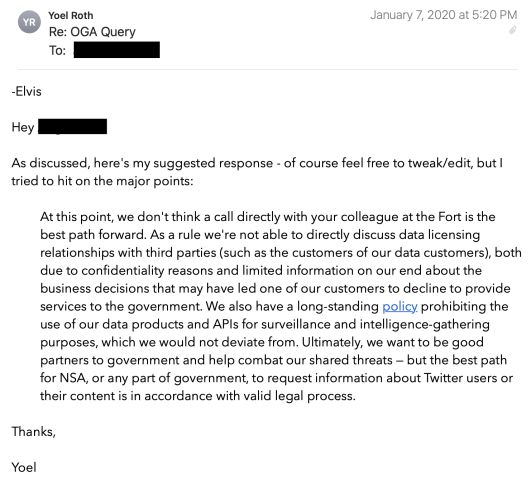
Indeed, even as presented (repeatedly) by Taibbi and Shellenberger as if it’s proof that Twitter closely cooperated with the FBI, over and over again if you read the actual screenshots, it shows Twitter (rightly!) pushing back on the FBI. Here, for example, Michael Shellenberger, shows Twitter’s Yoel Roth rejecting a request from the FBI to share information, saying they need to take the proper legal steps to request that info (depending on the situation, likely getting a judge to approve the request):
Now, we could have an interesting discussion (and I actually do think it’s an interesting discussion) about whether or not the government should be flagging accounts to review as terms of service violations. Right now, anyone can do this. You or I can go on Twitter and if we see something that we think violates a content policy, we can flag it for Twitter to review. Twitter than will review the content and determine whether or not it’s violative, and then decide what the remedy should be if it is.
That opens up an interesting question in general: should government officials and entities also be allowed to do the same type of flagging? Considering that anyone else can do it, and the company still reviews against its own terms of service and (importantly) feels free to reject those requests when they do not appear to violate the terms, I’m hard pressed to see the problem here on its own.
If there were evidence that there was some pressure, coercion, or compulsion for the company to comply with the government requests, that would be a different story. But, to date, there remains none (at least in the US).
As for the accounts that were flagged, from everything revealed to date in the Twitter Files, it mostly appears to be accounts that were telling a certain segment of the population (sometimes Republicans, sometimes Democrats) to vote on Wednesday, the day after Election Day, rather than Tuesday. Twitter had announced long before the election that any such tweets would violate policy. It does appear that a number of those tweets were meant as jokes, but as is the nature of content moderation, it’s difficult to tell what’s a joke from what’s not a joke, and quite frequently malicious actors will try to hide behind “but I was only joking…” when fighting back against an enforcement action. So, under that context, a flat “do not suggest people vote the day after Election Day” rule seems reasonable.
Given all that, to date, the only “evidence” that people can look at regarding “the FBI sent a list to censor” is that the FBI flagged (just as your or I could flag) accounts that were pretty clearly violating Twitter policies in a way that could undermine the US election, and left it entirely up to Twitter to decide what to do about it — and Twitter chose to listen to some requests and ignore others.
That doesn’t seem so bad in context, does it? It actually kinda seems like the sort of thing people would want the FBI to do to support election integrity.
But the payments!
So, there’s no evidence of censorship. But what about these payments? Well, that’s Musk’s hand-chosen reporters, Musk himself, and his fans totally misunderstanding some very basic stuff that any serious reporter with knowledge of the law would not mess up. Here’s Shellenberger’s tweet from yesterday that has spun up this new false argument:
That’s Shellenberger saying:
The FBI’s influence campaign may have been helped by the fact that it was paying Twitter millions of dollars for its staff time.
“I am happy to report we have collected $3,415,323 since October 2019!” reports an associate of Jim Baker in early 2021.
But this is a misreading/misunderstanding of how things work. This had nothing to do with any “influence campaign.” The law already says that if the FBI is legally requesting information for an investigation under a number of different legal authorities, the companies receiving those requests can be reimbursed for fulfilling them.
(a)Payment.—
Except as otherwise provided in subsection (c), a governmental entity obtaining the contents of communications, records, or other information under section 2702, 2703, or 2704 of this title shall pay to the person or entity assembling or providing such information a fee for reimbursement for such costs as are reasonably necessary and which have been directly incurred in searching for, assembling, reproducing, or otherwise providing such information. Such reimbursable costs shall include any costs due to necessary disruption of normal operations of any electronic communication service or remote computing service in which such information may be stored.
But note what this is limited to. These are investigatory requests for information, or so called 2703(d) requests, which require a court order.
Now, there are reasons to be concerned about the 2703(d) program. I mean, going back to 2013, when it was revealed that the 2703(d) program was abused as part of an interpretation of the Patriot Act to allow the DOJ/NSA to collect data secretly from companies, we’ve highlighted the many problems with the program.
So, by the way, did old Twitter. More than a decade ago, Twitter went to court to challenge the claim that a Twitter user had no standing to challenge a 2703(d) order. Unfortunately, Twitter lost and the feds are still allowed to use these orders (which, again, require a judge to sign off on them).
I do think it remains a scandal the way that 2703(d) orders work, and the inability of users to push back on them. But that is the law. And it has literally nothing whatsoever to do with “censorship” requests. It is entirely about investigations by the FBI into Twitter users based on evidence of a crime. If you want, you can read the DOJ’s own guidelines regarding what they can request under 2703(d).
Looking at that, you can see that if they can get a 2703(d) order (again, signed by a judge) they can seek to obtain subscriber info, transaction records, retrieved communications, and unretrieved communications stored for more than 180 days (in the past, we’ve long complained about the whole 180 days thing, but that’s another issue).
You know what’s not on that list? “Censoring people.” It’s just not a thing. The reimbursement that is talked about in that email is about complying with these information production orders that have been reviewed and signed by a judge.
It’s got nothing at all to do with “censorship demands.” And yet Musk and friends are going hog wild pushing this utter nonsense.
Meanwhile, Twitter’s own transparency report again already reveals data on these orders as part of its “data information requests” list, where it shows that in the latest period reported (second half of 2021) it received 2.3k requests specifying 11.3k accounts, and complied with 69% of the requests.
This was actually down a bit from 2020. But since the period the email covers is from 2019 through 2020, you can see that there were a fair number of information requests from the FBI:
Given all that, it looks like there were probably in the range of 8,000 requests for information, covering who knows how many accounts, that Twitter had to comply with. And so the $3 million reimbursement seems pretty reasonable, assuming you would need a decent sized skilled team to review the orders, collect the information, and respond appropriately.
If there’s any scandal at all, it remains the lack of more detailed transparency about the (d) orders, or the ability of companies like Twitter to have standing to challenge them on behalf of users. Also, there are reasonable arguments for why judges are too quick to approve (d) orders as valid under the 4th Amendment.
But literally none of that is “the FBI paid Twitter to censor people.”
Maybe, just maybe, before we rush to pass questionable new laws about “protecting children online,” we should look to make use of the old ones? The Children’s Online Privacy Protection Act (COPPA) has been in place for years, and it has problems, but so many companies ignore it. I’ve mentioned in the past how I once walked around a part of CES that had a bunch of startups focused on offering services to kids, and a DC lawyer I was with made sure to ask each one what their COPPA compliance strategy was… and we just got blank stares.
On Monday, video game giant Epic agreed to pay $520 million in two separate fines to the FTC for violating COPPA with some pretty deceptive behavior targeted at kids. First up were your garden variety privacy violations in collecting data on kids under 13 without obtaining parental consent:
Violated COPPA by Failing to Notify Parents, Obtain Consent: The FTC alleged that Epic was aware that many children were playing Fortnite—as shown through surveys of Fortnite users, the licensing and marketing of Fortnite toys and merchandise, player support and other company communications—and collected personal data from children without first obtaining parents’ verifiable consent. The company also required parents who requested that their children’s personal information be deleted to jump through unreasonable hoops, and sometimes failed to honor such requests.
Default settings harm children and teens: Epic’s settings enable live on-by-default text and voice communications for users. The FTC alleges that these default settings, along with Epic’s role in matching children and teens with strangers to play Fortnite together, harmed children and teens. Children and teens have been bullied, threatened, harassed, and exposed to dangerous and psychologically traumatizing issues such as suicide while on Fortnite.
As the FTC notes, Epic employees knew this was a problem, but the company didn’t fix things. In fact, when it finally did create an option to turn the voice chat off, “Epic made it difficult for users to find.”
Perhaps more concerning were the deceptive practices.
Used dark patterns to trick users into making purchases: The company has deployed a variety of dark patterns aimed at getting consumers of all ages to make unintended in-game purchases. Fortnite’s counterintuitive, inconsistent, and confusing button configuration led players to incur unwanted charges based on the press of a single button. For example, players could be charged while attempting to wake the game from sleep mode, while the game was in a loading screen, or by pressing an adjacent button while attempting simply to preview an item. These tactics led to hundreds of millions of dollars in unauthorized charges for consumers.
Charged account holders without authorization: Children and other users who play Fortnite can purchase in-game content such as cosmetics and battle passes using Fortnite’s V-Bucks. Up until 2018, Epic allowed children to purchase V-Bucks by simply pressing buttons without requiring any parental or card holder action or consent. Some parents complained that their children had racked up hundreds of dollars in charges before they realized Epic had charged their credit card without their consent. The FTC has brought similar claims against companies such as Amazon, Apple, and Google for billing consumers millions of dollars for in-app purchases made by children while playing mobile app games without obtaining their parents’ consent.
Blocked access to purchased content: The FTC alleged that Epic locked the accounts of customers who disputed unauthorized charges with their credit card companies. Consumers whose accounts have been locked lose access to all the content they have purchased, which can total thousands of dollars. Even when Epic agreed to unlock an account, consumers were warned that they could be banned for life if they disputed any future charges.
I generally dislike the term “dark patterns,” as it’s frequently used to basically just mean “making a service useful in a way that someone else dislikes.” But, uh, yeah, making it way too easy for kids to rack up huge bills on their parents’ credit cards? That seems super sketchy.
This all seems like the kind of thing that the FTC should be doing, rather than some of the other sillier things it’s been focused on of late. And, also, again, suggests that maybe we don’t need these new, badly drafted laws, but instead should just make sure the FTC is able to better enforce existing laws.
AIR NEO from AirSelfie is the easiest and most fun way to take stunning, high definition photos and videos from the air completely hands-free. It lets you focus on your fiercest pose, silliest dance, or trickiest stunt while it tracks your motion using AI to get the perfect shot which you can instantly post to social media from the AIR NEO app. The AIR NEO has various Auto-Fly modes that are so easy and so flawless it feels like magic when you toss AIR NEO into the air, watch it perform and fly back to you without a smartphone or controller connection. It’s on sale for $159.95.
Note: The Techdirt Deals Store is powered and curated by StackCommerce. A portion of all sales from Techdirt Deals helps support Techdirt. The products featured do not reflect endorsements by our editorial team.
Is this irony? It kind of seems like it is. Maybe it isn’t. It could just be a coincidence. An extremely unfortunate, ironic coincidence.
Whatever it is, it doesn’t look good for the FBI, which encouraged pretty much every private company to register as reporting entities so the FBI could (theoretically, it appears) respond to reported security threats.
InfraGard, a program run by the U.S. Federal Bureau of Investigation (FBI) to build cyber and physical threat information sharing partnerships with the private sector, this week saw its database of contact information on more than 80,000 members go up for sale on an English-language cybercrime forum. Meanwhile, the hackers responsible are communicating directly with members through the InfraGard portal online — using a new account under the assumed identity of a financial industry CEO that was vetted by the FBI itself.
Trust, but don’t even bother verifying, I guess. That’s how they — and by “they,” I mean the hacker referring to themselves as “USDoD” — get you. A portal for private companies to report threats has been compromised using nothing more than credentials that have likely been floating around the web (dark or otherwise) for some time now.
USDoD said they gained access to the FBI’s InfraGard system by applying for a new account using the name, Social Security Number, date of birth and other personal details of a chief executive officer at a company that was highly likely to be granted InfraGard membership.
The CEO in question — currently the head of a major U.S. financial corporation that has a direct impact on the creditworthiness of most Americans — told KrebsOnSecurity they were never contacted by the FBI seeking to vet an InfraGard application.
With access obtained, the breach began. USDoD “asked a friend” to create a script that would pull all available user data from the database, which apparently had no defensive methods in place to thwart the script, or any siloing in place to ensure one user’s approved access wouldn’t allow them to obtain other users’ information.
In an effort to increase collaboration between private sector contributors (if not the FBI itself, although there doesn’t appear to be any actual FBI data/communications included in the hacking haul), InfraGard acted as a quasi-social media hub to allow private companies to share info with each other. That connectivity apparently contributed to the easy exfiltration of data, albeit data of disputable value.
USDoD acknowledged that their $50,000 asking price for the InfraGard database may be a tad high, given that it is a fairly basic list of people who are already very security-conscious. Also, only about half of the user accounts contain an email address, and most of the other database fields — like Social Security Number and Date of Birth — are completely empty.
While the eventual sale of this data will put USDoD in the black, the ultimate end game may not be the easily-absconded-with user data. The hacker is taking full advantage of this impersonation to contact private sector participants in hopes of securing additional data and/or credentials usable for bigger and better data heists.
The FBI has responded to these reports with a no comment.
“This is an ongoing situation, and we are not able to provide any additional information at this time,” the FBI said in a written statement.
It’s a shame the FBI wasn’t aware of this before being contacted by people who don’t work for the FBI. If the agency wants the private sector to trust it with its threat reports and data, it needs to be ahead of things like this, rather than simply refusing to talk about incidents it should have been more proactive about.
But spending tax dollars on “cyber security furniture” only buys so much competence. While it’s essential private sector contributors are able to share information easily with each other, a breach like this will only encourage them to cut the FBI out of the loop. There are obviously more secure channels for communication about these issues. Allowing a hacker to make off with critical data suggests the FBI is not only failing to fully vet contributors to its cyber security marketplace of ideas, but failing to ensure the private companies it hires to provide solutions are capable of meeting the demands of the job.
Much like the company’s dedication to women, AT&T’s dedication to not funding people eager to overthrow democracy appears to be somewhere between inconsistent and nonexistent. And the company certainly isn’t alone.
Shortly after January 6 a number of companies, including telecom giants like AT&T, publicly crowed about how they’d be ceasing all funding to politicians who supported the attack on the Capitol and the overturning of, you know, democracy. Of course that promise was never worth all that much, given that the umbrella lobbying orgs companies like AT&T used never really stopped financing terrible people.
Initially, AT&T made a big stink about how it had suspended funding to all 147 Republicans who voted to overturn the 2020 election. But not only did AT&T not actually suspend funding via its numerous policy and lobbying tendrils, it didn’t even really ever stop funding insurrectionists directly.
A more recent breakdown of campaign financing by Bloomberg found several things. One, big telecom, which has largely been forgotten about during the myopic, multi-year DC policy fixation on “big tech,” was far and away among the biggest donors to insurrectionists and election conspiracy theorists:
Bloomberg found that companies like Comcast not only didn’t pause donations to election deniers long, they ramped up the funding of those candidates right before the midterms, as it was working tirelessly to keep the FCC mired permanently in partisan gridlock so it can’t do any of the things the public wants (restoring net neutrality, restoring media consolidation rules).
As is usually the case, Comcast didn’t much want to talk about why it throws money at people trying to destroy democracy:
By the end of the 2021, the Philadelphia-based cable giant had not only resumed giving to those candidates, but increased its contributions throughout 2022 to $365,500, becoming the second-biggest donor to election deniers among the tech and telecom firms. Comcast didn’t respond to a request for comment.
The mainstream press being, well, the mainstream press, Bloomberg chooses to inform its readers that telecom companies are lobbying radical anti-democracy insurrectionists and conspiracy theorists to “boost broadband rollout”:
Conversely, telecom companies and semiconductor makers want more government aid for programs to boost broadband rollout and domestic manufacturing. That requires developing relationships with newly empowered Republicans.
Most of the federal COVID and infrastructure broadband funding has already been assigned. And most of the dictating of who gets that money is being determined on the state level, not the federal. Bloomberg just somehow forgets to mention that AT&T and Comcast have been working tirelessly, arm in arm with the GOP, to keep the FCC mired in partisan gridlock in perpetuity.
All told, most of the claims by corporations that they’d be more discerning about their campaign financing in the wake of January 6 wound up being bullshit. And any interest in campaign finance reform in the wake of this giant middle finger to democracy appears similarly hollow.