Remember “DoNotPay”? They were the company, run by Joshua Browder, claiming to be the “world’s first robot lawyer.” There were all sorts of sketchy things going on, some of which dated back to “DoNotPay’s” earliest days. But things really came to a head last year when legal investigator extraordinaire, Kathryn Tewson, started digging in and finding an awful lot of questionable things going on.
In May of last year, we noted that the FTC had put out a notice which we interpreted as directly targeted at DoNotPay’s myriad false and misleading claims. It looks like we were right.
An FTC complaint claims U.K.-based DoNotPay told people its online subscription service acts as “the world’s first robot lawyer” and an “AI lawyer” by using a chatbot to prepare “ironclad” documents for the U.S. legal system. The complaint also says DoNotPay told small businesses its service could check their websites for law violations and help them avoid significant legal fees. In fact, according to the complaint, DoNotPay’s service didn’t live up to the hype. You’ll have 30 days to comment on a proposed settlement between FTC and DoNotPay, which requires DoNotPay to stop misleading people, pay $193,000, and tell certain subscribers about the case.
Respondent described the Service as “the world’s first robot lawyer” and an “AI lawyer” capable of performing legal services such as drafting “ironclad” demand letters, contracts, complaints for small claims court, challenging speeding tickets, and appealing parking tickets. Through a chatbot, subscribers would submit prompts or queries to an AI “robot lawyer” that purportedly operated like a human lawyer, including by applying the relevant laws to subscribers’ particular legal and factual situations; relying on legal expertise and knowledge to avoid potential complications, such as statutes of limitations, compensation limits, and jurisdiction, when generating legal demand letters or initiating cases in small claims court; and detecting legal violations on subscribers’ business websites and providing advice about how to fix them. In fact, the DoNotPay Service was not designed to operate like a human lawyer in these respects.
The complaint confirms basically everything that Tewson reported, and based on the timing of the investigation, it sure looks like the FTC was inspired by Tewson’s work.
They also point out that, beyond just misrepresenting the whole “AI lawyer” thing, Browder and DoNotPay inflated a user-generated comment on a site for kids that the LA Times ran as an LA Times review of the service. Really.
The donotpay.com website has prominently featured a quote that purports to come from The Los Angeles Times newspaper and states, “What this robot lawyer can do is astonishingly similar – if not more – to what human lawyers do.” Compl. Exh. F.
In fact, the foregoing quote derives from a high-schooler’s opinion piece in the Los Angeles Times’ High School Insider website, a user-generated content platform for young people.
I dunno, but it sure feels like Joshua Browder has a problem with being honest.
The complaint goes on to detail a whole bunch of claims DoNotPay made about legal services its system could offer, including suggesting it was specialized in legal expertise and could help you avoid having to hire a lawyer. But, the FTC notes:
DoNotPay did not test whether the Service’s law-related features operated like a human lawyer. DoNotPay has developed the Service based on technologies that included a natural language processing model for recognizing statistical relationships between words, chatbot software for conversing with users, and an Application Programming Interface (“API”) with OpenAI’s ChatGPT. None of the Service’s technologies has been trained on a comprehensive and current corpus of federal and state laws, regulations, and judicial decisions or on the application of those laws to fact patterns. DoNotPay employees have not tested the quality and accuracy of the legal documents and advice generated by most of the Service’s law-related features. DoNotPay has not employed attorneys and has not retained attorneys, let alone attorneys with the relevant legal expertise, to test the quality and accuracy of the Service’s law-related features.
That all seems a bit important? Maybe?
Then there’s the “diagnostic feature” that DoNotPay offered, where it said it would scan your business website and see if you violated any federal or state laws based on your email address. But, as the FTC notes:
DoNotPay’s website diagnostic tool did not, in fact, analyze a consumer’s small business website for hundreds of federal and state law violations based solely on an email address.
Also, apparently the State Bar of California had investigated DoNotPay in late 2021 and accused it of unauthorized practice of law. According to the complaint, Browder agreed to change their marketing behavior:
On or about January 21, 2022, the Chief Executive Officer for DoNotPay promised the California Bar that DoNotPay would no longer represent that the DoNotPay Service was the world’s first robot lawyer
Take a wild guess how that went?
Nevertheless, DoNotPay continued to make this representation.
On June 15, 2023, the California Bar sent a cease-and-desist notice alleging the DoNotPay Service amounted to engagement in the unauthorized practice of law. On the same day, Respondent affirmed that it had removed: a) all mentions of “robot lawyer” from the DoNotPay website and related social media; b) all products on the DoNotPay website that allowed consumers to generate legal documents; and c) any mention of “sue anyone” from the DoNotPay website. Notwithstanding these representations to the California Bar, the DoNotPay website and social media account continued to promote the Service as the “World’s First Robot Lawyer” and advertise “sue anyone” claims
Still, having to pay $193,000 seems like small potatoes for a company that has raised over $25 million from some big names like Andreessen Horowitz and DST Global (oh and convict Sam Bankman-Fried).
The company does have to alert a bunch of users to this settlement as well which might reasonably cause customers to think twice about doing business with such a problematic company.
But also, the settlement includes a consent order, which says DoNotPay cannot keep misrepresenting its products. And this is often how companies get into serious trouble with the FTC. First they do something bad and get a slap on the wrist that contains a consent decree. And then they violate the consent decree. At that point the FTC can come down on them hard.
Anyway, the company is no longer pitching itself as an AI robot lawyer, but rather your “AI consumer champion.”
Would you trust a company that just got rung up for lying to the public by the FTC about its AI capabilities to be your “AI consumer champion”? I wouldn’t.
We were already expecting a lawsuit to be filed against DoNotPay, the massively hyped up company that promises an “AI lawyer” despite all evidence suggesting it’s nothing of the sort. Investigator and paralegal (and Techdirt guest author and podcast guest) Kathryn Tewson had already filed for pre-action discovery in New York, in the expectation of filing a consumer rights case against the company.
However, some others have also jumped in, with a class action complaint being filed in state court in California (first covered by Courthouse News). The full complaint is worth reading.
Defendant DoNotPay claims to be the “world’s first robot lawyer” that can help people with a range of legal issues, from drafting powers of attorney, to creating divorce settlement agreements, or filing suit in small claims court.
Unfortunately for its customers, DoNotPay is not actually a robot, a lawyer, nor a law firm. DoNotPay does not have a law degree, is not barred in any jurisdiction, and is not supervised by any lawyer.
DoNotPay is merely a website with a repository of—unfortunately, substandard— legal documents that at best fills in a legal adlib based on information input by customers.
This is precisely why the practice of law is regulated in every state in the nation. Individuals seeking legal services most often do not fully understand the law or the implications of the legal documents or processes that they are looking to DoNotPay for help with.
The key claim is that DoNotPay is engaged in the unauthorized practice of law. And, of course, this is mostly on CEO/founder Joshua Browder and his greatly exaggerated marketing claims. Of course, when Tewson confronted him on this, he told her “the robot lawyer stuff is a controversial marketing term, but I would (sic) get to wound up over it.”
Yeah, but the thing is, people relying on you for legal services might (reasonably?) get “wound up over it” if the legal services they receive make life worse for themselves. The complaint highlights just how hard the company has leaned into these claims about being a “robot lawyer.”
Yeah, I’m going to have to say that this is probably not a good look if you’re then going to claim in court that your “robot lawyer” is not actually doing legal stuff. The complaint also anticipates Browder’s usual response to critics. As we’ve noted, he has a habit of insisting that it’s all nothing important, and it’s just “greedy lawyers” who are scared that he’s disrupting their business.
The complaint pre-buts that argument:
Not surprisingly, DoNotPay has been publicly called out for practicing law without a license—most recently in relation to a stunt in which it sought to actively represent a client in court using AI. In response, DoNotPay’s CEO deflects, blaming “greedy lawyers” for getting in the way….
Sadly, DoNotPay misses the point. Providing legal services to the public, without being a lawyer or even supervised by a lawyer is reckless and dangerous. And it has real world consequences for customers it hurts.
The complaint then highlights some of the problems users of DoNotPay have faced while relying on the service:
One customer, who posted an online review, used DoNotPay’s legal services to dispute two parking tickets. According to his account, his fines actually increased because DoNotPay failed to respond to the ticket summons. The customer then cancelled his account, but DoNotPay continued to charge a subscription fee.
DoNotPay’s service then reversed another customer’s arguments in her parking ticket dispute. Where she had intended to argue she was not at fault, DoNotPay’s services instead admitted fault, and the customer had to pay a resulting $114 fine.
Those are based on online reviews, but the complaint also details the named plaintiff in this case, Jonathan Faridian, and his experience:
Plaintiff Faridian believed he was purchasing legal documents and services that would be fit for use from a lawyer that was competent to provide them. Unfortunately, Faridian did not receive that.
The services DoNotPay provided to Faridian were not provided by a law firm, lawyer, or by a person supervised by a lawyer or firm.
The services DoNotPay provided Faridian were substandard and poorly done.
For example, the demand letters DoNotPay drafted for him, and which were to be delivered to the opposing party, never even made it to his intended recipient. Rather, the letters were ultimately returned undelivered to Faridian’s home. Upon opening one of the letters, Faridian found it to be an otherwise-blank piece of paper with his name printed on it. As a result of this delay, his claims may be time-barred.
Other documents Faridian purchased from DoNotPay were so poorly or inaccurately drafted that he could not even use them. For example, Faridian requested an agency agreement for an online marketing business he wished to start. Upon reviewing the agency agreement drafted by DoNotPay, he noted that the language did not seem to apply to his business. Even the names of relevant parties were printed inaccurately. Faridian was ultimately unable to use this document in his business project. In the end, Faridian would not have paid to use DoNotPay’s services had he known that DoNotPay was not actually a lawyer.
Yikes. Perhaps not a surprise after what Tewson had found, but, still. Sending a blank piece of paper with just his name on it, and not even delivering it properly?
DoNotPay gave Courthouse News a statement that seems typical of its responses to these kinds of allegations… once again attacking the lawyers.
“The named plaintiff has submitted dozens of cases and seen significant success with our products,” the company said. “The case is being filed by a lawyer that has personally made hundreds of millions from class actions, so it’s not surprising that he would accuse an AI of ‘unauthorized practice of law.’ Once we respond in court, this will be cleared up.”
It is true that Jay Edelson is a well known class action lawyer, who has somewhat famously sued a wide variety of Silicon Valley tech companies. I would argue that not all of his lawsuits are necessarily well targeted, but plenty of them are legit, and he’s generally not messing around when he sues. In other words, this may not be the kind of thing that Browder wouldn’t get “wound up over” but… he probably should.
Over the last few weeks, you may have noticed that the world’s most tenacious paralegal, Kathryn Tewson, has been carefully dismantling claim after claim after claim from the company DoNotPay and its CEO Joshua Browder. I won’t rehash all of her discoveries, but many of them called into question Browder’s apparent tendency to massively overstate what his company can do, even as he would then seek to quietly cover his tracks every time Tewson pointed out another bit of nonsense.
Browder made the incredibly unwise decision (he probably should have checked with a real lawyer rather than his fake AI lawyer) to appear on Bob Ambrogi’s always excellent podcast where he continued to just totally misrepresent a ton of things, some of which could get him into serious legal difficulty. As an aside, I saw some people claim that Ambrogi let Browder off easily each time he misrepresented things, but that wasn’t my impression at all. He kept bringing up more and more problems (sometimes citing us at Techdirt), and just let Browder hang himself with his own words. Words that I think he may come to regret.
I won’t go through the entire podcast, but I will note that Browder’s attack on Tewson is just blatantly false. He claims that DoNotPay delivered its first document to her, and then “the system” thought she was entering fake data, and therefore, for the next two filings she made, she got the notice she’d have to wait hours. Except… that’s not what happened. As anyone who read Kathryn’s article here knows, while Kathryn did request three documents, Browder got the order wrong. It was the first two that the company said would be delivered hours later. It was the third one that was delivered immediately (though it was terrible).
Also, Browder keeps insisting over and over again that Tewson is just mad because she was banned, except anyone following Tewson knows that’s false. She’s mad that Browder is misleading the public and selling a legal service that doesn’t do what it claims. He also keeps falsely saying that Tewson claimed that DoNotPay was really sending data off to “an army of people, typing out every letter manually.” He made that claim a few weeks ago too, but Tewson never said nor even implied that. Instead, she’s noted that the timing delays make it seem like DoNotPay is simply taking basic templates, a la LegalZoom, and having someone fill in the details from the submitted users, which would explain the delay. By exaggerating and misrepresenting Tewson’s claims, Browder gets to frame them as ridiculous, rather than addressing her real concerns.
Well, now he may have to address her real concerns. On Monday, Tewson filed a petition with the NY Supreme Court asking for an order for Browder and DoNotPay to preserve evidence, while also seeking pre-action discovery, as she plans to file a consumer rights suit, arguing that DoNotPay is fundamentally a fraud. The petition, written by J. Remy Green, is… worth reading. It’s quite impressive.
This action seeks pre-action discovery preliminary to a consumer rights suit over,
at its core, a $36 dollar fraud. Respondents appear to have lied to consumers and are pretending
to have cutting edge legal technology, all to scam them out of about $36 a person.
The petition lays out that DoNotPay is advertising a bunch of legal services that there is little indication it can actually provide, and calls out the similarities to Theranos.
This episode smacks of nothing so much as the Theranos fraud.
Theranos, like DoNotPay, was built on a noble idea. It was designed to cut
through medical testing using cutting edge technology. Theranos was built on the claim it had a
unique technology for blood testing that made it cheaper, more accessible, and less painful for
patients. It drew investments from across the ideological spectrum and was valued at over $10
Billion at its peak.
But Theranos never actually had that technology.
Instead, once cornered and forced to deliver a product, Theranos dressed up an
existing Seimens testing machine and ran it using too little blood for valid results.
So too here: By all appearances, Respondents are dressing up an old-fashioned
document wizard and calling it a “Robot Lawyer.” Certainly that’s what Respondents did with
the one document Petitioner was able to get before Mr. Browder personally began re-writing the
DoNotPay terms of service to basically say “TELL NOTHING TO KATHRYN TEWSON, SHE
IS BANNED FOR LIFE.”
The petition notes that it’s seeking pre-action discovery so that the upcoming suit is more accurate, and allowing Browder to show at least some evidence as to whether or not DoNotPay actually uses any AI at all.
Before bringing a consumer class action alleging this is all a house of cards, while
Petitioner believes she is able to plausibly allege the fraud, Petitioner would like to be able to
allege the details with specificity. And she would like to give Respondents a chance to show that
at least somewhere in their start up, something was running on Artificial Intelligence.
Much of the petition is basically a rewriting of the article Tewson wrote for us and various Twitter threads she’s posted on the subject.
There is some amusement in the filing, mainly in the footnotes. In one message that Browder sent to Tewson, published in the petition, Browder claims the evidence that Tewson is using his platform for inauthentic reasons is that she made up the name “James Joyce.”
In relation to the authentic usage, I messaged you on the 24th to tell you that and
reactivated your account but you should keep it real to stop our systems flagging
you. Who is James Joyce? You are clearly operating in bad faith by creating fake
names and “generating a TON of” (your words) of fake cases.
In the Ambrogi interview, Browder also calls Joyce a “fictional” character. James Joyce was a real person. He wrote fictional characters, but he, himself, is not fictional. In one of the footnotes, this aside is called out: “While not legally actionable, later statements demonstrate the literary offense that Mr. Browder genuinely appears not to know who James Joyce is.”
But the really fun footnote is towards the end, where Tewson notes that she consents to Browder using his robot lawyer to defend himself in this case, and practically dares him to do so:
For what it is worth, Petitioner does and will consent to any application Respondents make to use their “Robot
Lawyer” in these proceedings. And she submits that a failure to make such an application should weigh heavily in
the Court’s evaluation of whether DoNotPay actually has such a product.
So, perhaps Browder finally will get to test his robot lawyer in court after all…
We’ve written a few stories lately about DoNotPay, the “robot lawyer” service whose gimmick of an automated AI-driven tool that would help users deal with challenges like getting out of parking tickets or cancelling subscription services that are difficult to get out of sounds like a really enticing idea. But there have long been questions about the service. While we’ve seen a bunch of truly impressive AI-generation tools in the last year or so, for years many companies claiming to offer AI-powered services often seemed to be doing little more than finding someone to hack together a complicated spreadsheet that the marketing folks would labels as “artificial intelligence.” It’s unclear how sophisticated DoNotPay’s technology actually is, though as guest poster Kathryn Tewson discovered last week, it sure seemed sketchy.
Kathryn, a paralegal with a preternatural skill at dismantling legal bullshit from people who pretend to understand the ins and outs of the law, sought to test the service’s ability to craft legal documents, and found that the whole thing raised a lot more questions than it answered with weird, potentially problematic language, questionable promises, and just the fact that out of multiple tries, the only document she actually received appeared to be produced by little more than legal madlibs, filling in a template. Furthermore, with the more “sophisticated” documents she requested, she was told they would take hours to send over, which seems strange for a robot lawyer. Of course, as her writeup got more attention, rather than deliver those documents, DoNotPay’s CEO, Joshua Browder, announced that he was shutting down these more sophisticated legal offerings, claiming that they were a “distraction.”
He claimed that he did this after various state bars suggested that his marketing stunt to have a lawyer argue in court while his “AI” whispered into the lawyer’s ear via an AirPod might result in him going to jail. Browder then made the rounds in the press implying that the criticism was from lawyers who were worried DoNotPay was going to cut into their business. In that interview he claims the pushback on his nonsense publicity stunts was “from lawyers,” but that because “there’s not a lawyer who will get out of bed for a $500 refund,” the company will instead focus on that area of business “so that they don’t come after us…”
But, the concerns from Kathryn and others are not about it cutting into the legal profession. I mean, personally, I’d love to see technology disrupt the legal business. It’s a business that could use quite a lot of disruption. The problem is that Browder’s propensity for publicity stunts means it often appears he’s vastly exaggerating what his company can do, and that’s a real concern when he’s advertising it for people involved in serious legal matters, like trying to navigate the immigration system (which, yes, was another offering from the company, which generated a lot of publicity but raised serious concerns from actual lawyers about what could go wrong).
Over the last few days, however, Kathryn keeps turning up more and more questionable behavior by Browder that is making him look like a naive, inexperienced kid pretending to run a serious company, rather than the CEO of a sophisticated “robot lawyer” company that has raised millions of dollars from sophisticated investors (and Sam Bankman-Fried).
Last week, for example, she found that almost immediately after a conversation with her in which she noted that she had not violated the company’s terms of service in running her test documents, DoNotPay’s terms of service were changed to say you were no longer allowed to create “test” documents that were not part of an authentic dispute. That was both oddly specific, and oddly… stupid. Who would ever want to use a Robot Lawyer you couldn’t first test to make sure it works well?
Over the weekend, things got even dumber. Kathryn noticed an earlier publicity stunt from Browder (who seems to spend more time thinking up dumb publicity stunts than making sure his robot lawyer actually works). He had promised to buy up medical debt for every retweet or follow of one of his tweets.
For what it’s worth, it appears he just deleted this tweet, and the rest of this article may explain why. First off, we should note that he’s correct: medical debt is a scourge. We’ve discussed how medical billing is a complete economic scam. For a variety of reasons, the US healthcare space is simply designed to siphon away every penny someone has by the time they die (sometimes hastened by that same medical system). It’s… not great. So, hey, I appreciate efforts to forgive medical debt (though I’d appreciate efforts to fix the underlying system more).
But Kathryn noticed that despite the promise to “post receipts” there were no such receipts published:
After discussing the related issue of how medical debt is often sold for pennies on the dollar, meaning that he could appear to be a lot more generous than he was in reality, Browder jumped into the conversation to claim that he absolutely did make the donation in question for $500, which he later claimed bought up $50,000 worth of debt.
In that (also since deleted!) tweet, Browder presents a receipt from the non-profit RIP Medical Debt (which was created for this kind of purchase-and-forgiveness of medical debt), showing that he paid $500, allegedly on December 2nd of last year.
But (again, never try lying to Kathryn, who seems to be the living embodiment of Natasha Lyonne’s character in Poker Face), Kathryn noticed that something was a little odd in the receipt: while the font of the dates matched the font of the rest of the notice, they did not line up properly in the image, suggesting that he might have photoshopped the date. In an amazing bit of sleuthing, Kathryn highlighted how the dates were posted a little below the line where they should be. It’s something you could really only see if you inserted guidelines and zoomed in close:
She then purchased some debt herself just to see how the email receipt shows up, and found that on her own donation, the dates lined up perfectly with the guidelines:
At the very least, it’s pretty strong circumstantial evidence that the dates on Browder’s screenshots were faked.
But then Kathryn took it up on a notch. She reached out to RIP Medical Debt and asked about Browder’s donation. RIP Medical Debt confirmed to her that Browder’s donation was not made on December 2nd, but rather it was made on January 29th, at 12:36 am EST (Kathryn shared the email with me so I can confirm RIP Medical Debt’s statement on this). 12:36 am EST was exactly four minutes after Kathryn originally tweeted her concern as to whether or not Browder ever actually did buy up the debt he promised.
Four minutes.
He posted the screenshot 17 minutes later (which would be enough time to sloppily edit the receipt to change the date).
Browder (who appears to have then gone back and deleted all of the tweets mentioned in this article) did complain about how people were “criticizing a donation.” Except no one is criticizing the donation. The donation is great. Make more of them, Josh.
What Kathryn was criticizing was how you used the claim of paying off medical debt as a publicity stunt when it was unclear that you had actually followed through and which, it now seems clear, you only followed through on months afterwards, and four minutes after Kathryn called it out. And then it appears that you fudged the date to hide that fact. Also, the fact that since you can buy medical debt for pennies on the dollar, you can appear to be way more generous than you were actually being, especially since your original tweet did not promise to pay $10 for each retweet or follow, which would have been more significant.
This would appear to be extremely questionable behavior, and not the kind of behavior that makes one say “yes, I’m going to trust this company to help me resolve legal disputes.”
Perhaps Browder’s next project should be building the “world’s first AI CEO” to replace himself. At this point, I’m not sure it could be much worse or less trustworthy than the human currently in that position. Or, hell, maybe he should ask his “AI lawyer” what it thinks of all this. I decided to ask ChatGPT what it thinks and got a pretty good answer:
And modifying a date to make it appear that you did the thing you promised is also not a good look according to ChatGPT:
Not bad, ChatGPT. Not bad at all.
Again, I wish that DoNotPay actually could do much of what it claims to do. It sounds like it could be a really useful service, one that we would actually like to see more widely implemented. But the antics and shenanigans over the last few months should raise serious concerns about why anyone would trust the company with literally anything. Browder’s seeming unwillingness to be truthful in his discussions on all of these things does not bode well.
Well, a lot has happened since I first started looking into the “World’s First Robot Lawyer,” from DoNotPay. First, Joshua Browder, DoNotPay’s CEO, reached out to me via direct message (DM) and told me he would get me access to my documents by 2 PM the next day – Tuesday, January 24th – saying that the delay was caused by my account being locked for “inauthentic activity,” a term he did not explain or define. Then, Josh claimed he was going to pull out of the industry entirely, canceling his courtroom stunt and saying he would disable all the legal tools on DoNotPay.com. He said he was doing it because it was a distraction, but the fact that he cited exactly the same two documents that I was waiting to receive seemed like a hell of a coincidence.
But plus ça change, plus c’est la même fucking chose, as the poet says. Here’s what hasn’t changed: I still don’t have my documents, and Josh still hasn’t answered the questions I asked him like he said I would.
In his direct message, Josh said he would be willing to answer any questions I asked in good faith. I took him at his word, and responded to the email he sent me announcing his pullout with the following four questions:
Were humans involved in the generation of any client documents described by anything under your “Legal Tools” section? I don’t mean the creation of the templates, etc., I mean in the production of a document based on client responses to prompts.
Are the articles in the “Learn” section of your website written by ChatGPT or equivalent, or by humans?
Who signed the subpoena for the officer in the traffic case that was referenced in your now-deleted tweet?
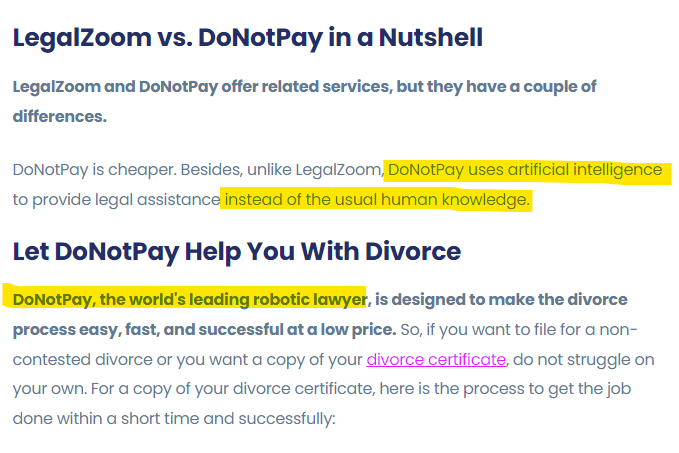
I asked all these questions in good faith, and for good reasons. Josh represents — over and over and over and over again — that DoNotPay features a robot lawyer with artificial intelligence, going so far as to say that it uses AI instead of “human knowledge.” The sole document I got was one that didn’t make any kind of promise of customization or that it would contain “the most” relevant legislation for anything; the ones that did require that kind of analysis were the ones that got hung up in multi-hour deadlines and never ultimately delivered. Given how much weight he puts on these claims, I think it’s fair to interrogate and test them.
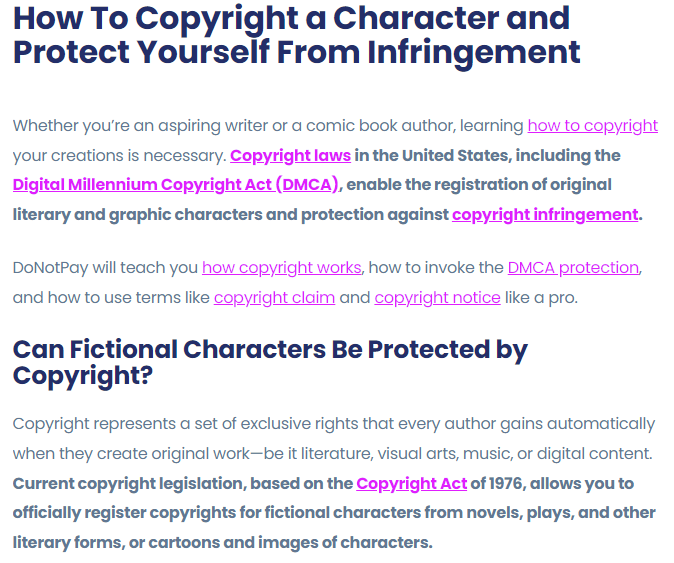
The articles, or “blog posts” as Josh calls them, are a slightly different situation. There are a TON of them, and they are all published without dates or bylines. But many of those articles have significant errors, both legal and factual, and if someone relied upon them, they could be in big trouble. And while I didn’t actually expect him to answer the question about the subpoena, he opened the door by bragging about it in the first place, as far as I’m concerned.
(Only two sentences in this screenshot above are completely accurate. I’m not going to represent to you which two they are, because I am not a lawyer.)
This email, to my great disappointment, went completely ignored.
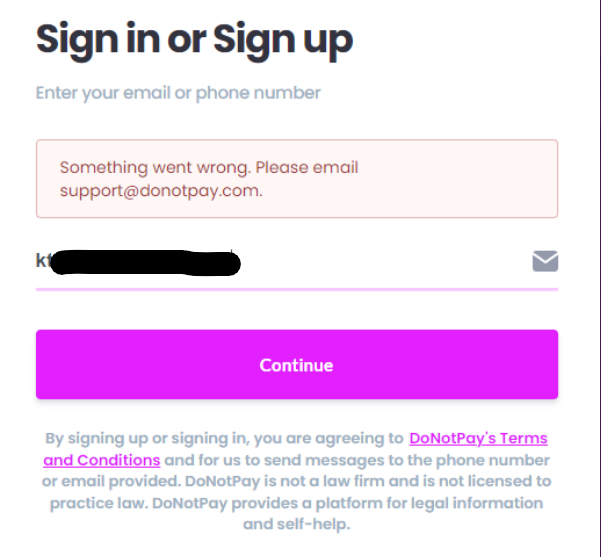
It wasn’t because he was too busy taking down all his bots, either. On Thursday night, I logged back into the site to check, and discovered that all the prompts I had accessed before were still available, save the two that Josh mentioned specifically in his tweet — the defamation demand letter and the divorce settlement. But even those were still being advertised; every “blog post” on the site has a signup teaser in it advertising access to the site’s legal and other services with no sign that they’re inaccessible until after DoNotPay has your money. One particularly egregious blog post that advertised “free legal advice” to those looking for help navigating the immigration process to become American citizens finally pushed me over the edge, and so I pinged Josh to remind him that I was still waiting for my documents and an answer to my questions, let that sit for a bit, and then started another thread about all the ways he was being less than forthright with the truth. In the course of writing that thread, I discovered that I was suddenly banned from the site; not only could I not log in, but any attempts to do so gave me an error message that read merely “something went wrong.”
It took Josh less than an hour to get back to me via DM, informing me that my money had been completely refunded and complaining that I was lying about the “bots” still being up, although he later admitted that only 7 bots had come down in the previous 36 hours (out of an advertised 1,000):
When I told him I had tested them myself and even generated new documents and cases, he demanded “Was your usage authentic?” I responded “It certainly complied with every provision of the Terms of Service.” At this point, Josh disappeared from the conversation.
After this pause had stretched out for a while, something was kind of nagging at me. I went back and looked at that question and answer again and thought “what is it about the Terms of Service that suddenly had him needing to leave immediately?”
By sheer coincidence, someone — not me (at least I don’t think so) — had archived the DoNotPay Terms of Service just about exactly when I started tweeting my thread, so I know exactly what they said then.
It also meant that I could spot exactly what had changed between that time and this one, a mere two hours later: Josh added a clause to the TOS prohibiting users from testing the website prior to using it in a live dispute.
If you can’t see that, right after I told him I was not violating his terms, he appeared to add this to his terms:
You represent that any dispute or request submitted is an authentic problem you are having. You are responsible for any damages to DoNotPay or others from fake, inauthentic or test disputes.
So now “test” disputes violate the terms?
This change was made after he banned me, without any warning. He claims he told me to “keep it real,” but he absolutely did not, and his claim that I “triggered his anti-spam” by making 10 or 15 new cases seems to run against his site’s promises that one can create an “unlimited number of documents.”
He didn’t answer my questions outside of saying “no the letters aren’t being hand typed out and no we didn’t write them,” which… didn’t answer my questions in the slightest. And then he blocked me.
So there you go. Joshua Browder, CEO of DoNotPay.com, would rather block me, ban my account, retcon his terms of service to disallow any test usage at all, and claim to pull out of the “Legal Services” industry that his site is PLASTERED with branding for, rather than show me the two documents I generated and tried to buy.
So, we’ve written a few times about DoNotPay, the supposedly AI-powered “robot lawyer” that was initially designed to help you contest parking tickets but then expanded to helping (usefully) with a bunch of consumer annoyances, like cancelling accounts, obtaining owed refunds, and the like. But it’s also got some shadiness in its past, like the time it wanted to automate sharing of streaming account credential cookies. And, while there have long been pretty serious questions about what things you should trust it to do, a couple years ago the company raised a round of venture capital from such trustworthy investors as (checks notes) Sam Bankman-Fried, along with a16z, and DST Global, which has a bit of an interesting history.
Anyway, since then it has ramped up some of its attempts to generate publicity via very questionable stunts. Earlier this month it announced that its “AI lawyer” would represent clients in traffic court via an earbud, and then went even further by promising a very publicity-stuntalicious $1 million to any lawyer who would use its AI lawyer via an earbud to argue in front of the Supreme Court. Leaving aside that such tech isn’t allowed in the Supreme Court, at one point CEO Josh Browder said that they would effectively abuse the rules the court has in place for making courts “accessible” to get the ear buds in. Which is, really not great.
All of these publicity stunts brought with them some scrutiny. And, as we posted this week, Kathryn Tewson (who is one of the most astute legal commentators out there) decided to test out many of its “legal” services. She found them extremely lacking. And maybe that’s fine in low stakes situations like parking tickets or consumer refunds and complaints. But it could do real harm to people relying on the service for larger things. Personally, the fact that it seemed to be encouraging people to make questionable defamation threats seemed pretty problematic to me.
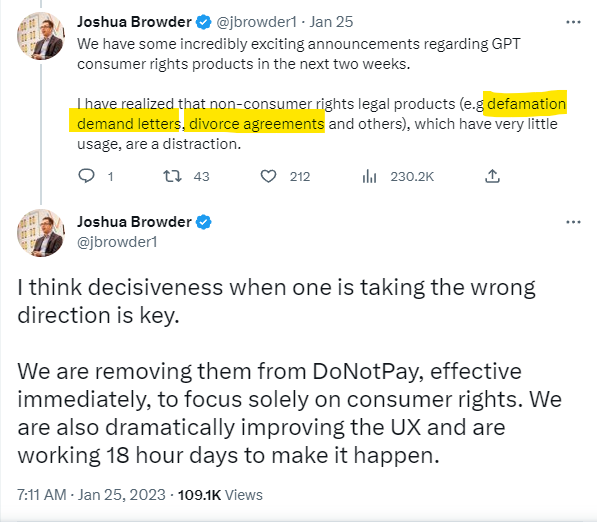
On Wednesday morning, Browder announced that the company was (1) ditching the plans to be used in court and (2) stepping back from some of those more harrowing legal jobs (coincidentally, the very ones that Kathryn had tested out). Of course, rather than admit that the company shouldn’t be doing those things and was not qualified to be doing them, Browder did the techbro equivalent of claiming that it was all a “distraction” with very little usage. Oh, and also, that state bars were threatening him with potential jail time for the courtroom antics:
I guess Browder didn’t trust his AI lawyer whispering in his AirPods to keep him out of jail for the unauthorized practice of law. And if he’s unwilling to eat his own dogfood that way, perhaps he shouldn’t be offering it to other people.
The “distraction” claim is not all that believable, honestly:
If they were a distraction, they were a self-created distraction, in which Browder used all this to generate publicity for his not-ready-for-prime-time “legal” services that people with real problems might have otherwise come to rely on.
I actually do think that there is some interesting ideas in the underlying concept behind this company. Using smarter tools to help automate the horrible processes that large companies and governments put people through to get them to give up and not exercise their rights is a good idea. But it feels like someone should sit Browder down and explain to him the value of actually delivering a good and useful product over hyping up something that can’t do what it promises.
Last year, 19-year-old UK student Josh Browder released a chatbot called “DoNotPay” that assisted drivers in challenging parking tickets. It was a small program with a huge upside. The bot’s legal guidance — in the form of yes/no questions — resulted in more than $4 million in tickets being dismissed.
Chatbots are no replacement for lawyers, but almost no one seeks legal help when dealing with parking tickets. That’s probably why law/traffic enforcement agencies feel comfortable issuing so many bogus ones. DoNotPay not only saved UK residents millions of dollars, it also proved the ticketing system was fundamentally broken. More than 64% of the 250,000 tickets challenged were overturned.
Browder was hoping to apply his chatbot AI to other legal issues — narrowly-focused areas where legal help might be appreciated, but without the chance of severely screwing up someone’s life if the chatbot led someone down the wrong path.
Browder’s next challenge for the AI lawyer is helping people with flight delay compensation, as well as helping the HIV positive understand their rights and acting as a guide for refugees navigating foreign legal systems.
It’s the last one on the list receiving attention this year. Immigration law is an incredibly-dense legal thicket where wrong moves can mean finding yourself stranded in a country that doesn’t want you or forcibly returned to the country you’ve been trying to leave. Brower’s chatbot — running through Facebook messenger this time — isn’t going to put immigrants in awkward positions, though. Instead, it’s much more in line with DoNotPay: something that provides helpful assistance to make an often-confusing experience easier to tackle, but without the potential downside of someone wishing they’d spoken to an actual lawyer instead.
The chatbot works by asking the user a series of questions, in order to determine which application the refugee needs to fill out and whether a refugee is eligible for asylum protection under international law.
After this, it takes down the necessary details required for the appropriate asylum application – an I-589 for the United States or a Canadian Asylum Application for Canada. Those in the UK are told they need to apply in person, and the bot helps fill out an ASF1 form for asylum support.
If the program fails, nothing is made worse. The person seeking asylum is still stuck in the country they’re trying to leave, but they’re not sitting in a customs holding cell awaiting deportation. (At least, one hopes not. The best case scenario would be to apply for asylum before arriving, rather than after.)
Browder is also doing everything he can to protect users. The information obtained to autofill applications is only stored long enough to be transferred and deleted within 10 minutes of the app’s use. The chatbot can also put users in touch with legal representation if requested.
This bot’s success will be much more difficult to enumerate, but it’s building on Browder’s past successes. Since the debut of DoNotPay, Browder’s legal assistance bots have helped UK citizens obtain reimbursement for delayed planes/trains and helped homeless individuals seek emergency housing.
In what is likely a sign of the coming government-rent-seeking apocalypse, a 19-year-old Stanford student from the UK has created a bot that assists users in challenging parking tickets. The inevitable result of parking nearly anywhere can now be handled with something other than a) meekly paying the fine or b) throwing them away until a bench warrant is issued.
In the 21 months since the free service was launched in London and now New York, Browder says DoNotPay has taken on 250,000 cases and won 160,000, giving it a success rate of 64% appealing over $4m of parking tickets.
Fighting parking tickets is a good place to start, considering most people aren’t looking to retain representation when faced with questionable tickets. The route to a successful challenge isn’t always straightforward, so it’s obviously beneficial to have some guidance in this area — especially guidance that can determine from a set of pre-generated questions where the flaw in the issued ticket might lie.
Anyone looking for an expansion of chatbots into trickier areas of criminal law are probably going to need to rein in their enthusiasm. There’s not much at stake individually in challenging a traffic ticket. The 36% who haven’t seen a successful appeal are no worse off than they were in the first place. But it’s still better than simply assuming that paying the fine is the only option, especially when the ticket appears to be bogus.
Browder has plans for similar bot-based legal guidance in the future.
Browder’s next challenge for the AI lawyer is helping people with flight delay compensation, as well as helping the HIV positive understand their rights and acting as a guide for refugees navigating foreign legal systems.
The fight against airlines should prove interesting. Generally speaking, most airlines aren’t willing to exchange their money for people’s time, especially when the situation creating the delay is out of their hands — which seems to be every situation, whether it’s a snowstorm or a passenger confusing math with terrorism. But, if it proves as successful as Browder’s first AI assistant, more grumbling from those whose business model has just been interfered with is on the way.