As we’ve discussed widely, the entire premise of various link tax bills has never made sense. They’re pushed by the media and politicians insisting that Google and Facebook are unfairly “profiting” off of their news. Except that’s never made any sense at all to anyone who looked at the situation carefully.
First of all, links to news has never been particularly important to either Google or Facebook. It’s always been a small part of what they do, and almost always not a key part of monetizing anything, but just as an extra feature (Google, famously, barely monetizes Google News at all).
Second, as we just discussed on our recent podcast, in the pre-internet era, the largest expense for newspapers was printing and distribution, and the internet basically removed the vast majority of those expenses, and gave them a system to do both for basically nothing.
Third, Google and Facebook were then sending traffic to these news sites for free. And we know that the news sites valued that free traffic, because if they didn’t they (1) could easily block it, and (2) wouldn’t hire SEO and social media experts to help try to get more such traffic. Indeed, there was tremendous empirical evidence suggesting that the news orgs got way more benefit from Facebook and Google sending them traffic than either Facebook or Google got from having links to news on their platform.
And, now, with Canada’s C-18, we’re seeing even more evidence making this point. As you’ll recall, C-18 is Canada’s version of a link tax that was signed into law earlier this year, and which will go into effect soon. However, both Meta and Google have said that they will respond to this by blocking links to news in Canada, and Meta has already done so.
And while Canadian media orgs and politicians completely lost their shit about this, effectively claiming that Meta linking to news sites is “theft” and not linking to news sites is corrupt, you’d think that maybe someone in the Canadian government would realize just how bad all this looks.
The latest is that, once again, the actual market is showing that the news orgs appear to need Facebook and Google way more than Facebook or Google need news. First there was a report showing that the lack of news links in Canada did literally nothing to Facebook’s traffic.
Daily active users of Facebook and time spent on the app in Canada have stayed roughly unchanged since parent company Meta started blocking news there at the start of August, according to data shared by Similarweb, a digital analytics company that tracks traffic on websites and apps, at Reuters’ request.
Another analytics firm, Data.ai, likewise told Reuters that its data was not showing any meaningful change to usage of the platform in Canada in August.
So, all this talk about how Facebook needed news to keep users on the site… the reality is that, no, they did not.
Of course, if we check in on the other side of the equation, we see that maybe the news orgs actually kinda relied on that traffic more than Facebook did. There was a CNN report claiming a “dramatic drop” in traffic from Meta to news orgs, but that’s to be expected, given it was going from whatever it was to basically zero. The question is how much of their traffic does that represent.
A quick look around at Canadian news orgs suggests that (unlike Facebook’s traffic), the traffic to news orgs in Canada has mostly (though not entirely) declined since the block went into effect in early August. The Toronto Star showed a decline in visitors from July to August of 1.6 million visits, according to Similarweb. The NationalPost was down about 300k visits. The TorontoSun was down about 500k visits. CTV News also lost about 500k visits.
Of course, not all news orgs saw their traffic decline. Two of the biggest actually saw a bump up in traffic: CBC.ca and the Globe and Mail both saw their traffic jump up a bit, perhaps because as Canadians look for other sources for news, they were more likely to go directly to two of the most well known news sites for Canadians.
Along those lines, another report, this time from Insider, notes that those Canadian news orgs with apps saw app usage increase in August:
Yet, because of the loss of access on Facebook and Instagram, several major news outlets in Canada are seeing an uptick in downloads and usage of their own apps, according to an analysis from Apptopia. The apps of CTV, and Globe and Mail, as well as French language outlet La Presse, saw thousands more downloads in August compared to July, when content was still available on Meta’s platforms.
The Globe and Mail in August saw a 98% increase in app downloads and a 27% increase in daily users; CTV News saw a 157% increase in app downloads and an 83% increase in daily usage; La Presse saw a 32% increase in app downloads and an 8% increase in usage; and The National Post’s downloads were up almost 10%, with daily usage up 3%. Meanwhile, CBC News saw downloads and daily usage remain relatively flat.
All in all, it looks like maybe it doesn’t much matter if Meta doesn’t link to news sites. Of course, you can argue this is a good result for basically everyone involved: getting rid of news doesn’t harm Facebook, and the media get more direct traffic. Though, of course, if you listen to Canadian politicians you’d think it was the end of the world. PM Justin Trudeau acted as if this is all about “corporate profits,” but that literally makes no sense.
Again, as everyone tried to explain to Canadian politicians from the beginning, none of this makes sense. It requires paying for something that should never be paid for, so it’s entirely reasonable to just stop hosting news links. It’s not about “corporate profits,” it’s about recognizing the problems of paying for links fundamentally.
Either way, though, the early results suggest that Facebook made the right decision here, while the Canadian government looks extremely foolish.
This is just so painfully obnoxious. The legacy news media, spurred on by a welfare system that pretend free market supporter Rupert Murdoch dreamed up and convinced governments to implement, whereby the government would force internet companies, which had innovated and created new business models that worked, to suddenly be required to pay for sending traffic to legacy news media organizations which failed to innovate. It’s extreme corporate welfare, egged on by a guy who pretends to be against all kinds of welfare.
Canada is the latest country that was convinced to go down this very stupid route, and even as everyone explained (repeatedly) to the Canadian government how this would flop, they still went forward with it. In response Meta and Google (the two targets the Canadian government were trying to extort with this new law) announced that they would no longer allow any news links in Canada. Meta has already begun phasing out links to news in Canada.
The legacy media, which promoted this without the slightest bit of critical analysis (after all they were going to get paid, so why spend any time exploring the downside to such a tax?) is now losing its remaining braincells over this. A bunch of legacy Canadian media orgs are demanding a regulatory investigation of Meta over this move.
CBC/Radio-Canada has joined other news publishers and broadcasters in requesting that Canada’s Competition Bureau investigate Meta’s decision to block news content on its digital platforms in Canada, describing the social media giant’s decision as “anticompetitive.”
Let’s just review this more clearly for the slow folks who work in Canadian media (and the Canadian government):
Media whines that Meta and Google are unfair, because they’re making money on the internet while the media is not. They often claim that Google and Meta are “stealing” from them when all they’ve actually done is provide a better vehicle for advertisers.
In particular, the media complains that these companies are “making money from our content,” never once considering that news is a very, very, very tiny part of both Meta and Google’s business (Google doesn’t even try to monetize it in much of the world), and the thing that both companies do is PROVIDE LINKS TO THOSE MEDIA ORGS. These are the same orgs that, I guarantee you, have people on staff whose job it is to try to get more traffic. And here, Google and Meta are giving them a ton of traffic for free and the media orgs are somehow complaining that all that traffic is unfair.
They convince politicians to pass a law requiring the big internet companies to pay for links, even though that goes against the fundamental concept of an open web. If these media orgs don’t want traffic from Google or Meta, they can easily block it. The problem is that they want that traffic AND they want to get paid for it, which has the whole equation backwards.
The law that they demanded gets passed and Meta and Google start blocking links exactly as they promised they would do, and which makes perfect economic sense as the money they’d have to pay far outweighs the value of posting news links.
The legacy media orgs… whine that this is anticompetitive.
So… according to these media orgs, Meta and Google linking to news is anticompetitive. But also not linking to news is anticompetitive.
Of course, when you put it that way, you realize this has fuck all to do with links or competition. It’s just straight up corruption. Meta and Google have large bank accounts. The media orgs have smaller bank accounts. The only fair thing, according to these legacy media orgs, is that Meta and Google should be forced to give them money. I mean, this is just pathetic:
“Meta’s practices are clearly designed to discipline Canadian news companies, prevent them from participating in and accessing the advertising market, and significantly reduce their visibility to Canadians on social media channels,” the CBC said in a joint statement with the Canadian Association of Broadcasters and News Media Canada, a trade organization that represents newspapers.
“Meta’s anticompetitive conduct, which has attracted the attention of regulators around the world, will strengthen its already dominant position in advertising and social media distribution and harm Canadian journalism,” the statement read.
“The applicants ask the Competition Bureau to use its investigative and prosecutorial tools to protect competition and prohibit Meta from continuing to block Canadians’ access to news content.”
So, linking to them in the first place was anticompetitive because it helped Meta get more advertising, and now not linking to them is anticompetitive because it helps Meta get more advertising, and holy shit how does anyone take these media orgs seriously any more?
Canadian politicians supporting this nonsense sound even worse:
“Facebook … would rather block their users from accessing good quality and local news instead of paying their fair share to news organizations,” Canadian Heritage Minister Pascale St-Onge said in a statement Tuesday.
Again this is so out of touch that Canada should feel embarrassed that it has an elected official this clueless. The “fair share” to pay to send someone free traffic is zero. Zilch. Nada. There is no world in which anyone should ever have to pay to send someone free traffic on the internet. When you charge for such nonsense the only logical business move is to block all such links.
It’s got nothing to do with competition at all. It has to do with greedy media owners who are looking for a handout from the government, by asking them to tax internet companies on the media orgs’ behalf.
Let’s start from the basics here: if you tax something, you will get less of it. That’s how taxes work. If you want less of something, you add a tax to it. In Canada, some very, very clueless politicians (pushed by the news media) passed a tax on Facebook and Google linking to news. Both companies have long made it clear that news is not a revenue driver for either company, so Canada’s decision to make it more expensive basically priced both companies out of the market, and both have announced a discontinuation of links to news for Canadian users.
Meta began removing links to news at the beginning of this month, and people are already realizing how messed up things are when you can’t link. Up in Canada’s Northwest Territories, there are wildfires happening, and people were relying on social media to share news… but they can’t do that any more.
Like many in Canada’s Northwest Territories, Poul Osted has been relying on social media to keep in touch with loved ones as they scramble to evacuate from nearby wildfires.
But Mr Osted said he has been left frustrated by his inability to share news articles on Facebook during the active emergency situation, due to Meta’s ban on news content for Canadian users.
“Instead we have to screenshot parts of a news story and post that as a picture,” Mr Osted told the BBC.
“Oftentimes this means you don’t get the whole story, or have to go searching the web for verification.”
I’m sure some will blame Meta for this, but this is 100% on the Canadian government. As we’ve explained over and over again, no matter what you think of Meta, this law is breaking one of the fundamental pieces of the open web: you never have to pay to link to someone.
Meta may be a terrible messenger for this, but we should be happy that the company is taking a stand here, even if it’s doing it for selfish reasons. If link taxes like this are allowed to sweep the globe, the fundamental internet that we rely on will have changed in a very bad way. There is no way that these kinds of taxes stop at just news providers. Once other industries catch on, you can expect link taxes for all sorts of other “struggling” industries.
If people are frustrated about not being able to share important information about wildfires, that’s totally understandable, but they should be asking their government why they’ve made linking too expensive.
Meanwhile, others are complaining that Meta is blocking sites that aren’t really news. This isn’t a surprise. The same thing happened in Australia too, when that country launched its own link tax. I know when that happened some people got mad at Meta, but that was silly. When the penalty for not paying for a news link can be massive, you can bet Meta is (reasonably!) going to err on the side of overblocking.
And, as the company has to go through tons of sites to figure out which are and which are not allowed to be linked to, of course some borderline cases are going to get caught in the crossfire. According to this article, it includes things like a satire publications and a music radio station that doesn’t really publish any news.
In both cases, it’s fairly understandable. Both publications look pretty close to news, and there’s no way for a human to carefully vet which “news-looking-sites” are actually news vs. those that are not. At least this round of overblocking resulted in a funny situation:
The Beaverton, which describes itself as a “satire and parody publication,” was blocked by Meta on Facebook and Instagram a week ago after the technology conglomerate mistakenly lumped it in with news providers in Canada. Its readers, however, could once again see its content online by Thursday.
Luke Gordon Field, editor in chief of The Beaverton, said the blocking prompted him to act. The blocking was no joke, he said.
Field wrote an open letter to Meta threatening CEO Mark Zuckerberg with a fake lawsuit for defaming the publication by calling it a news organization. That letter was posted to X, the platform formerly known as Twitter.
Then there’s the music radio station:
Dan Lovranski, the volunteer host of Dr Mouth’s Rock and Roll Lunch Party on CIUT 89.5 FM Tuesdays at noon, said CIUT-FM, the University of Toronto’s radio station, is being blocked by Meta on Facebook and Instagram. He said CIUT-FM, which mainly produces music-based programming, is a community-based university-run radio station.
“It’s affecting a lot more things than just news agencies,” Lovranski said on Tuesday.
Lovranski said he’s amassed a global audience by promoting his show — “rock and roll, lots of fun, loud and boisterous, crazy music” — on Facebook and Instagram. He said Facebook is a “great promotional tool,” but no longer.
Now, listeners cannot be alerted to the show on Facebook and cannot be given information on how to download the show so that they can listen to it later, he said.
Again, you could argue that this doesn’t belong in the block, but Meta can’t afford to make mistakes here, so a radio station seems close enough to news that you can understand why it would get blocked.
Don’t like it? Complain to the Canadian government who pushed for and passed this very dumb link tax.
The lawsuits against Elon Musk’s ex-Twitter continue to pile up, but here’s one where the law itself is ridiculous and unjust. As you’ll recall, the EU Copyright Directive included a link or snippet tax for news (which they call a “neighboring right”) similar to the link taxes we’ve discussed in Australia and Canada. The main difference here was that the “tax” was for including snippets (the short summaries or clips) of news. Of course, since the EU’s was a directive, it was left to the member countries to implement their own version, which has mostly been a mess.
It’s not at all surprising that France rushed out of the gate with its implementation of it, though it’s had mixed results. Given France’s lack of a “fair use” as a concept, it seemed to have no issue with demanding taxes from social media companies for sending traffic to news publishers. Google (the main target of the snippet tax) basically told French publishers that rather than pay, it would simply stop posting snippets from news stories, unless news publishers “opted in” to reenable snippets, effectively creating a system in which news publishers would admit that they needed Google sending them traffic more than they were angry at Google for “stealing” from them.
The French publishers were… less than pleased with this, and after Google was fined €500 million for “failing to negotiate in good faith” (a pretty ridiculous bit of nonsense), the company eventually agreed to pay some pocket change ($76 million over 3 years split between over 150 publications, which was obviously significantly less than the fines they would have racked up otherwise).
Anyway, the law is ridiculous and a sham. And while French regulators were able to force Google (and Meta) to pay up eventually, now Agence France-Presse, more commonly known as AFP, has decided to sue exTwitter directly for failing to negotiate.
AFP has accused X, owned by billionaire tycoon Elon Musk, of a “clear refusal” to engage in discussions on neighboring rights.
AFP said in a statement it had lodged a case with a judge in Paris to force the platform to hand over data that would allow the French news agency to estimate a fair level of compensation.
I’m curious about the details here, because ex-Twitter doesn’t just grab snippets like, say, a Google news does. It is true that if you post a link to an article it can show a “card” but… as far as I know, the news website themselves have to set that up. So, to the extent that there are snippets of news stories from AFP on ex-Twitter, it’s because AFP enabled ex-Twitter’s social cards.
As for Elon’s “clear refusal” to negotiate, I mean, sure? He’s ignoring lots of other obligations that are actually serious, so why wouldn’t he ignore this. Frankly, he should be ignoring this, or fighting back against this nonsense (my guess is that there’s no one left at ex-Twitter who even understands the issue, and that’s why it got ignored).
Either way, going to court over this is pretty silly by AFP (though AFP has a history of filing very silly law suits like this. Back in 2005, they literally sued Google for linking to their stories, despite the lack of any such neighboring right. And, AFP has been a leading advocate for neighboring rights (I mean, it profits from them, so why not?) including that the EU Parliament literally paid off AFP to create pro-Copyright Directive propaganda videos.
So, basically, this whole situation seems like a mess. If ex-Twitter still had a legal and policy strategy, it might have handled this more properly, and prepared a real challenge to the nonsense of France’s laws. Or, done something like blocking news links in France. But, either way, this is a very stupid law being abused by a corrupt, greedy, news organization, filing a very silly lawsuit that, as far as I can tell, is saying that Twitter has to pay AFP for the snippets on link cards that AFP itself enabled.
This is not a surprise, because the company made it clear it planned to do exactly this, but Meta has now begun the process of stopping links to news sources from appearing in Canada, something that Canadian Heritage Minister Pablo Rodriguez insisted would never happen. The company says it will take a few weeks to roll out fully, but in the meantime, Meta explains what this will actually look like.
For Canadian news outlets this means:
News links and content posted by news publishers and broadcasters in Canada will no longer be viewable by people in Canada. We are identifying news outlets based on legislative definitions and guidance from the Online News Act.
For international news outlets this means:
News publishers and broadcasters outside of Canada will continue to be able to post news links and content, however, that content will not be viewable by people in Canada.
For our Canadian community this means:
People in Canada will no longer be able to view or share news content on Facebook and Instagram, including news articles and audio-visual content posted by news outlets.
For our international community this means:
There is no change to our services for people accessing our technologies outside of Canada.
The details mention Facebook and Instagram, though it’s not clear if Threads is included as well. Perhaps as a subset of Instagram it is, but that also might damage Threads viability even more.
This is disappointing in all sorts of ways. Not being able to post, view, or discuss news is not a great result, obviously. I especially feel bad for the media orgs who bet big on Facebook as a delivery channel, who are hurt by this (as many people know, Techdirt basically ignored Facebook other than setting up an auto-posting system, and while others mocked us for this decision, in the long run, I still stand by it).
But the blame for this disappointing result needs to go fully on the Canadian government. This law is bad. The entire structure of it is an attack on the open web, suggesting that governments can force some companies to pay other companies for sending them traffic. That makes no sense in any world.
Throughout this process, the media orgs that supported this bill, and the politicians behind it as well, have vastly (embarrassingly) overestimated the importance and value of news to Facebook and Google. Even in what they’ve talked about, suggesting that these companies were “profiting unfairly” off of news, just never made any sense if you had any idea how any of this actually works. Google and Facebook make very little money off of news links. At best, they served as a way to get some users to spend a bit more time coming to their platforms as part of their feed, but it was never a central part, nor particularly valuable.
I did, however, want to respond to a few comments (often screamed at me on Twitter) directed at me regarding my opposition to these laws. There’s this weird, dangerous, belief that because these laws “tax” Facebook and Google and lots of people (reasonably!) dislike Facebook and Google, so they must be good laws. And, relatedly, they claim that anyone who doesn’t support these laws, must be doing so in support of Facebook or Google.
But, that’s both silly and shortsighted. I’d be happy to see both Meta and Google cut down to size, and have said so for years, and have even suggested many ways of making that a reality. But these kinds of laws are dangerous, on principle, in taxing something that makes no sense to tax, forcing payments for something that should be fundamentally free, and undermining the basic structure of the open web.
But, worse, they represent an acceptance of a fundamentally corrupt principle that will undoubtedly be abused to much greater lengths going forward.
In establishing the principle that the government can look at one industry and force another industry to pay it, is a recipe for very dangerous corruption. That’s doubly true when, as in this case, we’re talking about one industry that mostly failed to innovate, rested on its cash cow laurels, and spent years mocking the innovation occurring around them. And then going after the industry that did innovate, that built products and services that customers actually used, with better business models, and basically telling them they have to cough up cash for the industry that failed to do that?
That creates incredibly skewed incentives for literally everyone involved. It creates terrible incentives for legacy industries. Terrible incentives for innovative industries. Terrible incentives for politicians. It’s a lose-lose-lose proposition.
Am I concerned about the plight of media today? Absolutely (I mean, for fuck’s sake, I run a media site!). Am I concerned that Google and Meta are too powerful, and prone to abusing that power? Absolutely. That’s why I constantly push for plans that lessen their power and move people to alternative approaches.
But you have to do it in a way that doesn’t fundamentally mess up literally everyone’s incentives in a manner that isn’t just obviously corrupt, but so blatantly so that it diminishes everyone’s trust in our institutions.
Well, one terrible bill won’t be a problem this year, though will come back next. The CJPA (California Journalism Protection Act) from Assemblymember Buffy Wick, won’t move forward this year. Technically it’s “become a two-year bill” which basically means they can (and will) pick it back up again next year without having to revisit the steps it’s already taken this year.
The CJPA is a terrible bill. It’s an attack on the open internet, creating a wealth transfer system on links. Even if there are good intentions behind it (and I have seen little evidence to support that in this case), any bill that puts a tax on links is dangerous for the open internet. There’s also the soft corruption side of it, in that this is literally a bill to transfer wealth from one industry to a different industry, where the recipient industry (media) is important to the careers of many elected officials.
Either way, that bill is not moving any further this year, and that’s worth a temporary sigh of relief.
From the details, it sounds like State Senator Tom Umberg (correctly) highlighted how the CJPA would basically benefit nonsense peddling media operations as well as vulturistic hedge funds.
Wicks said that Umberg had voiced concerns about who would benefit from the bill, and that it needed to be focused on California news publications specifically.
Of course, Wicks knew this already, because lots of us had raised these concerns, and she ignored or handwaved them away, insisting that those concerns were overblown. So it’s good that at least someone in the California legislature was able to point out how problematic the bill is.
That said, it’ll be back next year, and I have little faith that Wicks legitimately wants to engage on the vast problems with the bill when she provides statements like this one:
“I look forward to working with Senator Umberg to make this a first-in-the-nation bill, and continue to welcome all stakeholders to the table – including Big Tech – to help us get this policy exactly right.”
Calling out “big tech” that way suggests she thinks the only people opposed to this monstrosity are big tech. If you want to tax big tech, tax big tech. The issue is that you’re breaking the open internet. And that impacts those of us who rely on the open internet.
This isn’t a huge surprise, as they’d already suggested they would do this, but Google has announced officially that it will block news links in Canada to avoid having to pay to send traffic to Canadian news sources.
We have now informed the Government that when the law takes effect, we unfortunately will have to remove links to Canadian news from our Search, News and Discover products in Canada, and that C-18 will also make it untenable for us to continue offering our Google News Showcase product in Canada.
The company goes on to note all the ways in which it had been supporting journalism in Canada, nearly all of which it will now stop because of the pure stupidity and open internet-breaking nature of the bill, which demands payments for linking to news, going against the fundamental principle of the web.
We already pay to support Canadian journalism through our programs and partnerships – and we’ve been clear we’re prepared to do more. As part of our Google News Showcase program, we have negotiated agreements covering over 150 news publications across Canada. Last year alone, we linked to Canadian news publications more than 3.6 billion times — at no charge — helping publishers make money through ads and new subscriptions. This referral traffic from links has been valued at $250 million CAD annually. We’re willing to do more; we just can’t do it in a way that breaks the way that the web and search engines are designed to work, and that creates untenable product and financial uncertainty.
Ever since the Government introduced C-18 last year, we have shared our experiences in other countries and been clear that unworkable legislation could lead to changes that affect the availability of news on Google’s products in Canada.
We have successfully collaborated with Governments and news publishers around the world on the shared goal of strengthening the news industry, and we currently have thousands of mutually beneficial agreements with news publications around the world.
We tried to take this same approach with Bill C-18. We repeatedly offered constructive feedback and recommended solutions that would have made it more workable for both platforms and publishers, unlocking further financial support for Canadian journalism. We also endorsed the alternative model of an independent fund for Canadian journalism supported by both platforms and the Government, an approach that’s worked elsewhere. We appeared several times before the Standing Committee on Canadian Heritage and the Senate Committee on Transport and Communications and submitted detailed recommendations to both committees.
We advocated for reasonable and balanced amendments to the legislation for over a year. None of our suggestions for changes to C-18 were accepted.
As the fallout from the federal government’s Online News Act continues, Facebook parent Meta is terminating a contract with The Canadian Press that saw the digital giant support the hiring of a limited number of emerging journalists at the national newswire service.
The newswire agency was informed Wednesday that Meta will end the contract, which has funded roughly 30 reporting fellowship positions for early-career journalists at CP since the program’s inception in 2020.
Canadian Press executive editor Gerry Arnold said that in its letter informing the media company of its decision, Meta clearly linked its termination of the program to Canada’s Online News Act, which became law last week.
With all of this going on, even as the Canadian government was very clearly warned about just how damaging C-18 would be, Drew Wilson at Freezenet reported that the government is now scrambling to negotiate (after the bill was passed) on ways to keep Meta and Google allowing news links in Canada.
Of course, that quoted some Google folks saying that they were hopeful for an agreement — and that was before this announcement from Google, so it sounds like the negotiations failed.
Meanwhile, two of Canada’s biggest newspapers, Postmedia (owners of the National Post) and Nordstar (owners of the Toronto Star), are apparently in talks to merge, meaning there would be even less competition and fewer major news orgs in Canada. I’m sure that some would argue that this is why the internet companies need to pay for links, but it actually just reinforces how terribly traditional news orgs have been run in the internet age, where they’ve consistently failed to adapt or figure out how to actually embrace the internet.
And now they want to be paid for their own failures. But, instead, the end result may be that they’re in more trouble because Google and Facebook take away all the benefits they’ve been providing them already.
The California legislature is competing with states like Florida and Texas to see who can pass laws that will be more devastating to the Internet. California’s latest entry into this Internet death-spiral is the California Journalism Protection Act (CJPA, AB 886). CJPA has passed the California Assembly and is pending in the California Senate.
The CJPA engages with a critical problem in our society: how to ensure the production of socially valuable journalism in the face of the Internet’s changes to journalists’ business models? The bill declares, and I agree, that a “free and diverse fourth estate was critical in the founding of our democracy and continues to be the lifeblood for a functioning democracy…. Quality local journalism is key to sustaining civic society, strengthening communal ties, and providing information at a deeper level that national outlets cannot match.” Given these stakes, politicians should prioritize developing good-faith and well-researched ways to facilitate and support journalism. The CJPA is none of that.
Instead, the CJPA takes an asinine, ineffective, unconstitutional, and industry-captured approach to this critical topic. The CJPA isn’t a referendum on the importance of journalism; instead, it’s a test of our legislators’ skills at problem-solving, drafting, and helping constituents. Sadly, the California Assembly failed that test.
Overview of the Bill
The CJPA would make some Big Tech services pay journalists for using snippets of their content and providing links to the journalists’ websites. This policy approach is sometimes called a “link tax,” but that’s a misnomer. Tax dollars go to the government, which can then allocate the money to (in theory) advance the public good—such as funding journalism.
The CJPA bypasses the government’s intermediation and supervision of these cash flows. Instead, it pursues a policy worse than socialism. CJPA would compel some bigger online publishers (called “covered platforms” in the bill) to transfer some of their wealth directly to other publishers—intended to be journalistic operations, but most of the dollars will go to vulture capitalists’ stockholders and MAGA-clickbait outlets like Breitbart.
In an effort to justify this compelled wealth transfer, the bill manufactures a new intellectual property right—sometimes called an “ancillary copyright for press publishers“—in snippets and links and then requires the platforms to pay royalties (euphemistically called “journalism usage fee payments”) for the “privilege” of publishing ancillary-copyrighted material. The platforms aren’t allowed to reject or hide DJPs’ content, so they must show the content to their audiences and pay royalties even if they don’t want to.
The wealth-transfer recipients are called “digital journalism providers” (DJPs). The bill contemplates that the royalty amounts will be set by an “arbitrator” who will apply baseball-style “arbitration,” i.e., the valuation expert picks one of the parties’ proposals. “Arbitrator” is another misnomer; the so-called arbitrators are just setting valuations.
DJPs must spend 70% of their royalty payouts on “news journalists and support staff,” but that money won’t necessarily fund NEW INCREMENTAL journalism. The bill explicitly permits the money to be spent on administrative overhead instead of actual journalism. With the influx of new cash, DJPs can divert their current spending on journalists and overhead into the owners’ pockets. Recall how the COVID stimulus programs directly led to massive stock buybacks that put the government’s cash into the hands of already-wealthy stockholders—same thing here. Worse, journalist operations may become dependent on the platforms’ royalties, which could dry up with little warning (e.g., a platform could drop below CJPA’s statutory threshold). We should encourage journalists to build sustainable business models. CJPA does the opposite.
Detailed Analysis of the Bill Text
Who is a Digital Journalism Provider (DJP)?
A print publisher qualifies as a DJP if it:
“provide[s] information to an audience in the state.” Is a single reader in California an “audience”? By mandating royalty payouts despite limited ties to California, the bill ensures that many/most DJPs will not be California-based or have any interest in California-focused journalism.
“performs a public information function comparable to that traditionally served by newspapers and other periodical news publications.” What publications don’t serve that function?
“engages professionals to create, edit, produce, and distribute original content concerning local, regional, national, or international matters of public interest through activities, including conducting interviews, observing current events, analyzing documents and other information, or fact checking through multiple firsthand or secondhand news sources.” This is an attempt to define “journalists,” but what publications don’t “observe current events” or “analyze documents or other information”?
updates its content at least weekly.
has “an editorial process for error correction and clarification, including a transparent process for reporting errors or complaints to the publication.”
has:
$100k in annual revenue “from its editorial content,” or
an ISSN (good news for me; my blog ISSN is 2833-745X), or
is a non-profit organization
25%+ of content is about “topics of current local, regional, national, or international public interest.” Again, what publications don’t do this?
is not foreign-owned, terrorist-owned, etc.
If my blog qualifies as an eligible DJP, the definition of DJPs is surely over-inclusive.
Broadcasters qualify as DJPs if they:
have the specified FCC license,
engage journalists (like the factor above),
update content at least weekly, and
have error correction processes (like the factor above).
Who is a Covered Platform?
A service is a covered platform if it:
Acquires, indexes, or crawls DJP content,
“Aggregates, displays, provides, distributes, or directs users” to that content, and
Either
Has 50M+ US-based MAUs or subscribers, or
Its owner has (1) net annual sales or a market cap of $550B+ OR (2) 1B+ worldwide MAUs.
(For more details about the problems created by using MAUs/subscribers and revenues/market cap to measure size, see this article).
How is the “Journalism Usage Fee”/Ancillary Copyright Royalty Computed?
The CJPA creates a royalty pool of the “revenue generated through the sale of digital advertising impressions that are served to customers in the state through an online platform.” I didn’t understand the “impressions” reference. Publishers can charge for advertising in many ways, including ad impressions (CPM), clicks, actions, fixed fee, etc. Does the definition only include CPM-based revenue? Or all ad revenue, even if impressions aren’t used as a payment metric? There’s also the standard problem of apportioning ad revenue to “California.” Some readers’ locations won’t be determinable or will be wrong; and it may not be possible to disaggregate non-CPM payments by state.
Each platform’s royalty pool is reduced by a flat percentage, nominally to convert ad revenues from gross to net. This percentage is determined by a valuation-setting “arbitration” every 2 years (unless the parties reach an agreement). The valuation-setting process is confusing because it contemplates that all DJPs will coordinate their participation in a single “arbitration” per platform, but the bill doesn’t provide any mechanisms for that coordination. As a result, it appears that JDPs can independently band together and initiate their own customized “arbitration,” which could multiply the proceedings and possibly reach inconsistent results.
The bill tells the valuation-setter to:
Ignore any value conferred by the platform to the JDPs due to the traffic referrals, “unless the covered platform does not automatically access and extract information.” This latter exclusion is weird. For example, if a user posts a link to a third-party service, the platform could argue that this confers value to the JDP only if the platform doesn’t show an automated preview.
Note: In a typical open-market transaction, the parties always consider the value they confer on each other when setting the price. By unbalancing those considerations, the CJPA guarantees the royalties will overcompensate DJPs.
“Consider past incremental revenue contributions as a guide to the future incremental revenue contribution” by each DJP. No idea what this means.
Consider “comparable commercial agreements between parties granting access to digital content…[including] any material disparities in negotiating power between the parties to those commercial agreements.” I assume the analogous agreements will come from music licensing?
Each JDP is entitled to a percentage, called the “allocation share,” of the “net” royalty pool. It’s computed using this formula: (the number of pages linking to, containing, or displaying the JDP’s content to Californians) / (the total number of pages linking to, containing, or displaying any JDP’s content to Californians). Putting aside the problems with determining which readers are from California, this formula ignores that a single page may have content from multiple DJPs. Accordingly, the allocation share percentages cumulatively should add up to over 100% of the net royalty pool calculated by the valuation-setters. In other words, the formula ensures the unprofitability of publishing DJP content. For-profit companies typically exit unprofitable lines of business.
Elimination of Platforms’ Editorial Discretion
The CJPA has an anti-“retaliation” clause that nominally prevents platforms from reducing their financial exposure:
(a) A covered platform shall not retaliate against an eligible digital journalism provider for asserting its rights under this title by refusing to index content or changing the ranking, identification, modification, branding, or placement of the content of the eligible digital journalism provider on the covered platform.
(b) An eligible digital journalism provider that is retaliated against may bring a civil action against the covered platform.
(c) This section does not prohibit a covered platform from, and does not impose liability on a covered platform for, enforcing its terms of service against an eligible journalism provider.
This provision functions as a mandatory must-carry provision. It forces platforms to carry content they don’t want to carry and don’t think is appropriate for their audience—at peril of being sued for retaliation. In other words, any editorial decision that is adverse to any DJP creates a non-trivial risk of a lawsuit alleging that the decision was retaliatory. It doesn’t really change the calculus if the platform might ultimately prevail in the lawsuit; the costs and risks of being sued are enough to prospectively distort the platform’s decision-making.
[Note: section (c) doesn’t negate this issue at all. It simply converts a litigation battle over retaliation into a battle over whether the DJP violated the TOS. Platforms could try to eliminate the anti-retaliation provision by drafting TOS provisions broad enough to provide them with total editorial flexibility. However, courts might consider such broad drafting efforts to be bad faith non-compliance with the bill. Further, unhappy DJPs will still claim that broad TOS provisions were selectively enforced against them due to the platform’s retaliatory intent, so even tricky TOS drafting won’t eliminate the litigation risk.]
Thus, CJPA rigs the rules in favor of DJPs. The financial exposure from the anti-retaliation provision, plus the platform’s reduced ability to cater to the needs of its audience, further incentivizes platforms to drop all DJP content entirely or otherwise substantially reconfigure their offerings.
Limitations on JDP Royalty Spending
DJPs must spend 70% of the royalties on “news journalists and support staff.” Support staff includes “payroll, human resources, fundraising and grant support, advertising and sales, community events and partnerships, technical support, sanitation, and security.” This indicates that a DJP could spend the CJPA royalties on administrative overhead, spend a nominal amount on new “journalism,” and divert all other revenue to its capital owners. The CJPA doesn’t ensure any new investments in journalism or discourage looting of journalist organizations. Yet, I thought supporting journalism was CJPA’s raison d’être.
Why CJPA Won’t Survive Court Challenges
If passed, the CJPA will surely be subject to legal challenges, including:
Restrictions on Editorial Freedom. The CJPA mandates that the covered platforms must publish content they don’t want to publish—even anti-vax misinformation, election denialism, clickbait, shill content, and other forms of pernicious or junk content.
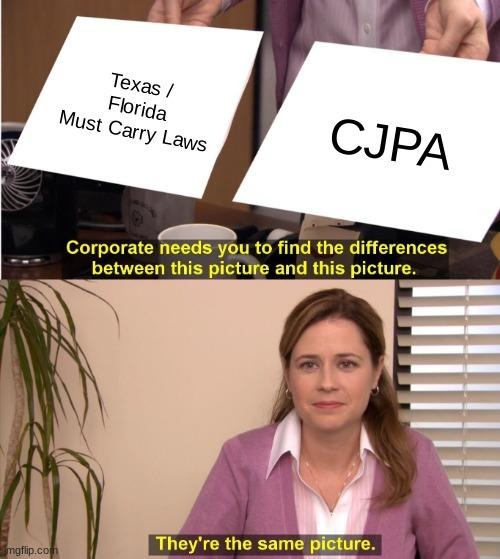
Florida and Texas recently imposed similar must-carry obligations in their social media censorship laws. The Florida social media censorship law specifically restricted platforms’ ability to remove journalist content. The 11th Circuit held that the provision triggered strict scrutiny because it was content-based. The court then said the journalism-protection clause failed strict scrutiny—and would have failed even lower levels of scrutiny because “the State has no substantial (or even legitimate) interest in restricting platforms’ speech… to ‘enhance the relative voice’ of… journalistic enterprises.” The court also questioned the tailoring fit. I think CJPA raises the same concerns. For more on this topic, see Ashutosh A. Bhagwat, Why Social Media Platforms Are Not Common Carriers, 2 J. Free Speech L. 127 (2022).
Note: the Florida bill required platforms to carry the journalism content for free. CJPA would require platforms to pay for the “privilege” of being forced to carry journalism content, wanted or not. CJPA’s skewed economics denigrate editorial freedom even more grossly than Florida’s law.
Copyright Preemption. The CJPA creates copyright-like protection for snippets and links. Per 17 USC 301 (the copyright preemption clause), only Congress has the power to provide copyright-like protection for works, including works that do not contain sufficient creativity to qualify as an original work of authorship. Content snippets and links individually aren’t original works of authorship, so they do not qualify for federal copyright protection at the federal or state level; while any compilation copyright is within federal copyright’s scope and therefore is also off-limits to state protection.
The CJPA governs the reproduction, distribution, and display of snippets and links, and the federal copyright law governs those activities in 17 USC 106. CJPA’s provisions thus overlap with 106’s scope, but the works are within the scope of federal copyright law. This is not permitted by federal copyright preemption.
Section 230. Most or all of the snippets/links governed by the CJPA will constitute third-party content, including search results containing third-party content and user-submitted links where the platform automatically fetches a preview from the JDP’s website. Thus, CJPA runs afoul of Section 230 in two ways. First, it treats the covered platforms as the “publishers or speakers” of those snippets and links for purposes of the allocation share. Second, the anti-retaliation claim imposes liability for removing/downgrading third-party content, which courts have repeatedly said is covered by Section 230 (in addition to the First Amendment).
DCC. I believe the Dormant Commerce Clause should always apply to state regulation of the Internet. In this case, the law repeatedly contemplates the platforms determining the location of California’s virtual borders, which will always have an error rate that cannot be eliminated. Those errors guarantee that the law reaches activity outside of California.
Takings. I’m not a takings expert, but a government-compelled wealth transfer from one private party to another sounds like the kind of thing our country’s founders would have wanted to revolt against.
Conclusion
Other countries have attempted “link taxes” like CJPA. I’m not aware of any proof that those laws have accomplished their goal of enhancing local journalism. Knowing the track record of global futility, why do the bill’s supporters think CJPA will achieve better results? Because of their blind faith that the bill will work exactly as they anticipate? Their hatred of Big Tech? Their desire to support journalism, even if it requires using illegitimate means?
Our country absolutely needs a robust and well-functioning journalism industry. Instead of making progress towards that vital goal, we’re wasting our time futzing with crap like CJPA.
Originally posted to Eric Goldman’s Technology & Marketing Law Blog, reposted here with permission, and (thankfully, for the time being) without having to pay Eric to link back to his original even though he qualifies as a “DJP” under this law.
Two weeks ago, Canada’s Heritage Minister, Pablo Rodriguez, who has been the main Canadian government official pushing for C-18, the bullshit link tax bill, that is just a corrupt wealth transfer from one disliked industry to a favored industry, insisted that it was “unacceptable” that Meta might stop allowing links to news if the bill passed.
The interview is quite incredible. Rodriguez makes a number of absolutely laughable claims, such as acting as if the value flow is entirely in one direction: from media to the tech companies. The CBC journalist, correctly, points out that the media orgs (including his own) get value from being able to distribute their content for free online, and notes that if Meta (and Google) stop allowing links that will harm the media.
Rodriguez seems wholly unprepared for this question. As he looks stunned, he stumbles through the following:
CBC: I agree that our work has a value, but also their platforms allow us to reach an audience. We use Facebook, we use Instagram, to reach people, to help us. And if this goes through and Meta follows through on its threat, we’re going to lose access to those audiences. So how is this a helpful thing for Canadian media.
Rodriguez: Well… first of all. They have to make that business decision and… they’re making a lot of money… in Canada and… they would have to justify why they do that… and second they have a lot of deals with a lot of news media outlets across the country. What would happen to those deals? I think we can come to a fair deal. We can talk to each other. I always said it. And they know it. My door is always open. They have my cell phone and my staff at any time. So we’re ready to discuss, we’re ready to negotiate, but we’ll never negotiate or accept something under threat.
I mean… what does that even mean? We’re ready to negotiate, but we won’t negotiate “under threat”? But the “threat” is simply Meta saying that news content just isn’t worth paying for.
As the CBC reporter points out in response, the reality is that this is likely to harm news organizations even more (this is after a hilarious exchange in which Rodriguez, the government minister pushing this bill to force websites to pay up for links, insists that the best part of his bill is that it creates a “marketplace” that “the government has nothing to do with” which is… not how any of this works).
CBC: We heard at the Senate this week, the Committee studying this, Brian Myles is with Le Devoir said they get 40% of their traffic from Google and 30% from social media. And if Google and Facebook go through with this they will suffer, he says, because direct traffic is less than 20%. The Globe and Mail CEO Phillip Crawley told Senators if Facebook pulls out “millions of dollars go away.” Millions of dollars go away. And that’s a lot in the newspaper world. I mean, I know you’re saying you’re trying to help newspapers and media organizations. This would not help if they follow through, if they’re provoked by your legislation.
Rodriguez: But that’s exactly what they’re trying to do through their threat. They want you to repeat what they’re saying. They want to scare people and scare politicians too. That’s what they’re trying to do! They want to intimidate MPs. They want to intimidate Senators, especially Senators because the bill is there at this moment…
The man seems to be in deep deep denial. This is not about “threats.” It’s about saying that having to pay for links is just not worth it. It’s a straight up cost-benefit decision. And Rodriguez seems unable to comprehend that Meta would actually stop allowing news links, or that it’s just not worth paying for links.
Today, we are confirming that news availability will be ended on Facebook and Instagram for all users in Canada prior to the Online News Act (Bill C-18) taking effect.
We have repeatedly shared that in order to comply with Bill C-18, passed today in Parliament, content from news outlets, including news publishers and broadcasters, will no longer be available to people accessing our platforms in Canada.
Ooops.
Now, as when this happened in Australia, I’m sure some people are going to get mad at Meta, but that makes no sense. If you believe in the open web, if you believe that you should never have to pay to link to something, if you believe that no one should have to pay to provide you a benefit, then you should support Meta’s stance here. Yes, it’s self-serving for Meta. Of course it is. But, even if it’s by accident, or a side-effect, it’s helping to defend the open web, against a ridiculous attack from an astoundingly ignorant and foolish set of Canadian politicians.