A year ago, I noted that many of Walled Culture’s illustrations were being produced using generative AI. During that time, AI has developed rapidly. For example, in the field of images, OpenAI has introduced DALL-E 3 in ChatGPT:
When prompted with an idea, ChatGPT will automatically generate tailored, detailed prompts for DALL·E 3 that bring your idea to life. If you like a particular image, but it’s not quite right, you can ask ChatGPT to make tweaks with just a few words.
Ars Technica has written a good intro to the new DALL-E 3, describing it as “a wake-up call for visual artists” in terms of its advanced capabilities. The article naturally touches on the current situation regarding copyright for these creations:
In the United States, purely AI-generated art cannot currently be copyrighted and exists in the public domain. It’s not cut and dried, though, because the US Copyright Office has supported the idea of allowing copyright protection for AI-generated artwork that has been appreciably altered by humans or incorporated into a larger work.
The article goes on to explore an interesting aspect of that situation:
there’s suddenly a huge new pool of public domain media to work with, and it’s often “open source”—as in, many people share the prompts and recipes used to create the artworks so that others can replicate and build on them. That spirit of sharing has been behind the popularity of the Midjourney community on Discord, for example, where people typically freely see each other’s prompts.
When several mesmerizing AI-generated spiral images went viral in September, the AI art community on Reddit quickly built off of the trend since the originator detailed his workflow publicly. People created their own variations and simplified the tools used in creating the optical illusions. It was a good example of what the future of an “open source creative media” or “open source generative media” landscape might look like (to play with a few terms).
There are two important points there. First, that the current, admittedly tentative, status of generative AI creations as being outside the copyright system means that many of them, perhaps most, are available for anyone to use in any way. Generative AI could drive a massive expansion of the public domain, acting as a welcome antidote to constant attempts to enclose the public domain by re-imposing copyright on older works – for example, as attempted by galleries and museums.
The second point is that without the shackles of copyright, these creations can form the basis of collaborative works among artists willing to embrace that approach, and to work with this new technology in new ways. That’s a really exciting possibility that has been hard to implement without recourse to legal approaches like Creative Commons. Although the intention there is laudable, most people don’t really want to worry about the finer points of licensing – not least out of fear that they might get it wrong, and be sued by the famously litigious copyright industry.
A situation in which generative AI creations are unequivocally in the public domain could unleash a flood of pent-up creativity. Unfortunately, as the Ars Technica article rightly points out, the status of AI generated artworks is already slightly unclear. We can expect the copyright world to push hard to exploit that opening, and to demand that everything created by computers should be locked down under copyright for decades, just as human inspiration generally is from the moment it is in a fixed form. Artists should enjoy this new freedom to explore and build on generative AI images while they can – it may not last.
It’s that time… Get ready for the Gaming Like It’s 1928! public domain game jam! The game jam, like all our public domain game jams, runs from January 1st through January 31st, and we’re eager to see what kinds of games, both digital and analog, you’ll make by building on newly public domain works. As always we’ll have awards in six different categories: best analog game, best digital game, best adaptation, best visuals, best remix, and best deep cut.
In January 2019, work in the US from 1923 entered the public domain. It was the first time in decades that works in the US had entered the public domain, as certain copyright interests, led by the Walt Disney Company, had continually pushed out the term of copyright again and again and again.
A while back Tom Bell coined the term the “Mickey Mouse Curve” to describe how copyright extensions seemed to keep happening just before Mickey Mouse would be entering the public domain.
However, in part because of widespread activism and the calling out of this curve, the legacy copyright industries admitted in the late teens that they were pretty much done with copyright term extension and that, finally, Mickey Mouse might enter the public domain. 2019 was the first year in decades (thanks to the Sonny Bono Copyright Term Extension Act two decades earlier) that anything went into the public domain: works from 1923.
At the time, we launched our very first public domain game jam, Gaming Like It’s 1923. We’ve done one every year since then. Here are the 1924, 1925, 1926, and 1927 versions. But this year is the big one.
The very first Mickey Mouse short, Steamboat Willie, was released in 1928. Leaving aside that Steamboat Willie itself was a clear play on the film Steamboat Bill that also came out in 1928 and used the song Steamboat Bill from 1911, it’s pretty incredible that this one short from 1928 was the basis on which so much culture and content was locked up.
Until… just a few weeks from now. And, so we’re certainly expecting a few Mickey-themed games for the game jam this year, and we welcome them all.
Our friends over at Duke Center for the Study of the Public Domain have put together a nice guide to what it means for the 1928 Mickey to be in the public domain, which includes explanations of what you can and cannot do with Mickey. It includes a lovely graphical representation that you might like:
There are, of course, lots of other works entering the public domain on January 1st, and we’re always excited to see what interesting and unique works people find and remix for use in the submitted games. Copyright Lately has a good starter list for some of the many other works entering the public domain. It includes things like the Peter Pan play (which has a tricky copyright history as it was performed long before 1928, but not officially published until then).
We know that John Oliver got a bit of a head start on using Mickey Mouse a bit early, and as far as I know, Disney’s lawyers (for once!) actually sat on their hands and did nothing about it. But, on January 1st all of you will be able to use Mickey and lots of other newly public domain works, and we hope that you’ll try to come up with some games for our jam.
If you’re looking for inspiration, please check some of the earlier game jams, each of which have the various winners listed, and check out our spotlight posts for last year’s winners. And we look forward to what you’ll be creating this time, whether or not it includes some variation of Mickey. Head on over to the game jam page on Itch.io to sign up and see all the rules and details.
* As explained above, Mickey is only partially free, as new works must be based on the original Mickey, not later updates, and you have to make sure there are no trademark issues, such that anyone would think that your use was an official Disney offering.
As of now, 15 September 2023, the comic book property called Fables, including all related Fables spin-offs and characters, is now in the public domain. What was once wholly owned by Bill Willingham is now owned by everyone, for all time. It’s done, and as most experts will tell you, once done it cannot be undone. Take-backs are neither contemplated nor possible.
If you know Techdirt, you know that we’ve always encouraged people to put works into the public domain (and to use the public domain). Every year we run a public domain game jam. We’ve long noted that anything of our own that we publish on Techdirt should be considered in the public domain, and you are free to do with it what you will. The reports we’ve published are generally in the public domain as well. When I published two short sci-fi stories in our larger collection of sci-fi stories about the future of work, I put them into the public domain as well (a few other stories in that collection are also public domain).
Willingham’s reasons for doing so are a bit more complex than ours, but he admits that he’s become disillusioned by our copyright and trademark laws recently, recognizing (as we’ve long pointed out), that they seem mostly designed to empower gatekeepers in ways that harm the creators themselves, rather than help them. From that he even has his own idea on how copyright should be reformed:
In the past decade or so, my thoughts on how to reform the trademark and copyright laws in this country (and others, I suppose) have undergone something of a radical transformation. The current laws are a mishmash of unethical backroom deals to keep trademarks and copyrights in the hands of large corporations, who can largely afford to buy the outcomes they want.
In my template for radical reform of those laws I would like it if any IP is owned by its original creator for up to twenty years from the point of first publication, and then goes into the public domain for any and all to use. However, at any time before that twenty year span bleeds out, you the IP owner can sell it to another person or corporate entity, who can have exclusive use of it for up to a maximum of ten years. That’s it. Then it cannot be resold. It goes into the public domain. So then, at the most, any intellectual property can be kept for exclusive use for up to about thirty years, and no longer, without exception.
And thus, he decided to practice what he’s preaching:
Of course, if I’m going to believe such radical ideas, what kind of hypocrite would I be if I didn’t practice them? Fables has been my baby for about twenty years now. It’s time to let it go. This is my first test of this process. If it works, and I see no legal reason why it won’t, look for other properties to follow in the future. Since DC, or any other corporate entity, doesn’t actually own the property, they don’t get a say in this decision.
There’s also the… being mad at DC thing. He notes that when he originally signed his deal with DC, the company was good to work with, and whenever any problems arose, they were able to work things out. However, as Willingham puts it DC has “fallen into bad hands.” It seems that a part of that is Warner Bros. Discovery, which now owns DC. There have long been concerns that Warner Bros. Discovery is basically destroying what’s left of DC (while trying to wring extra cash out of it).
Elsewhere, Willingham noted that he had turned in scripts for Fables two years ago, and DC has basically dropped the ball on the property, so he’s freeing it for everyone else to use.
And… here’s where it gets complicated. Lots of people asked if he can actually do that, and the likely answer is that… we really don’t know. It may depend very much on the specific contracts Willingham has with DC Comics. It is possible that he signed a contract in which he retains the copyrights and trademarks. He certainly claims as much in his announcement:
The one thing in our contract the DC lawyers can’t contest, or reinterpret to their own benefit, is that I am the sole owner of the intellectual property. I can sell it or give it away to whomever I want.
A few people have pointed to the notice on Fables indicating the copyright is jointly owned by both and that the trademark is owned by Willingham:
But… if you go digging into the copyright registration database… well… it’s messy. There are a bunch of registrations for Fables, though as I flip through them, many suggest that he assigned the copyright to DC. If that’s true, then… he doesn’t actually have the copyrights to free and his claim that he’s the sole owner of the IP is incorrect.
However, other registrations do list them as co-owners of the copyright, including what I believe is the original copyright registration for the original Fables series:
And… if that’s the case, then there’s potentially more legitimacy to Willingham’s decision. When there’s a jointly created work with multiple authors holding the copyright, each author is able to license out the work to others without gaining permission from the other authors. They just need to let the co-copyright owners know about it.
So… this is… messy. DC, for it’s part, says no fucking way does Willingham have the right to do this:
The Fables comic books and graphic novels published by DC, and the storylines, characters, and elements therein, are owned by DC and protected under the copyright laws of the United States and throughout the world in accordance with applicable law and are not in the public domain. DC reserves all rights and will take such action as DC deems necessary or appropriate to protect its intellectual property rights.
Which means, we’re likely to see some sort of legal fight. Well, that is if anyone actually takes Willingham up on the offer. Because of DC’s posturing here, it will likely scare off some from going forward with things.
Willingham notes that he told DC that he was going to do this, and also tried to get them to write clearer contracts (which suggests that the existing contracts are about as messy as many such contracts tend to be):
I gave them an opportunity to renegotiate the contracts from the ground up, putting everything in unambiguous language, and they ignored that offer. I gave them the opportunity, twice, to simply tear up our contracts, and we each go our separate ways, and they ignored those offers. I tried to go over their heads, to deal directly with their new corporate masters, and maybe find someone willing to deal in good faith, and they blocked all attempts to do so. (Try getting any officer of DC Comics to identify who they report to up the company ladder. I dare you.) In any case, without giving them details, I warned them months in advance that this moment was coming. I told them what I was about to do would be “both legal and ethical.” Now it’s happened.
I hope it is true that he has the rights, and that this is legitimate, because we need more works in the public domain.
For what it’s worth, Willingham also notes that he’s still bound by his contracts with DC that if he creates more Fables works, they have to go through DC, but since none of the rest of us are bound by that contract, we can do whatever we want. But, as he notes (entirely correctly!) copyright law is a fucking mess, and you’ll find copyright lawyers who will argue all sides of this:
Note that my contracts with DC Comics are still in force. I did nothing to break them, and cannot unilaterally end them. I still can’t publish Fables comics through anyone but them. I still can’t authorize a Fables movie through anyone but them. Nor can I license Fables toys nor lunchboxes, nor anything else. And they still have to pay me for the books they publish. And I’m not giving up on the other money they owe. One way or another, I intend to get my 50% of the money they’ve owed me for years for the Telltale Game and other things.
However, you, the new 100% owner of Fables never signed such agreements. For better or worse, DC and I are still locked together in this unhappy marriage, perhaps for all time.
But you aren’t.
If I understand the law correctly (and be advised that copyright law is a mess; purposely vague and murky, and no two lawyers – not even those specializing in copyright and trademark law – agree on anything), you have the rights to make your Fables movies, and cartoons, and publish your Fables books, and manufacture your Fables toys, and do anything you want with your property, because it’s your property.
I hope that is the case, but DC is making it clear that if anyone takes him up on that offer, they’re likely to take legal action, which might just (unfortunately) be enough to make sure that no one even tries.
But, without seeing the details of the contracts (and even if we had them, that wouldn’t mean any of this would necessarily be any clearer), it’s very difficult to tell who is really correct here. It’s even possible that some characters/plots/etc. are public domain, and some are not. Without the contracts, it just becomes a big ¯\_(ツ)_/¯.
Anyway, I’d be remiss if I didn’t at least mention that Fables itself is based on taking public domain characters from old fairy tales and folklore, and building storylines around them in modern day New York. It seems only fitting that they should be released to the public domain for others…
Stephen Thaler has spent years trying, and almost always failing, to convince both patent and copyright bodies to give him patents and copyrights on works he says are created by AI systems he’s built.
His latest attempt was to sue the Copyright Office and the Register of Copyrights, Shira Perlmutter, over his attempt to get copyright on AI created works. It did not work. Judge Beryl Howell, a former RIAA lobbyist who often does seem willing to go to bat for expanding the boundaries of copyright law, wouldn’t go as far as Thaler wanted, and said pretty clearly that AI-created works are not subject to copyright protection.
As the court explains, Thaler tried to jump multiple steps in arguing for why the copyright on a computer generated work should be assigned to himself as the computer owner. But, the Judge points out, that question is only worth exploring if there’s a legitimate copyright in the first place:
Plaintiff attempts to complicate the issues presented by devoting a substantial portion of his briefing to the viability of various legal theories under which a copyright in the computer’s work would transfer to him, as the computer’s owner; for example, by operation of common law property principles or the work-for-hire doctrine. See Pl.’s Mem. at 31–37; Pl.’s Reply Supp. Mot. Summ. J. & Opp’n Def.’s Cross-Mot. Summ. J. (“Pl.’s Opp’n”) at 11–15, ECF No. 18. These arguments concern to whom a valid copyright should have been registered, and in so doing put the cart before the horse. By denying registration, the Register concluded that no valid copyright had ever existed in a work generated absent human involvement, leaving nothing at all to register and thus no question as to whom that registration belonged.
Judge Howell details, as Thaler argued, that copyright law has changed over time as new developments in creativity have developed, but notes this goes too far:
Copyright has never stretched so far, however, as to protect works generated by new forms of technology operating absent any guiding human hand, as plaintiff urges here. Human authorship is a bedrock requirement of copyright.
That principle follows from the plain text of the Copyright Act. The current incarnation of the copyright law, the Copyright Act of 1976, provides copyright protection to “original works of authorship fixed in any tangible medium of expression, now known or later developed, from which they can be perceived, reproduced, or otherwise communicated, either directly or with the aid of a machine or device.” 17 U.S.C. § 102(a). The “fixing” of the work in the tangible medium must be done “by or under the authority of the author.” Id. § 101. In order to be eligible for copyright, then, a work must have an “author.”
From there, the discussion mostly follows along with the same discussion that we had over the monkey selfie. Basically, there’s nothing that says that non-humans are covered by copyright law. Because that wouldn’t make any sense at all.
The understanding that “authorship” is synonymous with human creation has persisted even as the copyright law has otherwise evolved. The immediate precursor to the modern copyright law—the Copyright Act of 1909—explicitly provided that only a “person” could “secure copyright for his work” under the Act. Act of Mar. 4, 1909, ch. 320, §§ 9, 10, 35 Stat. 1075, 1077. Copyright under the 1909 Act was thus unambiguously limited to the works of human creators. There is absolutely no indication that Congress intended to effect any change to this longstanding requirement with the modern incarnation of the copyright law. To the contrary, the relevant congressional report indicates that in enacting the 1976 Act, Congress intended to incorporate the “original work of authorship” standard “without change” from the previous 1909 Act. See H.R. REP. NO. 94-1476, at 51 (1976)
The human authorship requirement has also been consistently recognized by the Supreme Court when called upon to interpret the copyright law. As already noted, in Sarony, the Court’s recognition of the copyrightability of a photograph rested on the fact that the human creator, not the camera, conceived of and designed the image and then used the camera to capture the image. See Sarony, 111 U.S. at 60. The photograph was “the product of [the photographer’s] intellectual invention,” and given “the nature of authorship,” was deemed “an original work of art . . . of which [the photographer] is the author.” Id. at 60–61. Similarly, in Mazer v. Stein, the Court delineated a prerequisite for copyrightability to be that a work “must be original, that is, the author’s tangible expression of his ideas.” 347 U.S. 201, 214 (1954). Goldstein v. California, too, defines “author” as “an ‘originator,’ ‘he to whom anything owes its origin,’” 412 U.S. at 561 (quoting Sarony, 111 U.S. at 58). In all these cases, authorship centers on acts of human creativity.
The judge says that AI can create “challenges” to the copyright system, but that’s not an issue for the courts to work out. Therefore, the court says, all of Thaler’s arguments about assigning the copyright to himself are moot, as there was no copyright in the first place.
Given that the work at issue did not give rise to a valid copyright upon its creation, plaintiff’s myriad theories for how ownership of such a copyright could have passed to him need not be further addressed. Common law doctrines of property transfer cannot be implicated where no property right exists to transfer in the first instance. The work-for-hire provisions of the Copyright Act, too, presuppose that an interest exists to be claimed. See 17 U.S.C § 201(b) (“In the case of a work made for hire, the employer . . . owns all of the rights comprised in the copyright.”). Here, the image autonomously generated by plaintiff’s computer system was never eligible for copyright, so none of the doctrines invoked by plaintiff conjure up a copyright over which ownership may be claimed.
And thus, we have yet another loss on the books for Thaler and another win for the belief that AI created works are not subject to copyright (or patents).
People accuse me of unfairly bashing Elon Musk, but I’ve always highlighted the things he’s done that I thought were smart as well, and a big one was his decision nearly a decade ago to free all of Tesla’s patents. The company put out a blog post, saying that anyone could use its patents, and that Tesla would never initiate a patent lawsuit. We’ve been happy to see him continue to stand by this position over the years.
Musk’s rationale for doing so was exactly correct: patents tend to hold back innovation in many cases, especially in innovative and emerging markets, such as electric cars. That’s because whoever gets to the patent office first might not actually be the best at building a product that users want, and to really drive the market forward, letting everyone try to build better products for users is the most important driver of innovation and overall consumer welfare.
Patents stop that, by saying only whoever made it to the patent office first is allowed to innovate.
Obviously, Tesla has held a somewhat commanding lead over the EV market over the last decade, but with a bunch of new EVs coming on the market, combined with Musk’s seeming infatuation with suing others, I wondered if the pledge would stand. So it caught my attention when I saw that Tesla had sued an Australian supercapacitor company, Cap-XX, for patent infringement. The patents came to Tesla when it purchased Maxwell Technologies a few years back.
So, at first I worried that this was Musk going back on his word. However, the company claims that this is actually a response to Cap-XX’s own patent lawsuit against Maxwell that goes back to around the time of Tesla’s purchase of Maxwell. Remember, the Tesla promise was simply that it would not initiate infringement lawsuits. If it’s just suing a company that is already engaged in a patent infringement lawsuit against it, the situation is a bit more understandable and reasonable, and is more akin to the frequent belief in Silicon Valley of mostly using your patents defensively, rather than offensively (basically collecting patents to say that if someone sues you for patent infringement, you’ll sue them right back, in hopes of deterring the initial lawsuit).
That said, it’s not clear why Tesla waited around four years to hit back with this lawsuit, and it will be interesting to see if Cap-XX tries to use Tesla’s patent pledge in court against the company. Some could argue that a full patent disarmament would entail never suing over patents at all, but given the circumstances, I think this move is mostly understandable.
However, it’s still worth watching to make sure Tesla doesn’t go back on the full patent pledge in the future.
Look, we all knew that there was going to be a lot of fuss about the upcoming public domaining (finally!) of Mickey Mouse nine months from now on January 1, 2024. I mean, we’ve already been talking about what next year’s public domain game jam is going to look like with Mickey as one of the options.
If you somehow have been living under a rock and never read anything on Techdirt before, let’s get you up to speed. Mickey Mouse debuted as Steamboat Willie in 1928. The character was a blatant animated copy of Steamboat Bill, a Buster Keaton silent film that came out… the same year. Disney, of course, also built up much of its success by taking public domain stories and animating them.
But, of course, once Disney became the Walt Disney Corporation, it chose to lock up everything it could. Disney has been absolutely famous for its aggressive copyright lawyering for years, which included what we’ve referred to as the Mickey Mouse curve: every time Mickey Mouse started to get near the public domain, a purely coincidental thing happened where Congress would (totally unrelatedly) extend copyrights:
The last extension, the 1998 Sonny Bono Copyright Term Extension Act was quite frequently referred to as the Mickey Mouse Protection Act.
Over the last few years there remained concerns that Disney would try to extend copyrights once again, but I think once the public rose up against SOPA in 2012, Disney and most of the rest of the copyright legacy players realized that there was no chance they were going to extend terms again. Hell, even Maria Pallante, one of the more extreme copyright maximalists (currently trying to kill libraries) while she was head of the Copyright Office, suggested that maybe it was time to cut back on copyright terms, rather than extend them.
And so, everyone has more or less accepted as fact that the Steamboat Willie version of Mickey becomes public domain next year. Even leaving aside the weird series of articles that showed up in the middle of last summer whining about how awful it is that Disney will “lose” Mickey, there are still some concerns about Disney lawyer fuckery on the way.
Again, many of you know this already, but just to be clear: the only thing that’s going into the public domain is the 1928 version of Mickey, which you can see here:
It’s not quite the iconic version of Mickey from today, though it’s not that far off. But, Disney will still hold the trademark on Mickey, which could limit how it’s used in commerce (in theory, it should only limit uses where someone is confusing people into believing their Mickey-related product is from or endorsed by Disney, but theory doesn’t always match reality when these things go to court).
But, as we discussed earlier this month, Disney has already been quietly making some moves that suggest it’s going to try to use trademark law as ridiculously as it can:
In 2007, Walt Disney Animation Studios redesigned its logo to incorporate the “Steamboat Willie” mouse. It has appeared before every movie the unit has released since, including “Frozen” and “Encanto,” deepening the old character’s association with the company. (The logo is also protected by a trademark.) In addition, Disney sells “Steamboat Willie” merchandise, including socks, backpacks, mugs, stickers, shirts and collectibles.
Either way, we expected that there’d be some legal shenanigans worth paying attention to next year. I also thought that maybe some people or small companies without good lawyers might accidentally jump the gun a bit and do something in December.
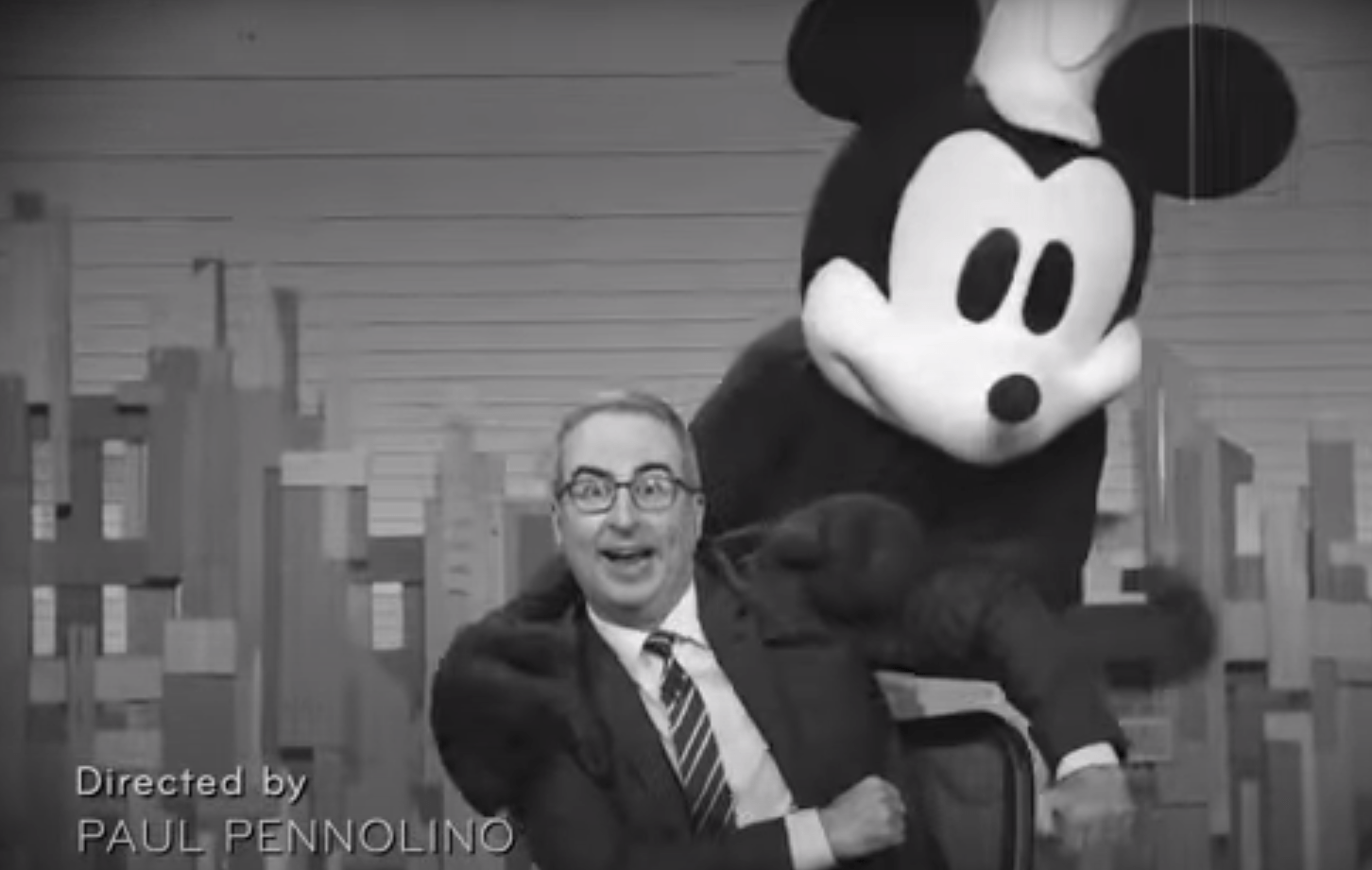
But… what I did not expect was that John Oliver and the folks at Last Week Tonight, an HBO show currently owned by cost-cutting Warner Bros. Discovery would say “fuck it” and start using Mickey Mouse… now.
I mean, I shouldn’t be surprised. Half the time I think Oliver’s show is basically Techdirt-but-if-funny,-entertaining,-and-clever, with the way he seems to cover the same topics we’re always covering, but, you know, better (mostly). And, Oliver has become somewhat famous for poking the eye of his own corporate masters (quite gleefully).
It absolutely would not have taken me by surprise if Oliver had done this nine months from now once Mickey is officially in the public domain. But… jumping the gun like this? That still surprised me.
The bit is, as you’d expect, hilarious. It starts with a discussion of the horror film, Winnie the Pooh: Blood and Honey, which, as you know, is building on a work that entered the public domain last year. But then moves on to Mickey. He talks about Mickey going into the public domain next year, highlights the litigiousness of Disney over Mickey (including legal crackdowns on a gravestone and a daycare center using images of Mickey) before noting he’s not going to wait to use it himself.
On top of which Disney has registered trademarks related to Disney, which don’t expire. In fact, some have speculated that might be why Disney redesigned its animation studios opening logo to incorporate the Steamboat Willie Mickey Mouse.
And it does feel like a tactical legal move. Basically, they may argue that this early Mickey image is so closely associated with their company, that people will automatically assume that any image of him was produced or authorized by them, and still take legal action.
So the fact is, anyone wanting to use the Steamboat Willie Mickey Mouse, will probably still be taking a risk.
But… if you know anything about this show by now… you know, we do like to take a risk every now and then. And there’s a lot to be said for beating the rush to capitalize on Mickey that will be starting next year.
So, tonight, I’d like to preview for you, our brand new character on this show, Mickey Mouse
He introduces some new, um, catch phrases for Mickey including “where’s Shelly Miscavige?” (a running… sorta… joke on the show about the missing wife of Scientology leader David Miscavige), “Jeffrey Epstein didn’t kill himself,” and “I hope Henry Kissinger dies soon!”
As Oliver says:
You know, the nice thing about characters entering the public domain is that you can do new, interesting things with them.
This is true. It’s why we celebrate the public domain every chance we can (psst, have you checked out the entries in this year’s public domain game jam?)
Mickey then asks John about the fact that he’s not actually in the public domain yet, and John doesn’t seem too concerned:
Mickey Mouse: I thought I wasn’t public domain until next year!
John Oliver: That’s actually true, buddy, we are pushing the limit a bit here. Actually, come to think of it, is your voice public domain yet?
Mickey: I guess you’ll find out!
John: Yeah! I guess we will!
He then decides to provoke Disney even more.
And I know, Disney’s lawyers might take the trademark angle and argue that this Mickey is closely associated with their brand. Although they should know that he’s pretty closely associated with our brand now too. And not just because I have a general vibe that screams 95-year-old rat-faced idiot, but also, because the Steamboat Willie Mickey has actually been in our opening credits since the first show of this season…
And then… even more.
And I don’t doubt that Disney has some other legal arguments up their sleeve, but we’re only likely to find out what they are if, and when, then sue. So, you know what? Let’s take this up a notch. Come say ‘hi’ Mickey!
And… out comes a Steamboat Willie Mickey in a costume to say his catch phrases to Oliver:
And, from there, he promises that as of January 1st, this costume will be available for all sorts of events (“birthday parties, theme park openings, funerals, sex dungeons, whatever you want.”)
So… now the question… does Disney actually do anything? Do they call up Warner Bros. Discovery and say WTF? Or do they send in the lawyers? I guess we’ll find out!
Oh, and John, if they do send in the lawyers, your own lawyers might want to look more deeply into reports that turned up 15 years ago that Disney’s lawyers, way back in the early days, fucked up the registration and don’t actually hold any copyright on Mickey Mouse at all. That’ll be fun.
The life-plus-seventy-years sentence imposed on Winnie the Pooh by Cher’s ex-husband is finally over. Petitions for an early release went unheeded, forcing the butt naked childhood icon to perform tricks for the heirs of its creator’s estate until it was finally allowed to roam free — nearly 40 years after the bear’s sentence should have been commuted.
Pooh’s freedom prompted questions about what he might do following his release, the best of which was posed by comic artist Luke McGarry. McGarry suggested the future would bring us a far less innocuous Pooh Bear in this extremely prescient tweet:
Less than a year later, the question posed by Christopher Robin had been answered in the affirmative. A horror film utilizing characters from A.A. Milne’s creations debuted. Entitled “Winnie the Pooh: Blood and Honey,” the horror film turns Pooh and Piglet into partners in slashy crime, presumably much to the chagrin of the former rights holders. And definitely to the chagrin of critics and audiences alike, who possibly wouldn’t have minded a more transgressive Pooh Bear, but desired something far more clever and watchable than this hustled-into-existence transformative work.
Film distributor VII Pillars Entertainment announced on Facebook that the release of “Winnie the Pooh: Blood and Honey” on Thursday had been canceled with “great regret” in Hong Kong and neighboring Macao.
In an email reply to The Associated Press, the distributor said it was notified by cinemas that they could not show the film as scheduled, but it didn’t know why. The cinema chains involved did not immediately reply to a request for comment.
The problem here likely isn’t the bloody content or the lazy subversion of childhood innocence. No, the problem here is most likely China’s president, Xi Jinping. Critics and shitposters in China (and China’s newest subservient domain) have deployed plenty of memes depicting President Xi as Winnie the Pooh due to his passing resemblance to the notorious honey fiend.
This has resulted in some seriously weird censorship efforts and this ejection of the Pooh-based horror film appears to be a continuation of that censorship theme. Allowing Hong Kong residents to view content that might mentally link the president to a surprisingly violent stuffed animal is the sort of the thing that simply can’t be allowed, especially since this comparison is far more apt than merely noting a facial resemblance between Xi and a child’s harmless imaginary friend.
The crackdown continues. And the Hong Kong government is trying to alter the narrative by claiming (without a shred of credibility) that theater owners arrived at this decision on their own.
The Office for Film, Newspaper and Article Administration said it had approved the film and arrangements by local cinemas to screen approved films “are the commercial decisions of the cinemas concerned.” It refused to comment on such arrangements.
A screening initially scheduled for Tuesday night in one cinema was canceled due to “technical reasons,” the organizer said on Instagram.
I supposed a forced cancellation could (very charitably) be called a “technical reason.” No one really believes these statements from the government’s censors, not even the censors themselves. But they’re the ones with power, so everyone just has to pretend theater owners decided, independently, to cancel more than 30 planned showings, all within hours of each other. There’s a murderous Pooh Bear still wandering the streets of Hong Kong, if only in spirit. But it’s not the protagonist of the film the government won’t allow to be shown.
Jason Morningstar seems to have a knack for Deep Cut games: last year he handily snagged the prize with The Obstruction Method, and this year’s entry has once again demonstrated why the category is one of our favorites. The Pigeon Wager takes its inspiration from “The Military Use Of The Homing Pigeon”, an article published in a 1927 issue of an ornithology quarterly. On this humble foundation, the game builds a live-action roleplaying exercise full of drama and creativity.
The setting is a pigeon club in Hoboken, where three players take on the roles of three characters awaiting the results of a big race. There’s Januszewski, the biologist and club Secretary whose only interest is the birds, especially since they help him manage his lasting trauma from World War 1. Then there’s Tully and Capotorti, the representatives of competing local gangs that have made high-stakes bets on the race about the future of the city’s criminal enterprise. The tension they create in the room has driven all the other enthusiasts away, and now all anyone can do is make small talk while they wait for reports of the pigeons’ progress.
Oh, and each of the three has a gun.
Seasoned roleplayers could already have a lot of free-form fun with just the introduction and character bios that lay all this out, but the game provides some extremely creative scaffolding to give things a bit of structure. Key to it all is a 90-minute audio file that plays in the background throughout a session. Most of it is period-appropriate music taken from an archive of cylinder recordings, but these are punctuated by pigeon noises that instruct Januszewski to draw a card from a small deck of events, and update the official log of the race’s progress. Eventually, this culminates in a random selection of the winning pigeon and (probably) guns being drawn.
The game also includes a couple of newspaper pages for players to print out, populated with real snippets from a 1927 archive. These serve as inspiration for the tense conversation that takes place while everyone waits for the race’s results. As for what else happens in the game, well, that’s up to the players! The game presents a situation that is at once wholly immersive and simple: players only have to read a fairly short bio, and each role is easily realized, even for an inexperienced roleplayer, by sticking to just a couple of key points. For once again spinning simple and easily-overlooked source material into a truly unique piece of game design, The Pigeon Wager couldn’t be more deserving of Best Deep Cut.
Perrin is one of three returning winners in this year’s jam, having won the same category last year with The Wall Across The River. Much like that game, To And Again combines some basic board game and roleplaying game mechanics with a strong storytelling framework that empowers players to explore the themes of the work it’s based on while telling their own original tales. The two games share many of the same strengths, but To And Again feels notably more personal because of the designer’s relationship with the underlying work.
As you can see from the cover, that underlying work is a 1927 book of the same name by Walter R. Brooks. It’s a classic adventure tale for children in which a group of farm animals go on a journey, and would later expand into a series (and get new illustrations that are not yet in the public domain, as referenced in the clever cover design for the game). As Perrin explains in the game’s introduction, the series was a personal childhood favorite and one that, for most of their life, nobody else seemed to have heard of (it seems it was by no means the best of its genre, but perhaps deserves more attention than its ever gotten). So the game serves as a grand introduction of the story to a presumably new audience, and is clearly designed to do justice to both the book itself and the designer’s own memory of it.
As such, gameplay starts with some basic board game mechanics in which players traverse an overall “Journey Board” through a series of Episodes on their own smaller boards, immediately capturing that all-important structure of a simple and satisfying adventure story: a series of well-defined individual challenges that each represent a step towards the broader goal.
Next, the game layers on some basic RPG mechanics, giving each player a character with a strength, a weakness, a characteristic, and the ability to gain skills and improve stats as they progress. A game master guides players through the process of setting goals and generating episodes in which some or all of the characters take part. All of this is supported by rules and tools that are robust without ever becoming overly complicated, with dice tables that can generate goals, settings, obstacles, and other details coupled with concise examples of how every element of gameplay works. Everything is well-designed and well-explained, and all of it is fine-tuned to evoke the original book (there are also pre-made character sheets for all the animals in the original cast).
Put it all together and you’ve got a game that is obviously a labor of love, with design that is informed at every turn by the creator’s relationship with the original work. It’s made me curious about the books, while also making me feel like I have a strong sense of at least some aspects of what they’re like — just as any good adaptation should. For that, To And Again is a deserving winner of Best Adaptation.
Walled Culture is a big fan of the public domain. The amazing artistic uses that people are able to make of material only once it enters the public domain are an indication that copyright can act as an obstacle to wider creativity, rather than something that automatically promotes it. But there’s a problem: because the public domain is about making artistic productions available to everyone for no cost and without restrictions, there are no well-funded lobbyists who stand up and defend it. Instead, all we hear is whining from the copyright world that the public domain exists, and calls for it to be diminished or even abolished by extending copyright wherever possible.
Sometimes those attacks can come from surprising quarters. For example, in October last year Walled Culture wrote about Italy’s Uffizi Galleries suing the French fashion house Jean Paul Gaultier for the allegedly unauthorized use of images of Botticelli’s Renaissance masterpiece The Birth of Venus on its clothing products.
Sadly, this is not a one-off case. The Communia blog has another example of something that is unequivocally in the public domain and yet cannot be used for any purpose, in this case a commercial one. The public domain art is the famous Vitruvian Man drawn by Leonardo da Vinci over 500 years ago.
The commercial use is as the image on a Ravensburger puzzle. As the Communia blog post explains:
According to the Italian Cultural Heritage Code and relevant case law, faithful digital reproductions of works of cultural heritage — including works in the Public Domain — can only be used for commercial purposes against authorization and payment of a fee. Importantly though, the decision to require authorization and claim payment is left to the discretion of each cultural institution (see articles 107 and 108). In practice, this means that cultural institutions have the option to allow users to reproduce and reuse faithful digital reproductions of Public Domain works for free, including for commercial uses. This flexibility is fundamental for institutions to support open access to cultural heritage.
This makes a mockery of the idea of the public domain, which to be meaningful has to apply in all cases, not just in ones where the relevant Italian cultural institution graciously decides to allow it. The fact that this law was passed is in part down to the success of the copyright industry in belittling the public domain as an aberration of no real value – something that can be jettisoned without any ill effects. However:
These cases are bound to leave wreckage in their wake: great uncertainty around the use of cultural heritage across the entire single market, hampered creativity, stifled European entrepreneurship, reduced economic opportunities, and a diminished, impoverished Public Domain. To address these issues, we hope the European Court of Justice will soon have the opportunity to clarify that the Public Domain must not be restricted, a fortiori by rules outside of copyright and related rights, which compromise the European legislator’s clear intent to uphold the Public Domain.
Let’s hope the Court of Justice of the European Union does the right thing, and defends the incredible riches of the public domain against every depredation – including those by Italian cultural institutions.