For more than fifty years the U.S. right wing has embraced a neat trick: by claiming that literally anything in factual opposition to their beliefs is “biased” and therefore must be discarded as unreliable, they’ve bullied U.S. media into becoming a feckless mess terrified of accusations of “liberal bias.”
Of course, if you ask the actual media academics who study U.S. media bias, they’ll quickly tell you that the U.S. media generally veers toward center-right corporatism because we’ve let it consolidate at the hands of center-right billionaires. The obvious result is a hot feckless mess that lacks the courage to speak truth to power, something that became obvious to even the most obtuse with the rise of U.S. authoritarianism.
Still, this idea that the U.S. media is “too woke” and “has a liberal bias” is central to the generational Republican mission of creating a press that only exists to make affluent Conservatives happy.
“The inquiry was met with stunned awkwardness, according to three people who recounted details from the private session in Midtown Manhattan. The staff of “60 Minutes,” the nation’s most-watched news program, view their coverage as firmly nonpartisan and reject criticism from President Trump and his allies who argue that it has a liberal slant.”
60 Minutes is fairly centrist and tame. But it’s the same old trick: if you say things Republicans or corporate power don’t like, you’ll be branded as foundationally untrustworthy. That, more than anything, results in a broader public distrust in U.S. journalism, which the modern, corporatist, brunchlord, far right alliance then exploits and insists can only be fixed by pushing news coverage even further to the right.
Neat trick, right?
It’s worth reiterating that Weiss has no experience in real journalism. She doesn’t own a television. Her tenure at the New York Times involved writing a few opinion columns and helping to turn the New York Times’ op-ed section into a rightward-lurching contrarian troll farm. She’s been hired to turn CBS into the same thing, with the help of a Trump-appointed right wing “ombudsman” providing a fake veneer of authority with some feigned furrowed-brow seriousness.
The goal isn’t objective journalism, it’s to help center-right billionaires further put their thumb on the scale of the consensus definition of objective journalism, shoveling us deeper down the rabbit hole of an anti-democratic state run by the whims of our richest sociopaths. And while it’s only been a week or two, Weiss’ goal here is really not subtle, especially as it pertains to validating Netanyahu:
“As a Middle East peace deal came into view, Ms. Weiss shared numerous pro-Israel opinion pieces from The Free Press, and an editorial that said Zohran Mamdani, the Democratic nominee for New York City mayor, had failed ‘the Hamas test.'”
If you want to remain employed in a highly consolidated U.S. journalism industry owned by rich oligarchs, you’re supposed to pretend none of this is happening, or that it’s perfectly normal to put a right wing troll with no journalism experience in charge of one of the nation’s biggest news operations. At worst, you might be allowed by your editors to hint that Weiss is “controversial” and “unconventional.”
But make no mistake: Weiss is being used as a prop by the billionaire Ellison family to encourage U.S. media’s steady lurch rightward as a necessary anti-woke corrective to mainstream media’s non-existent liberal bias. The primary goal is to undermine the kind of academics, progressive reformers, scientists and marginalized communities that actually speak truth to consolidated wealth and power.
You’d like to think, at some point, the American media and public could awake from this generational con. But the only way to truly fix the U.S. media’s real bias is to untether it from consolidated billionaire ownership and the distorted incentives created by advertising engagement. But because that’s going to make billionaires less money and result in real journalism, it’s always deemed a bridge too far.
Brian Reed’s “Question Everything” podcast built its reputation on careful journalism that explores moral complexity within the journalism field. It’s one of my favorite podcasts. Which makes his latest pivot so infuriating: Reed has announced he’s now advocating to repeal Section 230—while demonstrating he fundamentally misunderstands what the law does, how it works, and what repealing it would accomplish.
If you’ve read Techdirt for basically any length of time, you’ll know that I feel the exact opposite on this topic. Repealing, or really almost all proposals to reform Section 230, would be a complete disaster for free speech on the internet, including for journalists.
The problem isn’t advocacy journalism—I’ve been doing that myself for years. The problem is Reed’s approach: decide on a solution, then cherry-pick emotional anecdotes and misleading sources to support it, while ignoring the legal experts who could explain why he’s wrong. It’s the exact opposite of how to do good journalism, which is unfortunate for someone who holds out his (otherwise excellent!) podcast as a place to explore how to do journalism well.
Last week, he published the first episode of his “get rid of 230” series, and it has so many problems, mistakes, and nonsense, that I feel like I had to write about it now, in the hopes that Brian might be more careful in future pieces. (Reed has said he plans to interview critics of his position, including me, but only after the series gets going—which seems backwards for someone advocating major legal changes.)
The framing of this piece is around the conspiracy theory regarding the Sandy Hook school shootings, and someone who used to believe them. First off, this feels like a cheap journalistic hook, basing a larger argument on an emotional hook that clouds the issues and the trade-offs. The Sandy Hook shooting was horrible! The fact that some jackasses pushed conspiracy theories about it is also horrific! That primes you in the form of “something must be done, this is something, we must do this” to accept Reed’s preferred solution: repeal 230.
But he doesn’t talk to any actual experts on 230, misrepresents Section 230, misleads people into understanding how repealing 230 would impact that specific (highly emotional) story, and then closes on an emotionally manipulative hook (convincing the person he spoke to who used to believe in Sandy Hook conspiracy theories, that getting rid of 230 would work, despite her lack of understanding or knowledge of what would actually happen).
In listening to the piece, it struck me that Reed here is doing part of what he (somewhat misleadingly) claims social media companies are doing: hooking you with manipulative lies and misrepresentations to keep you hooked and to convince you something false is true by lying to his listeners. It’s a shame, but it’s certainly not journalism.
Let’s dig into some of the many problems with the piece.
The Framing is Manipulative
I already mentioned that the decision to frame the entire piece around one extraordinary, but horrific story is manipulative, but it goes beyond that. Reed compares the fact that some of the victims from Sandy Hook successfully sued Alex Jones for defamation over the lies and conspiracy theories he spread regarding that event, to the fact that they can’t sue YouTube.
But in 2022, family members of 10 of the Sandy Hook victims did win a defamation case against Alex Jones’s company, and the verdict was huge. Jones was ordered to pay the family members over a billion dollars in damages.
Just this week, the Supreme Court declined to hear an appeal from Jones over it. A semblance of justice for the victims, though infuriatingly, Alex Jones filed for bankruptcy and has avoided paying them so far. But also, and this is what I want to focus on, the lawsuits are a real deterrent to Alex Jones and others who will likely think twice before lying like this again.
So now I want you to think about this. Alex Jones did not spread this lie on his own. He relied on social media companies, especially YouTube, which hosts his show, to send his conspiracy theory, out to the masses. One YouTube video spouting this lie shortly after the shooting got nearly 11 million views in less than 2 weeks. And by 2018 when the family sued him. Alex Jones had 1.6 billion views on his YouTube channel. The Sandy Hook lie was laced throughout that content, burrowing its way into the psyche of millions of people, including Kate and her dad.
Alex Jones made money off of each of those views. But so did YouTube. Yet, the Sandy Hook families, they cannot sue YouTube for defaming them because of section 230.
There are a ton of important details left out of this, that, if actually presented, might change the understanding here. First, while the families did win that huge verdict, much of that was because Jones defaulted. He didn’t really fight the defamation case, basically ignoring court orders to turn over discovery. It was only after the default that he really tried to fight things at the remedy stage. Indeed, part of the Supreme Court cert petition that was just rejected was because he claimed he didn’t get a fair trial due to the default.
You simply can’t assume that because the families won that very bizarre case in which Jones treated the entire affair with contempt, that means that the families would have a case against YouTube as well. That’s not how this works.
This is Not How Defamation Law Works
Reed correctly notes that the bar for defamation is high, including that there has to be knowledge to qualify, but then immediately seems to forget that. Without a prior judicial determination that specific content is defamatory, no platform—with or without Section 230—is likely to meet the knowledge standard required for liability. That’s kind of important!
Now this is really important to keep in mind. Freedom of speech means we have the freedom to lie. We have the freedom to spew absolute utter bullshit. We have the freedom to concoct conspiracy theories and even use them to make money by selling ads or subscriptions or what have you.
Most lies are protected by the First Amendment and they should be.
But there’s a small subset of lies that are not protected speech even under the First Amendment. The old shouting fire in a crowded theater, not necessarily protected. And similarly, lies that are defamatory aren’t protected.
In order for a statement to be defamatory, okay, for the most part,whoever’s publishing it has to know it’s untrueand it has to cause damage to the person or the institution the statement’s about. Reputational damage, emotional damage, or a lie could hurt someone’s business. The bar for proving defamation is high in the US. It can be hard to win those cases.
I bolded the key part here: while there’s some nuance here, mostly, the publisher has to know the statement is untrue. And the bar here is very high. To survive under the First Amendment, the knowledge standard is important.
It’s why booksellers can’t be held liable for “obscene” books on their shelves. It’s why publishers aren’t held liable for books they publish, even if those books lead people to eat poisonous mushrooms. The knowledge standard matters.
And even though Reed mentions the knowledge point, he seems to immediately forget it. Nor does he even attempt to deal with the question of how an algorithm can have the requisite knowledge (hint: it can’t). He just brushes past that kind of important part.
But it’s the key to why his entire argument premise is flawed: just making it so anyone can sue web platforms doesn’t mean anyone will win. Indeed, they’ll lose in most cases. Because if you get rid of 230, the First Amendment still exists. But, because of a bunch of structural reasons explained below, it will make the world of internet speech much worse for you and I (and the journalists Reed wants to help), while actually clearing the market of competitors to the Googles and Metas of the world Reed is hoping to punish.
That’s Not How Section 230 Works
Reed’s summary is simply inaccurate. And not in the “well, we can differ on how we describe it.” He makes blatant factual errors. First, he claims that “only internet companies” get 230 protections:
These companies have a special protection that only internet companies get. We need to strip that protection away.
But that’s wrong. Section 230 applies to any provider of an interactive computer service (which is more than just “internet companies”) and their users. It’s right there in the law. Because of that latter part, it has protected people forwarding emails and retweeting content. It has been used repeatedly to protect journalists on that basis. It protects you and me. It is not exclusive to “internet companies.” That’s just factually wrong.
The law is not, and has never been, some sort of special privilege for certain kinds of companies, but a framework for protecting speech online, by making it possible for speech distributing intermediaries to exist in the first place. Which helps journalists. And helps you and me. Without it, there would be fewer ways in which we could speak.
Reed also appears to misrepresent or conflate a bunch of things here:
Section 230, which Congress passed in 1996, it makes it so that internet companies can’t be sued for what happened happens on their sites. Facebook, YouTube, Tik Tok, they bear essentially no responsibility for the content they amplify and recommend to millions, even billions of people. No matter how much it harms people, no matter how much it warps our democracy under section 230, you cannot successfully sue tech companies for defamation, even if they spread lies about you. You can’t sue them for pushing a terror recruitment video on someone who then goes and kills your family member. You can’t sue them for bombarding your kids. with videos that promote eating disorders or that share suicide methods or sexual content.
First off, much of what he describes is First Amendment protected speech. Second, he ignores that Section 230 doesn’t apply to federal criminal law, which is what things like terrorist content would likely cover (I’m guessing he’s confused based on the Supreme Court cases from a few years ago, where 230 wasn’t the issue—the lack of any traceability of the terrorist attacks to the websites was).
But, generally speaking, if you’re advocating for legal changes, you should be specific in what you want changed and why. Putting out a big list of stuff, some of which would be protected, some of which would not be, as well as some that the law covers and some it doesn’t… isn’t compelling. It suggests you don’t understand the basics. Furthermore, lumping things like eating disorders in with defamation and terrorist content, suggests an unwillingness to deal with the specifics and the complexities. Instead, it suggests a desire for a general “why can’t we pass a law that says ‘bad stuff isn’t allowed online?'” But that’s a First Amendment issue, not a 230 issue (as we’ll explain in more detail below).
Reed also, unfortunately, seems to have been influenced by the blatantly false argument that there’s a platform/publisher distinction buried within Section 230. There isn’t. But it doesn’t stop him from saying this:
I’m going to keep reminding you what Section 230 is, as we covered on this show, because I want it to stick. Section 230, small provision in a law Congress passed in 1996, just 26 words, but words that were so influential, they’re known as the 26 words that created the internet.
Quick fact check: Section 230 is way longer than 26 words. Yes, Section (c)(1) is 26 words. But, the rest matters too. If you’re advocating to repeal a law, maybe read the whole thing?
Those words make it so that internet platforms cannot be treated as publishers of the content on their platform. It’s why Sandy Hook parents could sue Alex Jones for the lies he told, but they couldn’t sue the platforms like YouTube that Jones used to spread those lies.
And there is a logic to this that I think made sense when Section 230 was passed in the ’90s. Back then, internet companies offered chat rooms, message boards, places where other people posted, and the companies were pretty passively transmitting those posts.
Reed has this completely backwards. Section 230 was a direct response to Stratton Oakmont v. Prodigy, where a judge ruled that Prodigy’s active moderation to create a “family friendly” service made it liable for all content on the platform.
The two authors of Section 230, Ron Wyden and Chris Cox, have talked about this at length for decades. They wanted platforms to be active participants and not dumb conduits passively transmitting posts. Their fear was without Section 230, those services would be forced to just be passive transmitters, because doing anything to the content (as Prodigy did) would make them liable. But given the amount of content, that would be impossible.
So Cox and Wyden’s solution to encourage platforms to be more than passive conduits was to say “if you do regular publishing activities—such as promoting, rearranging, and removing certain content then we won’t treat you like a publisher.”
The entire point was to encourage publisher-like behavior, not discourage it.
Reed has the law’s purpose exactly backwards!
That’s kind of shocking for someone advocating to overturn the law! It would help to understand it first! Because if the law actually did what Reed pretends it does, I might be in favor of repeal as well! The problem is, it doesn’t. And it never did.
One analogy that gets thrown around for this is that the platforms, they’re like your mailman. They’re just delivering somebody else’s letter about the Sandy Hook conspiracy. They’re not writing it themselves. And sure, that might have been true for a while, but imagine now that the mailman reads the letter he’s delivering, sees it’s pretty tantalizing. There’s a government conspiracy to take away people’s guns by orchestrating a fake school shooting, hiring child actors, and staging a massacre and a whole 911 response.
The mailman thinks, “That’s pretty good stuff. People are going to like this.” He makes millions of copies of the letter and delivers them to millions of people. And then as all those people start writing letters to their friends and family talking about this crazy conspiracy, the mailman keeps making copies of those letters and sending them around to more people.
And he makes a ton of money off of this by selling ads that he sticks into those envelopes. Would you say in that case the mailman is just a conduit for someone else’s message? Or has he transformed into a different role? A role more like a publisher who should be responsible for the statements he or she actively chooses to amplify to the world. That is essentially what YouTube and other social media platforms are doing by using algorithms to boost certain content. In fact, I think the mailman analogy is tame for what these companies are up to.
Again, the entire framing here is backwards. It’s based on Reed’s false assumption—an assumption that any expert in 230 would hopefully disabuse him of—that the reason for 230 was to encourage platforms to be “passive conduits” but it’s the exact opposite.
Cox and Wyden were clear (and have remained clear) that the purpose of the law was exactly the opposite. It was to give platforms the ability to create different kinds of communities and to promote/demote/moderate/delete at will.
The key point was that, because of the amount of content, no website would be willing and able to do any of this if they were potentially held liable for everything.
As for the final point, that social media companies are now way different from “the mailman,” both Cox and Wyden have talked about how wrong that is. In an FCC filing a few years back, debunking some myths about 230, they pointed out that this claim of “oh sites are different” is nonsense and misunderstands the fundamentals of the law:
Critics of Section 230 point out the significant differences between the internet of 1996 and today.Those differences, however, are not unanticipated. When we wrote the law, we believed the internet of the future was going to be a very vibrant and extraordinary opportunity for people to become educated about innumerable subjects, from health care to technological innovation to their own fields of employment. So we began with these two propositions: let’s make sure that every internet user has the opportunity to exercise their First Amendment rights; and let’s deal with the slime and horrible material on the internet by giving both websites and their users the tools and the legal protection necessary to take it down.
The march of technology and the profusion of e-commerce business models over the last two decadesrepresent precisely the kind of progress that Congress in 1996 hoped would follow from Section 230’s protectionsfor speech on the internet and for the websites that host it. The increase in user-created content in the years since then is both a desired result of the certainty the law provides, and further reason that the law is needed more than ever in today’s environment.
The Understanding of How Incentives Work Under the Law is Wrong
Here’s where Reed’s misunderstanding gets truly dangerous. He claims Section 230 removes incentives for platforms to moderate content. In reality, it’s the opposite: without Section 230, websites would have less incentive to moderate, not more.
Why? Because under the First Amendment, you need to show that the intermediary had actual knowledge of the violative nature of the content. If you removed Section 230, the best way to prove that you have no knowledge is not to look, and not to moderate.
You potentially go back to a Stratton Oakmont-style world, where the incentives are to do less moderation because any moderation you do introduces more liability. The more liability you create, the less likely someone is to take on the task. Any investigation into Section 230 has to start from understanding those basic facts, so it’s odd that Reed so blatantly misrepresents them and suggests that 230 means there’s no incentive to moderate:
We want to make stories that are popular so we can keep audiences paying attention and sell ads—or movie tickets or streaming subscriptions—to support our businesses. But in the world that every other media company occupies, aside from social media, if we go too far and put a lie out that hurts somebody, we risk getting sued.
It doesn’t mean other media outlets don’t lie or exaggerate or spin stories, but there’s still a meaningful guard rail there. There’s a real deterrent to make sure we’re not publishing or promoting lies that are so egregious, so harmful that we risk getting sued, such as lying about the deaths of kids who were killed and their devastated parents.
Social media companies have no such deterrent and they’re making tons of money. We don’t know how much money in large part because the way that kind of info usually gets forced out of companies is through lawsuits which we can’t file against these tech behemoths because of section 230. So, we don’t know, for instance, how much money YouTube made from content with the Sandy Hook conspiracy in it. All we know is that they can and do boost defamatory lies as much as they want, raking cash without any risk of being sued for it.
But this gets at a fundamental flaw that shows up in these debates: that the only possible pressure on websites is the threat of being sued. That’s not just wrong, it, again, totally gets the purpose and function of Section 230 backwards.
There are tons of reasons for websites to do a better job moderating: if your platform fills up with garbage, users start to go away. As do advertisers, investors, other partners as well.
This is, fundamentally, the most frustrating part about every single new person who stumbles haphazardly into the Section 230 debate without bothering to understand how it works within the law. They get the incentives exactly backwards.
230 says “experiment with different approaches to making your website safe.” Taking away 230 says “any experiment you try to keep your website safe opens you up to ruinous litigation.” Which one do you think leads to a healthier internet?
It Misrepresents how Companies Actually Work
Reed paints tech companies as cartoon villains, relying on simplistic and misleading interpretations of leaked documents and outdated sources. This isn’t just sloppy—it’s the kind of manipulative framing he’d probably critique in other contexts.
For example, he grossly misrepresents (in a truly manipulative way!) what the documents Frances Haugen released said, just as much of the media did. For example, here’s how Reed characterizes some of what Haugen leaked:
Haugen’s document dump showed that Facebook leadership knew about the harms their product is causing, including disinformation and hate speech, but also product designs that were hurting children, such as the algorithm’s tendency to lead teen girls to posts about anorexia. Francis Haugen told lawmakers that top people at Facebook knew exactly what the company was doing and why it was doing.
Except… that’s very much out of context. Here’s how misleading Reed’s characterization is. The actual internal research Haugen leaked—the stuff Reed claims shows Facebook “knew about the harms”—looked like this:
The headline of that slide sure looks bad, right? But then you look at the context, which shows that in nearly every single category they studied across boys and girls, they found that more users found Instagram made them feel better, not worse. The only category where that wasn’t true was teen girls and body image, where the split was pretty equal. That’s one category out of 24 studied! And this was internal research calling out that fact because the point was to convince the company to figure out ways to better deal with that one case, not to ignore it.
And, what we’ve heard over and over again since all this is that companies have moved away from doing this kind of internal exploration, because they know that if they learn about negative impacts of their own service, it will be used against them by the media.
Reed’s misrepresentation creates exactly the perverse incentive he claims to oppose: companies now avoid studying potential harms because any honest internal research will be weaponized against them by journalists who don’t bother to read past the headline. Reed’s approach of getting rid of 230’s protections would make this even worse, not better.
Because as part of any related lawsuit there would be discovery, and you can absolutely guarantee that a study like the one above that Haugen leaked would be used in court, in a misleading way, showing just that headline, without the necessary context of “we called this out to see how we could improve.”
So without Section 230 and with lawsuits, companies would have much less incentive to look for ways to improve safety online, because any such investigation would be presented as “knowledge” of the problem. Better not to look at all.
There’s a similar problem with the way Reed reports on the YouTube algorithm. Reed quotes Guillaume Chaslot but doesn’t mention that Chaslot left YouTube in 2013—12 years ago. That’s ancient history in tech terms. I’ve met Chaslot and been on panels with him. He’s great! And I think his insights on the dangers of the algorithm in the early days were important work and highlighted to the world the problems of bad algorithms. But it’s way out of date. And not all of the algorithms are bad.
Conspiracy theories are are really easy to make. You can just make your own conspiracy theories in like one hour shoot it and then it get it can get millions of views. They’re addictive because people who live in this filter bubble of conspiracy theories and they don’t watch the classical media. So they spend more time on YouTube.
Imagine you’re someone who doesn’t trust the media, you’re going to spend more time on YouTube. So since you spend more time on YouTube, the algorithm thinks you’re better than anybody else. The definition of better for the algorithm, it’s who spends more time. So it will recommend you more. So there’s like this vicious call.
It’s a vicious circle, Chaslot says, where the more conspiratorial the videos, the longer users stay on the platform watching them, the more valuable that content becomes, the more YouTube’s algorithm recommends the conspiratorial videos.
Since Chaslot left YouTube, there have been a series of studies that have shown that, while some of that may have been true back when Chaslot was at the company, it hasn’t been true in many, many years.
A study in 2019 (looking at data from 2016 onwards) found that YouTube’s algorithm actually pushed people away from radicalizing content. A further study a couple of years ago similarly found no evidence of YouTube’s algorithm sending people down these rabbit holes.
It turns out that things like Chaslot’s public berating of the company, as well as public and media pressure, not to mention political blowback, had helped the company re-calibrate the algorithm away from all that.
And you know what allowed them to do that? The freedom Section 230 provided, saying that they wouldn’t face any litigation liability for adjusting the algorithm.
A Total Misunderstanding of What Would Happen Absent 230
Reed’s fundamental error runs deeper than just misunderstanding the law—he completely misunderstands what would happen if his “solution” were implemented. He claims that the risk of lawsuits would make the companies act better:
We need to be able to sue these companies.
Imagine the Sandy Hook families had been able to sue YouTube for defaming them in addition to Alex Jones. Again, we don’t know how much money YouTube made off the Sandy Hook lies. Did YouTube pull in as much cash as Alex Jones, five times as much? A hundred times? Whatever it was, what if the victims were able to sue YouTube? It wouldn’t get rid of their loss or trauma, but it could offer some compensation. YouTube’s owned by Google, remember, one of the most valuable companies in the world. More likely to actually pay out instead of going bankrupt like Alex Jones.
This fantasy scenario has three fatal flaws:
First, YouTube would still win these cases. As we discussed above, there’s almost certainly no valid defamation suit here. Most complained about content will still be First Amendment-protected speech, and YouTube, as the intermediary, would still have the First Amendment and the “actual knowledge” standard to fall back on.
The only way to have actual knowledge of content being defamatory is for there to be a judgment in court about the content. So, YouTube couldn’t be on the hook in this scenario until after the plaintiffs had already taken the speaker to court and received a judgment that the content was defamatory. At that point, you could argue that the platform would then be on notice and could no longer promote the content. But that wouldn’t stop any of the initial harms that Reed thinks they would.
Second, Reed’s solution would entrench Big Tech’s dominance. Getting a case dismissed on Section 230 grounds costs maybe $50k to $100k. Getting the same case dismissed on First Amendment grounds? Try $2 to $5 million.
For a company like Google or Meta, with their buildings full of lawyers, this is still pocket change. They’ll win those cases. But it means that you’ve wiped out the market for non-Meta, non-Google sized companies. The smaller players get wiped out because a single lawsuit (or even a threat of a lawsuit) can be existential.
The end result: Reed’s solution gives more power to the giant companies he paints as evil villains.
Third, there’s vanishingly little content that isn’t protected by the First Amendment. Using the Alex Jones example is distorting and manipulative, because it’s one of the extremely rare cases where defamation has been shown (and that was partly just because Jones didn’t really fight the case).
Reed doubles down on these errors:
But on a wider scale, The risk of massive lawsuits like this, a real threat to these companies’ profits, could finally force the platforms to change how they’re operating. Maybe they change the algorithms to prioritize content from outlets that fact check because that’s less risky. Maybe they’d get rid of fancy algorithms altogether, go back to people getting shown posts chronologically or based on their own choice of search terms. It’d be up to the companies, but however they chose to address it, they would at least have to adapt their business model so that it incorporated the risk of getting sued when they boost damaging lies.
This shows Reed still doesn’t understand the incentive structure. Companies would still win these lawsuits on First Amendment grounds. And they’d increase their odds by programming algorithms and then never reviewing content—the exact opposite of what Reed suggests he wants.
And here’s where Reed’s pattern of using questionable sources becomes most problematic. He quotes Frances Haugen advocating for his position, without noting that Haugen has no legal expertise on these issues:
For what it’s worth, this is what Facebook whistleblower Frances Haugen argued for in Congress in 2021.
I strongly encourage reforming Section 230 to exempt decisions about algorithms. They have 100% control over their algorithms and Facebook should not get a free pass on choices it makes to prioritize growth and virality and reactiveness over public safety. They shouldn’t get a free pass on that because they’re paying for their profits right now with our safety. So, I strongly encourage reform of 230 in that way.
But, as we noted when Haugen said that, this is (again) getting it all backwards. At the very same time that Haugen was testifying with those words, Facebook was literally running ads all over Washington DC, encouraging Congress to reform Section 230 in this way. Facebook wants to destroy 230.
Why? Because Zuckerberg knows full well what I wrote above. Getting rid of 230 means a few expensive lawsuits that his legal team can easily win, while wiping out smaller competitors who can’t afford the legal bills.
Meta’s usage has been declining as users migrate to smaller platforms. What better way to eliminate that competition than making platform operation legally prohibitive for anyone without Meta’s legal budget?
Notably, not a single person Reed speaks to is a lawyer. He doesn’t talk to anyone who lays out the details of how all this works. He only speaks to people who dislike tech companies. Which is fine, because it’s perfectly understandable to hate on big tech companies. But if you’re advocating for a massive legal change, shouldn’t you first understand how the law actually works in practice?
For a podcast about improving journalism, this represents a spectacular failure of basic journalistic practices. Indeed, Reed admits at the end that he’s still trying to figure out how to do all this:
I’m still trying to figure out how to do this whole advocacy thing. Honestly, pushing for a policy change rather than just reporting on it. It’s new to me and I don’t know exactly what I’m supposed to be doing. Should I be launching a petition, raising money for like a PAC? I’ve been talking to marketing people about slogans for a campaign. We’ll document this as I stumble my way through. It’s all a bit awkward for me. So, if you have ideas for how you can build this movement to be able to sue big tech. Please tell me.
There it is: “I’m still trying to figure out how to do this whole advocacy thing.” Reed has publicly committed to advocating for a specific legal change—one that would fundamentally reshape how the internet works—while admitting he doesn’t understand advocacy, hasn’t talked to experts, and is figuring it out as he goes. Generally it’s a bad idea to come up with a slogan when you still don’t even understand the thing you’re advocating for.
This is advocacy journalism in reverse: decide your conclusion, then do the research. It’s exactly the kind of shoddy approach that Reed would rightly criticize in other contexts.
I have no problem with advocacy journalism. I’ve been doing it for years. But effective advocacy starts with understanding the subject deeply, consulting with experts, and then forming a position based on that knowledge. Reed has it backwards.
The tragedy is that there are so many real problems with how big tech companies operate, and there are thoughtful reforms that could help. But Reed’s approach—emotional manipulation, factual errors, and backwards legal analysis—makes productive conversation harder, not easier.
Maybe next time, try learning about the law first, then deciding whether to advocate for its repeal.
Techdirt recently passed its 28th anniversary as an independent online media outlet. Once, it looked like such outlets might take over, but then most were scooped up by traditional media or grew into more traditional companies themselves. But now we’re seeing a new generation emerge, especially via newsletters on platforms like Substack, and one such journalist is Marisa Kabas, creator of The Handbasket. This week, Marisa joins the podcast to talk about the modern rise of independent online journalism.
America isn’t the land of the free. We abandoned that title when we returned Donald Trump to office — the same person who refused to engage in the peaceful transfer of power in 2020 and, immediately upon his return to power, pardoned almost everyone who engaged in an attempted insurrection on his behalf.
The so-called “party of free speech” has repeatedly made it clear that the First Amendment means everyone should be subjected to their hateful speech, but will never be extended to those who oppose the current leadership and/or simply wish to document the evil acts of those currently in power.
The GOP’s extreme hypocrisy during both Trump administrations makes the usual hypocrisy expected of politicians look like a mostly-benign side effect of existing in a democratic republic. Under Trump, there’s nothing benign about the hypocrisy, which no longer contains even the minimum of plausible deniability we’ve come to expect from more competent, less bigoted politicians.
Activists, journalists, and the occasional opinionated college student have all been targeted for expressing their displeasure with this government and its policies. Turning ICE, DHS, and the DOJ into politicized weapons of administration vengeance has ensured maximum pain in return for acts that used to be considered protected by enshrined constitutional rights.
That’s no longer the case. Rights are now privileges under Trump, which means they’ll only protect people the GOP likes. For everyone else, there’s the constant threat of government retaliation — an act that has long been considered illegal by every federal court, but now is destined to become quasi-codified by a Supreme Court that is just as beholden to Trump as any of his Cabinet appointees.
This may be an exceedingly long preamble to the subject matter discussed in this post. But I don’t want any reader to skip over the reality of the current situation before they decide to start being bitchy and pedantic in the comment threads. This country is being destroyed from within by those “leading” it. These are the symptoms of deliberate internal rot. This isn’t just about some guy having his rights ignored and his life expectancy cut short by a deliberately cruel administration.
“The charges were dropped, yet he remains detained by Ice,” said José Zamora, the regional director for the Americas at the Committee to Protect Journalists, during a press conference on Tuesday morning at the Georgia capitol with Guevara’s attorneys and family. “Let’s be clear, Mario is being punished for his journalism. He is now the only journalist in prison in the US in direct retaliation for his reporting.”
The Trump administration learned only one thing from this blowback: to stock its prisons with more people in “direct retaliation” for “reporting,” ensuring Guevara could never be considered an anomaly. That it’s been unable to make these charges stick says more about the ridiculousness of its efforts than any belated recognition that locking up people for using their First Amendment rights might be a bad idea.
Guevara was placed in a detention center run by GEO Group, which has gone all starry-eyed now that ICE has billions of extra dollars to play with and needs more detainment facilities immediately from whatever government contractor is first to respond with literally any bid.
On top of that, Guevara’s phone was seized by federal officers, but as of the end of July, his legal reps had yet to see a warrant justifying its continued detention, much less any searches the government has most likely already performed.
Guevera’s case made the news, as was to be expected when the government arrests journalists (no matter their country of origin) for performing journalism. Just as predictably, the Trump administration has chosen to amp up the punishment of Mario Guevara because his very existence remains problematic for a government that occasionally has to pay lip service to long-held rights.
So, this is what the Trump administration has decided to do with El Salvadoran native Mario Guevara, who fled his country to avoid being imprisoned and tortured by local militia groups: under the cover of night, it has vanished him back to the land he fled, as The Guardian reports:
Guevara has been a media mainstay in the Atlanta area for about 20 years, after fleeing El Salvador to escape leftwing militias in 2004. Though he has a work permit and two of his children are American citizens, he has operated under the “administrative closure” of deportation orders for much of that time.
Immigration officials put him on a plane at 4am on Friday morning, family members said.
Guevara’s final destination is El Salvador, something that follows (as The Guardian reports puts it) the “longest imprisonment” of any reporter arrested for acts of journalism “in United States history.”
This latest act of betrayal of American ideals follows more than 100 days of detention, even though all criminal charges were dropped, leaving Guevara only with dubious claims about legal residency by ICE.
Speaking of ICE, immigration officers told Guevara this his documentation of public activities by public officials in public places was literally a threat to the US government in general.
Despite clearly identifying himself as press, Guevara was arrested by local law enforcement in June while reporting on a protest against the Trump administration near Atlanta. Immigration and Customs Enforcement (ICE) then took him into custody. Prosecutors quickly dropped the charges after confirming he was complying with law enforcement, and an immigration judge granted him bond. Immigration officials, however, refused to release him, claiming that livestreaming law enforcement activity makes him a threat.
This is, of course, the current administration’s stance on documenting any federal mass deportation activity. DHS and ICE have both issued statements about the supposed increasing threat to officers (mostly to justify the never-needed-before mask use by federal officers) and the DHS itself has issued guidance to other law enforcement agencies stating that filming law enforcement (itself a protected First Amendment activity) is a threatening act worthy of criminal charges.
Because Guevara managed to attract international attention with his unjustified arrest and lengthy detention, the government has decided to punish him by sending him back to the country he left because he feared for his life.
That’s extremely disheartening because it means shaming the government is no longer enough on its own to provoke change. Sure, plenty of governments decide to become even more vindictive when shamed, but that desire for revenge often results in mistakes that can be undone by federal courts. Now, it appears even the federal courts are powerless (because the Supreme Court is unwilling to oppose Trump) to right wrongs by forcing the government to pay for its mistakes.
This doesn’t mean the government shouldn’t be named and shamed for it being shitty on pretty much every conceivable level. It’s still worth doing, because every bit of exposure has the possibility to help. But we should temper our expectations for positive changes. That’s not meant to be defeatist. Every bit of resistance is worth the effort. If nothing else, we should not be deterred from documenting this rise of authoritarianism as it’s happening. The truth still needs to be told, even if those who find it inconvenient are doing all they can to erase it from the permanent record.
It’s super curious how the folks most vocal about being cancelled or having their “Conservative viewpoints silenced” now own or control most major U.S. media companies. Almost as if their claims of being silenced have always been a bullshit ploy to dominate the discourse on the back of something other than the quality of their ideas!
Paramount boss David Ellison, son of billionaire Trump ally Larry Ellison, sent staff an embarrassing memo claiming the Weiss hire was all about ushering in a new era of “rigorous, fact-based reporting” and “a “relentless commitment to amplifying voices from all corners of the spectrum” at the dying media giant, concepts Weiss historically knows nothing about:
BREAKING— David Ellison, CEO of Paramount Skydance, just sent out this email to Paramount employees re: The Free Press acquisition/Bari Weiss. Says she has passion for "rigorous, fact-based reporting & a relentless commitment to amplifying voices from all corners of the spectrum."Text shared w me:
Larry and David Ellison are on a media acquisition spree with the very obvious goal of turning what’s left of the dying U.S. media into a soggy mishmash of right wing propaganda and corporatist infotainment. As with what Musk “accomplished” with Twitter, the goal is information warfare and this hasn’t been remotely subtle; yet these attacks on the press have left it incapable of explaining this to the public.
Ellison’s platitude-filled missive is particularly amusing if you’ve actually watched Weiss’ career trajectory.
Weiss’ shtick is part of a much broader effort by the extraction class to frame the media’s steady lurch rightward as a necessary anti-woke corrective to mainstream media’s non-existent liberal bias. Its primary function is to punch down against the kind of academics, progressive reformers, and marginalized communities that speak truth to power. The kind of folks that white, affluent, center-right brunchlords clearly view as more dangerous to their wealth and power than violent authoritarianism.
Weiss is not really qualified to run a newsroom; she was a junior NYT editor who occasionally wrote opinion pieces in the NYT opinion section, helping the operation’s slow descent into a troll and clickbait farm that now coddles authoritarianism. Actual journalists have spent the last few weeks disgusted and embarrassed by Weiss’ fail-upward trajectory given her outlet’s past history of dangerous falsehoods.
Remember when these guys ran a completely fabricated story about trans kids sourced to a single bigot who worked at St Louis Children’s Hospital and it got so much traction that they ended a bunch of programs for trans kids because of all the bomb threats
And most folks seem to recognize that Weiss is the very last person you’d hire if your goal was to actually do good journalism, embrace professional ideological diversity, or lower the temperature of U.S. media discourse:
Hiring Bari Weiss to bring down the temperature of the discourse is like hiring Animal from the Muppets to reduce workplace noise
CBS News employees (or at least the ones who haven’t quit after the network’s relentless Trump ass kissing) are very worried. And they should be:
“The imminent arrival of anti-woke and stridently pro-Israel “heterodox” pundit Bari Weiss as the editor-in-chief of CBS News has left the newsroom’s staff “literally freaking out,” with sources telling The Independent that the Tiffany Network is “not a good place right now.”
On the upside, there’s no evidence that David Ellison (a nepobaby who failed upward into media ownership) and Weiss (a “contrarian” troll and Netanyahu apologist who failed upward into media prominence) have absolutely any idea what they’re doing or that anybody actually wants what they’re making. Which may provide for a healthy dose of entertainment as what’s left of CBS disintegrates:
“Bari Weiss has no idea what she’s doing. CBS News is a newsroom, and Bari has never run a newsroom (The Free Press does publish some real reporting, but the vast majority of its output is punditry). She’s never even really been a reporter. Her editorial output is embarrassing: just recently The Free Press published a piece about an AI “actress” where the author noted that the actress was a good option “if you wish to see a virgin on-screen.”
Larry Ellison clearly wants to buy up Time Warner, CBS, and even TikTok, and turn the entire operation into a modern Fox News that relentlessly attacks anything the planet’s richest people don’t like. This, just as is happening at the New York Times, Washington Post, CNN, and countless other U.S. corporate media orgs, will be dressed up as some sort of noble, corrective dedication to free speech and quality journalism.
But historically, these kinds of media domination plays don’t go that well (just ask the fine folks at AT&T). Media is a pretty unforgiving industry, even for the savvy and competent. And the market for blowing smoke up the assholes of right wing billionaires has limited appeal and is already fairly saturated at this point.
Still, folks like Musk and Ellison are happy to take constant financial losses if they feel it helps them win their ideological war on things like equity, democracy, and informed consensus. For the kind of folks bankrolling this rightward lurch of U.S. media, fairness, opinion diversity, and serious journalism is the very last thing on their minds and money is clearly no object.
Earlier today we wrote about Trump’s extraordinary admission that he was basing military deployment decisions on old Fox News footage and lies from his advisors. But there’s an even more damning story here: how that revelation almost never saw the light of day because of journalistic cowardice.
The smoking gun quote came from Trump’s phone interview with NBC’s Yamiche Alcindor:
“I spoke to the governor, she was very nice,” Trump said. “But I said, ‘Well wait a minute, am I watching things on television that are different from what’s happening? My people tell me different.’ They are literally attacking and there are fires all over the place…it looks like terrible.”
This is an absolutely nuclear quote.
But note that we linked to the local KGW affiliate report on it and not NBC’s.
And that’s because NBC didn’t even mention the quote at all in its own coverage. As Dan Froomkin highlighted in his article about all this, NBC ran two stories by Alcindor (with Alexandra Marquez) about her interview with Trump, neither of which mentioned that bombshell of a quote.
Instead, it was only because NBC apparently sent the full transcript to affiliates that Evan Watson at KGW picked it up and ran a story about it.
But that raises a ton of questions, including how could NBC and Alcindor not see this as a story? And what is wrong with the mainstream media that it basically skipped over this?
The quote is devastating. It reveals a president who is either completely detached from reality, easily manipulated by advisors feeding him false information, or being deliberately deceived by old Fox News footage (as we now know was happening). It raises fundamental questions about who is actually running the country and whether the person with access to nuclear codes can distinguish between television clips from five years ago and reality. As we detailed yesterday, this quote reveals everything about how Trump ended up threatening military action against an American city based on five-year-old Fox News b-roll.
NBC’s failure to see the story in this is journalistic malpractice of the highest order. When the President admits he can’t tell the difference between Fox News b-roll and reality, that’s not a throwaway line—it’s the story.
But it’s also part of a much larger pattern of media cowardice that’s actively damaging public trust in journalism. The problem isn’t just burying important quotes—it’s the widespread adoption of “view from nowhere” reporting that treats even the most basic facts as matters of debate.
Take this astounding example from a recent New York Times piece about Trump’s use of military force against boats in the Caribbean.
Some legal expertshave called it a crime to summarily kill civilians not directly taking part in hostilities, even if they are believed to be smuggling drugs.
“Some legal experts?” Are you kidding me? Summarily executing civilians is a war crime under international law. This isn’t a matter of debate among competing schools of legal thought. There isn’t another camp of legal experts arguing that, actually, murdering civilians is totally fine. The Times is creating false balance where none exists, making it sound like there’s some reasonable disagreement about whether mass murder constitutes a crime.
Or consider this gem from CNN, fact-checking Trump’s claim that he reduced prescription drug prices by 1500%:
Trump has unveiled a number of moves aimed at cutting drug prices in recent months, but he has yet to move the needle on reducing costs – much less slashing them by 1,500%, which is mathematically impossible,experts say.
Experts say? You need experts to tell you that 1500% is more than 100%? This is elementary school math. A 100% reduction means something is free. A 1500% reduction would mean pharmaceutical companies are paying you a decent sum of money to take their pills. You don’t need to consult the National Academy of Sciences to determine this is bullshit—you need to remember fourth grade.
This kind of reporting is journalistic malpractice disguised as objectivity. When reporters feel compelled to add “experts say” to basic mathematical facts or treat war crimes as matters of legitimate debate, they’re not being neutral—they’re actively misleading their audience into believing basic facts are up for debate among “experts.”
The pattern is clear: mainstream media has become so terrified of appearing biased that they’ve abandoned their basic responsibility to clearly communicate truth to the public. They’d rather hide behind the false comfort of “some say” and “experts disagree” than plainly state obvious facts.
This isn’t objectivity—it’s cowardice. And it’s precisely why trust in media continues to crater.
There’s an old joke in the journalism field (with disputes over where it originated from) but the line is “if one person says it’s raining and another says it’s not, the journalist should look outside and report the truth” rather than suggesting whether or not it’s raining is a matter of dispute.
We’re seeing the opposite from the mainstream media these days.
When the President of the United States admits he can’t distinguish between television and reality, that’s not a “both sides” story, or a cute anecdote not worth mentioning. When someone claims to have reduced costs by 1500%, that’s not a matter requiring expert consultation—it’s a mathematical impossibility. When military officials discuss summarily executing civilians, that’s not a policy debate—it’s war crimes.
The public deserves better than this mealy-mouthed nonsense. They deserve reporters who can recognize when they’re witnessing something extraordinary and have the courage to say so clearly. They deserve news organizations that understand the difference between false balance and actual journalism.
Instead, we get reporters who bury the most important quotes of their own interviews and editors who think basic arithmetic requires expert verification. Is it any wonder people are losing faith in institutions that seem incapable of simply stating reality on its own terms?
The media keeps wondering why trust in journalism is at historic lows. Here’s a thought: maybe it’s because when the President reveals he’s making military decisions based on old Fox News footage and lies from his advisors, the reporter who got that admission decides it’s not worth mentioning. Or maybe it’s because the likes of CNN and the NY Times are so worried about angry people attacking them for calling bullshit on the President that they have to cower behind “experts say” on basic objective facts.
That’s not journalism. That’s stenography. And the American people can tell the difference, even when their media apparently cannot.
There’s a bit of a trend emerging: when you decide to stand up and fight against Donald Trump and his parade of dim authoritarian sycophants, you usually win. If you fecklessly fold (like CBS, Meta, Columbia, and countless others), these annoying assholes just keep pushing you harder for concessions.
That’s certainly the lesson from ABC’s effort to ban Jimmy Kimmel for no good reason.
The flood of public outrage at the Disney/FCC suspension of Jimmy Kimmel ultimately forced the company to retreat and put Kimmel back on the air. Disney apparently didn’t much like the wave of folks cancelling their Disney+ streaming video subscriptions in response to the government and a major corporation coordinating a frontal assault on the First Amendment.
And while local right wing broadcast affiliates Nexstar and Sinclair tried to impose their will and extend the ban, that didn’t work out well either. Both companies continued to “pre-empt” Kimmel last week with reruns and game shows, but announced on Friday they’d be returning his program to the air after annoyed locals had some success convincing advertisers to pull their funding.
Both companies were hoping to curry favor with the Trump administration, which is planning to eliminate the country’s remaining media consolidation limits and rubber stamp another round of mergers that will make U.S. local broadcast journalism worse than ever. And while both companies may have convinced Donald they’re very obedient poodles, their efforts clearly came with a public cost.
In internal memos and public statements, both companies tried to insist they were simply trying to protect local communities from dangerous comedians despite the fact Kimmel said absolutely nothing remotely controversial. Sinclair put it this way in a statement issued last Friday:
“Our objective throughout this process has been to ensure that programming remains accurate and engaging for the widest possible audience. We take seriously our responsibility as local broadcasters to provide programming that serves the interests of our communities, while also honoring our obligations to air national network programming.
…As a company rooted in local stations, Sinclair remains committed to serving our communities with programming that reflects their priorities, earns their trust, and promotes constructive dialogue.”
This line of bullshit is particularly amusing given Sinclair’s history of airing everything from dangerous election fraud conspiracy theories to dangerous right wing medical disinformation. That’s stuff that really does harm the local communities they “serve,” but because it’s in line with management’s radical right wing ideology, it apparently gets a pass.
Sinclair then proceeds to pretend that this had nothing to do with government censorship, insisting they’d decided to engage in stupid behavior all on their own:
“Our decision to preempt this program was independent of any government interaction or influence. Free speech provides broadcasters with the right to exercise judgment as to the content on their local stations. While we understand that not everyone will agree with our decisions about programming, it is simply inconsistent to champion free speech while demanding that broadcasters air specific content.”
This too is amusing, given that all of the major broadcasters, Sinclair, Nexstar, and Tegna, are all pushing the Trump administration to let them merge into one even bigger, shittier, company. Similarly the big four networks (ABC, FOX, CBS, NBC) have been lobbying the Trump administration to eliminate other protections banning mergers among media’s biggest companies.
Trump FCC boss Brendan Carr clearly was (once again) abusing his agency’s merger approval authority to bully companies into doing the administration’s bidding if they want their mergers approved, which is illegal censorship and a trampling of the First Amendment regardless of whether Sinclair and Nexstar executives are feckless dipshits who were enthusiastic about the whole thing.
Brendan Carr had been hinting for months before the Kimmel ban that one of his top priorities would be to strengthen local right wing broadcasters trying to dress up right wing propaganda as journalism. Both by rubber stamping their harmful mergers, and by giving them greater government support in their battles for concessions with their nationwide affiliate partners.
Carr clearly saw the Kimmel situation as an opportunity to test the waters. It went… poorly, with Carr and the agency receiving massive, unprecedented public backlash from Republicans and Democrats alike. Carr’s now making the rounds trying to lie about what happened, hoping to fend off several fledgling investigations into his clearly illegal abuse of FCC power and waste of taxpayer resources.
Everything’s a purge in this administration. The Defense Department — now absurdly referred to by the administration as the “Department of War” — is headed by a guy no one really seems to respect and who has the unfortunate habit of ignoring OPSEC 101 at every opportunity.
Pete Hegseth is the victim of self-inflicted wounds but, much like Trump himself, continues to claim the damage he’s created is everyone else’s fault. That’s why he’s instituted insane plans meant to limit leaks but that will only encourage them. That’s why he’s embraced this stupid as fuck move to rename the Defense Department the “Department of War.” That’s why he has actively sought to eradicate anything that might indicate the military is willing to welcome the service and sacrifice of people who aren’t white, hetero males.
The Trump administration unveiled a new crackdown Friday on journalists at the Pentagon, saying it will require them to pledge they won’t gather any information — even unclassified — that hasn’t been expressly authorized for release, and will revoke the press credentials of those who do not obey.
Under the policy, the Pentagon may revoke press passes for anyone it deems a security threat. Possessing confidential or unauthorized information, under the new rules, would be grounds for a journalist’s press pass to be revoked.
Banning journalists for publishing anything not “expressly authorized for release” and forcing them into agreements like this doesn’t do anything for journalism. All it does is turn journalists into government stenographers. While there will certainly be journalists willing to exchange their ideals for access, if this is what the Trump administration really wants, why bother doing any of this? Why not just kick every journalist out and handle everything via press releases?
I mean, Hegseth’s Defense Department is at least halfway there already, having purged most of the real journalists and replaced them with “GO TEAM TRUMP” typists who never had any journalistic ethic to begin with:
In February, Hegseth kicked out several long-standing Pentagon news organizations from their dedicated offices there, including NBC News, the New York Times and NPR, to rotate in new, conservative outlets, including OAN, Newsmax and Breitbart, as well as the left-leaning HuffPost.
It’s either be a propagandist or be shown the exit. This is the sort of thing that should alarm every American who actually believes in this nation’s ideals. But most of them won’t even know it’s even happening and even fewer will actually care. And those already aligned with Trump and the GOP will cheer it on, even the small minority of MAGA fans who may recognize the actual harm being done to the nation by this regime.
This administration has tapped into something ugly and primal in its voter base, something so devoid of patriotic ideals it makes Trump’s preferred slogan a sickening joke. Not only will none of this actually make America great again, it ensures it will take years to return America to normalcy, much less the greatness this nation, and especially its leaders, should aspire to. Hegseth is just another bully — someone always willing to punch down but just as subservient as his victims when it comes to dealing with the biggest bully of all, Donald Trump.
The flood of outrage at the Disney/FCC cancellation of Jimmy Kimmel ultimately forced the company to retreat and put Kimmel back on the air. Disney apparently didn’t much like the wave of folks cancelling their Disney+ streaming video subscriptions in response to the government and a major corporation coordinating a frontal assault on the First Amendment.
Some insiders at Disney indicated that Disney had a planned Disney+ price hike coming this week, and executives worried the backlash to both was going to cause significant financial harm to their quarterly numbers, as revealed by independent journalist Marisa Kabas.
SCOOP — Part of the reason Disney/ABC may have rushed to sort things out with Kimmel is because tomorrow they have a planned price increase for Disney+ streaming, a Disney source tells me. With subscriptions hemorrhaging since last week, they couldn’t risk losing more users with this announcement.
Indeed, on Tuesday morning the price hike was confirmed.
Local ABC broadcast affiliate owner Sinclair Broadcasting, however, appears intent on pushing its luck. We’ve long pointed out how the right wing broadcaster is basically GOP propaganda pretending to be local news. The company has an extended history of kissing Trump’s ass, airing all kinds of pro-Trump propaganda (the company’s infamous “must run” segments), and is often cozy with white nationalists.
“Beginning Tuesday night, Sinclair will be preempting Jimmy Kimmel Live! across our ABC affiliate stations and replacing it with news programming. Discussions with ABC are ongoing as we evaluate the show’s potential return.”
Soon after Sinclair’s announcement, Nexstar followed suit and said it would also not show Kimmel’s show despite the high ratings it was guaranteed to get last night.
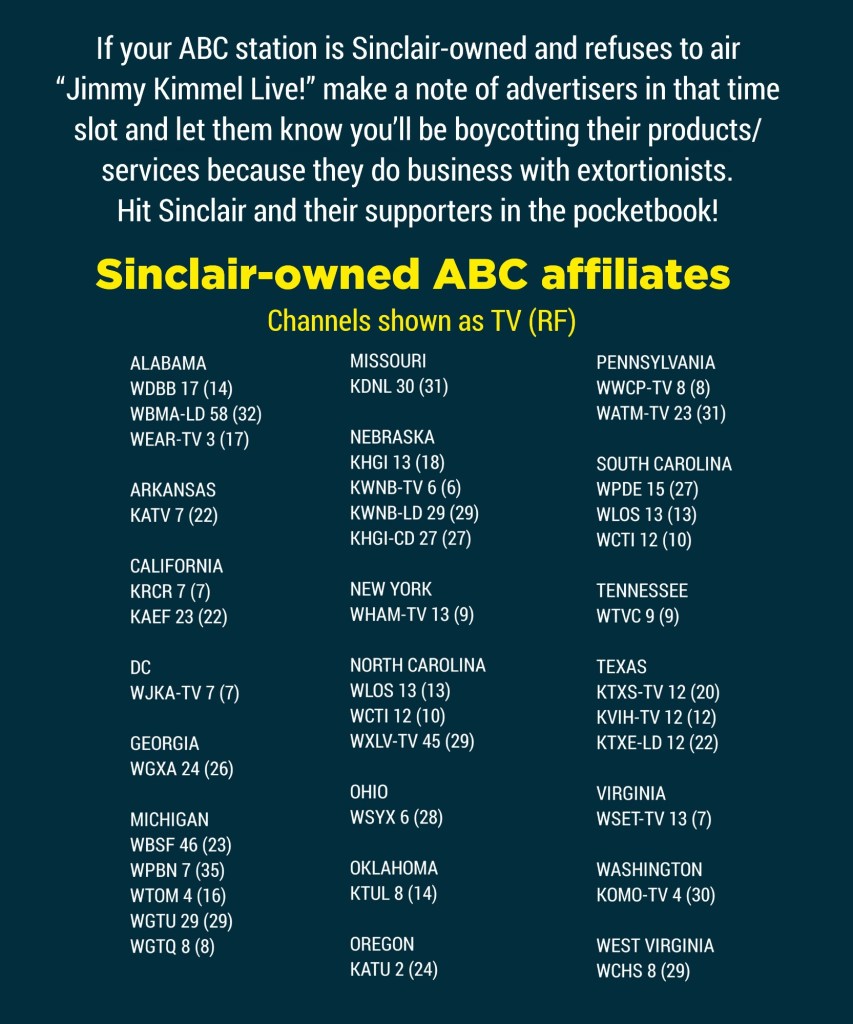
Sinclair owns 39 ABC-affiliated stations across the country, including WJLA-TV in Washington, D.C. The company, along with the nation’s other major right wing local broadcaster, Nexstar, originally demanded Kimmel issue an apology (for doing nothing really wrong), and donate to Charlie Kirk’s right wing outreach (and dim college kid disinformation project), Turning Point USA.
Nexstar is pushing for Trump FCC approval of a $6.2 billion deal merger with Tegna, which is part of a massive new wave of harmful media consolidation under Trump 2.0. The Kimmel saga began when FCC boss Brendan Carr, once again abused the agency’s regulatory approval powers to convince Sinclair and Nexstar that pre-empting Kimmel for criticizing the President would be in their best interests.
That’s clearly an illegal government effort to cancel free speech, and Disney has paid the price already. The censorship effort saw widespread, bipartisan backlash, including (somewhat surprisingly) from the likes of Senators Ted Cruz and Mitch McConnell, and former Fox News propagandist Tucker Carlson. They’re at least aware enough to know that this sort of abuse of government power could inevitably be turned against them.
Sinclair likely still believes that pushing its luck and continuing to “pre-empt” Kimmel gives them additional leeway within the Trump administration, cements their power in the right wing propaganda ecosystem, and makes merger approval more likely. But that’s going to come with an obvious ratings cost, and any costs incurred by those identifying Sinclair stations and contacting their advertisers to complain in the weeks to come:
Ultimately Sinclair and Nexstar may get more harmful media consolidation approved, but it’s likely going to be more trouble than it was worth. The MAGA set clearly thinks they can exploit Charlie Kirk’s death to escalate their war on their ideological enemies, but having been pickled in their own propaganda, one gets the sense they’re really not tuned into how violently unpopular their “movement” is becoming (something set to get worse as the impacts of things like tariffs, the elimination of all corporate oversight, and the evisceration of the social safety net begin to arrive in concussive waves).
Meanwhile, local broadcast television was also already seeing steady viewership declines as their mostly older audience dies off; advertising yourself as a bunch of weird censorial zealots engaged in fake journalism in service to an unpopular idiot king isn’t likely to help the company make inroads with a younger target demographic essential for the company’s longer term survival.
It’s a story as old as law enforcement itself: when protesters start protesting, it’s often the cops who decide it’s time for everything to get violent, rather than those engaged in protests.
We saw a LOT of this during the protests following the murder of George Floyd by Minneapolis, Minnesota police officer Derek Chauvin. Whatever “wrongs” the cops felt they had “suffered” following nationwide protests a few years earlier in the wake of the killing of Michael Brown by a police officer were now multiplied. No one trusted the cops. And the cops, in response, proved themselves completely untrustworthy by turning non-violent protests into violent interactions by attacking peaceful protesters, journalists, and civil rights activists.
Lots of litigation occurred during these protests, and a lot of federal courts declared the actions of officers to be unconstitutional. But it appears no one has learned anything they were supposed to learn. The pattern persists, with law enforcement deciding precedential rulings addressing exactly these sort of violent actions just don’t apply because it’s a different set of protests.
Los Angeles has been invaded by the Trump Administration. In addition to the influx of federal law enforcement officers (mainly ICE, CBP, and Federal Protection Service personnel), Trump sent in the National Guard and the Marines.
Fortunately, the Martial Law Starter Pack hasn’t resulted in military troops beating, assaulting, or shooting residents of Los Angeles. (Yet!) But it has generated a lot of unprovoked — and legally unjustifiable — assaults on citizens by federal officers.
Journalistic entities in the Los Angeles area sued the government for targeting and injuring journalists. And the government is now forbidden from doing several things to people engaged in journalism, as well as people simply engaged in peaceful protest efforts.
This injunction [PDF], handed down in a California federal court, makes it clear federal officers are deliberately targeting people engaged in acts that are firmly protected by the First Amendment. There’s a lot more detailed in this decision, but this set of bullet points gives a good summary of the police violence:
Plaintiff journalist Ryanne Mena was struck by a pepper ball while covering protests in downtown Los Angeles though she stepped away to approximately 20 feet behind protestors. The following day, Border Patrol agents hit her in the head with a rubber bullet while she was observing protestors from about 30 to 50 feet away.
Plaintiff journalist Lexis-Olivier Ray recounts being targeted by volleys of pepper balls while taking cover near a group of media trucks about 50 feet away from the line of officers. See Kerlikowske Decl. ¶¶ 22–35 (averring that DHS’ use of force in firing pepper balls directly at press was excessive and unnecessary).
Plaintiff journalist Sean Beckner-Carmitchel was hit in the head with a tear gas canister while filming protestors from over 20 feet away.
Veteran journalist Ted Soqui was repeatedly hit in the back with pepper balls on two successive days, between 15 and 100 feet from any protestors.
Border Patrol officers hit veteran photojournalist Jonthan Alcorn (who carried professional photography equipment) with a tear gas canister, while he was retreating and over 100 yards from federal officers.
And if you choose not to believe the sworn statements of journalists, the court says there’s plenty of stuff on the record that backs these assertions:
These were not isolated incidents. Indeed, the record includes detailed and credible declarations from nearly 50 journalists, legal observers, and protestors averring that federal law enforcement agents used rubber bullets, pepper balls, tear gas, and other crowd control weapons on them at protests from June 6 through July 10, 2025.
[…]
Moreover, the avalanche of evidence before the Court—along with federal officials’ statement —suggests that federal agents acted pursuant to a common and widespread practice of violating the First Amendment rights of journalists, legal observers, and protestors.
The government claimed it was the journalists’ fault for being too close to the protests they were covering. The court is having none of it:
Defendants attempt to flip this burden. Defendants contend in the main that members of the press and legal observers have not adequately distinguished themselves from “rioters.” But that is not their responsibility. By Defendants’ logic, any journalist seeking to inform the public of the “operations of [its] government,” must be prepared to face serious physical injury if a single protestor launches a plastic water bottle.
Federal officers deliberately violated rights because they thought they’d get away with it. It’s government-sanctioned sadism, even if the government is careful enough to prevent creating a paper trail that endorses sadists/rights violations. As the court notes, the mere existence of policies that outline what is or isn’t an acceptable use of force does the government no favors, especially when those policies appear to have been violated regularly by federal officers.
The government’s counterarguments are so bad that the court is forced to point out it can’t even win this case if the court decides it’s going to take the government’s side, which is something it’s procedurally prevented from doing at this point in the litigation:
Viewed in the light most generous to Defendants, the record reveals that upon encountering any violence—however minor—Defendants indiscriminately targeted in equal measure violent actors and peaceful protestors, journalists, and observers.
The end result? A sweeping injunction forbidding the government from “dispersing, threatening, or assaulting” any journalist or legal observer, along with extensive limitations on force deployment, whether the target is a journalist or just someone engaged in a peaceful protest. On top of that, dispersal orders must be clear and audible, and allow time for people to disperse. Furthermore, “kinetic” projectiles (rubber bullets, beanbag rounds, flashbangs, tear gas, etc.) must be used sparingly and carefully and never used as replacements for actual bullets (targeting people’s heads, chests, etc.) unless there’s the threat of imminent harm to officers or bystanders.
This is how the court sums up its decision and the actions of federal officers in Los Angeles:
[T]he Court concludes that federal agents’ indiscriminate use of force—targeting journalists standing far from any protest activity, launching scorching-hot tear gas canisters directly at people, and shooting projectiles at protestors attempting to comply with dispersal orders—will undoubtedly chill the media’s efforts to cover these public events and protestors seeking to express peacefully their views on national policies.
To be clear, the Court expresses no sympathy for those private individuals who engaged in violence during this period. Indeed, this Order does not prevent any appropriate enforcement of the law against these individuals. But the actions of a relative few does not give DHS carte blanche to unleash near-lethal force on crowds of third parties in the vicinity. Indeed, under the guise of protecting the public, federal agents have endangered large numbers of peaceful protestors, legal observers, and journalists—as well as the public that relies on them to hold their government accountable. The First Amendment demands better.
Which is how it should be. The government shouldn’t be allowed to deter reporting and protests simply because it doesn’t like being protested and/or reported on. But it’s one thing to issue an injunction like this. It’s quite another to force the government to comply. We’ll see how things play out going forward but I’m not going to hold my breath in hopes of federal compliance.