The facts are all up there in the headline, so let’s deal with the lies first. Lots of places reported on this incident, but we’ll go to the original source, WESH TV.
Body cam footage recovered from Lake County (FL) Sheriff’s Office deputy Tristan Macomber’s body cam showed him driving southbound before hitting a stopped vehicle ahead of him, deploying his airbags. Then it showed him fishing around for his phone (which was now on the driver seat floorboard), flipping it over, taking it with him, and heading to the car he hit to apologize.
Then came all the lies.
At the scene, the deputy told officials a vehicle ahead of him was stopped for a school bus with flashing lights when the crash occurred.
Macomber said he tried to stop, but the “brakes on his patrol vehicle locked up,” the report reads.
Furthermore, Macomber advised the patrol car’s speedometer had just been calibrated and the anti-lock braking system (ABS) light had been on since.
The internal report said something else. It said the investigator noticed deputy Macomber had been “holding his cellphone” in his right hand prior to the crash. That led to a new lie:
According to the report, Macomber said he was looking at text messages from his colleagues just before the crash.
Let’s just say some of these lies were true. The second lie is the sort of thing officers cite or arrest people for doing: using their phones while driving. Even if Macomber was engaged in a discussion with fellow officers, he had an obligation to do that safely. Let’s not forget this happened directly behind a stopped school bus, which means Macomber was fortunate to hit another driver, rather than kids being loaded into/unloaded from a stopped school bus.
Investigators reviewed the recordings and saw that Macomber was definitely looking at images and not engaging with an officer-centric group chat. Furthermore, the chat group the deputy claimed to be looking at when he rear-ended an innocent person contained no images.
And, as if there’s anything else damning that really needs to be added here, there’s this:
Body camera footage shows that the deputy was not wearing his seatbelt at the time of the incident, which is another violation.
After getting his narrative shot to shit by investigators, the deputy finally admitted the truth: he had been looking at porn on his phone when he crashed into a car and, apparently, almost crashed into a school bus. But rather than take what was coming to him, Macomber resigned and presumably hopes some other law enforcement agency won’t do a bit of Googling while considering his job application.
Perhaps the best part of this debacle is that pretty much every news agency covering this has refused to sugarcoat the truth. Here’s the headline from the Express Tribune’s coverage:
Police officer crashes car while watching porn
And this is WCSC TV’s report (which contains nothing more than a recording of its newscast covering the incident), which contains a headline equally succinct:
Deputy crashes patrol car while watching porn
Finally, there’s this, which isn’t quite as fun. Here’s the official terminology for the violations Macomber engaged in while looking at porn on his phone while driving, as reported by the Miami Herald:
Officials determined he had committed three violations: departure from the truth in giving testimony or in connection with any official duties, certain use of electronic handheld devices prohibited and use of safety belt.
Even the rulebook is so reflexively exonerative, it can’t be bothered to call a lie a lie. Instead, it’s a “departure from the truth.” While it’s technically correct, it’s also worded specifically to soften the blow of the charges brought against liars with badges, as well as meant to downplay the severity of these actions. It’s a good thing the feds weren’t brought in for this. Say what you will about the routine abuse of “lying to federal officers” charges, but at least they call it lying or obstruction, rather than pretending it’s nothing more than crossing the fog line of truth.
To quote the relevant part for those who can’t view the video or would just prefer me to put my cop-hating in plain text, here it is. Yumyulack, an alien, is trying to achieve fulfillment by helping people. His sci-fi ray teaches a baby to read. He zaps the person pushing the stroller, who protests she already knows how to read because she’s a famous novelist.
He then zaps her hat and her car, resulting in her calling the cops because the alien is “educating her things.” He then zaps a cop, who says:
Oh God! I can read! What if I gain empathy? What if I learn things that force me to reevaluate my hardline conservative opinions?
And there you have it. This is all extremely relevant.
That person, as Jason Koebler reports for independent outlet 404 Media, is Marianna Cochran, the founder of CleanBooks4Kids. She’s one of those people. You know the ones I mean. The people advocating for the silencing of voices related to minorities and anyone not explicitly heterosexual. Ignoring the hundreds of explicit romance novels available to any pre-teen with a library card, Cochran has made claims (without facts in evidence) that libraries and librarians are pushing smut to kids and are staffed by groomers.
Because both she and Sheriff Robert Norris agree libraries are just dens of underage sexual iniquity, Sheriff Norris (who is supposed to serve everyone in the county, not just one particularly vocal idiot) decided to flip on his body cam and go hunting for the supposedly immediately recognizable filth that has Cochran so upset she formed a group catering to the most small-minded people in her community.
Cops have never been great at understanding the law. This often works out for them. They’re even worse when it comes to understanding the legal boundaries of free speech, even when they fervently believe they’ll know obscenity “when they see it.”
This would be surreal enough if the recording had originated in a foreign country. But this happened here, the nation where free speech protections have been part of this country since its origination.
Here’s Koebler, describing some of the hideous/hilarious incidents captured by the sheriff’s body cam. It begins with one bigot (Marianna Cochran) telling another bigot (Sheriff Norris) the things she’s supposedly observed in this very library.
Cochran tells him that there is a “whole series” of books by the same author which feature “gay orgies, the whole deal. Prostitution.” Identical is a 2010 novel by Ellen Hopkins about twin sisters, and deals with themes of domestic sexual abuse.
Cochran also claimed a poster in the library recently featured books containing a “preponderance of demonology and witchcraft.” She does not, however, share any photos of said poster or contribute any other evidence to back this claim.
Walking through the library with Cochran, Sheriff Norris does his best to obtain evidence of obscene material within immediate reach of minors. This does not go well.
They walk into the library, and for the next 45 minutes search for “obscene” books in the Young Adult section while Norris’s camera is rolling in one of the most bizarre police body camera videos I’ve ever seen. During the visit, Norris is annoyed to learn that Identical isn’t actually at the library. He also learns what a “graphic novel” is, and spends most of his time flipping silently through graphic novels.
The frustration over this pair’s inability to find a copy of the book that has them so hot and bothered soon bubbles over. Cochran tells Sheriff Norris several things that are true about nearly every library in America, not just the one where two stupid people are misinterpreting obscenity statutes to engage in an act that most people would only assume occurs in countries headed by autocrats: the literal policing of the printed word.
Cochran points out that the library (like thousands of others) operates a bookmobile, allows patrons to check out their own books using self-service stations, and provides inter-library loan services, which allow readers to request books not currently on the shelves at their local library. To Cochran, this is evidence the library is aiding and abetting in the poisoning of children’s minds. To anyone else with half a brain (Sheriff Norris not included), this is just how libraries operate to best serve their clientele: the reading public.
Refusing to let this initial failure slow them down, Cochran performs an internet search and presents the search results as evidence of… well, who knows what the fuck… to the sheriff.
After the disappointment over Identical, Norris and Cochran begin looking for other books they find distasteful. She shows him a series of printouts from BookLooks.org, which catalogues the number of times words like “Ass, Cunt, Fag, Fuck, Goddamn, Piss, Prick, and Shit” are written in various books and includes excerpts listed by page number of content that it believes could be “of an ADULT nature.”
Bringing the sheriff a couple of other graphic novels (a term the sheriff isn’t familiar with), Cochran continues to insist the law is being broken, even as she admits the graphic novels she’s showing him aren’t actually explicit.
She brings him another graphic novel (Fence, Vol. 2, about fencing). “There’s nothing blatant in here. Nothing blatantly sexual. I think there’s just no innuendo at all. These guys on the team, this is an intentionally very androgynous character. All the girls falling for him in the beginning of the book, but it’s made clear later in the book that, you know, he prefers boys. Is that necessary? Illegal? No. Unnecessary? Yes,” she says.
The sheriff continues to page through a handful of graphic novels. Finding nothing worth seizing and/or arresting anyone over, the sheriff says to his body cam that maybe the library could put “PVC pipe, a drape, or something” over an area housing the books even the sheriff can’t credibly claim might be inappropriate for minors.
This quasi-raid occurred last year. Sheriff Norris — along with his bigoted compatriot — have already made a bit of hateful hay from this complete failure to discover supposedly illicit material at this library.
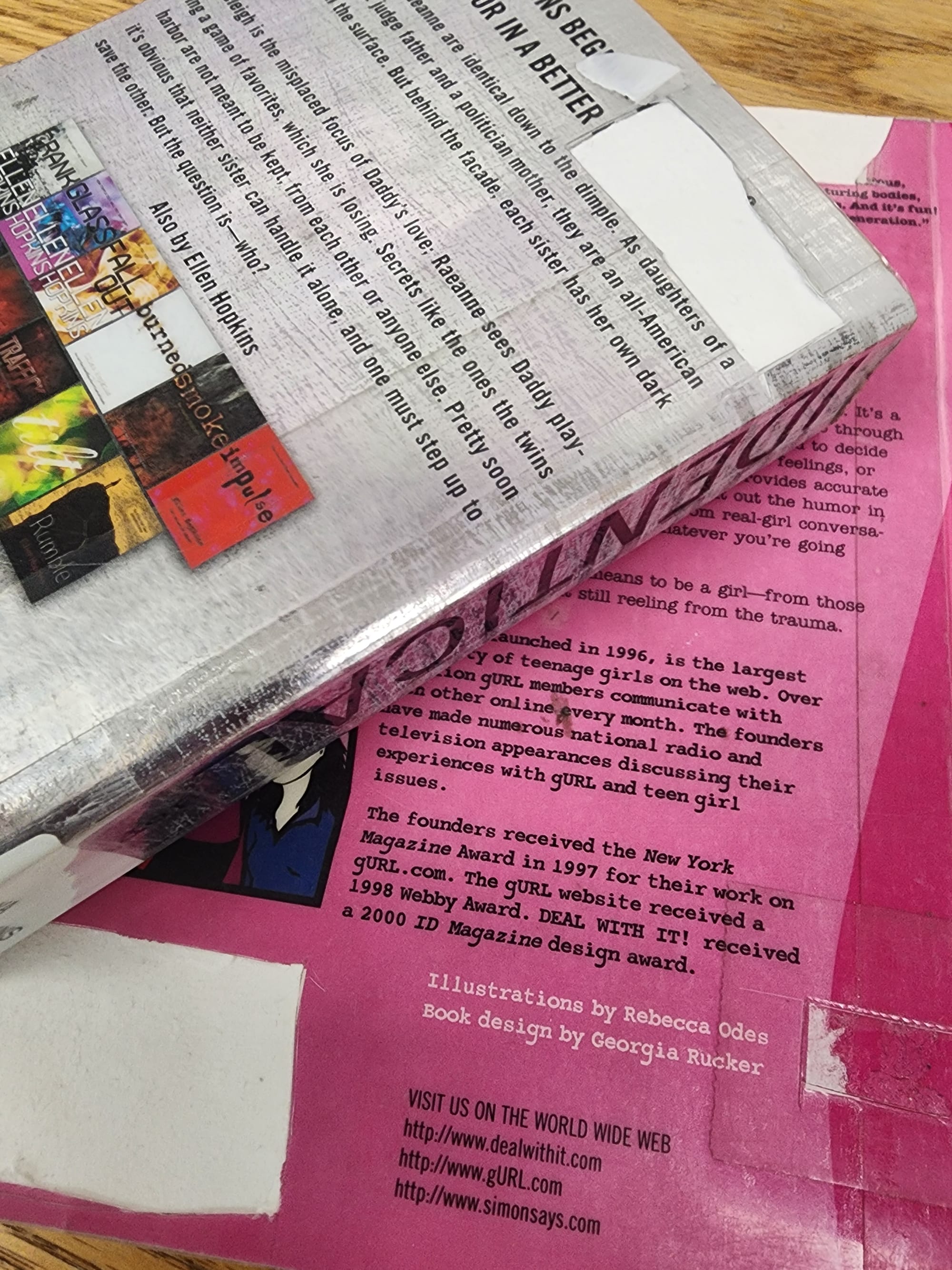
Norris’s antics with the library went viral last year, when he bragged at that meeting about the body camera stunt. At that meeting, he holds up copies of the books Identical and Deal With It! A Whole New Approach to Your Body, Brain, and Life as a gURL. “I took a body cam and went to a library. I went to the teen section of the library and I saw children, kids that were not of teenage years, this is the teen section of the Hayden Library, I wanted to see it for myself,” he says. He then holds up Identical and Deal With It, and has a community member hand the books to a teenager. “Now that,” he says, “is against the law … I have read this book and it’s disgusting for it to be for children ages 13 through 19” (18 and 19 year olds are adults, obviously).
The real facts are that two of the books referenced had not been checked out from the library he searched. One was checked out from another library (not the one he searched) and the other had been reported as stolen. The other books were seized by the sheriff, who originally refused to return them. When he finally decided to return them, he had removed the library barcodes and UPCs, making it impossible for the library to loan them to anyone until they were re-labeled or replaced.
This is not what we, as Americans, expect law enforcement officers (and especially, law enforcement officials) to be doing with our tax dollars. This recording is the honest portrayal of what happens when two people filled with irrational hate combine forces. Marianna Cochran is an idiot and irritant. But without the willing assistance of Sheriff Norris, she’s nothing more than a particularly pesky insect. But now that she has Sheriff Norris in her corner, she’s nothing more than a censor who has the luxury of pretending she’s speaking for the people while turning their own public servants against them.
If you’ve done nothing wrong, you have nothing to hide, right? That’s what law enforcement and surveillance agencies tell us, coaxing us into letting our guard down so they can dig into our stuff without worrying about little things like probable cause.
Cops like to do their work without creating narratives they can’t challenge. Hence the resistance to recording devices, despite the fact body cameras remain far more useful to prosecutors than to members of the public demanding better police accountability.
The Los Angeles Police Department is host to myriad problems. Among those many problems are its officers. Los Angeles is home to a number of gangs. It’s also home to a number of officers who believe the best way to police the gang problem is to generate junk data (which is then fed to its crime fighting AI) and engage in bogus enforcement activity.
One of the generally accepted methods of handling gang crime is allowing officers to call pretty much anyone they run into a “gang member.” On top of that, there’s the LAPD’s “gang unit,” which is supposed to be composed of officers with specific skills that allow them to more effectively grapple with the city’s gang problem.
Instead, it appears “gang unit” is a name that generates the wrong connotation. Instead of insinuating these are gang-focused crime fighters, the name could be read to mean the “unit” is just another “gang” (like those so common in the Los Angeles Sheriff’s Department) that thinks fighting crime means being aggressive, violent, and unwilling to comply with PD rules.
Several members of an LAPD gang unit that is often responsible for serving warrants on suspected criminals recently found themselves on the other side of the equation — as subjects of search warrants that allowed the department’s internal affairs investigators to take the rare step of inspecting their lockers.
The precise nature of the allegations against officers remains unclear, but, according to multiple sources who requested anonymity because they are not authorized to speak publicly about the ongoing investigation, some of those targeted by the search warrants were found to have routinely switched off their body cameras during traffic stops.
Come for the locker searches. Stay for the last sentence. “Routinely switched off their body cameras.”
Policies say this isn’t allowed. These cops don’t care. And, up until now, their refusal to comply with body camera policy hasn’t affected their jobs.
But now it is. And for good reason. If you’re doing your job right, you won’t care that it’s being documented by the narc pinned to your chest. But if you’re doing it wrong, you’ll want to make sure the eye blinks when told to in order to deliver the narrative that supports whatever violations you’ve just engaged in.
While officers may decide they have nothing to fear from internal investigations performed by people most cops consider to be traitors (read: Internal Affairs), these gang unit officers are now up against an agency that doesn’t care what LAPD gang unit members think of it.
The FBI has joined a widening investigation into a Los Angeles Police Department gang unit whose members are accused of routinely failing to document their actions during traffic stops, an alleged pattern of deception that Mayor Karen Bass called “very disturbing.”
Sure, the FBI has its own problems that it won’t fix, but its involvement here means the LAPD can’t continue to ignore selective on-the-fly-editing of body cam footage by gang unit members. Instead, it will have to face whatever’s uncovered by the FBI, which has the power to force the LAPD to hand over data and documents it would never hand over voluntarily to anyone else, including its own in-house “oversight.”
The investigation was triggered by a complaint from a driver who claimed he and his car were unconstitutionally searched. But before this could be swept under the rug and/or dismissed as the rantings of a person who didn’t enjoy their last interaction with LAPD officers, enough was discovered that locker searches were ordered and the FBI invited into the fold.
Two gang unit officers were found to have “not properly documented the detention, or their actions.” By switching off their cameras until they moved forward with an arrest, the officers obscured the events that led to this action. And that discovery led to more discoveries: the two officers involved were found to have done this on multiple occasions, allowing their body cameras to record only what the officers wanted them to record.
Two officers may not seem like much given the number of officers the LAPD employees. But if two officers felt comfortable doing this, it would be insane to believe these were the only two officers who felt OK with editing the permanent record on the fly. Hence the IA investigation. And hence the likely more effective FBI investigation.
Tip of the iceberg, as they say. There will be more to come. The rules have changed for the LAPD and its gang unit. But that doesn’t mean officer behavior has been altered.
According to an LAPD online dashboard, the Mission gang unit is among the most active in the city’s 21 police divisions, but nearly 10% of the unit’s traffic stops were considered pretextual, meaning officers used minor traffic violations as a reason to pull over vehicles and search them for evidence of more serious crimes. The data show the Mission‘s has the highest rate of such stops among all of the department’s gang units.
In March 2022, the department tightened its rules on pretextual stops, after years of pressure from police reformists and politicians who argued they disproportionately affect people of color.
You can take the bias out of the policy, but you can’t take the bias out of the officer. The policy alters the contours for pretextual stops. It also mandates officers record the justification for the stop on the body cameras when performing a pretextual stop.
Judging from what’s been revealed so far, we can make an educated guess as to what’s happening. The pretextual stops are continuing in violation of department orders. Covering up this violation of policies means not recording the information department policy mandates. It’s the cop version of asking for forgiveness, rather than asking for permission. And that version means never asking for forgiveness.
A law unto themselves. That’s the gang unit officers caught so far. There will be more. And by the end of it, people will have even less reason to trust cops, nor any reason to believe their primary interests are protecting and serving anyone but themselves.
Two years after cops killed Ronald Greene following a car chase, the Louisiana State Police have finally released the recordings. Greene led officers on a high-speed chase before being stopped, subdued, and ultimately killed. Here’s how the State Police described it two years ago when it still had control of the narrative.
Greene allegedly sped away, and a chase continued for over 20 miles until Green wrecked near the intersection of Louisiana 2 and Highway 143 in Union Parish.
After the wreck, troopers allegedly attempted to take Greene into custody. An altercation with troopers allegedly followed until Greene was handcuffed.
According to LSP, Greene became unresponsive after emergency responders arrived on the scene and died on the way to the hospital.
Lots of really passive writing here, with an altercation “allegedly following” and Greene magically “becoming unresponsive” but not until after emergency responders arrived.
Greene’s family has said that police initially told them he died on impact when his car crashed on May 10, 2019, after a police pursuit.
And the officers told the coroner’s office roughly the same thing:
An initial crash report from state police did not mention there was a struggle between Greene and the officers.
The final report from the coroner’s office noted the injuries were inconsistent with those sustained from a car crash. It noted Greene had a fractured sternum and multiple contusions. It also noted the LSP seemed uninterested in helping the office perform an accurate autopsy.
The autopsy, prepared by the Union Parish Coroner’s Office, states in its opinion section that lacerations of Greene’s head were “inconsistent with motor vehicle collision injury and most consistent with multiple impacts from a blunt object.”
The report notes that “no written incident report was provided despite requests,” and that “no detailed information regarding the motor vehicle collision … was provided. It also notes that “no emergency services medical records were provided” to the coroner’s office.
The fix was already in. The coroner’s office ultimately decided there was no one to blame for the death other than the injuries and the substances in Greene’s system, ultimately chalking it up to cardiac arrest. But now that the recordings have been released, it’s pretty clear Greene might have survived the encounter with LSP officers if they hadn’t been so enthusiastic about beating him.
Louisiana state troopers were captured on body camera video stunning, punching and dragging a Black man as he apologized for leading them on a high-speed chase — footage of the man’s last moments alive that The Associated Press obtained after authorities refused to release it for two years.
“I’m your brother! I’m scared! I’m scared!” Ronald Greene can be heard telling the white troopers as the unarmed man is jolted repeatedly with a stun gun before he even gets out of his car along a dark, rural road.
That was just the beginning. The entire ordeal lasted almost 45 minutes. For much of the recording, Greene and the officers can’t be seen. When they do reappear, Greene is covered in blood and already pretty much unresponsive. And he’s surrounded by people who have no interest in keeping him from dying.
The 46-minute clip shows one trooper wrestling Greene to the ground, putting him in a chokehold and punching him in the face while another can be heard calling him a “stupid motherf——.”
Greene wails “I’m sorry!” as another trooper delivers another stun gun shock to his backside and warns, “Look, you’re going to get it again if you don’t put your f——- hands behind your back!” Another trooper can be seen briefly dragging the man facedown after his legs had been shackled and his hands cuffed behind him.
Instead of rendering aid, the troopers leave the heavyset man unattended, facedown and moaning for more than nine minutes, as they use sanitizer wipes to wash blood off their hands and faces.
“I hope this guy ain’t got f—— AIDS,” one of the troopers can be heard saying.
The fine public servants of the Louisiana State Police, wondering whether the beating they’ve just inflicted might possibly injure them. And there’s more. One trooper, Chris Hollingsworth, can be heard in a separate recording telling other troopers at the station that he “beat the everliving fuck” out of Greene.
There should be more recordings. But of course there aren’t. Another trooper, Kory York, was suspended without pay for failing to activate his body cam. Six troopers responded to the scene but only one appears to have activated his camera. At one point during the sole recording, the microphone is deactivated, leading to even less information being captured.
The LSP may claim no coverup took place but that’s hard to square with the initial reports handed to Greene’s family and the coroner’s office — both of which suggested a car accident was to blame for Greene’s injuries and death. And it took the LSP 474 days to even bother opening up an investigation into the incident, suggesting LSP officials either didn’t want to know what they’d find or, more likely, didn’t want to give the public any way of discovering what had actually happened that night.
If you want the public to trust you, you can’t lie to them for months and let a questionable incident go uninvestigated for a year-and-a-half. The Louisiana State Police has proven itself unworthy of trust — both in its inaction and its officers’ actions, which needlessly ended a man’s life and went mostly undocumented because the troopers knew better than to record their own excessive force and rights violations. It shouldn’t take two years for the truth to come out.
A 19-year-old woman whose hands were cuffed behind her back when she committed suicide during a traffic stop in Chesapeake died of a gunshot wound through the mouth, according to the Office of the Chief Medical Examiner.
This is the official line — one repeated several times by local journalists. The traffic stop leading to this highly unlikely conclusion occurred July 25, 2018. Here’s what the Chesapeake Police Department said then:
Officers pulled over the car at 4:24 p.m. Wednesday near the intersection of Berkley Avenue and Wilson Road, police said in a news release Wednesday afternoon.
The exact timeline is not clear, [spokesman Leo] Kosinski said. As officers used a stun gun on the driver, Wilson, who was a passenger, shot herself, he said. Police attempted life-saving measures and called for medical assistance, but she died at the scene, the news release said.
The original report also noted the PD was looking at body cam footage from the scene to determine what happened.
Police had handcuffed Wilson when Medlin began resisting arrest and trying to flee, said Officer Leo Kosinski, police spokesman. Wilson was left standing next to the passenger side of the car while police rushed to help the officer who was trying to arrest Medlin, he said.
It was then that Wilson somehow got a gun and shot herself in the head, Kosinski said. It was not immediately clear how Wilson got the gun, but it was not a police weapon, he said.
“We clearly ruled that it was a suicide,” Kosinski said.
“We.” I guess that means the PD since the medical examiner didn’t hand down his declaration until March 14, 2019. The police department, however, made its own unscientific findings public twice in one week.
As for the body camera footage, there was nothing usable there.
One officer was wearing a body camera, but it was “knocked offline” while Medlin was fighting the officer, Kosinski said. If the camera hadn’t gone offline, it still wouldn’t have recorded the shooting, Kosinski said, because the officer was struggling with Medlin.
The police department has 356 cameras and deploys “40-60 per shift.” The department has 525 officers so it seems the odds were in favor of there being multiple cameras on the scene. But the only footage recorded didn’t capture the incident. Multiple police cruisers were on the scene, but the Chesapeake PD decided to eliminate dash cams when it acquired body cameras, removing one more impartial witness.
With the official word from the state, the Chesapeake PD closes the book on an extremely dubious “suicide.” Whether this is just a bunch of lies or some very terrible police work, the end result is the same: someone in handcuffs ended up dead. The odds that this person decided to escalate a traffic stop to a successful suicide attempt are incredibly low. Something fucked up happened that afternoon and the police department hasn’t even attempted to explain how something like this might have happened. Since the medical examiner has spoken, the Chesapeake PD has decided it’s no longer obligated to provide an explanation.
The CPD launched an internal investigation into Wilson’s suicide in July. Kosinski confirmed that the department has since concluded that investigation, but declined to comment on its outcome.
Worse, there’s been no pushback from the local media covering this arrest and its ensuing, and completely unbelievable, suicide. This isn’t journalism. It’s stenography.
With so many police forces being saddled with body cams against their (or their union’s) will, you’d think this form of public accountability (but not really, because so many legislators are helping cops opt out of the “accountability” part) was foisted upon law enforcement by axe-grinders looking to finally expose the proverbial “bad apples.” There’s some truth to that, seeing as some of these implementations have originated as stipulations in settlements with the DOJ.
The young woman in the video attempts to set the officer up by using her phone to record an audio only performance meant to make it appear as though he was acting inappropriately. She was attempting to ‘flip the script’. What she failed to realize is that the entire thing, including her devious performance, were recorded.
Audio-only: for when you want a certain version of the “truth” on record. (Still a step ahead of the FBI’s pen-and-paper interrogation “recordings…”) After failing a field sobriety test, this woman thought she could turn an embarrassing arrest into sexual assault allegations. She asks to use the restroom, and while in there, wonders aloud (a bit too aloud, apparently) how she can get her arresting officer in trouble. Cue the false accusations of “inappropriately touching” her while she was in the squad car and her saying, “Please don’t touch me” when the officer is outside the bathroom door, getting this all down on his body cam.
Now, while this does show that body cams can help cops, rather than just “hurting” them, there’s still the issue that far too many agencies retain strict control of the resulting footage. This was released by the involved police department — something likely expedited by the fact that the recording showed no wrongdoing by the officer. The real test of this department’s transparency will come when the disputed footage isn’t nearly as flattering.