“Senior White House officials recently discussed antitrust concerns surrounding Netflix’s interest in acquiring the Warner Bros. studio and the HBO Max streaming service – raising doubts whether such a deal would give Netflix too much power over Hollywood, The Post has learned.
The high-level meeting that took place about 10 days ago hasn’t been previously reported. Several White House officials also suggested during the sitdown that a broader investigation is necessary focusing on Netflix’s market power, a government official who attended the confab said.”
Most media coverage of these rival bids won’t have the backbone to make it clear that while Netflix ownership of Warner Brothers would most certainly probably be bad for the market, the Trump administration doesn’t actually care about that. It cares about helping billionaire allies and punishing “woke” companies that platform too many minorities and gay people for their liking.
Netflix ownership of HBO likely wouldn’t be good for the brand, but it’s not like Warner Brothers Discovery or AT&T were good for the brand (or market health) either. David Zaslav has been notorious for mismanaging the home of CNN and HBO. And Netflix, as the New York Times noted last September, is possibly the least overtly compromised of the three companies when it comes to kissing MAGA ass (which isn’t saying much, and certainly isn’t guaranteed to last).
In this case, the options here are all bad. The other bidders for Warner Brothers, HBO, and CNN include Comcast (NBC Universal) and Larry Ellison (CBS). Neither would be good stewards of the HBO brand, clearly don’t give much of a shit about healthy market competition, and have shown they’re more than willing to throw any remaining principles in the trash to curry favor with the administration.
The best and correct play for a government that actually cared about antitrust reform, consumer protection, and healthy markets would be no additional consolidation at all. But good faith media reform is not, and has never been, what the Trump administration is after.
We’ve documented in detail how the whole AT&T–>Time Warner–>Warner Brothers Discovery merger process has been a pointless mess, resulting in no limits of layoffs and damage to the underlying brands. What was supposed to be a gambit by these companies to dominate streaming TV, wound up being a very expensive act of seppuku by over-compensated executives clearly out of their depths.
The merger disaster was particularly hard on HBO, once the pinnacle of prestige television. AT&T executives were obsessed with distancing themselves from the popular brand, and their decisions (like demanding Game Of Thrones be shot in short-form verticality so it would be easier to watch on phones) showed they really didn’t understand what made HBO popular in the first place.
“The result was that HBO, the most premium of premium TV companies, became absorbed into something that was meant to be a Netflix-killer.
As HBO Max CEO Casey Bloys told reporters Nov. 20 in the company’s Hudson Yards offices, that ended up being a fool’s errand: “To Netflix’s credit, as the first mover, they have become a utility for consumers,” Bloys said. “In retrospect, we can all see that the streaming industry’s race for volume, years ago, found many brands losing their identity.”
So HBO is hoping to focus on being the kind of company that made it originally popular in the first place, nine years after AT&T originally signaled its intention to acquire Time Warner. Nine years for these guys to figure out that they should stick to what they’re good at: quality television.
Unfortunately, there’s some bad news for Bloys.
Warner Brothers is about to be purchased by the Ellisons, who are on a massive acquisition spree (TikTok, CBS, the exclusive rights to MMA). All of these deals are going to saddle HBO’s new parent company with mountains of debt. And just like AT&T, Time Warner, and Discovery, that’s going to result in an entirely new wave of layoffs, quality erosion, and price hikes to recoup the investment.
And this is all going to happen before the damage from all the past pointless consolidation deals (including ongoing layoffs from Paramount’s acquisition of CBS) have even fully formed.
It’s also going to result in an entirely new wave of trust fund brats, out of their depths and obsessed with scale, trying to “tweak” the HBO formula so they can obtain impossible scale by being everything to everyone. They’re going to look at the hard lessons HBO experienced over the last nine years and… completely ignore them and repeat all the same mistakes. Write it down.
As we’ve documented, Trump’s right wing billionaire friend Larry Ellison (and his nepobaby son, David) recently acquired CBS and likely co-ownership of TikTok. Like Elon Musk’s acquisition of Twitter, the goal isn’t really subtle: Rich right wingers want to own the entirety of U.S. new and old media, then convert it into a giant propaganda and lazy infotainment mill that blows smoke up their asses.
There’s a wrinkle though: both Comcast (NBC Universal) and Netflix are also rumored to be interested in acquiring some or all of Warner Brothers (HBO being the prize). As we’ve noted repeatedly, as the streaming market saturated these executives have shown they’re all out of original ideas. The only way to goose quarterly earnings is more pointless, generally harmful consolidation:
“This could be Comcast’s last shot at transforming NBCUniversal into a long-term structural winner in media,” LightShed Partners analyst Richard Greenfield wrote in a note to investors. “If Paramount or another buyer acquires Warner Bros., there would be no obvious merger partner for NBCU.”
It’s pretty clear that Trump’s DOJ and FCC are likely to erect hurdles and obstacles making it difficult for anybody to outmaneuver Larry Ellison here. It should be interesting to watch Trump lackeys like Brendan Carr twist themselves into pretzels trying to pretend they’re conducting an equitable merger review. It should also prove interesting to see in what new ways Netflix and Comcast execs are willing to debase themselves.
Whoever wins the bid, we all lose. Warner Brothers is already the shredded husk of what was left after decades of similar, pointless consolidation, starting all the way back with the pointless AOL deal in 2001, then later layoff and chaos inducing acquisitions by AT&T and Discovery.
Skydance, Paramount, and CBS haven’t even finished firing employees due to their last series of pointless mergers. Now they’re already gearing up to generate massive new debt to acquire Warner Brothers and CNN. That’s going to result in all the usual additional layoffs and corner cutting, before you even get to the problem of letting Larry Ellison turn CBS and TikTok into right wing propaganda outlets.
Netflix and Comcast winning this bid is probably the best of a bunch of bad outcomes, but that’s going to require that both companies seriously level up their ass kissing of our mad, idiot king.
That has involved chasing pointless “growth for growth’s sake” megamergers, imposing bottomless price hikes and new annoying restrictions, undermining labor, and cutting corners on product quality in a bid to give Wall Street that sweet, impossible, unlimited, quarterly growth it demands.
Last week Warner Brothers announced it was up for sale; ushering forth yet another acquisition or merger after literally two decades of terrible, harmful mergers (AOL, AT&T, Time Warner, Discovery) resulting in endless price hikes, layoffs, and dysfunction. And if as on cue, the company announced they’d be once again hiking prices on their HBO (Max Extreme Plus) streaming video service:
“HBO Max’s ad plan is going from $10 per month to $11/month. The ad-free plan is going from $17/month to $18.49/month. And the premium ad-free plan (which adds 4K support, Dolby Atmos, and the ability to download more content) is increasing from $21 to $23.
Meanwhile, prices for HBO Max’s annual plans are increasing from $100 to $110 with ads, $170 to $185 without ads, and $210 to $230 for the premium tier.”
The move comes after Warner Bros CEO David Zaslav spent much of last month whining about how the company’s streaming service was “way underpriced.” Despite the fact the company has raised prices every year for the past three years. Zaslav himself has been endlessly criticized for his soaring compensation package that’s never been commensurate with any sort of actual leadership skill.
Again: these are executives all out of original ideas, boxed in by Wall Street’s demand for impossible, endless growth. They can’t deliver consumers and labor what they want (better pay, better product, lower prices, better customer service), so execs have to resort to financial trickery, price hikes, and megamergers to goose stock valuations and provide significant tax relief.
They’re not building or improving anything, they’re just engaged in an elaborate shell game where they shuffle things around and pretend they’re savvy deal makers.
If you’re not familiar with what happens next: Warner Brothers is sold (probably to Larry Ellison and Paramount/CBS, which is already laying off people from its latest merger). The massive debt load triggers even more layoffs and additional price hikes, the quality of the overall product continues to deteriorate, and annoyed customers flee to fee alternatives, including piracy.
At that point the executives responsible blame everything but themselves (generational entitlement! VPNs!) until companies are finally forced to face evolutionary disruption by more convenient, cheaper alternatives, at which point the execs responsible have taken their bag and failed upward to other companies. And the cycle repeats itself all over again.
The sort of executives who fail upward into positions of prominence at major media and streaming companies are all out of original ideas. So as the Wall Street pressure for impossible, perpetual quarterly growth mounts, they’ve increasingly resorted to the same tactics we’ve long seen at major shitty cable companies like Comcast.
“Several months of testing has enabled WBD to determine “who’s a legitimate user who may not be a legitimate user,” Perrette said. Once that is determined, he continued, the next step is to “turn on the more aggressive language around what needs to happen” in order to and make sure that “we are putting the net in the right place, so to speak.”
You might recall that early on, streaming executives loved password sharing. HBO and Netflix saw it as effectively a form of free advertising, which would encourage people to sign up for service. They actively encouraged it. But now that U.S. streaming growth has saturated in the U.S., they still need their improved quarterly returns. And you certainly can’t achieve that by spending more money on labor and content.
So the push is afoot to generally cut corners and goose profits, or enshittification. In streaming, that also includes harassing people who used a friend’s or parent’s password into signing for their own service. The executive assumption is that people will actually want to do that, as opposed to say, just cancelling service or pirating the content with a VPN and BitTorrent.
It’s understandable executives want people viewing their streaming content to pay for it. The problem is that with the other hand, these same executives, through harmful mergers, new restrictions, price cuts, layoffs, and general quality erosion, are ensuring that it’s less compelling than ever for consumers to actually sign up for their own account.
There’s really no escape from this doom loop, as traditional cable companies long demonstrated. The kind of stuff streaming consumers want (better customer support, lower prices, better features, higher quality content) hurt quarterly revenues. So the process switches to a form of product and brand cannibalization by the extraction class, which is where enshittification enters the frame.
Some of these efforts may temporarily goose earnings (the press tends to credulously parrot claims password sharing crackdowns are goosing earnings, even though streaming companies usually offer no hard data to confirm it), but ultimately the check comes due in the form of merger debt and customer defections. At that point, the executives responsible have likely already moved on to other companies to engage in the same sort of “savvy deal-making,” and the cycle begins again.
When piracy inevitably sees a resurgence, the media executives that remain will blame everything (generational entitlement! China! VPNs!) but themselves. And the cycle continues until piracy or new market disruption forces the companies in question to re-assess their choices. That last part, as the cable TV industry’s slow migration to streaming demonstrated, always takes much longer than it should.
We’ve noted in detail how the AT&T/Time Warner/Discovery mergers have been an apocalyptic mess that aptly demonstrates the U.S. obsession with utterly pointless megadeals and the “growth for growth’s sake” mindset. Hundreds of billions of dollars later and the companies have produced a product that’s notably shittier than when they started, laying off thousands of people, cancelling popular shows, and leaving the company’s catalogs with new, weird gaps due to a refusal to pay residuals.
You’ll recall that this all began with AT&T’s disastrous $200 billion acquisition of Time Warner and DirecTV in a clumsy bid to dominate the video ad space. When that failed, AT&T spun off Time Warner, which was quickly merged with Discovery in yet another deal that’s been almost as bad for employees, consumers, and creators.
“Dropping HBO from the name is cementing that ‘we’re not just a home for premium programming,’” Ms. Alexander said. “‘We’re the home for anything you want to watch.’”
The HBO brand has been synonymous with quality for fifty years. But the shift away from quality to low quality mass consumable dreck began under AT&T in 2018 and continues here. Just a continuing array of strange branding and marketing from a team of executives that have, at absolutely no point, indicated that they have any idea what they’re doing or what users want. And it shows in the ratings:
According to Nielsen, 1.3 percent of the total minutes spent by Americans using television was with HBO Max in February, a fraction of what YouTube (7.9 percent), Netflix (7.3 percent), Hulu (3.3 percent) and Amazon Prime (3 percent) garnered. HBO Max instead finds itself in the same neighborhood as Comcast’s Peacock and the Fox Corporation’s free advertising-supported streaming service, Tubi.
Keep in mind, that under AT&T this company integrated so many different dumb streaming branding names that they confused even the company’s own support employees. Now, what’s left of the company is further distancing itself from the popular HBO brand, launching a $16 a month streaming service just called “Max” sometime in May or June. HBO will continue to exist as a cable channel, for however long cable channels continue to exist.
It can’t be repeated often enough that this entire megamerger saga, from AT&T to now, involved companies spending burning hundreds of billions of dollars to make a worse product, fire untold people, cancel numerous popular programs, and even kill Mad Magazine.
Now maybe this whole gambit works out, and offering lower-quality dreck (I think often about the “Ow, my balls” TV show in Idiocracy for some reason) really works out for them. But I still tend to think its a lovely demonstration of the idiocy of pointless megadeals, which routinely harm consumers and creators so some unremarkable MBAs can get a tax break and put “savvy dealmaker” on their resumes.
Look, we all knew that there was going to be a lot of fuss about the upcoming public domaining (finally!) of Mickey Mouse nine months from now on January 1, 2024. I mean, we’ve already been talking about what next year’s public domain game jam is going to look like with Mickey as one of the options.
If you somehow have been living under a rock and never read anything on Techdirt before, let’s get you up to speed. Mickey Mouse debuted as Steamboat Willie in 1928. The character was a blatant animated copy of Steamboat Bill, a Buster Keaton silent film that came out… the same year. Disney, of course, also built up much of its success by taking public domain stories and animating them.
But, of course, once Disney became the Walt Disney Corporation, it chose to lock up everything it could. Disney has been absolutely famous for its aggressive copyright lawyering for years, which included what we’ve referred to as the Mickey Mouse curve: every time Mickey Mouse started to get near the public domain, a purely coincidental thing happened where Congress would (totally unrelatedly) extend copyrights:
The last extension, the 1998 Sonny Bono Copyright Term Extension Act was quite frequently referred to as the Mickey Mouse Protection Act.
Over the last few years there remained concerns that Disney would try to extend copyrights once again, but I think once the public rose up against SOPA in 2012, Disney and most of the rest of the copyright legacy players realized that there was no chance they were going to extend terms again. Hell, even Maria Pallante, one of the more extreme copyright maximalists (currently trying to kill libraries) while she was head of the Copyright Office, suggested that maybe it was time to cut back on copyright terms, rather than extend them.
And so, everyone has more or less accepted as fact that the Steamboat Willie version of Mickey becomes public domain next year. Even leaving aside the weird series of articles that showed up in the middle of last summer whining about how awful it is that Disney will “lose” Mickey, there are still some concerns about Disney lawyer fuckery on the way.
Again, many of you know this already, but just to be clear: the only thing that’s going into the public domain is the 1928 version of Mickey, which you can see here:
It’s not quite the iconic version of Mickey from today, though it’s not that far off. But, Disney will still hold the trademark on Mickey, which could limit how it’s used in commerce (in theory, it should only limit uses where someone is confusing people into believing their Mickey-related product is from or endorsed by Disney, but theory doesn’t always match reality when these things go to court).
But, as we discussed earlier this month, Disney has already been quietly making some moves that suggest it’s going to try to use trademark law as ridiculously as it can:
In 2007, Walt Disney Animation Studios redesigned its logo to incorporate the “Steamboat Willie” mouse. It has appeared before every movie the unit has released since, including “Frozen” and “Encanto,” deepening the old character’s association with the company. (The logo is also protected by a trademark.) In addition, Disney sells “Steamboat Willie” merchandise, including socks, backpacks, mugs, stickers, shirts and collectibles.
Either way, we expected that there’d be some legal shenanigans worth paying attention to next year. I also thought that maybe some people or small companies without good lawyers might accidentally jump the gun a bit and do something in December.
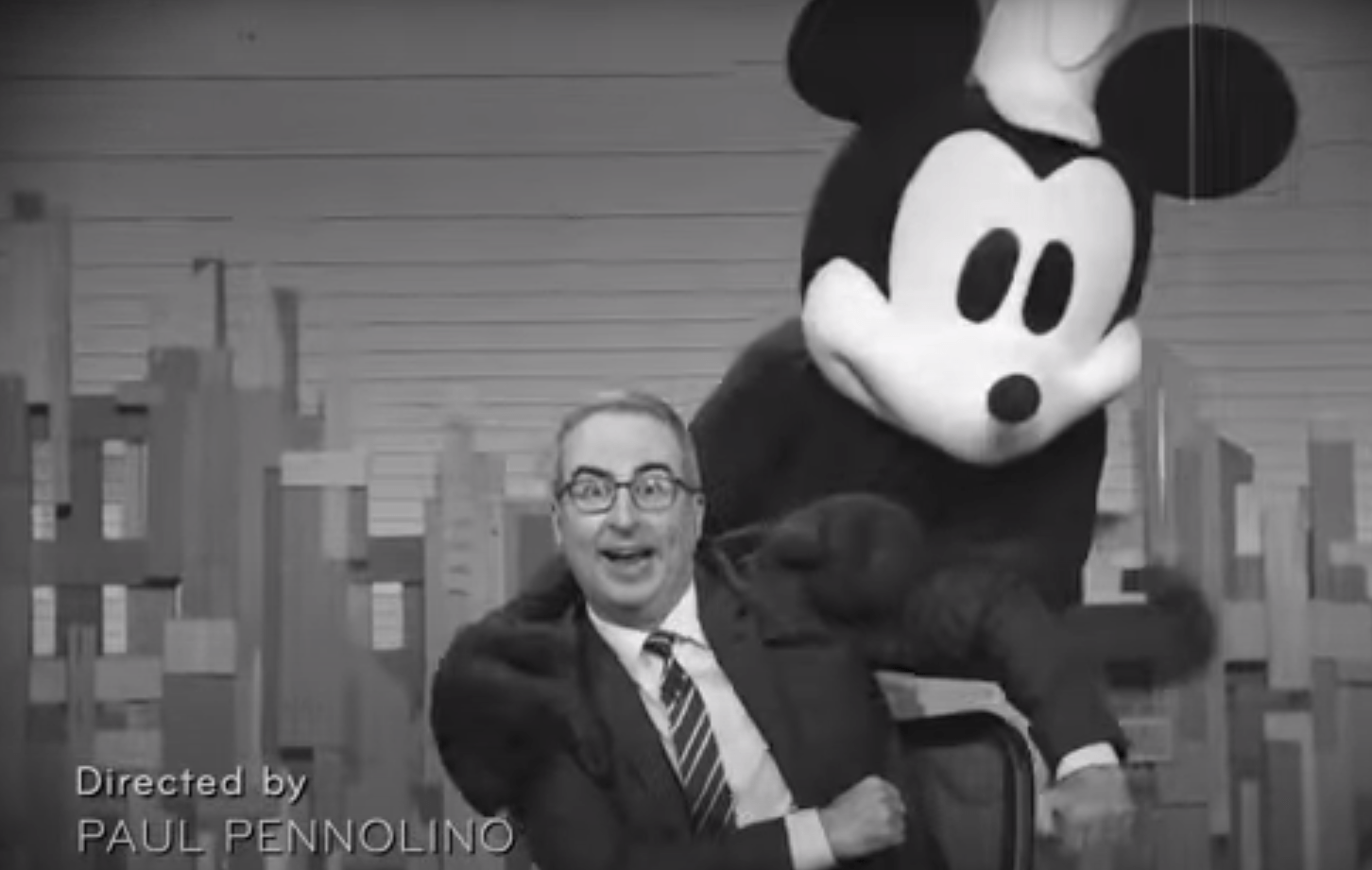
But… what I did not expect was that John Oliver and the folks at Last Week Tonight, an HBO show currently owned by cost-cutting Warner Bros. Discovery would say “fuck it” and start using Mickey Mouse… now.
I mean, I shouldn’t be surprised. Half the time I think Oliver’s show is basically Techdirt-but-if-funny,-entertaining,-and-clever, with the way he seems to cover the same topics we’re always covering, but, you know, better (mostly). And, Oliver has become somewhat famous for poking the eye of his own corporate masters (quite gleefully).
It absolutely would not have taken me by surprise if Oliver had done this nine months from now once Mickey is officially in the public domain. But… jumping the gun like this? That still surprised me.
The bit is, as you’d expect, hilarious. It starts with a discussion of the horror film, Winnie the Pooh: Blood and Honey, which, as you know, is building on a work that entered the public domain last year. But then moves on to Mickey. He talks about Mickey going into the public domain next year, highlights the litigiousness of Disney over Mickey (including legal crackdowns on a gravestone and a daycare center using images of Mickey) before noting he’s not going to wait to use it himself.
On top of which Disney has registered trademarks related to Disney, which don’t expire. In fact, some have speculated that might be why Disney redesigned its animation studios opening logo to incorporate the Steamboat Willie Mickey Mouse.
And it does feel like a tactical legal move. Basically, they may argue that this early Mickey image is so closely associated with their company, that people will automatically assume that any image of him was produced or authorized by them, and still take legal action.
So the fact is, anyone wanting to use the Steamboat Willie Mickey Mouse, will probably still be taking a risk.
But… if you know anything about this show by now… you know, we do like to take a risk every now and then. And there’s a lot to be said for beating the rush to capitalize on Mickey that will be starting next year.
So, tonight, I’d like to preview for you, our brand new character on this show, Mickey Mouse
He introduces some new, um, catch phrases for Mickey including “where’s Shelly Miscavige?” (a running… sorta… joke on the show about the missing wife of Scientology leader David Miscavige), “Jeffrey Epstein didn’t kill himself,” and “I hope Henry Kissinger dies soon!”
As Oliver says:
You know, the nice thing about characters entering the public domain is that you can do new, interesting things with them.
This is true. It’s why we celebrate the public domain every chance we can (psst, have you checked out the entries in this year’s public domain game jam?)
Mickey then asks John about the fact that he’s not actually in the public domain yet, and John doesn’t seem too concerned:
Mickey Mouse: I thought I wasn’t public domain until next year!
John Oliver: That’s actually true, buddy, we are pushing the limit a bit here. Actually, come to think of it, is your voice public domain yet?
Mickey: I guess you’ll find out!
John: Yeah! I guess we will!
He then decides to provoke Disney even more.
And I know, Disney’s lawyers might take the trademark angle and argue that this Mickey is closely associated with their brand. Although they should know that he’s pretty closely associated with our brand now too. And not just because I have a general vibe that screams 95-year-old rat-faced idiot, but also, because the Steamboat Willie Mickey has actually been in our opening credits since the first show of this season…
And then… even more.
And I don’t doubt that Disney has some other legal arguments up their sleeve, but we’re only likely to find out what they are if, and when, then sue. So, you know what? Let’s take this up a notch. Come say ‘hi’ Mickey!
And… out comes a Steamboat Willie Mickey in a costume to say his catch phrases to Oliver:
And, from there, he promises that as of January 1st, this costume will be available for all sorts of events (“birthday parties, theme park openings, funerals, sex dungeons, whatever you want.”)
So… now the question… does Disney actually do anything? Do they call up Warner Bros. Discovery and say WTF? Or do they send in the lawyers? I guess we’ll find out!
Oh, and John, if they do send in the lawyers, your own lawyers might want to look more deeply into reports that turned up 15 years ago that Disney’s lawyers, way back in the early days, fucked up the registration and don’t actually hold any copyright on Mickey Mouse at all. That’ll be fun.
The AT&T Time Warner and DirecTV mergers were a monumental disasters. AT&T spent $200 billion to acquire both companies thinking it would dominate the video and internet ad space. Instead, the company lost 9 million subscribers in nine years, fired 50,000 employees, closed numerous popular brands (including Mad Magazine), and stumbled around incompetently for several years before giving up.
But that was just the start.
After its tactical retreat, AT&T spun off Time Warner into an entirely new company, Warner Media. Warner Media then immediately turned around and announced a blockbuster merger with Discovery, creating the creatively named Warner Brothers Discovery.
This new company has been a blistering mess as well. Executives there have been so cheap they’ve refused to pay residuals to creators, shuttered numerous popular programs they didn’t want to pay for, and engaged in round after round of additional layoffs to achieve promised “synergies.”
Throughout this whole mess, executives at the new media giant struggled to properly name what they had “created.” AT&T embraced so many different names for its streaming efforts, it even confused the company’s own employees. Three-plus years later and executives at Warner Brothers Discovery still can’t figure out what to name the effort, and are now keen on killing the only brand that means anything to its users:
Warner Bros. Discovery is pushing forward with a plan to drop “HBO” from the name of its flagship streaming service HBO Max.
That decision for the long-planned rebranding of the combined HBO Max and Discovery+ services was partially informed by the company’s belief that “the HBO name turns off many potential subscribers,” Bloomberg reported on Thursday and TheWrap independently confirmed.
Throughout this experiment, the executive brain trust have seemed keen on degrading the quality proposition of their streaming service, removing or burying much of HBO’s legacy content in menus while prioritizing garbage reality TV programming like “F-Boy Island.” At the same time, they’ve been keen to raise rates as quickly as possible to achieve hallucinated synergies of the deal.
Years later and not only are executives still debating what to call this hot mess, they continue to indicate they have no understanding of consistent branding, or that the HBO brand generally represented quality in a sea of homogenous crap.
All told, this series of pointless mergers only really illustrates the media industry’s mindless “growth for growth’s sake” mindset, in which multi-billion-dollar deals are made for no other reason than to reduce taxes, boost executive compensation, and delude wealthy media executives into believing they’re savvy deal makers. All while employees and customers alike get the very short end of the stick, and the end product winds up being decidedly worse than when these purportedly savvy dealmakers started.
If you recall, AT&T spent nearly $200 billion on megamergers thinking it was going to dominate the online video advertising space. But after spending a fortune on DirecTV and Time Warner, laying off 50,000 people, killing off popular properties like Mad Magazine and DC’s Vertigo imprint, it quickly became clear that AT&T executives had absolutely no idea what they were doing.
After stumbling around drunkenly for a while, AT&T returned to what it’s best at (running broadband networks and lobbying the government to crush broadband competition), and spun off Time Warner into an entirely new company, Warner Media. Warner Media immediately then turned around and announced a blockbuster merger with Discovery, creating the creatively named Warner Brothers Discovery.
If you’re a consumer or employee at any of these brands and companies, the last few years have proven to be a befuddling mess. Remember that the AT&T acquisition of HBO and Time Warner resulted in so many different brands it even confused employees at AT&T. Despite efforts to consolidate content, it’s somehow only gotten dumber since then.
Managers at the new company have taken a hatchet to HBO’s offerings in particular, culling a wide variety of popular content to cut costs. That includes roughly 200 episodes of popular shows like Sesame Street and dozens of films and shows overall. Why? In part because the new consolidated company doesn’t want to pay residuals in a bid to make deal financials make sense:
While HBO Max already paid for the production of these shows, it’s still on the hook for residuals, including so-called back-end payments to cast, crew and writers, based on long-term viewership metrics.
By removing these films and shows, especially the ones HBO Max created rather than licensed, executives can cut expenses immediately. Warner Bros. Discovery has promised at least $3 billion in synergies stemming from the merger of WarnerMedia and Discovery, announced in May.
Ah, megamerger synergies.
There’ve been several new additional casualties thanks to this latest series of mergers, including TBS’s Full Frontal With Samantha Bee (Turner and TBS merged with Warner Brothers way back in 1996). With the merger of HBO Max and Discovery+, they’re hoping to “declutter” what’s now just a discordant parade of content, much of which executives didn’t really even want. There’s also been just a steady parade of layoffs of employees they didn’t want either.
HBO employee John Oliver went so far as to call this final form version of HBO Max little more than a “series of tax write offs”:
John Oliver taking another shot at his new parent company Warner Bros. Discovery for removing shows from HBO Max without warning all in the name of tax cuts… pic.twitter.com/53dPr4uVwn
Again, this is just another example of the U.S.’ harmful obsession with megamergers, consolidation, purposeless (outside of stock fluffing) deal making, and growth for growth’s sake. All of these deals make perfect sense to the executives, lawyers, and accounting magicians exploiting them for tax breaks and various financial benefits, but that doesn’t make this whole saga any less preposterously pointless.
Employees and consumers certainly didn’t benefit from this idiotic parade of events that began with AT&T wasting hundreds of billions of dollars to buy companies it was too incompetent to run. And somehow the saga has only gotten dumber since then.
We’ve noted more than a few times how the AT&T Time Warner and DirecTV mergers were a monumental, historical disaster. AT&T spent $200 billion to acquire both companies thinking it would dominate the video and internet ad space. Instead, the company lost 9 million subscribers in nine years, fired 50,000 employees, closed numerous popular brands (DC’s Vertigo imprint, Mad Magazine), and basically stumbled around incompetently for several years before recently spinning off the entire mess for a song.
In a new book slated to be released next week, Time Warner CEO Jeff Bewkes didn’t hold back when talking about AT&T’s absolute incompetence at running a media empire:
“The most disappointing thing to me about the AT&T merger,” Mr. Bewkes is quoted in the book as saying, is that he and his board thought AT&T “would basically leave our people alone.” That didn’t happen, he said. “We didn’t think they would go to such a level of malpractice as to not listen to anybody? even though they themselves had no experience in those areas.”
Granted Bewkes was the one that proposed the sale of Time Warner and HBO to AT&T in the first place as a way to fend off a Rupert Murdoch News Corporation acquisition attempt. But if you’ve paid even the slightest bit of attention to U.S. telecom over the past 30 years, you quickly come to understand that US telecom a sector dominated by hubris and yes men and women who live in reality-optional bubbles. Being a government pampered monopoly creates an executive culture that’s not great at listening to or playing with others, and AT&T is the poster child.
Whether it’s Verizon’s Go90 or AT&T’s megamerger spree, the end result is always fairly consistent any time a telecom giant wanders outside of its core competencies (running networks and lobbying to dismantle competition and regulatory oversight). 50,000 people lost their jobs as a result of AT&T incompetence and hubris, and AT&T executives are still out there acting as if they are the victims. That’s the message again sent in the book by AT&T CEO John Stankey, who blames everybody but himself for the implosion:
“If you are in an acquisition and somebody pays a premium for your stock, by definition it means something has to change,” Stankey is quoted as saying in Miller’s book, according to the WSJ. “If you paid a premium for an operation and you continue to operate it exactly the same way, you never pay back the premium.”
Stankey also said that “he still believes in the vision behind AT&T’s purchase” but that he made the spinoff deal with Discovery in part because investors “refused to give us credit for [the] progress” made with Time Warner. “One of the jobs I need to do in carrying AT&T forward is ensuring we come up with a strategy that the investor base will tolerate and work through and give us the right credit for,” Stankey said.
Anybody surprised that myopic telecom monopoly executives wouldn’t be good at running a new media venture in a functional, competitive new market either wasn’t paying attention — or was just blinded by giant number signs.