It’s been over a year since we last talked about the trademark dispute between Katy Perry, the American pop star, and Katie Perry, an Australian woman with a fashion line. To bring you up to speed, and I’ll use first names here to keep the confusion at a minimum, Katy sold merchandise for her 2014 tour in Australia, which led Katie to sue the singer in 2023, nine years later, because Katie had a trademark for the name of her business. There had apparently been some back and forth between both women going as far back as 2009, with Katy offering to share the trademark with Katie so they could coexist, which Katie refused. The court sided with Katie in a rather insane ruling, given the complete lack of any customer confusion demonstrated in the case, and also ruled against Katy’s attempt to cancel Katie’s trademark.
(I’m so, so sorry for all the Katys/Katies, trust me.)
Well, Katy appealed the ruling, which led to a full on meltdown by Katie. She claimed the appeal was a “personal attack” against her. It takes a healthy does of chutzpah to sue someone and claim their appeal of that suit is somehow an attack on the person who initiated the lawsuit to begin with.
And now, a year later, the courts have sided with Katy Perry over Katie Perry, overturning the trademark infringement judgement and canceled Katie’s trademark registration to boot.
Three judges ruled that a 2023 decision involving alleged trademark infringement that favored Taylor should be overturned. In short, Katy Perry (the singer) − born Katheryn Hudson − can use her stage name to sell merchandise in the country, despite the clothing designer’s claim over the trademark. Since Perry had been using her name as a trademark five years before Taylor began selling clothes, and already had an “international reputation in her name in music and entertainment if not more broadly,” she was entitled to the use of her own name in Australia, the judges ruled.
The judges canceled Taylor’s trademark registration as well.
In addition, the court stated that Katie had attempted to associate herself in various ways with Katy, increasing the chances for confusion herself.
And if you were hoping that Katie Perry, who’s real name is actually Katie Taylor, was taking all of this in a more mature fashion than she did the initial appeal of the case, well, sorry to disappoint you, but:
Taylor was disappointed with the decision, telling The Guardian in a statement, “This case proves a trademark isn’t worth the paper it’s printed on.”
She went on to say: “My fashion label has been a dream of mine since I was 11 years old and now that dream that I have worked so hard for, since 2006, has been taken away.”
Nope, that’s not what happened at all. Trademarks are worth plenty, when you don’t attempt to over-enforce them. They’re especially worth the value of preventing confusion in the public as to the source of affiliation of goods. Confusion that simply did not exist here.
And nobody stole her fashion label. The label can carry on as though nothing happened. It just can’t wield its trademark any longer, given the bad behavior in which Katie partook.
And so the pop singer can sell her stuff under her name down under once more, having successfully Katy-parried Katie Perry’s lawsuit. I’ll show myself out.
I come here not to bury this Wired article, nor to damn it with faint praise. I come to critique it, while realizing the framing and (especially!) the headline may not be the direct responsibility of its author, Paresh Dave.
Privacy laws are hit and miss in the United States. Mostly miss. There’s not a lot of privacy to be had. But when privacy laws get enacted, they tend to benefit the most powerful people first. Even victims’ rights laws — which are supposed to protect crime victims — are most often abused to keep abusive cops’ names out of the headlines because they are supposedly the “victims” of crimes committed by the people they’ve brutalized/killed.
Unsurprisingly, “assaulting an officer” is the most used, with “resisting arrest” following close behind it. As “victims” of these entirely arrest-related crimes, cops have used these laws to make sure the public doesn’t know which officers are engaging in excessive force when effecting arrests.
That leads us to a New Jersey privacy law, one that was enacted after a government employee experienced some of the day-to-day violence we the people are just expected to handle without additional legal protections.
The Future of Online Privacy Hinges on Thousands of New Jersey Cops
First of all, fuck all that. This case does not have those sorts of implications. Second, this is all about cops ensuring their protections are better than those given to the people they serve. All of that is spelled out in the first two paragraphs:
In July 2020, a 72-year-old attorney posing as a delivery person rang the doorbell at US district judge Esther Salas’ house in North Brunswick, New Jersey. When the door opened, the attorney fired a gun, wounding the judge’s husband—and killing her only child, 20-year-old Daniel Mark Anderl.
The murderer, Salas said, had found her address online and was outraged because she hadn’t handled a case of his client fast enough. In her despair, Salas publicly pleaded, “We can make it hard for those who target us to track us down … We can’t just sit back and wait for another tragedy to strike.”
If everyone had been thinking rationally, the response would have been a law that protected every New Jersey citizen from the indiscriminate harvesting, sale, and access of their personal data. But legislation is rarely rational, and it’s especially irrational when the resulting law is named after the victim.
In New Jersey, it ended with “Daniel’s Law,” which only provides privacy protections for certain public employees.
Today, current and former judges, cops, prosecutors, and others working in criminal justice can have their household’s address and phone numbers withheld from government records in the state. They also can demand that the data be removed from any website, including popular tools for researching people such as Whitepages, Spokeo, Equifax, and RocketReach.
And that’s how that works. Render unto Caesar… and then shut the fuck up. Some defense attorneys might be covered by this law, but presumably only if they’re court-appointed. As for the rest of New Jersey — residents who might not want anyone to access their data and/or have already been subjected to harassment, stalking, etc. — there’s nothing in it for them.
This case — which the headline (and even some of the body of the article) argues might protect the rest of New Jersey residents — is being spearheaded by a lawyer who actually seems to care a bit about personal privacy. Matt Adkisson runs five law firms and is suing 150 companies for exposing cops’ personal data. Prior to that, he turned down multiple millions during an acquisition offer that would have required him to provide access to share tons of personal data his own company… had apparently already harvested.
Never mind. Maybe there’s no true hero here. It certainly isn’t the cops that are advocating for their own personal interest. And the anecdotal evidence doesn’t quite build the case Adkisson is pushing, much less the over-arching narrative the headline of this article is trying to sell.
Like this part of the article, which shows cops love using the same services that sell access to cops’ info. And the only reason the cops care is because it’s their info being sold.
Akisson says the most retaliatory response came from LexisNexis, which lets police and businesses search for people’s contact information and life history, typically for investigations and background checks. He alleges that instead of removing Atlas clients’ phone numbers and addresses from view, LexisNexis needlessly froze their entire files in its system, impeding credit checks some were undergoing for loan applications.
Adkisson and his clients apparently have no problem allowing cops to access this trove of data. And then they have the gall to claim it’s “retaliatory” when a company blocks third-party access to data this lawyer and his clients specifically told them to limit access to. Adkisson knows a thing or two about data collection and access. Perhaps he should have warned his cop clients that going off the grid (by enforcing Daniel’s Law) creates this entirely foreseeable consequence.
I mean, I’m not a lawyer or a cop, but realized that instituting a freeze on credit checks following the Equifax breach would result in credit checks failing to go through and any that did would require my direct interaction. Claiming this is “retaliatory” is like claiming civil rights lawsuits are “retaliatory” when cops deliberately violate rights, to use an analogy his clients might understand.
Then there’s this supposedly illustrative anecdote — something that proves nothing else than that GPS/mapping software works the way people expect it to. Well, people other than this attorney and his cop union client.
He was reminded of that this past May when he took WIRED in his Jeep to meet with Peter Andreyev, a cop in Point Pleasant Beach, New Jersey, and president of the statewide Policemen’s Benevolent Association. Around dusk that day, Adkisson handed Andreyev a search result for his name on DataTree.com, a website that sells property records. Andreyev slipped on his black-rimmed glasses and brought his linebacker figure toward a conference table to review the page. It took him just two seconds to tense up. “Oh shit,” he said.
He stared at a street-view image of his home, and a birds-eye shot with his address overlaid. The square footage was in there too, for good measure. His head visibly rattling and legs restless, Andreyev pounded the table. “I—I’m pretty infuriated by this.”
Like many law enforcement officers, the 51-year-old rarely goes a day without nightmares about some known thug or detractor attacking him and his family. The DataTree printout reinforced for him that it would take just a few clicks for anyone to target him in the vulnerability of his own home. WIRED pulled up Andreyev’s report from DataTree with just a free trial.
To be surprised by this is to be surprised that people show up at your house after you drop a pin on Google Maps. To be “infuriated” is to be performative — someone who somehow believes their public residence in a house visible from public roads is somehow the equivalent of Area 51: something that only extremely powerful people should have access to, rather than the pitiful peons the cops the PBA president represents pretend to protect and service.
Now, don’t take this critique as an argument against better protections from data harvesters and data brokers. We should all have access to better privacy protections. But what’s happening here ain’t it. This is just a law protecting the most powerful people in our society: judges, prosecutors, and cops. The law doesn’t care about the rest of us. And neither do the people it protects. Further, I would argue, neither does this attorney. If he truly cared, he’d be trying to expand the law to cover the rest of the state’s residents, rather than just collecting checks helping cops expand their extra rights.
And for damn sure the cops don’t care. The last thing they want is limits on data harvesting because it might make their jobs a little more difficult. Whatever’s happening here will — at best — help only these cops who think an operation satellite map is a privacy violation. As for the rest of us, the government still expects us to be an open book that can be browsed at will by anyone with access, even if they mean us harm.
Way back in the day (1971, to be precise), the Supreme Court created a cause of action to sue federal officers over rights violations. The original case, Bivens v. Six Unknown Named Agents, involved Webster Bivens and the warrantless search of his Brooklyn home by FBN (Federal Bureau of Narcotics — the precursor to the DEA) agents, which was then followed by his warrantless arrest.
With nothing else to go with at that point, the Supreme Court sided with Bivens, creating an implied cause of action that roughly aligned with Section 1983 of the US Code, which did the same thing for local law enforcement officers and other government employees who weren’t federal employees.
That was the last of the good news. Ever since then, the Supreme Court has done what it can to make sure federal agents can’t actually be sued, despite creating precedent that finally allowed them to be sued.
In almost every case, the Supreme Court ends up telling courts they can’t expand Bivens to cover other rights violations unless they involve (1) Webster Bivens and/or (2) six unknown named agents. I wish I were exaggerating or heavily paraphrasing legal developments over the years, but that’s pretty much exactly what it is.
This means most people incarcerated in federal prisons will never be able to successfully sue prison employees no matter how often or how egregiously their rights are violated. This is why Mexican families can’t sue Border Patrol officers for killing their children by firing bullets into Mexico from the litigation-friendly confines of US soil.
And that’s why this Tenth Circuit Appeals Court decision [PDF] leads off this exercise in futility by pointing out the futility before it dives into the weed of its legal discussion. (h/t Orin Kerr)
Dustin Rowland sued prison officials after they (allegedly) deliberately ignored his medical issues (an untreated hernia). While this may seem minimal in comparison to other cases of deliberate indifference suffered by incarcerated people, it still matters. The government has an obligation to take care of the people in its custody. When it refuses to do so, it’s a legal cause of action. Or, at least, it’s supposed to be.
Rowland exhausted all of his other options before filing suit, so the lower court and the Tenth Circuit were unable to simply claim the lawsuit was premature and dismiss it on those grounds.
But that would have been the simpler obstacle to hurdle. Despite the original Bivens decision creating a cause of action for suits like these, the post-Bivens judicial environment has been far less than welcoming. Even when the occasional appeals court finds in favor of the plaintiffs, the Supreme Court is swift to reject anything that might look like actual justice. And that leads to this: the Tenth Circuit Appeals Court giving Dustin Rowland the bad news right up front. A bit of shade is thrown by the Tenth Circuit:
Having come on the scene during an “ancien regime” where the Supreme Court “routinely” implied causes of action, Ziglar v. Abbasi, 582 U.S. 120, 132 (2017), Bivens is now all but dead. See Mohamed v. Jones, 100 F.4th 1214, 1236, 1237 (10th Cir. 2024) (Tymkovich, J., dissenting) (observing that the Supreme Court’s “abrogative process [of Bivens] has been ‘gradual, but relentless’” such that the “‘right answer’ to whether to recognize a Bivens cause of action ‘will always be no’”) (citations omitted). So much so, in fact, that the Supreme Court has not recognized a Bivens claim since 1980, and it has unambiguously stated that “if we were called to decide Bivens today, we would decline to discover any implied causes of action in the Constitution.” Egbert v. Boule, 596 U.S. 482, 502 (2022).
And there it is: the same court that ushered this cause of action into existence abandoned it pretty much completely less than a decade later. There’s still a way to get a Bivens action to stick, but you have to time-travel back to 1971 and be named Webster Bivens to get it to work.
None of that makes sense in terms of rights litigation. And yet, here’s the Tenth Circuit offering up additional explanation:
And this makes sense.
Ah. Well. Nonetheless.
To be fair, that quote is taken out of context. It is a direct quote of the paragraph immediately following the previous paragraph quoted in full above. But it does go on from there. In the sense that any of this “makes sense,” it only does so because the Supreme Court says it does and the Tenth Circuit — obliged to follow Supreme Court rulings — has affirmed that this narrowing of Bivens to the point of nonexistence complies with Supreme Court guidance.
[T]he Supreme Court has scaled back its Bivens jurisprudence considerably—effectively relegating it to a “relic of the 20th century.” Logsdon v. United States Marshal Serv., 91 F.4th 1352, 1355 (10th Cir. 2024). And this message has not gone unnoticed, as we are on record stating that extending Bivens would be “an action that is impermissible in virtually all circumstances.” Silva v. United States, 45 F.4th 1134, 1140 (10th Cir. 2022).
So, while the court recognizes that Rowland — like others before him — is doing all he can to “thread the needle,” the reality is there’s no eye to aim for, no matter how fine the thread Rowland is carrying. Rowland alleges medical indifference by federal prison officers. The case he cites does the same. The difference is that the case he cites involves prison officials acting in opposition to medical advice, where in Rowland’s case, it’s simply a matter of being ignored.
And the court agrees with Rowland. But that doesn’t matter, because the Supreme Court says absolutely no expansion of Bivens is allowed and, indeed, hasn’t been allowed for more than 40 years.
Indeed, these differences are more than “small” and would require, at bare minimum, an impermissible “modest extension” of Bivens.
Because Mr. Rowland’s claims are materially different from any of the three cases where a Bivens cause of action was recognized, we conclude Mr. Rowland’s case arises in a new Bivens context.
So, there is no good news here. The Tenth Circuit leads with bad news and, several pages later, delivers even more bad news to the plaintiff attempting to sue federal officers.
[T]o be sure, the most relevant question under Bivens now is “whether there is any rational reason (even one) to think that Congress is better suited to ‘weigh the costs and benefits of allowing a damages action to proceed.’” Egbert, 596 U.S. at 496 (citation omitted). And here, Congress will always be better suited to make such a call because, as the Supreme Court has emphasized, recognizing a Bivens action improperly merges the “Constitution’s separation of legislative and judicial power.” And more importantly, courts are simply ill-suited to “predict the ‘systemwide’ consequences of recognizing a cause of action under Bivens.”
That’s entirely laughable. This Congress isn’t better suited to do much. And it’s exceptionally uninterested in separating powers, not if it might mean limiting what the incoming president can do or what direct influence they (Congress and President-elect Trump) might be able to impose on a Supreme Court fully stocked with Trump’s hand-picked replacements for outgoing “liberal” justices.
Even in the best of times, Congress has shown little interest in ensuring the rights of inmates aren’t violated. When forced to deal with prison-related issues, more money and time is spent figuring out the logistics involved in locking up even more people than we already do. The amount of time spent considering legal options for inmates whose rights have been violated is less than a rounding error.
Bivens is dead. And, for all intents and purposes,Webster Bivens will be pretty much the last person to secure a win under this legal concept. And it didn’t even work for Bivens. It set precedent that was supposed to help those that followed. But the Supreme Court has spent nearly 50 years making sure it doesn’t work for anyone. What’s seen in this decision is resignation. But nowhere in the hundreds of pages of jurisprudence involving Bivens actions will you find anything approaching justice.
The Complete ChatGPT Artificial Intelligence OpenAI Training Bundle has 4 beginner-friendly courses to help you become more comfortable with the capabilities of OpenAI and ChatGPT. You’ll learn how to write effective prompts to get the best results, how to create blog posts and sales copy, and how to create your own chatbots. It’s on sale for $25.
Note: The Techdirt Deals Store is powered and curated by StackCommerce. A portion of all sales from Techdirt Deals helps support Techdirt. The products featured do not reflect endorsements by our editorial team.
Last week we launched the Kickstarter for our amazing new card game, One Billion Users. It’s a fast, fun card game where players try to build up the biggest and best social media network, while simultaneously trying to undermine the networks the other players are trying to build.
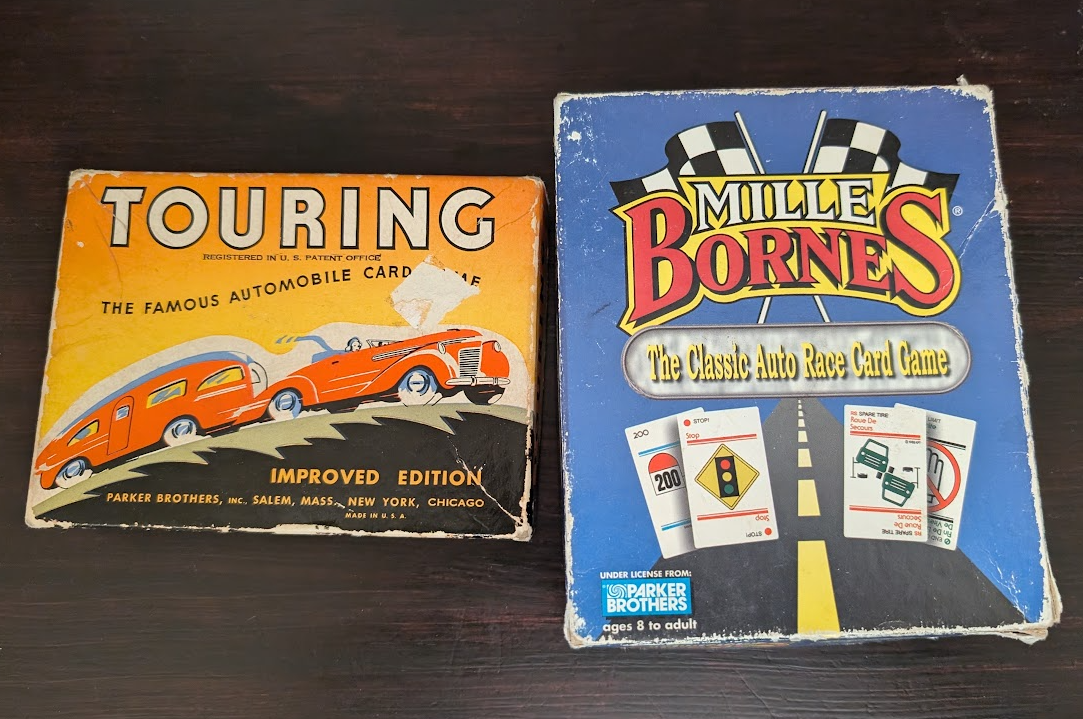
In the campaign, we mentioned a couple of historical card games that the game was loosely based on: 1906’s Touring and 1954’s Mille Bornes. I mentioned that Mille Bornes has been wildly popular at times since its launch, and over on Bluesky many people have been expressing their fond nostalgia for Mille Bornes.
It’s true that Mille Bornes is a fantastic game for friends and family, involving trying to win a car race while throwing up various hazards in front of your opponents. But I wanted to make clear that One Billion Users is not just a “re-skinned Mille Bornes” about social media.
It’s much better.
In fact, we’ve made several key improvements and additions that make One Billion Users a deeper, more strategic, and ultimately more engaging game than its predecessors.
Some of the most notable changes include:
A new “toxicity” mechanic that adds risk and consequences to your social media growth
Unique Influencer cards that have a mind of their own, making their own platform choices that can help or hinder your progress
Random Event cards that shake up the gameplay and force you to adapt your strategy
I wanted to talk a little bit about why we chose to build on the basic mechanics from Mille Bornes and Touring. I also wanted to discuss the limitations we found that they had, and how we sought to make a much better game building off of those mechanics.
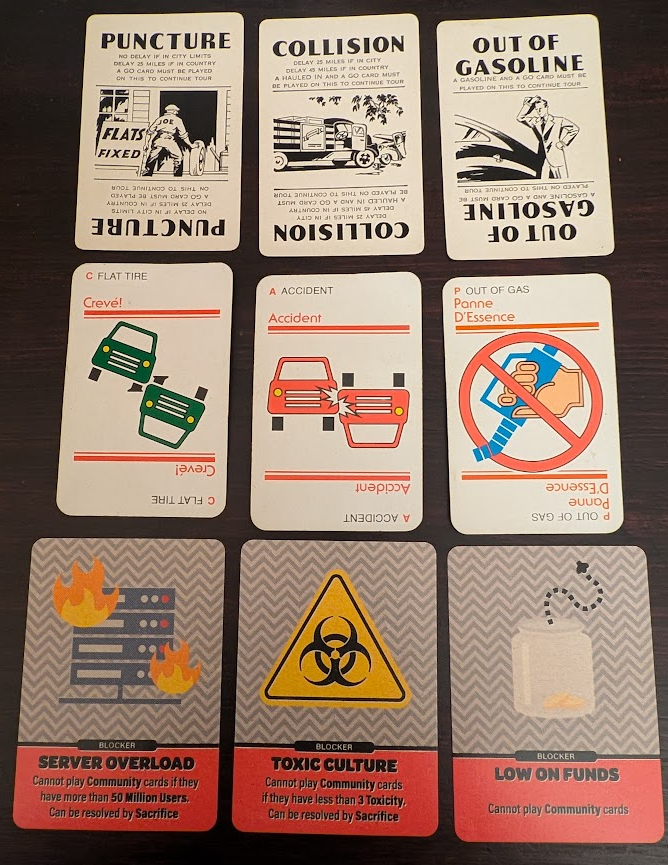
First off, it’s important to note that Mille Bornes is an almost exact replica of Touring. If you know how to play Mille Bornes, you already know how to play Touring. Both involve the same basic mechanics, though the mile distances in Touring are slightly smaller, and rather than the “Speed Limit” card in Mille Bornes, in Touring that’s replaced by a “Country” or “City Limits” card which determine their speed. Touring also has the concept of having to “discard” some mileage cards to get rid of a hazard (which we sorta brought back in One Billion Users) and isn’t in Mille Bornes.
The only really “different” mechanic found in Mille Bornes is the so-called “Safeties” or what many people call the “Coup Fourré” cards. In One Billion Users, we retain these cards (called Safeguards), but they’re not as powerful as they are in Mille Bornes, where they can dominate a round.
We chose to build off the basic mechanics in these games for a few reasons. First, we knew that they’re fun to play. The reason there’s so much nostalgia for Mille Bornes is because people enjoy it! We wanted to make sure that this game was, first and foremost, super fun to play with your friends and family.
With our last card game, CIA: Collect it All, we received some complaints (and some negative Boardgame Geek reviews!) saying that the game was just okay and wasn’t as captivating as other modern card games. But that’s because the game was designed primarily to be a teaching tool for incoming CIA analysts to better understand the tools at their disposal to analyze a global crisis.
During that campaign, we asked some backers if they wanted us to make a more “fun” version of the game or keep it as close as possible to the original. We heard loud and clear that most backers wanted it as close as possible to the CIA’s version.
With this new game, we wanted to make sure that its main guiding factor was that it be a fun game for friends and family, and that it be especially replayable. While we don’t mind slipping in some educational elements to our games if they fit, that was always secondary to making the game as fun as possible.
Starting with the Touring/Mille Bornes framework gave us a starting point that we knew was fun and which millions of people around the globe already know is fun.
While we loved the core gameplay loop of drawing cards, playing mileage, and dealing with hazards, we felt that both Mille Bornes and Touring were missing some key elements that could make the experience more dynamic and interactive. That’s where our new mechanics come in.
The biggest complaint we heard with Mille Bornes is that it’s entirely possible to get “stuck” for most of the game. If you get hit with a hazard where you don’t have the matching remedy, you can play an entire round that is pure frustration.
We attempted to solve this by offering up alternative methods for dealing with “blockers” (the equivalent of hazards in Mille Bornes). Some of the cards let you “sacrifice” some of your community cards to rid yourself of the blocker, though what the sacrifice is may depend on the issue.
Too much toxicity (more on that below)? You can choose to ban a toxic community. Servers overloaded? Get rid of some of your users. Also, we have an alternative resolution of blockers where in each turn that you don’t proactively play a card, you can sacrifice one of your hand cards to “work” on fixing the blocker. Once you’ve spent three turns doing so, it is now fixed.
The second complaint about Mille Bornes is that there isn’t that much strategy to it. At best, your choices tend to be “offense” (playing more miles) or “defense” (playing a hazard to stop an opponent).
But beyond that, there isn’t much to decide. If you’re playing offense, you automatically play the highest mileage card. If you’re playing defense, it doesn’t really matter which hazard you play on opponents, so long as they don’t have the relevant safety card.
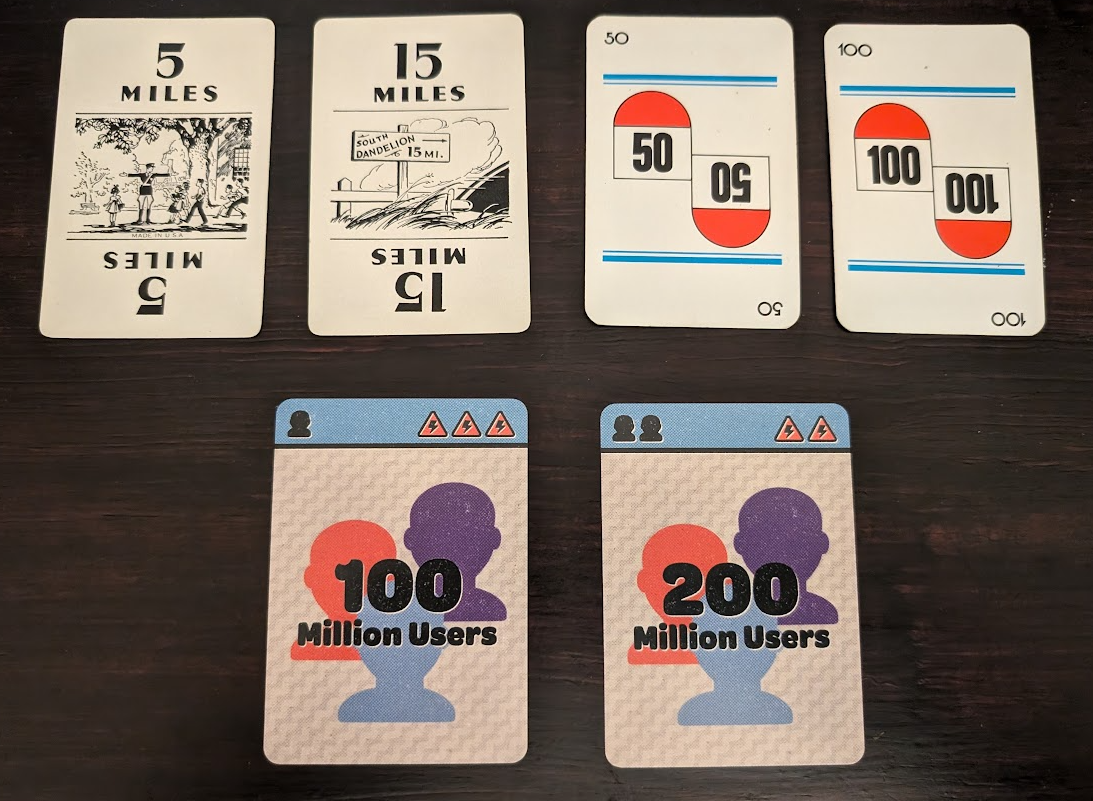
With One Billion Users, we’ve added the concept of “toxicity.” Each community card represents not only how many millions of users have joined your social media network, but also how much toxicity they bring with them, designated by the warning symbols in the upper right-hand corner. If you have too much toxicity, you may be limited in some of the cards you can play and also, at the end of the game, you can lose a lot of points.
This adds a very fun strategy element to the game. Players can decide to go for it, not care about the toxicity and just try to build up as big a site as possible, but if they’re not careful the toxicity can really tank their score at the end. Other times, players may decide to be much more careful and avoid playing overly toxic cards unless they have no other choice.
Another complaint that we heard regarding Mille Bornes is that some felt it wasn’t all that replayable, because the basic elements of the game are pretty much the same every time. I know some people (myself included!) don’t mind this aspect, but it is true that each time you play the game is pretty similar.
We’ve added three additional elements to the game: Influencers, Events, and Push/Poke cards, to change things up even more.
The Influencers are (obviously!) an element that fits perfectly within the theme of “social media.” Influencer cards are shuffled throughout the deck, and when a player picks one on their turn, instead of going into their hand, it immediately joins the network it prefers as designated on the card. This could be the biggest network… or the smallest. It could be the most toxic… or the least.
Influencer cards bring with them millions of users, but also varying degrees of toxicity. Some are certainly better than others. And lurking out there somewhere is the infamous Troll card, which brings with it a ton of toxicity, but barely any users at all. You want to avoid the Troll as much as you can.
Of course, Influencers can be fickle, and they can change which network they go to as social media sites change over time. One way they can move is via the Push and Poke cards. Push cards let whoever played the card move any influencer to any other social media network. Often this can be used to “steal” an Influencer and their community to your own network, but it can also be used strategically against others (especially with the Troll).
The “Poke” card nudges the Influencer to reconsider their choices by looking at the current state of the platforms. So, maybe The Investor prefers the network with the most users. But that can change over time. Perhaps you realize that your network now has more users than the one The Investor joined initially. You can “Poke” The Investor to look again and jump ship to you. And, in the process, the Investor’s community can pick up some more users to bring along to your network.
Finally, we have the “Event” cards, which are a way to add a lot more variety and challenging situations to the game. Event cards are shuffled into the deck and serve to create “global” conditions that can impact how you play. Sometimes, they allow you to do more (such as the “Move Fast” card that allows you to pick an extra card each round until it’s replaced) and sometimes they can limit what you do (such as the “Break Things” card that says you can’t play certain Safeguard cards while it’s in effect).
Some events stay in effect until the next Event card is drawn, and some have an immediate, one-time impact. For example, the “Troll Trouble” card means the player with the most toxicity has to move their Community Card with the least toxicity to the network with the least toxicity, representing users fleeing the toxic environment for a better one. Or the “Social Shuffle” card that causes all Influencers to reevaluate which network they’ve joined to see if there’s a different network that better matches their preferences.
All of these new elements — the toxicity mechanic, the Influencers, the Events, and the Push/Poke cards — come together to create a game that is familiar yet fresh, easy to learn but with layers of strategy to explore. One Billion Users takes the basic framework that made Mille Bornes a classic and builds on it to create a modern card game perfectly suited for the social media era.
Whether you’re a fan of the original auto racing card games or completely new to the genre, we think you’ll find One Billion Users to be a unique and captivating gaming experience. The added depth and player interaction make every playthrough feel different, as you navigate the ever-shifting landscape of social networks, influential figures, and online communities.
We’re hoping to release a copy of the rulebook and possibly a basic “Let’s Play” video before the campaign ends, to give folks a better sense of the game play.
But, for now, hopefully you can see why if you are nostalgic for Mille Bornes, you’ll absolutely love playing One Billion Users.
We’ve noted more than once that the 2021 infrastructure bill is poised to deliver $42.5 billion in broadband subsidies to the states. A lot of that money will be thrown in the lap of incumbents with long histories of empty promises, but a lot of it will be leveraged for genuine, major improvements in broadband options by ISPs, municipalities, cooperatives, and utilities.
Republicans, of course, voted against these improvements. At the same time, Republicans have lied repeatedly to their constituents and tried to take credit for them. They’ve also been whining for much of the last year about some pretty flimsy requirements requiring that ISPs have to try to make sure there’s a slower, more affordable option for poor people (the gall!).
They’ve had several show hearings about this massive indignity. Republicans are also simultaneously mad that nonprofits are poised to receive $1.25 billion in “Digital Equity Competitive Grant Program” grants to “support efforts to achieve digital equity, promote digital inclusion activities, and spur greater adoption of broadband among Covered Populations.” The horror.
U.S. broadband generally sucks, and is patchier, slower, and more expensive than in most developed nations. And however bad it is, it’s routinely worse for low income and minority communities. That’s documentable and not, as Republicans like to insist, up for debate.
The government only just last year even acknowledged this was happening. Note they didn’t really do a whole lot about it beyond that; but even the action of acknowledging racism was involved in fiber upgrades was enough to send Republicans into a hissy fit.
The Digital Equity Competitive Grant Program’s NOFO (Notice of Funding Opportunity) states that grant winners must use the funding to serve members of “covered populations,” defined to include “individuals who are members of a racial or ethnic minority group.” Basically, it’s a bare bones effort to ensure that some money is spent shoring up the decades of discrimination in broadband deployment.
Republicans and Ted Cruz don’t like that (for what should be obvious reasons), so Cruz last week fired off a letter to the NTIA (which manages the program in conjunction with the states) insisting that trying to help poor minority communities afford broadband is “unconstitutional.” In large part because the corrupt, Trumplican-stocked Supreme Court has looked poorly on similar programs:
“NTIA has not yet finalized a grant for any Digital Equity Competitive Grant Program funding to any applicants. Therefore, NTIA still has time to reverse course before it breaks the law. As the Ranking Member of the U.S. Senate Committee on Commerce, Science, and Transportation, we urge you to strike this unlawful Guidance now.”
Cruz, likely the incoming chair of the Senate Commerce Committee, is also calling for a pause of the Broadband Equity Access And Deployment (BEAD) infrastructure program more generally. In part because Republicans want to redirect subsidies away from community owned broadband initiatives (that focus on affordable fiber), and toward AT&T, Comcast, and Elon Musk’s expensive satellite services.
Of course guys like Cruz, who happily rubber stamp every unconstitutional whim King Donald has, couldn’t actually care any less about what is or isn’t constitutional. They’re simply upset that the federal government identified systemic racism and made the slightest effort to do something about it. All the legal arguments are just decorative, and routinely aren’t based in reason or precedent.
Republicans just genuinely despise helping the plebs. You might recall House Republicans tried to ban towns and cities from offering their residents affordable community broadband during peak COVID. They killed a COVID-era program that provided a $30 broadband discount for poor people. And they broadly support telecom monopolies’ quest to rip off captive customers in uncompetitive markets.
This is usually framed as a concern about taxpayer costs or “government overreach”; a concern that’s absent when it comes time to hand out fat subsidies to their cronies like AT&T, Comcast, or Elon Musk, or threaten journalists’ broadcast licenses for protected speech. The pseudo-legalese to justify the corruption and racism is the flimsiest, laziest scaffolding imaginable to disguise the active disdain the party has for poor minority communities. And given the corrupt nature of the courts, it often succeeds.
Keep in mind: it’s not like these Democratic equity programs are hugely transformative. They’re often the flimsiest effort imaginable to address longstanding systemic inequity. The FCC’s belated acknowledgement of racial discrimination in broadband earlier this year, for example, couldn’t even state offending ISPs by name or provide any real solutions for past inequities.
But even these day-late-dollar-short efforts are deemed radical and illegal by corrupt Republicans like Cruz. And when our broken press can be bothered to cover these efforts (see: Fox News), they take Republican opposition in exclusively good faith, utterly refusing to illustrate the inconsistent reasoning or underlying discrimination. It is, as they say, why we can’t have nice things.