The world of the cosmetics industry is no stranger to trademark disputes. Without really diving in, I can think of several reasons why this would be. It is a saturated market in which both very large and much smaller companies play. It’s an industry which produces products that basically beg for descriptive product names and branding. And it’s an industry that is heavily focused on the retail space covering a huge swath of the public, making the potential and concern for public confusion legitimately more likely than in other industries.
But not all of that is valid in every case all the time. The problem in most countries, and certainly in America, is that most trademark offices don’t often scrutinize opposition arguments or claims of infringement to the degree in which they should. That leads to far too many successful oppositions, bullying, and wins on infringement. But in New Zealand, at least, we get an example of a nation’s trademark office actually taking the time to get it right when it comes to two competing cosmetics companies.
An essential oils start-up company has won a trademark dispute against a skincare company endorsed by one of the Kardashian sisters. Manuka Medic was started by West-Coaster Rory Hill in 2018 after he noticed his sensitive skin cleared up whenever he was on properties surrounded by native mānuka.
However, another New Zealand company, Manuka Doctor, has been selling cosmetic products containing extracts from the mānuka plant for nearly a decade and in 2016 it announced Kourtney Kardashian as one of its brand ambassadors. In an advert by Manuka Doctor, the eldest Kardashian sister said she’d been using their products for years before the company reached out asking if she wanted to represent the brand.
You all know what happened next. Manuka Doctor opposed the trademark application from Manuka Medic, arguing that the branding was too similar and would cause confusion with the public in the marketplace. New Zealand’s IPO took the time to review that claim and concluded, properly in my opinion, that any concerns about confusion were unfounded.
Manuka Doctor’s lawyer, Jack Oliver-Hood, told the IPO the names Manuka Doctor and Manuka Medic were too similar and consumers would likely confuse them. He said registering the new trademark would prejudice the interests of the already well-established company he represented.
Assistant commissioner of trademarks, Nigel Robb, said in his ruling he did not believe consumers would confuse the two names.
“I do not think doctor and medic are commonly used interchangeably. A person might refer to taking a child to the doctor for an earache but is unlikely to say they were taking the child to the medic. Balancing the similarity of and strongly allusive nature of the marks, the nature of the goods and the surrounding circumstance I conclude the probability of deception or confusion is not reasonably likely.”
Combined with the examples of other similarly named companies and brands in the market brought by Hill, such as “Manuka Healer” and “Manuka Restore,” the IPO dismissed the opposition and is allowing Hill to register his mark. Now, Manuka Doctor has the option to appeal this decision, but it probably shouldn’t. Given the other players in the market and the analysis by the IPO, I would expect that appeal to fail.
It would be nice to see more of this sort of thing, particularly here in the US. Trademark law shouldn’t be used to suggest you get a full monopoly on words that only a part of your name. That allows the locking up of basic concepts, unrelated to the purpose of trademark law.
Wayne County, Michigan cops and prosecutors love seizing property. According to law enforcement, seizing cash and cars from people (while often not charging them with crimes) is the best way to break up criminal organizations and disrupt the illegal drug market.
What’s left unexplained is how Wayne County’s forfeiture program does anything more than make poor people poorer.
Jarrett Skorup of the Mackinac Center for Public Policy, who co-authored a recent report on civil forfeiture, said the data shows nearly all of those Wayne County seizures involved vehicles valued at less than $1,000. He said it’s likely that these forfeitures disproportionately affected low-income individuals, who are less able to afford an attorney or navigate the legal system to reclaim their property.
When I think “powerful/dangerous criminal,” I usually don’t associate them with vehicles featured in Craigslist ads suspiciously short on photos or vehicle condition descriptions. Seizing shitboxes from folks doesn’t do anything but add incrementally to the pool of purloined property prosecutors and cops are allowed to profit directly from.
That practice got Wayne County sued in 2020. Two plaintiffs, whose vehicles were taken due to alleged criminal acts of others (although criminal charges were never filed in either case), kicked off an expected class action challenging the county’s forfeiture program — both the way seizures were performed, as well as county’s unwillingness to engage with car owners seeking the return on their property.
That cycle of abuse also prompted asset forfeiture reforms in the state. (These have since been rolled back.) None other than Wayne County prosecutor Kym Worthy was the first to protest the proposal of making forfeiture dependent on criminal convictions, offering up this inadvertently hilarious criticism of the proposed reforms:
”Since a conviction is now required, it will make it extremely difficult to prosecute high level drug dealers,” Wayne County Prosecutor Kym Worthy said via email.
Did you get that? The prosecutor says prosecuting drug crimes will make it more difficult to PROSECUTE DRUG CRIMES.
Today, the 6th U.S. Circuit Court of Appeals ruled that Wayne County violated the rights of Detroiters by not offering prompt court hearings within two weeks of their vehicles being seized. Wayne County regularly seizes and retains vehicles for months or longer without providing an opportunity for a hearing to challenge the seizure and get their vehicles back. The Institute for Justice (IJ) filed its class action lawsuit challenging this program in February 2020 on behalf of Detroiters whose vehicles were seized without receiving a hearing.
There’s a lot of good stuff in the opinion [PDF] (as well as the concurring opinion) declaring this Wayne County abomination to be an unconstitutional abuse of government power. Let’s get to it.
Here’s the conclusion of the court, which is backed by lots of criticism of Wayne County’s abusive forfeiture activities:
Plaintiffs claim they were not provided an opportunity to be heard about the detention of their vehicles and that this failure violates the Due Process Clause of the Fourteenth Amendment. The district court held that plaintiffs are entitled to the requested hearing. We agree and hold that Wayne County violated that Constitution when it seized plaintiffs’ personal vehicles—which were vital to their transportation and livelihoods— with no timely process to contest the seizure. We further hold that Wayne County was required to provide an interim hearing within two weeks to test the probable validity of the deprivation.
And here’s how Wayne County’s program operates. Brace yourself. It’s pretty ugly.
According to plaintiffs, Wayne County seizes vehicles simply because of the vehicle’s location in an area generally associated with crime. Regardless of the owner’s innocence, Wayne County impounds the vehicles and its contents until the owner pays a redemption fee. This fee is $900 for the first seizure, $1,800 for the second, and $2,700 for the third, not including other fees for towing and storage.
If the owner is unwilling or unable to pay the redemption fee, the only alternatives are either to abandon the vehicle or to wait for county prosecutors to decide whether to initiate civil forfeiture proceedings. Before a forfeiture action is brought, there are four or more pretrial conferences involving the property owner and prosecutors, without a judge present. During those conferences, prosecutors “attempt to persuade [the owner] to pay the redemption fee,towing costs, and storage fees, pointing out that storage fees accrue daily.” The owner must attend all conferences, for missing just one will result in automatic forfeiture and transfer of title to the county.
As these conferences occur once a month, it takes at least four months, on top of any previous delays (usually an additional four to six months), to complete the pre-hearing requirements and finally arrive before a neutral decisionmaker. This results in a potential timeline of at least eight months from the time the vehicle was initially seized to when the owner may potentially recover it without paying a fee.
Months of mandatory hearings followed an arbitrary delay of several more months, all of it designed to convince car owners’ to relinquish their claims to their property. And these seizures — despite law enforcement claims about breaking up drug cartels — can be effected under nuisance abatement and prostitution laws. Plus, there’s the state’s Omnibus Forfeiture Act, which allows seizures under pretty much any crime imaginable.
Bring on the due process violations!
Plaintiffs allege they were forced to wait at least four to six months to challenge Wayne County’s possession of their vehicles plus four more months for pretrial conferences—a long time to be without something that “occup[ies] a central place in the lives of most Americans.” Wilson lost one vehicle entirely in the labyrinth of procedures, and Wayne County possessed her next vehicle for one year. Reeves’s vehicle was seized and held starting July 2019 through February 2020. Wayne County seized Ingram’s vehicle twice. After the first seizure, she was told it would be “at least four months” before her case could come before a judge, which led her to pay $1,355 in fees to reclaim the vehicle. The city’s practices pushed Ingram into bankruptcy, leading her to surrender her vehicle to a creditor after the second seizure. In contrast with these lengthy time frames, courts have found procedural due process violations for depriving people of their vehicles sans hearing for three weeks to two months, Krimstock, 306 F.3d at 54, one week, Coleman, 40 F.3d at 262, and 97 to 142 days, Smith, 524 F.3d at 835–36. In light of these analogous examples, the deprivation to the plaintiffs is substantial.
This leads to the appeals court calling Wayne County out for its transparent desire to enrich itself at the expense of its residents:
Although Wayne County ostensibly seized the vehicles because of reasons related to health, safety, and/or drugs, therecord suggests otherwise—that the county seized the vehicles in order to obtain proceeds from fees. If Wilson’s vehicle had a dangerous connection with drugs, it is unclear why the county promptly released the vehicle after a payment of $1,355. And if Ingram’s vehicle was a public nuisance, the county’s willingness to release the vehicle for $1,800 suggests it is more interested in the money than in remedying a public nuisance.
Wayne County can continue to seize cars. It will, however, no longer be able to simply wait out car owners while hitting them with compounding fees.
If a probable-cause hearing can be heard within 48 hours, and other circuits have found one to three weeks to be excessive in this sort of context, then, taking the factual setting of this case into account, we hold two weeks from the date of the vehicle’s seizure to be an appropriate time frame to provide the vehicle owner an opportunity to be heard to contest the holding of a vehicle vital to the owner’s transportation and livelihood.
The concurring opinion is even harsher in its assessment of this forfeiture program. Judge Thapar would rather see the government forced to hold a hearing within 48 hours. (The majority opinions notes that 48 hours — while certainly expedient — may put car owners in a more difficult situation than a two-week timeframe, noting that it may be impossible for claimants to find child care or request time off from work to attend a hearing held 48 hours after a vehicle seizure.) And the concurrence doesn’t pretty up its take on Wayne County’s actions.
Wayne County claims that it seizes cars to fight crime (and holds onto them for months for the same reason). But the County is happy to return those very cars as soon as it gets paid. That practice proves the County’s scheme is simply a money-making venture—one most often used to extort money from those who can least afford it.
That’s all it is and that’s all it’s ever been. But now the county must justify its actions within two weeks or return the vehicle. That alone might be enough to discourage baseless seizures, especially if this shortened time frame makes it far more likely the car’s owner will attend the hearing. When the government has all the time and money in the world to do something, it will generally achieve its goals. But when constrained, even a bit, it may find it a bit more difficult to justify taking residents’ stuff just because it can.
For many, many years we’ve detailed how big pharma companies, who only care about the monopoly rents they can receive on medicine while under patent, have concocted all sorts of scams and schemes to avoid having to compete with generic versions, even after their patents have expired (or been invalidated). But one of their older tricks is apparently popular yet again, though the FTC is now warning pharma that it might finally start cracking down.
If it does, it will just be reinforcing the kinds of actions the FTC used to bring. Twenty years ago, the FTC went after Bristol Meyer Squibb for false listings in the Orange Book. The Orange Book, managed by the FDA, is where pharma companies list the FDA-approved drugs they have under patent, which alerts generic drug companies basically not to make generic versions of those drugs.
But, of course, this creates a very tempting scenario: if pharma can get drugs not actually under patent into the Orange Book, they effectively save themselves from generic competition, and they get to profit massively (at the expense of the public and their need for affordable medicine).
However, despite enforcement against such abuse years ago, it seems that the FTC and the FDA have kinda let these things slip over the past few years. And Big Pharma has really taken advantage of that. Thankfully, it looks like the FTC is finally interested in cracking down on this practice again. In a new policy statement, it warns pharma companies that it’s looking into the abuse of the Orange Book and sham patent inclusions.
Brand drug manufacturers are responsible for ensuring their patents are properly listed. Yet certain manufacturers have submitted patents for listing in the Orange Book that claim neither the reference listed drug nor a method of using it. When brand drug manufacturers abuse the regulatory processes set up by Congress to promote generic drug competition, the result may be to increase the cost of and reduce access to prescription drugs.
The goal of this policy statement is to put market participants on notice that the FTC intends to scrutinize improper Orange Book listings to determine whether these constitute unfair methods of competition in violation of Section 5 of the Federal Trade Commission Act.
Of course, this raises some questions, including why do we make the pharma companies themselves the party responsible for making sure their patents are “properly” listed. Why don’t we have at least some process in place for these listings to be reviewed, whether when they’re submitted to the Orange Book or even if another party (such as the generic drug manufacturers) contest an Orange Book listing.
It seems the dumbest possible system is to assume that the Big Pharma companies will be honest in their Orange Book listings.
And, even though the FTC is now putting these companies “on notice,” the fact that the FTC has brought these cases in the past seems like it should be “notice” enough. Instead, it sounds like the FTC let enough pharma companies get away with this for long enough that the big pharma firms felt cleared to abuse the system this way and to delay competition in the marketplace.
The one thing I find interesting in this statement, is that they note that improperly listing things in the Orange Book may “constitute illegal monopolization.”
The improper listing of patents in the Orange Book may also constitute illegal monopolization. Monopolization requires proof of “the willful acquisition or maintenance of [monopoly] power as distinguished from growth or development as a consequence of a superior product, business acumen, or historic accident.” This requires proof that “the defendant has engaged in improper conduct that has or is likely to have the effect of controlling prices or excluding competition,” and courts have recognized that improperly listing patents in the Orange Book may constitute an “improper means” of competition. Accordingly, improperly listing patents in the Orange Book may also be worthy of enforcement scrutiny from government and private enforcers under a monopolization theory. Additionally, the FTC may also scrutinize a firm’s history of improperly listing patents during merger review
This seems exactly correct, but notable in that very few people seem to recognize that (1) patents are government granted monopolies, and thus (2) an abuse of the patent system to get a patent or patent-like protections you don’t deserve are therefore an illegal monopoly seems like an important point. I would hope that this could get expanded to other abuses of patent and copyright law as well.
Still, given that we’ve been facing this and multiple other schemes from Big Pharma to delay generics for decades, I’m not sure anything is really going to change just yet, but at least the FTC is waking up (again?) to this issue. Now let’s see if it actually starts bringing cases…
You hate to see it. But you know it’s always there. And it’s not even hidden below the surface. It’s right there on top: the disdain expressed by law enforcement officers for the people they’re supposed to be serving.
If you believe the people you swore to serve and protect are worth less than the so-called protectors and servers, that sentiment will continue to bubble to the top, even when the servers/protectors are (or, at least should be) aware their comments are being recorded.
That’s how you end up making the worst sort of headlines. And that’s how you end up saying the quiet part out loud while dealing with the aftermath of a seemingly preventable tragedy. Here’s Mike Carter, reporting for the Seattle Times:
A Seattle police watchdog agency is investigating rank-and-file union leaders over body-camera audio in which they laugh, joke about and downplay the death of a young woman struck by a police cruiser, suggesting her life had “limited value” and that the city should “just write a check.”
Officer Daniel Auderer, vice president of the Seattle Police Officers Guild, inadvertently left his body camera running after responding Jan. 23 to South Lake Union, where another officer, Kevin Dave, struck and killed Jaahnavi Kandula while driving 74 mph on the way to a report of an overdose.
There are a few things worth noting here beyond the obvious. First off, it’s police union reps that act as first responders when officers kill civilians. This is the first — and most powerful — CYA move. The rep shows up and immediately starts advising the officer of his considerable number of rights while ensuring no one says anything incriminating during the first stages of the investigation.
In this case, the investigation involved Officer Kevin Dave and Jaahnavi Kandula, whose body was thrown more than 100 feet when she was hit by Officer Dave and his fast-moving cruiser. The union rep was there for multiple reasons — both self-serving (in terms of the Seattle PD and its officers). First, he was the primary legal contact for Officer Dave. Second, he was (somehow!) allowed to determine whether or not the officer was impaired when he killed the young woman.
And this is what the union VP/exoneration professional had to say following his examination of Officer Dave:
Only Auderer’s side of the conversation is audible in the body-camera footage released Monday. In the conversation, he laughs about the deadly crash and dismissesany implication the officer might be at fault or that a criminal investigation was necessary.
He also laughed several times, saying at one point: “Yeah, just write a check.”
“Eleven thousand dollars. She was 26 anyway,” Auderer said, misstating the victim’s age. “She had limited value.”
It’s clear Auderer only had the details he wanted at this point. He misstated the victim’s age. And he suggested her life (at least at the supposed ripe old age of 26) was only worth an $11,000 payout from the city. At no point did he suggest Officer Dave might have been careless in his high-speed response to a call better handled by medical professionals, rather than a cop who decided his route from point A to point B should run through the body of a Seattle resident.
Here’s the edited video containing the comments Auderer made when he “accidentally” left his body camera running:
The officer turned himself in for a comment he made when his bodycam was accidentally turned on. It sounded like he was mocking a victim in a fatal crash, prompting fears the comments would be taken out of context to attack the Seattle Police Department (SPD). Those fears intensified thanks to what’s being described as a “leak” of the content to media members who are hypercritical of police.
Well, kudos for self-reporting, but the full video doesn’t make the point Auderer hopes it makes. In the full video, posted to X by Jason Rantz of KTTH Radio, the comments made by Audrerer both deny the obvious facts and downplay the significance of the incident. And that’s all before he makes the callous suggestion the dead woman was only worth $11,000.
The video contains Auderer misstating facts. First, he says the officer was only driving 50 mph, which is “not reckless for a trained driver.” Then he says he doesn’t believe the woman was “thrown 40 feet.” He then admits “but she is dead.” This is followed by laughter. Then this chilling statement: “No, it’s a regular person.”
Given this context, it’s hard to believe Auderer wasn’t minimizing the death caused by Officer Dave’s reckless driving. In fact, it gives the opposite impression: that Audrerer was minimizing everything about this: the speed the officer was driving, the distance the victim was thrown by the impact, and, finally the value of a human life formerly possessed by someone who was nothing more (in Auderer’s eyes) than a “regular person.”
Then there’s the fact that Auderer didn’t actually self-report this incident. Or, at least, he didn’t until after he was reported by another SPD officer. This is from the Seattle PD’s own website, which appears to state that the recording was reported by another officer first, prompting an internal investigation:
The following video was identified in the routine course of business by a department employee, who, concerned about the nature of statements heard on that video, appropriately escalated their concerns through their chain of command to the Chief’s Office which, following a review of the video, referred the matter to OPA for investigation into the context in which those statements were made and any policy violation that might be implicated.
Now, it could be Auderer is the “department employee.” But there’s nothing in the statement indicating that. From what’s published at the SPD blotter, it definitely appears that someone else saw it first, and Auderer’s “self-reporting” was after the fact.
While Jason Rantz continues to engage in vigorous police apologetics (as though powerful government agencies really need an assist from local reporters), declaring this to be some sort of triumph of police accountability, the full video shows exactly the same thing the edited version does: that cops place less value on the lives of the people they serve than they place on their own job security.
Auderer was right to self-report (if that’s even what happened), but despite his apologies (and this particular journalist’s backing), he’s not in the right. Nor is he simply the victim of limited context. He said what he said and it’s all on tape. And what he said is what he meant: cutting a check is better than engaging in actual accountability.
As of now, 15 September 2023, the comic book property called Fables, including all related Fables spin-offs and characters, is now in the public domain. What was once wholly owned by Bill Willingham is now owned by everyone, for all time. It’s done, and as most experts will tell you, once done it cannot be undone. Take-backs are neither contemplated nor possible.
If you know Techdirt, you know that we’ve always encouraged people to put works into the public domain (and to use the public domain). Every year we run a public domain game jam. We’ve long noted that anything of our own that we publish on Techdirt should be considered in the public domain, and you are free to do with it what you will. The reports we’ve published are generally in the public domain as well. When I published two short sci-fi stories in our larger collection of sci-fi stories about the future of work, I put them into the public domain as well (a few other stories in that collection are also public domain).
Willingham’s reasons for doing so are a bit more complex than ours, but he admits that he’s become disillusioned by our copyright and trademark laws recently, recognizing (as we’ve long pointed out), that they seem mostly designed to empower gatekeepers in ways that harm the creators themselves, rather than help them. From that he even has his own idea on how copyright should be reformed:
In the past decade or so, my thoughts on how to reform the trademark and copyright laws in this country (and others, I suppose) have undergone something of a radical transformation. The current laws are a mishmash of unethical backroom deals to keep trademarks and copyrights in the hands of large corporations, who can largely afford to buy the outcomes they want.
In my template for radical reform of those laws I would like it if any IP is owned by its original creator for up to twenty years from the point of first publication, and then goes into the public domain for any and all to use. However, at any time before that twenty year span bleeds out, you the IP owner can sell it to another person or corporate entity, who can have exclusive use of it for up to a maximum of ten years. That’s it. Then it cannot be resold. It goes into the public domain. So then, at the most, any intellectual property can be kept for exclusive use for up to about thirty years, and no longer, without exception.
And thus, he decided to practice what he’s preaching:
Of course, if I’m going to believe such radical ideas, what kind of hypocrite would I be if I didn’t practice them? Fables has been my baby for about twenty years now. It’s time to let it go. This is my first test of this process. If it works, and I see no legal reason why it won’t, look for other properties to follow in the future. Since DC, or any other corporate entity, doesn’t actually own the property, they don’t get a say in this decision.
There’s also the… being mad at DC thing. He notes that when he originally signed his deal with DC, the company was good to work with, and whenever any problems arose, they were able to work things out. However, as Willingham puts it DC has “fallen into bad hands.” It seems that a part of that is Warner Bros. Discovery, which now owns DC. There have long been concerns that Warner Bros. Discovery is basically destroying what’s left of DC (while trying to wring extra cash out of it).
Elsewhere, Willingham noted that he had turned in scripts for Fables two years ago, and DC has basically dropped the ball on the property, so he’s freeing it for everyone else to use.
And… here’s where it gets complicated. Lots of people asked if he can actually do that, and the likely answer is that… we really don’t know. It may depend very much on the specific contracts Willingham has with DC Comics. It is possible that he signed a contract in which he retains the copyrights and trademarks. He certainly claims as much in his announcement:
The one thing in our contract the DC lawyers can’t contest, or reinterpret to their own benefit, is that I am the sole owner of the intellectual property. I can sell it or give it away to whomever I want.
A few people have pointed to the notice on Fables indicating the copyright is jointly owned by both and that the trademark is owned by Willingham:
But… if you go digging into the copyright registration database… well… it’s messy. There are a bunch of registrations for Fables, though as I flip through them, many suggest that he assigned the copyright to DC. If that’s true, then… he doesn’t actually have the copyrights to free and his claim that he’s the sole owner of the IP is incorrect.
However, other registrations do list them as co-owners of the copyright, including what I believe is the original copyright registration for the original Fables series:
And… if that’s the case, then there’s potentially more legitimacy to Willingham’s decision. When there’s a jointly created work with multiple authors holding the copyright, each author is able to license out the work to others without gaining permission from the other authors. They just need to let the co-copyright owners know about it.
So… this is… messy. DC, for it’s part, says no fucking way does Willingham have the right to do this:
The Fables comic books and graphic novels published by DC, and the storylines, characters, and elements therein, are owned by DC and protected under the copyright laws of the United States and throughout the world in accordance with applicable law and are not in the public domain. DC reserves all rights and will take such action as DC deems necessary or appropriate to protect its intellectual property rights.
Which means, we’re likely to see some sort of legal fight. Well, that is if anyone actually takes Willingham up on the offer. Because of DC’s posturing here, it will likely scare off some from going forward with things.
Willingham notes that he told DC that he was going to do this, and also tried to get them to write clearer contracts (which suggests that the existing contracts are about as messy as many such contracts tend to be):
I gave them an opportunity to renegotiate the contracts from the ground up, putting everything in unambiguous language, and they ignored that offer. I gave them the opportunity, twice, to simply tear up our contracts, and we each go our separate ways, and they ignored those offers. I tried to go over their heads, to deal directly with their new corporate masters, and maybe find someone willing to deal in good faith, and they blocked all attempts to do so. (Try getting any officer of DC Comics to identify who they report to up the company ladder. I dare you.) In any case, without giving them details, I warned them months in advance that this moment was coming. I told them what I was about to do would be “both legal and ethical.” Now it’s happened.
I hope it is true that he has the rights, and that this is legitimate, because we need more works in the public domain.
For what it’s worth, Willingham also notes that he’s still bound by his contracts with DC that if he creates more Fables works, they have to go through DC, but since none of the rest of us are bound by that contract, we can do whatever we want. But, as he notes (entirely correctly!) copyright law is a fucking mess, and you’ll find copyright lawyers who will argue all sides of this:
Note that my contracts with DC Comics are still in force. I did nothing to break them, and cannot unilaterally end them. I still can’t publish Fables comics through anyone but them. I still can’t authorize a Fables movie through anyone but them. Nor can I license Fables toys nor lunchboxes, nor anything else. And they still have to pay me for the books they publish. And I’m not giving up on the other money they owe. One way or another, I intend to get my 50% of the money they’ve owed me for years for the Telltale Game and other things.
However, you, the new 100% owner of Fables never signed such agreements. For better or worse, DC and I are still locked together in this unhappy marriage, perhaps for all time.
But you aren’t.
If I understand the law correctly (and be advised that copyright law is a mess; purposely vague and murky, and no two lawyers – not even those specializing in copyright and trademark law – agree on anything), you have the rights to make your Fables movies, and cartoons, and publish your Fables books, and manufacture your Fables toys, and do anything you want with your property, because it’s your property.
I hope that is the case, but DC is making it clear that if anyone takes him up on that offer, they’re likely to take legal action, which might just (unfortunately) be enough to make sure that no one even tries.
But, without seeing the details of the contracts (and even if we had them, that wouldn’t mean any of this would necessarily be any clearer), it’s very difficult to tell who is really correct here. It’s even possible that some characters/plots/etc. are public domain, and some are not. Without the contracts, it just becomes a big ¯\_(ツ)_/¯.
Anyway, I’d be remiss if I didn’t at least mention that Fables itself is based on taking public domain characters from old fairy tales and folklore, and building storylines around them in modern day New York. It seems only fitting that they should be released to the public domain for others…
Designed for the world of hybrid work, Windows 11 can help you work more simply and seamlessly from anywhere. Windows 11 Pro also includes a number of productivity-focused features, such as the ability to snap multiple windows together and create custom layouts, improved voice typing, and a new, more powerful search experience. Personal and professional users will enjoy a modern and secure computing experience, with improved performance and productivity features to help users get more done. Windows 11 Pro is on sale for $29.97.
Note: The Techdirt Deals Store is powered and curated by StackCommerce. A portion of all sales from Techdirt Deals helps support Techdirt. The products featured do not reflect endorsements by our editorial team.
Who among us has not considered shoving a camera into our underwear… but for the greater good… on the public’s dime? No need to raise your hands. We already know where they are.
The only thing better than lots of surveillance is even more surveillance. That’s the unofficial tagline of the Intelligence Community, as headed up by the Office of the Director of National Intelligence (ODNI). The IC has its own version of DARPA (Defense Advanced Research Project Agency) called IARPA (the only thing that changes is the “Intelligence”).
The US intelligence community has invested $22 million in a project called SMART ePants, which aims to produce underwear and other garments that help the wearer conduct surveillance operations. Though fully washable, each garment is expected to contain audio, video, and geolocation recording devices.
Yes, they actually called it “SMART ePANTS.” And that’s not the only acronym in play here. Let’s just get the alphabet rolling here. The ODNI press release announcing this IARPA project that puts surveillance in pants — SMART ePANTs, that is — has this to say about the envisioned uses of its proposed surveillance underwear.
The Smart Electrically Powered and Networked Textile Systems (SMART ePANTS) program represents the largest single investment to develop Active Smart Textiles (AST) that feel, move, and function like any garment. Resulting innovations stand to provide the Intelligence Community (IC), Department of Defense, Department of Homeland Security, and other agencies with durable, ready-to-wear clothing that can record audio, video, and geolocation data. This eTextile technology could also assist personnel and first responders in dangerous, high-stress environments, such as crime scenes and arms control inspections without impeding their ability to swiftly and safely operate.
Lots being said here. Not much of it is coherent. While it may be useful for agencies to track employees during their interactions in “dangerous, high-stress environments,” it seems far more useful for these agencies to have always-on surveillance gear that doesn’t make it immediately apparent to the surveillance targets that they’re being surveilled.
And let’s stop pretending this is about “first responders,” who are usually fire department personnel and/or emergency medical technicians (EMTs). It’s not like these people have been crying out for more passive surveillance options, much less wearable tracking devices with cameras attached. The addition of the phrase “first responders” is supposed to soften the harder edges of the proposed $22 million, always-literally-on surveillance gear by pretending it may occasionally be useful to people mostly uninterested in becoming active or passive participants in government surveillance efforts.
On top of that, it’s unclear how wearable surveillance tech will “assist” personnel and first responders (other than by sending out geolocation data in case everything suddenly goes sideways). The press release gives the impression it might save the lives of professional lifesavers, but never bothers to explain how stuffing surveillance tech into shirts, pants, or underwear will do much more than provide documentation of first responders’ deaths and/or recordings of every interaction they have with anyone they encounter while performing their duties.
At the moment, the project is still just an experiment. But there’s no reason to believe the IC — and the law enforcement agencies who really wish they were anything but cops (you know, like maybe soldiers! or spies!) — isn’t interested in spy gear that can not only be tailored for specific operations, but tailored to fit the operative wearing them.
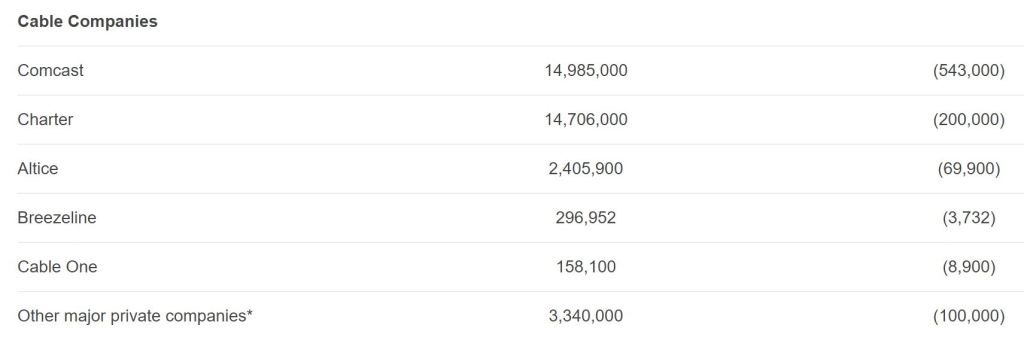
The “cord cutting” trend cable execs spent a decade claiming was a fad just broke another round of new records. According to Leichtman Research, major cable TV providers lost another 1.7 million subscribers last quarter, as users flock to streaming, over the air TV, TikTok, or, you know, books. Roughly 17,700 customers cut the cord every single day during the second quarter of 2023.
Over the last year (Q2 ’22 to Q2 ’23) the traditional cable TV sector lost a whopping 5,360,000 customers, compared to 4,235,000 customer defections the year earlier. The current number of U.S. households that has a cable connection sits somewhere around 46 percent, down from 73% at the end of 2017.
Comcast wound up being among the biggest losers in the quarter, losing 543,000 paying customers:
Historically, a big cable company like Comcast or Charter wasn’t too hurt by “cord cutting” because it could just jack up the cost of monopolized broadband access. And while that’s still generally true; here too cable giants are seeing increased competition from community broadband (co-ops, utilities, municipalities), 5G home wireless, and phone companies belatedly upgrading to fiber.
Interestingly though, streaming TV providers also wound up losing subscribers, albeit at a much slower rate:
The shift from traditional cable to streaming had some very obvious benefits. Lower costs, greater flexibility in choice, and even better customer service.
At the same time, as the streaming sector pursues quarterly growth, it’s increasingly adopting the kind of tactics that made cable TV so unpopular: relentless price hikes, shitty labor practices, and annoying new restrictions on usage. That, in turn, is driving more people to even less traditional services like Twitch or TikTok as the cycle of innovative disruption stumbles ever forth.