On February 2, 2022, Minneapolis PD officers executed a no-knock raid on an apartment. Officer Mark Hanneman then summarily executed Amir Locke within seconds of his entry into the apartment.
It didn’t have to go this way. The Minneapolis PD was carrying out a warrant obtained by the St. Paul Police Department. The warrant obtained by the St. Paul PD was a regular warrant: one in which officers would have knocked and announced their presence. The Minneapolis PD decided it didn’t want to handle it that way and sought permission to perform a no-knock entry. When Locke reached for the weapon he legally owned, he was killed. Given the time stamps on the body cam recording, it would have been impossible for Locke to rouse himself from his sleep and be fully cognizant of the situation. The officers created the danger that allowed Officer Hanneman to kill Amir Locke.
But that’s the way the MPD does business. The Star Tribune reported that the MPD preferred to use no-knock warrants, even though those are supposed to be limited to extreme cases necessitating unannounced entry. According to the Star Tribune, since the beginning of 2022, the MPD had obtained 13 no-knock warrants and only 12 regular search warrants.
The new policy prohibits Minneapolis police officers from applying for no-knock search warrants, which would allow them to enter a location without first knocking or announcing their presence. It also prohibits them from asking other agencies to “execute” a no-knock search warrant on their behalf, or executing them for other agencies.
There are, of course, exceptions to the new rule.
Officers can still apply for “knock and announce” search warrants — which would generally require them to wait 20 seconds before entering a location during daylight hours and 30 seconds before entering during nighttime hours (between 8 p.m. and 7 a.m.). Those requirements, however, can be waived if there are “exigent circumstances.” The city says officers may enter immediately “to prevent imminent harm or to provide emergency aid,” to prevent “imminent destruction or removal of evidence” (except narcotics), to prevent “imminent escape of a suspect” or when in “hot pursuit.”
So, not much of a change, really. This appears to be mostly how the MPD handled things before the policy change. The only thing that might limit the use of no-knock warrants in the future is the exemption of narcotics from the list of evidence that must be no-knocked to save from “immediate destruction and removal.” And, according to an MPD spokesperson, officers will still be able to make their own discretion to convert regular warrants to no-knock warrants during warrant service if they decide the unfolding situation can be described as exigent.
The more useful portion of the new policy requires the PD to develop and maintain a “public-facing, online dashboard” that tracks forced entries performed by officers, including no-knock warrants. This dashboard will include demographic info, time/date data, and whether or not officers deployed force against the residence or the residents.
Unfortunately, the Minneapolis PD won’t learn much from the Amir Locke tragedy. Officers seeking no-knock warrants may be slightly inconvenienced by the new rules governing no-knock warrants, but the policy, as written, doesn’t seem capable of deterring abuse of these warrants. And the officer who decided Amir Locke was a threat worth killing less than ten seconds after crossing the apartment threshold won’t be facing anything more than public damnation.
In a joint statement from the offices of Hennepin County Attorney Mike Freeman and Minnesota Attorney General Keith Ellison, the prosecutors noted that Locke “should be alive today, and his death is a tragedy,” but that “the state would be unable to prove beyond a reasonable doubt any of the elements of MInnesota’s use-of-deadly force statute.”
Unfortunately, this is how the law works. The MPD raid team told itself (and a judge) the situation would be dangerous — dangerous enough to justify an unannounced entry. The moment officers saw a person with a gun in their hand, the killing was lawful. In essence, the PD had its cake and ate it, too. It created the danger and then exploited it. When cops create their own danger, the public loses 100% of time, as Scott Greenfield points out:
Officer Hanneman was not unreasonable in believing that the sleeping guy in an apartment being raided under a judicially authorized no-knock warrant presented an imminent risk of death, and so he shot first and killed him. This is what the law permits, making a choice favoring police over the non-cop when the decision is made whether to pull the trigger. This situation is untenable. The outcome is bad. What it was not is criminal.
If the new rules for no-knock warrants even slightly reduce the MPD’s use of them, it will save lives. And that’s worth it, even if it’s clear the new no-knock rules are mostly window dressing that look like reform but hardly change anything.
Cops lie. It’s a statement more factual than statements cops — the people given the biggest benefit of a doubt in “your word against mine” courtroom showdowns — tend to make when testifying or filling out reports.
A Missouri State Highway Patrol trooper who faced multiple misdemeanor charges amid allegations of falsifying traffic stop reports has pleaded guilty.
That would be Sgt. Zachary Czerniewski, a 10-year veteran who had been promoted twice before admitting to altering traffic stop reports to alter the race of drivers (from black to white), and cover up warrantless searches of vehicles. The former alterations likely stemmed from previous discipline the trooper had received for “stopping a disproportionate amount of minorities.” The trooper was allowed to resign.
This trooper is just one of the Thin Blue Line guys. Cops lie all the time about the most basic function of law enforcement: stops of individuals and/or vehicles.
[Norwalk police] ran an audit and made a strange discovery. Traffic Division Officer Edgar Gonzalez had entered multiple warning tickets into the system, all for out-of-state motorists, without ever actual stopping the drivers.
Norwalk police said they don’t know how Gonzalez obtained the names of the drivers he allegedly entered into the system, or why those particular drivers were chosen.
Gonzalez also resigned while under investigation. He is also facing criminal charges.
Five Arlington police officers who had been accused of falsifying traffic stops have surrendered their state peace officer licenses to dodge criminal charges.
The officers were indicted Friday, records show, but charges of tampering with government records have been dismissed. Eleven other officers also gave up their licenses so their cases wouldn’t go to a grand jury, said Sam Jordan, a spokeswoman for the Tarrant County district attorney’s office.
Dace Warren, 46, faced 15 counts; Christopher John Dockery, 32, faced 14 counts; and Dane Alan Peterson, 33, faced 10 counts. Brandon Christopher Jones, 33, and Christopher Michael McCright, 47, each faced five counts. The offenses were alleged to have happened in the first half of 2016, according to the indictments.
[…]
In May, the Arlington Police Department announced that it had suspended 15 officers after an internal audit found evidence of phony traffic stops. A 16th officer was put on leave later.
That’s a pretty (un)healthy concentration of lying cops. And, again, most were allowed to avoid criminal charges or license revocation by resigning while under investigation.
From 2020, here’s some LAPD officers making the local gang database even shittier, raising the number of officers accused of falsifying information on in-person stops to twenty:
Three Los Angeles police officers were charged Friday with falsifying records and obstructing justice by claiming without evidence that people they stopped were gang members or associates, Los Angeles prosecutors announced Friday.
Why do they do this? Well, first: it’s easy to do. Lots of stops happen. Very few are audited. Second, it helps officers achieve the ends they desire, whether it’s too look less bigoted or to ensure a steady flow of meaningless work by filling crime databases with junk data.
Two New Jersey police officers were found guilty of tampering and other official misconduct Thursday in a June 2012 traffic stop on the Garden State Parkway.
Essex County prosecutors said dashcam video disproved Bloomfield officers Sean Courter and Orlando Trinidad’s claims that Marcus Jeter tried to grab Courter’s gun and hit Trinidad. The footage shows Jeter holding his hands up in his car and yelling out “I did nothing wrong!” as officers pull him out of an SUV and cuff him.
A similar situation, this time on the other side of the nation:
Former LMPD officer Matt Dages has pleaded not guilty to falsifying a report in the arrest of Amaurie Johnson near the Grossmont trolley station on May 27, 2020.
Dages, a three-year veteran of the force, accused Johnson of smoking on the trolley platform, leading to a confrontation between the two men. In bystander video and body-worn camera footage released during an investigation, Dages can be seen pushing Johnson to sit before his arrest on charges of resisting and assaulting an officer.
Two former Rohnert Park police officers are facing federal corruption charges of conspiracy, extortion, falsification of records and tax evasion, all tied to an alleged years-long scheme to pull over and rob people of cash and marijuana.
Brendon Jacy Tatum and Joseph Huffaker were assigned to Rohnert Park’s drug interdiction team at various times between 2015 and 2017, according to a federal criminal complaint unsealed Friday.
A Delaware state trooper who received several traffic commendations has been indicted in a fraudulent traffic warning scheme in which at least two of his victims were fellow law enforcement officers, the Delaware Department of Justice announced Tuesday.
Cpl. Edwin Ramirez, who was stationed at Troop 9, was charged with misdemeanor and felony tampering with public records; issuing a false certificate, a felony; and official misconduct, a misdemeanor. If convicted, he faces up to nine years in prison.
[…]
As state police continued to investigate, they found that in April alone, Ramirez issued more than 30 fraudulent warnings, according to the Justice Department. In some cases, motorists were not informed of the warnings.
In other instances, prosecutors said, the traffic stop never happened.
It’s not an epidemic. But it’s also just the tip of the iceberg. This is only a few of the notable symptoms of law enforcement rot. These are just some of those who have been caught and disciplined. Others have been caught and their punishment — what there is of it — have flown under the press radar. Others will never face punishment for their actions because their violations haven’t been egregious enough.
But this sort of behavior doesn’t arise in a vacuum. This happens because officers feel comfortable doing it. They feel confident their fellow officers will say nothing about it. And they feel assured the consequences will most likely be minimal. Even those who have been indicted or convicted resigned during investigations to avoid having a firing on their record or, in some cases, to avoid having their law enforcement certification stripped.
As police accountability efforts move forward, we will see more of this. If these efforts can be sustained, we hopefully, at some point, will see reports of this behavior decrease. But, at the moment, we’re stuck in the middle. We’re years away from better policing. And we’re still suffering the side effects of a police culture generated by decades of nearly nonexistent accountability.
In the pantheon of aggressive intellectual property bullies, Disney certainly would be one of the companies that would be competing to be Zeus. Disney has simply never seen an opportunity for IP enforcement that it hasn’t acted upon, be it copyright, trademark, or anywhere in between. More to the point for this post, Disney also has this fun mindset that even if it isn’t going to use an IP it owns, it doesn’t like it if anyone else does, either. On the topic of copyright specifically, this would represent a full departure from the purpose of copyright law: to encourage the creation and release of content in exchange for a temporary monopoly on that content.
Remember Club Penguin? That was the name of an online game/community, once independent, which Disney acquired in 2007 and spent the following decade running directly into the ground. The site and service, once beloved by the public, was fully shut down in 2017. Disney attempted to use the Club Penguin name by releasing a mobile app version of Club Penguin called Club Penguin Island. That mobile app was panned by Club Penguin fans and was shut down in 2018, a little over a year after its release.
But fans of the original independent Club Penguin lived on. In 2020, a group of fans released Club Penguin Online, run by fans in a completely unlicensed scenario. Disney fired off DMCA notices and got CPO taken down. To be fair to Disney, many at the time postulated that these actions were due to some extremely gross and illegal predatory behavior that was being conducted upon children on the CPO servers by some users. But to be fair to the law, that isn’t what copyright is for. There are already other laws designed to deal with such predators.
Besides, it’s 2022 and here we are all over again, with Disney working with City of London police not only to get another Club Penguin fan-run site shut down, but to actually get three individuals running it arrested.
In an emailed statement to TechCrunch, Detective Constable Daryl Fryatt from the Police Intellectual Property Crime Unit (PIPCU) at City of London Police said:
“Following a complaint under copyright law, PIPCU have seized a gaming website as part of an ongoing investigation into the site.Three people were arrested on April 12 on suspicion of distributing materials infringing copyright and searches were carried out.They have been released under investigation and to aid with the police investigation, they agreed to sign over the website to the control of PIPCU.”
Note the total lack of any accusation of racism, terrorism, or child predatory behavior in that statement. By all accounts, there doesn’t seem to be any indication here that this has anything to do with anything beyond Disney enforcing its copyright for Club Penguin. A copyright that, by the by, it has done absolutely nothing with for several years now.
In other words, Disney isn’t going to use this IP, and the public can’t use it either. So who gets to play the beloved Club Penguin in any form? Nobody, that’s who. Why? Because Disney would rather choose to enforce its copyright on a moldy piece of culture rather than let anyone else enjoy the meal.
And, we shouldn’t let the City of London police off the hook here either. Their actions have been well documented on Techdirt’s pages before. As everyone will remind you, this is not the Metropolitan Police Service in London. This is a law enforcement arm of “the City of London” which is a one-square mile chunk in the middle of London, where that police force long ago decided that it was going to become Hollywood’s personal thugs. They have a long history of overly aggressively attacking the internet, assuming everyone is a criminal. They have literally claimed that 90% of the internet is a risk to society. They’ve been able to inject “this website has been reported to the police” onto websites with no due process. They’ve arrested people on sketchy logic before. They’ve tried to argue that domain registrars are criminally liable for actions done by websites. And they’ve had some of their previous fever dream arrest cases over copyright fall apart.
Basically, they’re the police force that Hollywood has always wanted, and they’re happy to oblige, without ever recognizing that the world isn’t what they think it is, and some fans remembering a community they loved, even one owned by Disney, is not a criminal offense.
Again, this is the opposite of the intention of copyright law. Copyright wasn’t designed to refuse the public access to culture. It was designed to promote more access to culture by the public. It seems that this is yet another example of a design flaw within the law — and it’s sad that the City of London Police are so happy to abuse their power to lock people up to continue to pervert the intention of copyright law.
A few months after the snippet tax was agreed to as part of the EU Copyright Directive, Australia indicated it wanted to take the same route. The government there planned to make Internet companies pay newspapers for sending the latter extra traffic, by imposing something called the News Media Bargaining Code. In a blog post from December 2020, Mel Silva, VP, Google Australia & New Zealand, gave a good analysis of why Australia’s proposed Code was antithetical to the way the Web worked, including the following:
It forces Google to pay to show links in an unprecedented intervention that would fundamentally break how search engines work. No website and no search engine pays to connect people to other websites, yet the Code would force Google to include and pay for links to news websites in the search results you see. This sets the groundwork to unravel the key principles of the open internet people use every day—something neither a search engine nor anyone who enjoys the benefits of the free and open web should accept.
A few weeks later, Google turned up the pressure, and threatened to make its search engine unavailable in Australia if the News Media Bargaining Code went ahead. At this point, Microsoft sensed an opportunity to make life harder for its rival in the online search market. Microsoft’s President, Brad Smith, published the following post of his own, stating that in contrast to Google:
Microsoft fully supports the News Media Bargaining Code. The code reasonably attempts to address the bargaining power imbalance between digital platforms and Australian news businesses. It also recognises the important role search plays, not only to consumers but to the thousands of Australian small businesses that rely on search and advertising technology to fund and support their organisations. While Microsoft is not subject to the legislation currently pending, we’d be willing to live by these rules if the government designates us.
The reason why Microsoft was happy to throw the entire Web under a bus became clear later in the post:
Microsoft will ensure that small businesses who wish to transfer their advertising to Bing can do so simply and with no transfer costs. We recognise the important role search advertising plays to the more than two million small businesses in Australia.
We will invest further to ensure Bing is comparable to our competitors and we remind people that they can help, with every search Bing gets better at finding what you are looking for.
Bing is Microsoft’s largely forgotten search engine. In the desperate hope that making things difficult for Google might encourage a couple of people to switch to Bing, Microsoft decided to cozy up to the newspaper industry that was hell-bent on undermining the Web. A few weeks after Smith’s blog post, Microsoft joined with European newspaper publishers to call for the Web to be weakened there too.
Given that cynical attempt to use bad legislation to attack its rivals, it is gratifying to see that Microsoft’s plan of working with newspaper publishers isn’t going so well, as reported here by the Frankfurter Allgemeine Zeitung (translation via DeepL):
The collecting society Corint Media wants to enforce the demands of press publishers for the ancillary copyright against Microsoft in court. The company announced in Berlin on Friday [1 April 2022] that the step had been taken “after more than two years of talks without an acceptable result on an appropriate remuneration.”
Apparently, Microsoft had offered 700,000 euros for its 2022 use of newspaper material in the Bing search engine and MSN.com. The publishers, however, demanded 20 million euros. Microsoft had obviously forgotten that, as far as the copyright industry is concerned, coziness counts for nothing, and that enough is never enough.
Two men have been arrested for allegedly impersonating federal agents over the course of several years. The FBI alleges that Arian Taherzadeh, 40, and Haider Ali, 35, have been pretending to be various officers and employees of the U.S. government, including members of federal law enforcement agencies, since February 2020.
The two allegedly obtained paraphernalia, handguns and assault rifles used by federal law enforcement agencies. The FBI claims they used their false associations with the U.S. government “to ingratiate themselves with members of federal law enforcement and the defense community.”
The pair pretended to be DHS employees. Using this limited amount of subterfuge (along with an apartment full of police gear obtained [allegedly] illegally), the duo managed to compromise US Secret Service members as well as another DHS employee. This apparently included a member of the First Lady’s Secret Service detail.
Private surveillance was leveraged.
Other residents in the building said the two — who held several apartments in the building that they said were “being paid for by DHS” — had access to residents’ surveillance cameras, cell phones and other personal information. Authorities later learned that many of the buildings’ residents were in the FBI, Secret Service and DHS. Others were members of the Department of Defense and the U.S. Navy.
The two men — Arian Taherzadeh, 40, and Haider Ali, 36 — were taken into custody as more than a dozen FBI agents charged into a luxury apartment building in Southeast Washington on Wednesday evening.
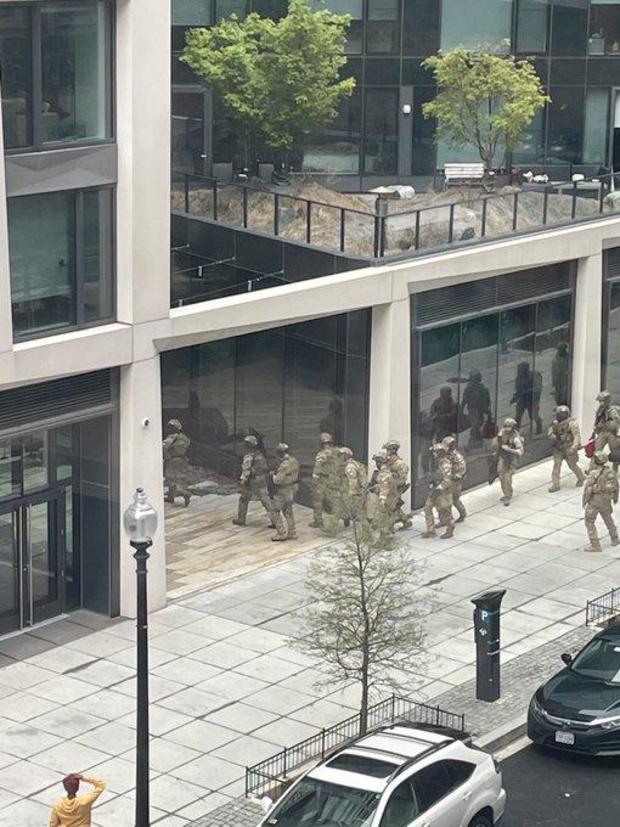
“More than a dozen” somewhat underplays what happened here. And, despite the fact this raid involved a “luxury apartment building,” the FBI dressed for war. This photo is from one of the government’s exhibits in the criminal case. Without context, one might assume this photo was taken at the frontlines of the Ukraine war or possibly is a historical artifact, like (for example) the US military taking control of an Iraqi government controlled financial institute.
In this photo (which does not appear to include the entire FBI raid team), there are at least 13 FBI agents visible. It might possibly contain 14 agents, depending on your interpretation of the protruding limbs seen at the right side of the frame. And it doesn’t appear as though the agents photographed are the entirety of the warrant service crew.
The question is why anyone in the FBI thought camouflage gear would be useful or necessary in a situation like this. The agents casually approaching the foyer of this luxury apartment complex don’t appear to be trying to blend in with the environment. When soldiers wear military gear into cities, it’s because that’s often the only option they have. That’s their normal uniform when engaged in combat and there’s really no convenient place to change into something more stealthy/appropriate when on patrol or seeking to secure certain areas.
But FBI agents have plenty of time to plan their tactical loadout. And, despite going no further than a DC apartment complex, the FBI chose to look like an invading force. While they may have been concerned that the suspects had access to guns and police gear, it makes zero sense to walk single file into an apartment complex duded up like Private Ryan.
Ironically, the gear obtained by the impersonators more closely resembled the public’s expectations about law enforcement’s appearance during police operations.
That’s what people expect cops (and the FBI) to wear. Instead, the FBI showed up like it was the first wave of martial law. And, despite being dressed up like an invading force, agents apparently encountered no resistance and took the suspects into custody without a fight. In the end, this looks like sending a bunch of boys pretending to be men to do a man’s job.
The message it sends to the public, however, is damaging. It shows law enforcement officers (at all levels of the government) prefer to present themselves as an occupying force, no matter what potential danger they’re facing.
Then there’s this bit of inadvertent hilarity in the DOJ’s request for denial of bail. Maybe I’m the only one that thinks it’s funny, but here it is:
[T]hey procured, stored, and used all the tools of law enforcement and covert tradecraft: weaponry, including firearms, scopes, and brass knuckles; surveillance equipment, including a drone, antennae, hard drives, and hard drive copying equipment.
You mean, like “hard drives?” This list (possibly excluding the brass knuckles) looks like the sort of thing any American with some tech knowledge might have in their home at any given time. That firearms are deemed “tools of law enforcement,” rather than the natural result of a constitutional right to bear arms is extremely concerning. That the ability to copy data is considered “covert tradecraft” by the FBI is even more alarming. And stupid. (But mostly alarming.)
It’s just not enough to be a cowboy cop anymore. Cops pretend they’re soldiers to psyche themselves up for regular warrant service. Meanwhile, actual soldiers have to pretend they’ve never been deployed to get average Americans to trust them. What a time to be alive.
The Z2 headphones earned their name because they feature twice the sound, twice the battery life, and twice the convenience of competing headphones. This updated version of the original Z2s comes with a new all-black design and Bluetooth 5.0. Packed with TREBLAB’s most advanced Sound2.0 technology with aptX and T-Quiet active noise-cancellation, these headphones deliver goose bump-inducing audio while drowning out unwanted background noise. These headphones are on sale for $70.
Note: The Techdirt Deals Store is powered and curated by StackCommerce. A portion of all sales from Techdirt Deals helps support Techdirt. The products featured do not reflect endorsements by our editorial team.
Lots of talk yesterday as Elon Musk made a hostile takeover bid for all of Twitter. This was always a possibility, and one that we discussed before in looking at how little Musk seemed to understand about free speech. But soon after the bid was made public, Musk went on stage at TED to be interviewed by Chris Anderson and spoke more about his thoughts on Twitter and content moderation.
It’s worth watching, though mostly for how it shows how very, very little Musk understands about all of this. Indeed, what struck me about his views is how much they sound like what the techies who originally created social media said in the early days. And here’s the important bit: all of them eventually learned that their simplistic belief in how things should work does not work in reality and have spent the past few decades trying to iterate. And Musk ignores all of that while (somewhat hilariously) suggesting that all of those things can be figured out eventually, despite all of the hard work many, many overworked and underpaid people have been doing figuring exactly that out, only to be told by Musk he’s sure they’re doing it wrong.
Because these posts tend to attract very, very angry people who are very, very sure of themselves on this topic they have no experience with, I’d ask that before any of you scream in the comments, please read all of Prof. Kate Klonick’s seminal paper on the history of content moderation and free speech called The New Governors. It is difficult to take seriously anyone on this topic who is not aware of the history.
But, just for fun, let’s go through what Musk said. Anderson asks Musk why he wants to buy Twitter and Elon responds:
Well, I think it’s really important for there to be an inclusive arena for free speech. Twitter has become the de facto town square, so, it’s really important that people have both the reality and the perception that they’re able to speak freely within the bounds of the law. And one of the things I believe Twitter should do is open source the algorithm, and make any changes to people’s tweets — if they’re emphasized or de-emphasized — that should be made apparent so that anyone can see that action has been taken. So there’s no sort of behind-the-scenes manipulation, either algorithmically or manually.
First, again, this is the same sort of thing that early Twitter and Facebook and other platform people said in the early days. And then they found out it doesn’t work for reasons that will be discussed shortly. Second, Twitter is not the town square, and it’s a ridiculous analogy. The internet itself is the town square. Twitter is just one private shop in that town square with its own rules.
Anderson asks Musk why he wants to take over Twitter when Musk had apparently told him just last week that taking over the company would lead to everyone blaming him for everything that went wrong, and Musk responds that things will still go wrong and you have to expect that. And he’s correct, but what’s notable here is how he’s asking for a level of understanding that he refuses to provide Twitter itself. Twitter has spent 15 years experimenting and iterating its policies to deal with a variety of incredibly complex and difficult challenges, nuances, and trade-offs, and as Musk demonstrates later in this interview, he’s not even begun to think through any of them.
My strong intuitive sense is that having a public platform that is maximally trusted and broadly inclusive is extremely important to the future of civilization.
Again, this is the same sort of things that the founders of these websites said… until they had to deal with the actual challenges of running such platforms at scale. And, I should note, anyone who’s spent any time at all working on these issues knows that “maximally trusted” requires some level of moderation, because otherwise platforms fill up with spam and scams (more on that later) and are not trusted at all. There’s a reason these efforts are put under the banner of “trust & safety.”
Finally, the “public platform” is the internet. And trust is earned, but opening up a platform broadly does not inspire trust. Being broadly inclusive and trustworthy also requires recognizing that bad actors need to be dealt with in some form or another. This is what people have spent over a decade working on. And Musk acts like it’s a brand new issue.
And so then we get to the inevitable point of any such discussion in which Musk admits that of course some moderation is important.
Chris Anderson: You’ve described yourself as a free speech absolutist. Does that mean that there’s literally nothing that people can’t say and it’s ok?
Elon Musk: Well, I think, obviously Twitter or any forum is bound by the laws of the country it operates in. So, obviously there are some limitations on free speech in the US. And of course, Twitter would have to abide by those rules.
CA: Right. So you can’t incite people to violence, like direct incitement to violence… like, you can’t do the equivalent of crying fire in a movie theater, for example.
EM: No, that would be a crime (laughs). It should be a crime.
But just the fact that Musk (1) agrees with this sentiment and (2) thinks that it would obviously be a crime shows how little he actually understands about free speech or the laws governing free speech. As a reminder for those who don’t know, the “fire in a crowded theater” line was a non-binding rhetorical aside in a case that was used to lock up a protestor for handing out anti-war literature (not exactly free speech supportive), and the Supreme Court Justice who used the phrase basically denounced it in rulings soon after — and the case that it came from was effectively overturned a few decades later, in the new case that set up the actual standard that Anderson suggests about incitement to imminent lawless action (which, in most cases, crying fire in a theater absolutely would not reach).
Anderson then tries (but basically fails) to get into some of the nuance of content moderation. It would have been nice if he’d actually spoken to, well, anyone with any experience in the space, because his examples aren’t just laughable, they’re kind of pathetic.
CA:But here’s the challenge, because it’s such a nuanced between different things. So, there’s incitement to violence, that’s a no if it’s illegal. There’s hate speech, which some forms of hate speech are fine. I… hate… spinach.
First of all, “I hate spinach” is not hate speech. I mean, of all the examples you could pull out… that’s not an example of hate speech (and we’ll leave aside Musk’s joke response, suggesting that if you cooked spinach right it’s good). But, much more importantly, here’s where Anderson and Elon could have confronted the actual issue which is that, in the US, hate speech is entirely protected under the 1st Amendment. And, we’ve explained why this is actually important and a good thing, because in places where hate speech is against the law, those laws are frequently abused to silence government critics.
But keeping hate speech legal is very different from saying that any private website must keep that speech on the platform. Indeed, keeping hate speech on a private platform takes away from the supposed “trust” and “broadly inclusive” nature Musk claimed to want. That would be an interesting point to discuss with Musk — and instead we’re left discussing what’s the best way to cook spinach.
Anderson again sorta weakly tries to get more to the point, but still doesn’t seem to know enough about the actual challenges of content moderation to have a serious discussion of the issue:
CA:So let’s say… here’s one tweet: ‘I hate politician X.’ Next tweet is ‘I wish politician X wasn’t alive.’ As some of us have said about Putin, right now for example. So that’s legitimate speech. Another tweet is ‘I wish Politician X wasn’t alive’ with a picture of their head with a gunsight over it. Or that plus their address. I mean at some point, someone has to make a decision as to which of those is not okay. Can an algorithm do that, or surely you need human judgment at some point.
First of all, broadly speaking all of the above are protected under the 1st Amendment. Somewhat incredibly, his final hypothetical is one I can talk about directly, because I was an expert witness in a case where a guy was facing criminal charges for literally Photoshopping gunsights over government officials, and the jury found him not guilty. But, also broadly speaking, there are plenty of legitimate reasons why a private platform would not want to host that content. In part, that gets back to the “maximally trusted” and “broadly inclusive” points.
But, on top of that, none of those examples are hate speech. Hate speech is not, as Chris Anderson bizarrely seems to believe, saying “I hate X.” Hate speech is generally seen as forms of expression designed to harass, humiliate, or incite hatred against a group or class of persons based on various characteristics about them (generally including things like race, religion, sexual identity, ethnicity, disability, etc.). The examples he raises are not, in fact, hate speech.
Either way, here’s where Elon shows how little he understands any of this, and how unfamiliar he is with all that’s happened in this space in the past two decades.
In my view, Twitter should match the laws of the country. And, really, there’s an obligation to do that. But going beyond that, and having it be unclear who’s making what changes to who… to where… having tweets mysteriously be promoted and demoted without insight into what’s going on, having a black box algorithm promote some things and not other things, I think those things can be quite dangerous.
Again, in the US, the laws say that such speech is protected, but that’s not a reasonable answer. We’ve gone through this before. Parler claimed it would only moderate speech that violated the law and then flipped out when it realized that people were getting on the site to mock Parler’s supporters or to post porn (which is also protected by the 1st Amendment). Simply saying that moderation should follow the law generally shows that one has never actually tried to moderate anything. Because it’s much more complicated than that, as Musk will implicitly admit later on in this interview, without the self-awareness to see how he’s contradicting himself.
There’s then a slightly more interesting discussion of open sourcing the algorithm, which is its own can of worms that I’m not sure Musk understands. I’m all for more transparency, and the ability for competing algorithms to be available for moderation, but open sourcing it is different and not as straightforward as Musk seems to imply. First of all, it’s often not the algorithm that is the issue. Second, algorithms that are built up in a proprietary stack are not so easy to just randomly “open source” without revealing all sorts of other stuff. Third, the biggest beneficiaries of open sourcing the ranking algorithm will be spammers (which is doubly amusing because in just a few moments Musk is going to whine about spammers). Open sourcing the algorithm will be most interesting to those looking to abuse and game the system to promote their own stuff.
We know this. We’ve seen it. There’s a reason why Google’s search algorithm has become more and more opaque over the years. Not because it’s trying to suppress people, but because the people who were most interested in understanding how it all worked were search engine spammers. Open sourcing the Twitter algorithm would do the same thing.
Chris then gets back to the moderation process (again in a slightly confused way about how Twitter trust & safety actually works), pointing out that “the algorithm” is probably less of an issue than all the human moderators, leading Musk to give a very long pause before stumbling through a bit of a word-salad response:
Well, I…I… I think we would want to err on the side… if in doubt, let… let… let the speech… let it exist. It would have… if it’s.. uh… a gray area, I would say, l would say let the tweet exist. But… obviously… in a case where perhaps there’s a lot of controversy where perhaps you’d not want to necessarily promote that tweet, you know… so…so… so… I’m not saying I have all the answers here, but I do think that we want to be very reluctant to delete things and be very cautious with permanent bans. I think time outs are better than permanent bans.
But just in general, like I said, it won’t be perfect but I think we want to really have the perception and reality that speech is as free as is reasonably possible and a good sign as to whether there is free speech, is ‘is someone you don’t like allowed to say something you don’t like.’ And if that is the case, then you have free speech. And it’s damn annoying when someone you don’t like says something you don’t like. That is a sign of a healthy, functioning free speech situation.
Again, so much to unpack here. First off, that approach of “when in doubt, let it exist” has almost always been the default position of the major social media companies from the beginning. Again, it’s important to go back to things like Klonick’s paper which describes all this. It’s just that over time anyone who’s done this quickly learns that fuzzy standards like “when in doubt” don’t work at all, especially at scale. You need specific rules that can be easily understood and rolled out to thousands of moderators around the world. Rules that can take into account local laws, local contexts, local customs. It’s not nearly as simple as Musk makes it out to be.
Indeed, to get to the spot that we’re in now, basically all of these companies started with that same premise, realized it wasn’t workable, and then iterated. And Musk is basically saying “I have a brilliant idea: let’s go back to step 1 and pretend none of the things experts in this space have learned over the past decade actually happened.”
And, again, Twitter and Facebook — just as Musk claims he wants — tend to lean towards time outs over permanent bans, but both recognize that malicious actors eventually will just keep trying, so some people you will have to ban. But Musk pretends like this is some deep wisdom when every website with any moderation at all knew this ages ago. Including Twitter.
Second, his definition of free speech is utter nonsense (and ridiculously got a big applause from the audience). That’s not the definition of free speech and if it is, then Twitter already has that. Tons of people I dislike are allowed to say things I dislike. You see that all over Twitter. But that’s not a reasonable or enforceable standard at all without context. The problem is not “someone I dislike saying something I dislike” the problem is spam, abuse, harassment, threats of violence, dangerously misleading false information, and more. Musk not understanding any of that is just a representation of how little he understands this topic.
Anderson then asks Musk about what changes he would make to Twitter, leading Musk to basically contradict everything he just said and go straight to banning speech on Twitter:
Frankly, the top priority I would have is eliminating the spam and scam bots and the bot armies that are on Twitter. You know, I think, these influence… they make the product much worse.
Um, nearly all of those are legal (the scam ones are a bit more hazy there, but the spam ones are legal speech). And just the fact that he acknowledges that they make the product much worse underlines how confused he is about everything else. Dealing with the things that “make the product much worse” is the underlying point of any trust & safety content moderation program — and tons and tons of work, and research, and testing have gone into how Twitter (and every other platform) tries to manage those things, and they all pretty much end up at the same place.
To deal with the spam and the scams and the things that “make the product much worse” you have to have rules, and you have to have enforcement that deals with the people who break the rules, meaning that you have to have people knowledgeable about content moderation and who are able to iterate and adjust, especially in the face of malicious actors trying to game the system.
But it’s quite incredible for him to say “pretty much leave it up if it’s legal” one moment, and the next moment say his top priority is to get rid of spam. Spam is legal.
And, again, as anyone who has lived through (or read up on) the history of content moderation knows, platforms all went through this exact process. The process that Musk thinks no one has actually done. They all started with a fundamental default towards allowing more speech and moderating less. And they all realized over time that it’s a lot more nuanced than that.
They all realized that there are massive trade-offs to every decision, but that some decisions still need to be made in order to stop “making the product worse” and to figure out ways to build “maximal trust” and to be “broadly inclusive.” In other words, for all of Musk’s complaining, Twitter has already done all the work he seems to pretend it hasn’t done. And his “solution” is to go back to square one while ignoring all the people who learned about the pitfalls, challenges, nuances, and trade-offs of the various approaches to dealing with these things… and to pretend that no one has done any work in this area.
Every time I post about this, Musk’s fans get angry and insist I couldn’t possibly understand this better than Musk. And, again, I actually really admire Musk’s ability to present visions and get the companies he’s run to achieve those visions. But dealing with human speech isn’t about building a car, a robot, a tunnel, or a rocket ship. It’s about dealing with human beings, human nature, and society.
None of this is to say that, if Musk does succeed in the bid, he doesn’t have the right to make these massive steps back to square one. Of course he has every right to make those mistakes. But it would be a disappointing move for Twitter, a company that has been more thoughtful, more careful, and more advanced than many other companies in this space. And it would likely wipe out the important institutional knowledge around all of this that has been so helpful.
I know that the narrative — which Musk has apparently bought into — is that Twitter’s content moderation efforts are targeted at stifling conservatives. There is, yet again, no actual evidence to support this. If anything, Twitter and Facebook have bent over backwards to be extra accommodating to those pushing the boundaries in order to use Twitter mainly as a platform to rile up those they dislike. But, from knowing how much effort Twitter has actually put into understanding interventions and how to build a trustworthy platform, I fear that what Musk would do with it would be a massive step backwards and a general loss for the world.
Incredibly, there’s a pretty good analogy to all of this earlier in that video. At the beginning, Anderson plays a snippet of a taped interview he did with Musk a week ago (when they weren’t sure if he’d be able to attend in person). And in that interview, Anderson points out that Musk predicted to Anderson five years ago that Tesla would have full self-driving working that year, and it obviously has not come to pass. Musk jokes about how he’s not always right, and explains that he’s only now realized that just how hard a problem driverless artificial intelligence is, and he talks about how every time it seems to be moving forward it hits an unexpected ceiling.
The simple fact is that dealing with human nature and human communication is much, much, much more complex than teaching a car how to drive by itself. And there is no perfect solution. There is no “congrats, we got there” moment in content moderation. Because humans are complex and ever-changing. And content moderation on a platform like Twitter is about recognizing that complexity and figuring out ways to deal with it. But Musk seems to be treating it as if it’s the same sort of challenge as self-driving — where if you just throw enough ideas at it you’ll magically fix it. But, even worse than that, he doesn’t realize that the people who have actually worked in this field for years have been making the kind of progress he talked about with self-driving cars — getting the curve to move in the right direction, before hitting some sort of ceiling. And Musk wants to take them all the way back to the ground floor for no reason other than he doesn’t seem to recognize that any of the work that’s already been done.
While the press and some policy circles have made a large stink the last few years about massive new “bipartisan support for antitrust reform,” we’ve noted that the push isn’t quite what’s being advertised. While some of the bills being proposed might help correct some competitive imbalances online, the push in general is bizarrely narrow and only targets some tech companies under some circumstances.
As a party that’s coddled monopolies (see: telecom, banking, airlines, insurance) for literally 40 years, the GOP support for “antitrust reform” has always been performative. The GOP largely sees “antitrust reform” as a way to gain leverage over social media giants so they can mandate the carriage of race-baiting propaganda, a cornerstone of GOP power in the face of shifting demographics and an aging electorate.
Democratic activists and lawmakers, hoping to push some of these antitrust bills across the finish line, have been debating whether crushing ethics underfoot is worth it. Case in point: some Democrats have chosen to partner with The American Principles Project on antitrust reform, despite the fact the group is jam-packed with no shortage of obvious bigotry:
“Consolidated corporate power is the biggest problem that we’re facing right now in our politics,” said Matt Stoller, research director at the anti-monopoly group American Economic Liberties Project, who regularly works with populist figures on the right, including APP. He said divisions within both parties about antitrust changes mean that supporters “have to cobble together a majority.”
There’s productively working with people you disagree with across the aisle, and then there’s… this. Authoritarians aren’t your friends. It doesn’t usually end well. And, as some other activists note in the piece, allying with bigots who literally want to destroy your constituents and everything they stand for just to pass some very limited reform laws (several of which have very concrete problems) isn’t worth it:
“It doesn’t make sense to work with someone that doesn’t share our values and doesn’t share our goal,” said Jeremie Greer, co-founder and executive director of economic rights group Liberation in a Generation. “I don’t think we’re fighting for the same thing.” Greer argued that the push for antitrust reform is essentially about increasing equality and strengthening democracy — and a group fighting against LGBTQ and minority rights is fundamentally opposed to that work.
Again, having some slightly more fair app stores or more competitive Amazon product listings isn’t going to mean a whole hell of a lot should authoritarians gain power and begin dismantling the law and numerous societal systems in a bid for complete and total domination of their political enemies. And make no mistake, while groups like this dress up far right authoritarianism and bigotry as a rosy-cheeked concern for family values, authoritarianism is very much what we’re talking about.
At the same time, if you’re a large U.S. company in any of a dozen heavily monopolized U.S. industries terrified of antitrust reform of any kind, highlighting these kind of issues in a bid to fracture delicate alliances is something you’d most certainly have your K Street policy and PR shops engaged in right now.
That said, if we’re going to tackle antitrust reform, let’s tackle antitrust reform. Instead, what we’ve wound up with is a bunch of extremely narrow bills that only meaningfully target a handful of companies that the GOP is mad at for belatedly policing political propaganda. And even then, this being the rabidly obstructionist GOP, there’s no guarantee they’ll show up to vote for a bill that actually does anything.
The entire recent “antitrust reform” effort literally pretends that sectors packed with natural monopolies (see: telecom) don’t exist. And while, yeah, I get the argument that some fairly minor progress in one industry is better than no progress at all, that’s not actually true if making that progress involves throwing your entire belief apparatus in the toilet and putting democracy and civility at risk.