It’s nothing new that video games are getting realistic enough at this point that some out there will use it and pass that footage off as things happening in real life. A rather innocuous example of this would be a real estate developer using images from a city-building game in a brochure, for instance. On the other hand, one of the more common ways we see this happen is with governments using footage from war simulation games to do things like pretend they have capabilities that they very much do not, pass off such footage as proof of IRL military strikes that didn’t occur in the manner shown in the footage, or the use of imagery from video games being used to accuse the United States of supporting ISIS when we very much did not.
Well, Russia has decided that peace and stability are rather boring and are currently attempting to either depose the government of Ukraine or annex it. The politics of all of this are too obvious to get into, but we’re already starting to see game footage being passed off as war footage in the conflict. In this case, it is not likely that any of the belligerent governments are doing this, but rather some enterprising internet users making use of Digital Combat Simulator: World footage to create the story of an ace Ukrainian pilot.
A clip of a Ukrainian fighter jet blowing up a suspected Russian aircraft started trending on social media yesterday. Many believed it was proof of the exploits of a mysterious and unverified ace pilot called the “Ghost of Kyiv.” It was actually fake footage from the 2013 PC game, Digital Combat Simulator: World.
As Russia’s invasion of Ukraine entered its second day, rumors began to circulate of Ukrainian fighter pilot responsible for taking down multiple Russian targets. “The General Staff of the Ukrainian Armed Forces has claimed five Russian aircraft and a helicopter were shot down early Thursday,” CNN reported on February 24 (via Snopes). Russia, however, denied the losses.
The source of all this was a YouTube video that was very open that this footage was from the game. It claims it was made “out of respect” for this pilot that may or may not exist. Notably, whoever put the video together did some extra work in order to make it appear more real. As Kotaku notes, the video was made to look as though shot from a cell phone, for instance, not to mention audio of people supposedly gasping and talking throughout it as well.
So what does that mean? A number of things. First and foremost, everyone really needs to be more cautious about excepting that video footage about IRL events cannot be faked and faked quite well. That is obviously not the case.
But it’s also interesting that videos like these really are good enough to fool a great many people. The technology is progressing, sure, but so are people’s creative abilities for how to use it. I’m reminded of the fans of Grand Theft Auto that used some tools to make an entire movie out of game footage. That isn’t what’s going on here, of course, but as games get more realistic, more opportunities for skullduggery and creative output alike are going to come about.
I have heard rumors from multiple quarters that President Biden might mention Section 230 in tonight’s State of the Union speech, and I cannot think of any reason he should, unless it is to venerate it. Because it is only through the existence of Section 230 that we, or the world, stand a chance against the threats we face, especially right now.
In any crisis there is always the impetus to use the moment to advance one’s position and claim how what is happening illustrates how everything you’ve been arguing for has been right all along. But sometimes the correctness of that position is exactly what the moment is showing. And such is the case right now.
The Russian invasion of Ukraine is providing testament to the critical importance of free speech, including online free speech, and the legal constructs that enable it. Dangerous people like Putin depend on silence to wreak their destruction so that their actions can proceed undetected and undeterred by dissent. As we see Putin demand his own people be disconnected from the Internet, and engage in tactics designed to disconnect everyone else, this is why: because free discourse is a powerful defense against tyrants, and it is one he does not want to confront.
People always need to talk to each other, and sometimes their very survival, let alone the future political stability of their nation, depends on being able to share ideas and information. The Internet is an amazing tool that enables such an exchange of expression, to a degree that is without precedent or substitute. It, and the Section 230 statute that enables it to be this fantastic global tool for keeping people connected, is a tremendous gift we years ago gave to our future selves, and one we would today be infinitely poorer without. This war is but one example of how much so.
Which is not to say that everything is perfect with the Internet and all the ways people use it. We have never before lived in a time when all people everywhere could be connected. But there is no simple solution to any of the hard challenges our new digitally-interconnected life has revealed. We should not pretend there is, and we certainly should not delude ourselves into believing that Section 230 is some low-hanging fruit that if plucked would miraculously fix all our problems without creating countless more, some of them much worse.
Because it would be doing a tyrant like Putin’s bidding to take any step that would end up crippling the ability to speak and exchange information online, and to take such stark, consequential action that would affect all speakers everywhere simply because some have used their speech rights poorly. When people abuse power, speech is what gives those they would hurt the power to stand against them. And the Internet is what allows us all to hear them. Yet every time lawmakers flirt with repealing Section 230, routing around Section 230, or even “reforming” Section 230, that’s the fate that they invite: a world without the Internet, and without this critically important way for people to stay connected with each other at a time when they most need to.
Every time we glibly try to mess with this essential statutory protection Internet services depend on to provide the services speakers around the world depend on, we threaten to destroy the very thing that evens our odds against totalitarian danger. The absurdity of this regulatory call to harm Section 230, and therefore the Internet, and therefore the world, should therefore be apparent. At a time when we most need to defend our principles and our friends, it makes absolutely no sense to disarm ourselves and take away the world’s best weapon against the threats we all face. The Internet lets people speak, and there is nothing to be gained by ever making it so they can’t – but especially not now. It is no time to do anything to curtail speech and leave the people desperately calling for the world’s help as isolated as their attackers want them to be.
Several days into Russia’s attack on Ukraine, we are already witnessing astonishing stories play out online. Social media platforms, after years of Techlash, are once again in the center of a historic event, as it unfolds.
Different tech issues are still evolving, but for now, here are the key themes.
Information overload
The combination of — smartphones, social media and high-speed data links — provides images that are almost certainly faster, more visual and more voluminous than in any previous major military conflict. What is coming out of Ukraine is simply impossible to produce on such a scale without citizens and soldiers throughout the country having easy access to cellphones, the internet, and, by extension, social media apps.
Social media is fueling a new type of ‘fog of war’
The ability to follow an escalating war is faster and easier than ever. But social media are also vulnerable to rapid-fire disinformation. So, social media are being blamed for fueling a new type of ‘fog of war’, in which information and disinformation are continuously entangled with each other — clarifying and confusing in almost equal measure.
Once again, the Internet is being used as a weapon
Tech platforms face a difficult question: “How do you mitigate online harms that make war worse for civilians while preserving evidence of human rights abuses and war crimes potentially?”
What about the end-to-end encrypted messaging apps?
Social media platforms have been on high alert for Russian disinformation that would violate their policies. But they have less control over private messaging, where some propaganda efforts have moved to avoid detection.
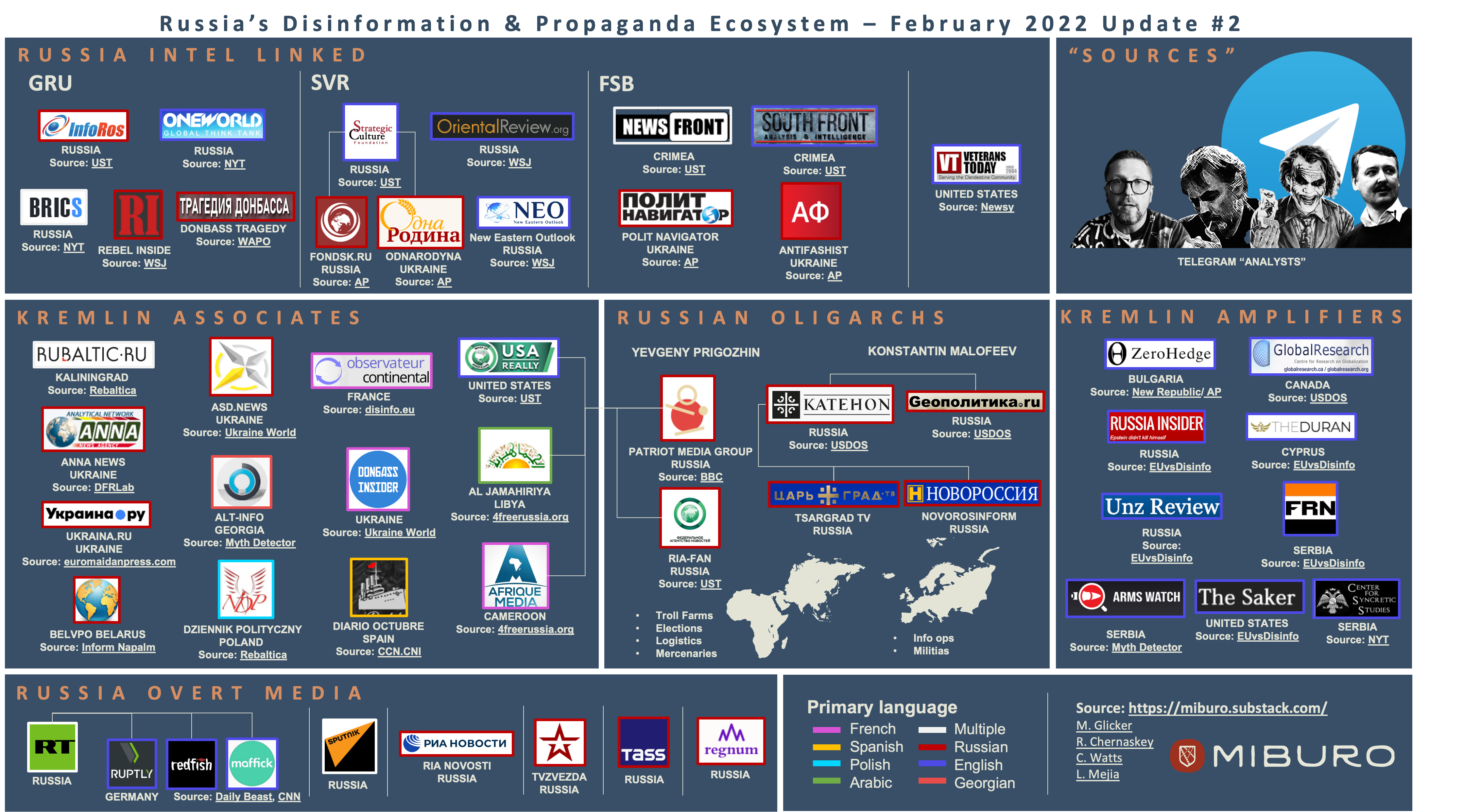
According to the “Russia’s Propaganda & Disinformation Ecosystem — 2022 Update & New Disclosures” post and image, the Russian media environment, from overt state-run media to covert intelligence-backed outlets, is built on an infrastructure of influencers, anonymous Telegram channels (which have become a very serious, a very effective tool of the disinformation machine), and content creators with nebulous ties to the wider ecosystem.
The Russian government restricts access to online services
On Friday, Meta’s president of global affairs, Nick Clegg, updated that the company declined to comply with the Russian government’s requests to “stop fact-checking and labeling of content posted on Facebook by four Russian state-owned media organizations.” “As a result, they have announced they will be restricting the use of our services,” tweeted Clegg. In the heart of this issue there are ordinary Russians “using Meta’s apps to express themselves and organize for action.” As Eva Galperin (EFF) noted: “Facebook is where what remains of Russian civil society does its organizing. Cut off access to Facebook and you are cutting off independent journalism and anti-war protests.”
Then, on Saturday, Twitter, which had said it was pausing ads in Ukraine and Russia, said that its service was also being restricted for some people in Russia. We can only assume that it wouldn’t be the last restriction we’ll see as Russia continues to splinter the open internet.
Collective action & debunking falsehood in real-time
It’s become increasingly difficult for Russia to publish believable propaganda. People on the internet are using open-source intelligence tools that have proliferated in recent years to debunk Russia’s claims in real-time. Satellites and cameras gather information every moment of the day, much of it available to the public. And eyewitnesses can speak directly to the public via social media. So, now you have communities of people on the internet geolocating videos and verifying videos coming out of conflict zones.
The ubiquity of high-quality maps in people’s pockets, coupled with social media where anyone can stream videos or photos of what’s happening around them, has given civilians insight into what is happening on the ground in a way that only governments had before. See, for example, two interactive maps, which track the Russian military movements: The Russian Military Forces and the Russia-Ukraine Monitor Map (screenshot from February 27):
But big tech has a lot of complicated choices to make. Google Maps, for example, was applauded as a tool for visualizing the military action, helping researchers track troops and civilians seeking shelter. On Sunday, though, Google blocked two features (live traffic overlay & live busyness) in an effort to help keep Ukrainians safe and after consultations with local officials. It’s a constant balancing act and there’s no easy solution.
Global protests, donations, and empathy
Social media platforms are giving Russians who disagree with the Kremlin a way to make their voice heard. Videos from Russian protests are going viral on Facebook, Twitter, Telegram and other platforms, generating tens of millions of views. Global protests are also being viewed and shared extensively online, like this protest in Rome, shared by an Italian Facebook group. Many organizations post their volunteers’ actions to support Ukrainians, like this Israeli humanitarian mission, rescuing Jewish refugees. Donations are being collected all over the web, and on Saturday, Ukraine’s official Twitter account posted requests for cryptocurrency donations (in bitcoin, ether and USDT). On Sunday, crypto donations to Ukraine reached $20 million.
According to Jon Steinberg, all of these actions “are reminders of why we turn to social media at times like this.” For all their countless faults — including their vulnerabilities to government propaganda and misinformation — tech’s largest platforms can amplify powerful acts of resistance. They can promote truth-tellers over lies. And “they can reinforce our common humanity at even the bleakest of times.”
“The role of misinformation/disinformation feels minor compared to what we might have expected,” Casey Newton noted. While tech companies need to “stay on alert for viral garbage,” social media is currently seen “as a force multiplier for Ukraine and pro-democracy efforts.”
Déjà vu to the onset of the pandemic
It reminds me a lot of March 2020, when Ben Smith praised that “Facebook, YouTube, and others can actually deliver on their old promise to democratize information and organize communities, and on their newer promise to drain the toxic information swamp.” Ina Fried added that if companies like Facebook and Google “are able to demonstrate they can be a force for good in a trying time, many inside the companies feel they could undo some of the Techlash’s ill will.” The article headline was: Tech’s moment to shine (or not).
On Feb 25, 2022, discussing the Russia-Ukraine conflict, Jon Stewart said social media “got to provide some measure of redemption for itself”: “There’s a part of me that truly hopes that this is where the social media algorithm will shine.”
All of the current online activities — taking advantage of the Social Smartphone Era — leave us with the hope the good can prevail over the bad and the ugly, but also with the fear it would not.
Remote test-taking spyware company Proctorio has spent months turning itself into an internet villain. It all started when student and security researcher Erik Johnson decided to take a look at the inner workings of Proctorio’s spyware, noting that it tracked everything from eye movement to mouse movement (with plenty in between) in apparent hopes of keeping students from cheating.
For providing this public service, Johnson’s Twitter account was hit with bullshit DMCA takedown requests from Proctorio, which objected to his fair use posting of the extension’s code — code that could easily be examined by anyone who installed the company’s spyware.
Proctorio probably thought it could intimidate Johnson into silence with its bogus DMCA demands. Instead, it poked a bear, leading to it being sued over its DMCA abuse by Johnson, now represented by the EFF. This was a new experience for Proctorio, which was used to being the plaintiff in lawsuits filed to silence critics of its software.
Now that it’s being sued, Proctorio is attempting to inflict misery on other critics of its spyware — even entities that are not a party to the lawsuit filed by Erik Johnson against the company. As Monica Chin reports for The Verge, Proctorio is attempting to drag internal documents and communications belonging to a critical nonprofit into court, seemingly solely for the purpose of discouraging EFF-alikes from continuing to expose the more concerning aspects of its remote education software.
The controversial proctoring platform Proctorio has filed a broad subpoena against the prominent digital rights nonprofit Fight for the Future as part of its legal battle with Miami University student Erik Johnson, in what the group describes as an effort to silence critics through legal maneuvering.
Certainly Proctorio would prefer FFTF to STFU. The nonprofit has been openly critical of Proctorio and other companies selling schools spyware to keep an eye on distance learners. It has also created a website that encourages students to pressure schools into dropping contracts with companies like Proctorio, citing all sorts of privacy issues this kind of intrusive software creates.
Fight for the Future is not a party to this lawsuit. Nonetheless, Proctorio is hoping a subpoena will give it access to a whole bunch of communications it has no right to obtain.
The subpoena requests that FFTF produce “all documents and communications” between itself and EFF, Erik Johnson, and Ian Linkletter, as well as any related to the proctoring software industry.
FFTF is fighting back. It has asked the court to quash the subpoena [PDF], pointing out Proctorio is engaging in a proxy war against its many critics with the obvious intent of silencing them.
Proctorio’s requests are a thinly veiled attempt to appropriate this court’s resources to extract information regarding the internal workings of a non-party advocacy organization with, at best, a tangential connection to the underlying litigation. Moreover, the Subpoena appears to be specifically calculated to chill FTTF’s future advocacy by blunting its speech and deterring association. These factors weigh heavily in favor of quashing the Subpoena.
Proctorio cannot satisfy even the general standard articulated in Rule 45, let alone the heightened standard to which the Subpoena is subject. The portion of the Subpoena in dispute — the request for “all documents and communications related to [Proctorio]” — would produce documents irrelevant to the litigation at hand, imposes an undue burden on FFTF, and is improperly motivated by a desire to access FTTF’s internal strategy. For these reasons, the Subpoena should be quashed or modified.
Proctorio — which cannot ever let anything go — claims this is a fully-justified wielding of proxy government power. It said (in its statement to The Verge) that this is just normal litigation stuff wherein parties being sued toss subpoenas in the general direction of non-parties that may or may not have anything of interest to the defendant. And while that may be true in some cases, Proctorio has made enough enemies it can likely claim every critic possesses some form of information “relevant” to its defense.
But that doesn’t make Proctorio right. And it doesn’t do anything to undermine the common perception that Proctorio is limiting its subpoenas to vocal critics or the objective truth that dragging critical non-parties into litigation has an undeniable chilling effect. Hopefully, the court will reject Proctorio’s critic-centric dragnet and force it to focus on the parties directly involved in the lawsuit.
AppMySite is a no-code DIY mobile app builder that delivers premium native mobile apps, in real-time, without writing a single line of code. Our product enables website owners, freelancers, and digital agencies to create customizable and affordable apps for Android & iOS. All mobile apps created are optimized for performance and built for publishing on the app stores. A one year subscription is on sale for $29, 3 years for $39, or 5 years for $50.
Note: The Techdirt Deals Store is powered and curated by StackCommerce. A portion of all sales from Techdirt Deals helps support Techdirt. The products featured do not reflect endorsements by our editorial team.
I’ve heard some truly bizarre attacks on Section 230, but Senator James Lankford from Oklahoma has taken it all to a new level of nonsense. The already Trumpian Senator is apparently facing a primary from someone even Trumpier, which perhaps contributes to whatever brain damage caused him to tweet a bunch of total nonsense over the weekend ostensibly about Section 230, but really just demonstrating what a very uninformed man, Senator James Lankford is.
Big Tech companies are not the ones who get to decide what free speech is. We need to rip & repeal legislation that allows Big Tech to subjectively censor groups they just don’t agree with that day. pic.twitter.com/IPiM0zVVXr
The three tweet thread reads as if Lankford asked an AI (or a very, very stupid intern) to come up with something to say criticizing Section 230, and this is what it spit out:
Big Tech companies are not the ones who get to decide what free speech is. We need to rip & repeal legislation that allows Big Tech to subjectively censor groups they just don’t agree with that day.
Legislation like Section 230 was originally made to protect from child trafficking over the internet through websites like backpage.com, but Big Tech companies are using it as a shield to censor Americans.
We need to continue to protect our children while also enforcing that Big Tech is doing their part to protect the next generation as well.
The first tweet also includes a video of Lankford doing the standard idiot’s guide to cherry-picking content moderation examples he disagrees with, pointing to a bunch of examples (almost all out of context) about what he believes are unfair or incorrect moderation choices. For example, he contrasts the removal of former President Trump with other awful global leaders, leaving out the reasons why Trump was banned. It wasn’t just that he was a terrible person or leader, but rather that he broke specific rules on the platform (specifically inciting violence). Lankford points to other terrible world leaders, but doesn’t point to any examples of them actually breaking Twitter’s rules.
Now, there may be a reasonable argument that Twitter shouldn’t allow terrible, dictatorial, authoritarian world leaders on its platforms. That could be a discussion worth having. But the argument here ignores the reality which is that — contrary to what Lankford and various very clueless people believe — the major sites don’t just ban people they dislike. They have policies in place, and they wait until someone actually violates those policies, as Trump did.
Either way, Lankford’s CPAC nonsense was wrong, but at least it was coherent. That Twitter thread, was both wrong and incoherent. First of all, if you want to “rip & repeal” what allows tech companies to moderate as they see fit, then you’re trying to throw out the 1st Amendment of the US Constitution (the same Constitution you swore to uphold and protect, Senator) not Section 230. It’s the 1st Amendment that grants a website the right to remove whatever content they want — and it’s what protects not just Facebook and Twitter’s choices, but also Truth Social and GETTR to similarly moderate how they see fit.
As for the second tweet… it’s just such pure incomprehensible nonsense that I need to repeat it here:
Legislation like Section 230 was originally made to protect from child trafficking over the internet through websites like backpage.com, but Big Tech companies are using it as a shield to censor Americans.
Leaving aside the (very weird) decision to literally link to Backpage, none of the rest of this tweet makes even the slightest bit of sense. Section 230 was passed in 1996. Backpage.com was founded in 2004. And Section 230 was not originally (or ever?) made to “protect from child trafficking over the internet” because child trafficking (over the internet or otherwise) is a federal crime, and Section 230(e)(1) has always exempted Section 230 from federal criminal law.
Also, Section 230 was not “made” for anything related to any of this. It was actually written to support a very traditionally conservative belief: that websites should be free to moderate as they see fit, without fear of either legal threats or government interference. And it covers not just every website that allows third party speech, but also their users as well (so it’s not just about “Big Tech”). But, either way, the choices of a website to moderate content is, generally, protected by the 1st Amendment. The benefit of Section 230 is that it helps get those nuisance lawsuits tossed out sooner, which actually protects the smaller internet competitors much more than the big guys.
So, if he’s talking about ripping and replacing Section 230 to “stop censorship” he’s going to be mighty disappointed. First of all, it won’t stop content moderation — which, again, is protected by the 1st Amendment of the US Constitution that Senator Lankford swore to protect and uphold. But it will lead to sites like Truth Social and GETTR (and lots of others) facing a lot more costly litigation. And would have no impact whatsoever on “child trafficking over the internet.”
So, Senator, either educate yourself, or find a better AI to write your tweets.
U.S. infrastructure policy is treated as annoying and boring… until a crisis hits and suddenly everybody cares. As millions of Texans found out last year when the state’s energy infrastructure crumbled like a rotten old house under the weight of heating energy demands, leaving millions without power during a major cold snap. While the state engaged in a lot of performative nonsense in the wake of the breakdown, nothing much changed. Most of the state laws passed to “fix” the problem just punted any meaningful action down the road, while carving out big exemptions for natural gas companies that helped write the laws.
A year later and the gas companies that refused to upgrade and weather proof their infrastructure, still largely haven’t done so. What have they done? Well, late last year they decided to hit Texas natural gas customers with a major and obnoxious new $3.4 billion surcharge with the blessing of state regulators:
“Texans will be paying for the effects of last February’s cold snap for decades to come, as the state?s oil and gas regulator approved a plan for natural gas utilities to recover $3.4 billion in debt they incurred during the storm. The regulator, the Railroad Commission, is allowing utilities to issue bonds to cover the debt. As a result, ratepayers could see an increase in their bills for the next 30 years.”
Texas consumers had already experienced electricity price gouging during the tragic blackout. During the power outage and deep freeze, the price of electricity in Texas was pegged at $9,000 per megawatt hour, up from $50 per megawatt hour before the blackout. Initially, this was deemed the exclusive decision by the Electric Reliability Council of Texas (ERCOT). That decision is estimated to have resulted in ERCOT overcharging state electricity companies by an estimated $16 billion during the tragedy, costs that were obviously passed on to Texas business and residential consumers.
But in court last week, former ERCOT boss Bill Magness testified that the decision to keep Texas electricity prices unreasonably high during the outage came at the direct behest of Texas Governor Greg Abbott:
“The former head of the organization behind Texas’ electric grid testified in court on Wednesday that he was following Texas Gov. Greg Abbott’s orders when he directed power prices to remain as high as possible for several days during Texas’ winter storm blackouts in February 2021, the Houston Chronicle first reported.
The former chief of the Electric Reliability Council of Texas (ERCOT), Bill Magness, said that Abbott’s orders came at a time when power plants were already starting to turn back on again.
Texas is largely detached from federal utility regulations. Instead, wholesale power prices are determined by supply and demand. When demand is high, ERCOT allows prices to go up in the hope Texas power companies will add more electricity to the grid. In this case, pegging power prices at up to 150 times normal cost forced many companies to buy power at unreasonable rates, triggering financial collapse for the smallest. Including Brazos Electric Cooperative, which is suing ERCOT claiming that $1.9 billion in additional costs drove it into bankruptcy.
Abbott’s office had previously denied that the Governor was not “involved in any way” in the decision to keep prices maxed at $9,000 per megawatt-hour even after things started to normalize. ERCOT and Abbott justified the decision by claiming that lowering prices would have driven more users back on to an already strained grid. The problem is that weatherproofing systems to prepare for climate change would have prevented any of this from happening in the first place (hard to do when you insist climate change isn’t real). The other problem; Abbott and his ilk aren’t keen on things like consumer protection and tough regulatory oversight, which results in Texas consumers holding the bag when all is said and done since high costs are always passed on to consumers.
246 Texans died during the February 2021 freeze, the majority by hypothermia. And while Texas consumers have dodged a repeat so far, they also haven’t seen the same kind of sustained, lower temperatures yet that let to the 2021 grid collapse. It’s only a matter of time, and there’s not a whole lot of evidence anybody involved learned much of a lesson. Granted this same lesson isn’t going to be exclusive to Texas; as climate change runs face-first into the U.S. trifecta of infrastructure neglect, greed/corruption, and a general disdain for consumer protection and functioning regulators, outcomes are going to be similar across numerous states. Wash, rinse, and repeat until somebody actually learns something from the experience.