It’s really quite amazing how frequently those who support more draconian copyright laws seem to be caught up in ethically dubious copying. We just had the example of the Hollywood astroturf group, CreativeAmerica, pretty blatantly “remixing” an anti-SOPA email alert from Public Knowledge, and turning it into a pro-SOPA argument. But this next one seems even worse. SOPA supporters, such as the MPAA and the very same Creative America, seemed overjoyed to point folks to an opinion piece in the Salt Lake Tribune by the state’s attorney general, Mark Shurtleff, claiming to support SOPA and PIPA.
Just one little tiny problem… there appears to be a fair bit of evidence that Shurtleff “copied” his work from elsewhere and simply “remixed” the work of others. TorrentFreak goes into great detail how many of the statements in the opinion piece supposedly written by Shurtleff, have appeared elsewhere from pro-SOPA folks.
To back up this claim we will highlight a few sentences from the Attorney General’s article, and compare them with those previously delivered by the MPAA and affiliated pro-copyright groups.
The first sentence that caught our attention is: “It will take a strong, sustained effort to stop Internet thieves and profiteers.”
Strong words, but also familiar ones. In fact, former MPAA President Bob Pisano uttered exactly the same words in 2010 when he congratulated the Senate Judiciary Committee with unanimously approving the COICA bill, the predecessor to SOPA and PIPA.
They go on to find lots of other rather complex phrases that show up in both Shurtleff’s “new” opinion piece… and lobbying efforts from times past. In fact, the whole thing seems like a classic “remix” — cutting and pasting lots of works from elsewhere, and creating something “new” out of it. Who knows if this reaches the legal standard for copyright infringement… but it certainly calls into serious question either the legitimacy of the op-ed… or, the competence of Shurtleff. Once again, we think such remixing is good and should be allowed. But it’s pretty crazy to argue for laws like SOPA… and do so with what certainly sounds like plagiarized phrases from elsewhere.
European Commission Vice-President Neelie Kroes has invited Karl-Theodor zu Guttenberg, a former Federal Minister of Defence, and of Economics and Technology, in Germany, to advise on how to provide ongoing support to Internet users, bloggers and cyber-activists living under authoritarian regimes. This appointment forms a key element of a new “No Disconnect Strategy” to uphold the EU’s commitment to ensure human rights and fundamental freedoms are respected both online and off-line, and that internet and other information and communication technology (ICT) can remain a driver of political freedom, democratic development and economic growth.
Of course, that’s rather rich coming from a region where France already allows disconnections as punishments (HADOPI), and where the UK has legislation in place that will allow it to do the same (Digital Economy Act). But it turns out that the ironies are even deeper.
The reason that Karl-Theodor zu Guttenberg — once seen as a likely successor to Germany’s current Chancellor, Angela Merkel — is no longer the Federal Minister of Defence, and of Economics and Technology, is that he resigned when it emerged that he had plagiarized significant parts of his doctorate.
After initial denials, Guttenberg was forced to admit the extent of his plagiarism thanks largely to a crowdsourced wiki called GutenPlag (original German) offering “collaborative documentation of plagiarism”, which went through his thesis searching for passages taken from elsewhere without acknowledgement. In total, it claims to have found “1218 plagiarized fragments from 135 sources, on 371 out of 393 pages (94.4%), in 10421 plagiarized lines (63.8%).” There’s even an interactive, color-coded visualization of what happened where.
Certainly, Guttenberg has been punished: as well as losing his position in the German government, he was also stripped of his doctorate. But his appointment as (unpaid) advisor to the “No Disconnect Strategy” raises a question. Is somebody whose downfall was mostly brought about by a website and its crowdsourced revelations really the right person to lead a project that aims to support online activists?
There is also the issue of Guttenberg’s multiple copyright infringements. This was investigated with a view to charges being brought, but then, as Wikipedia explains:
In November 2011, the prosecution dropped the charges, having found 23 relevant copyright violations but only marginal economic damage. Guttenberg had to make a payment of 20,000 Euros to a charitable foundation, the court ruled.
In jurisdictions with extreme copyright laws, that “marginal economic damage” argument wouldn’t be enough to protect those accused of infringement from prosecution or from being disconnected. So again the question has to be: is Guttenberg really going to understand what “No Disconnect” means to human rights activists living under authoritarian regimes when he got off so lightly himself?
We’ve talked in the past about how multiple studies have shown that greater enforcement efforts to stop copyright infringement aren’t particularly effective. One of the reasons for this is that they tend to piss off and anger the biggest fans, which has significant ripple effects and unintended consequences. A few months ago, there was an interesting article in the Chronicle of Higher Education, which I’m finally getting around to writing about, all about one NYU CS professor’s experience in trying to catch and deal with cheaters on tests.
The professor, Panagiotis Ipeirotis, wrote a very detailed blog post about what happened, but after it went viral online, and some others expressed concerns that it may have violated the privacy of some students, he took the post down. The Chronicle of Higher Education had a mirror of the post up for a while, but have since taken it down. What was really amazing is that Ipeirotis spends much of the post explaining just how “effective” his efforts to catch cheaters was. He was mainly using the (somewhat controversial) service Turnitin, and certainly found a lot of folks who were clearly copying answers from elsewhere. Reading just the first part of the post would make you think this had all been a huge success and that Ipeirortis was actually singing the praises of such software.
But he’s not. The key point was that it absolutely destroyed classroom morale. Rather than coming to class each day eager to learn, students (apparently even those who weren’t cheating) just weren’t as happy about the overall learning experience in the classroom. And part of that may have come from Ipeirotis, who notes that he spent a ton of time that semester “dealing with” cheaters and his general distrust may have carried over into the classroom. He notes that the whole class was a lot less fun and a lot less focused on actually learning.
That was clear in the classroom and later came through in the evaluations, which were significantly lower than usual — which also resulted in him getting a smaller raise. While some responded to the blog post by focusing just on the evaluations and the raise, he noted later that the evaluations was a lesser issue compared to the more general one, and in a later post, he noted it was the other issue that was the real problem:
Even if I had received a $1M bonus from NYU for my efforts, the basic problem would still be there: the teaching experience would degenerate into a witch hunt, focusing on cheating, instead of being about learning. And yes, I would still write the same blog post even if I were fully satisfied with my annual evaluation. In fact, the blog post was in my folder of draft posts for a few months now, long before receiving my annual evaluation.
This is a key point that we’ve been trying to make about enforcement in the copyright world. Even when it seems “effective,” the overall environment — created by suing fans, by trying to lock down technologies, by pursuing new draconian laws and by blaming people for sharing information — is simply toxic. It’s not a positive environment in which new beneficial ideas and solutions come forth readily. It’s an angry us-vs.-them world, rather than a “let’s learn and solve problems together” world.
And just as we’ve suggested all sorts of new business models that simply take “infringement” out of the equation, Ipeirotis similarly suggests that professors get around the whole cheating/plagiarism issue not by trying to crack down on cheating, but on creating situations where cheating is impossible or less effective:
He suggested several options. You could require that projects be made public, which would risk embarrassment for someone who wanted to copy from a past semester. You could assign homework where students give class presentations and then are graded by their peers, ratcheting up the social pressure to perform well. And you could create an incentive to do good work by turning homework into a competition, like asking students to build Web sites and rewarding those that get the most clicks.
The simple fact is that some people will always find a way to infringe, just as some people will always find a way to cheat. But plenty of others will not. Plenty of people want to support the content creators they like, just as plenty of people at universities really do want to learn. What many who focus on enforcement and punishment don’t realize is that creating an environment that focuses solely on punishing those who infringe or cheat does have serious and significant spillover effects and unintended consequences on the rest of the “market/class.” If, instead, you focus on the people who do want to support or who do want to learn, and provide them with a positive environment to do so, it actually ends up creating consequences in the other direction — often turning around those who wanted to infringe or to cheat, and turning them into good actors as they see what’s happening around them.
The folks at Attrition.org have been tracking a guy named Gregory Evans who runs LIGATT Security for a while now. Evans apparently hypes himself up as a fantastic hacker, though Attrition suggests he’s not all that skilled in reality. Still he’s been able to get himself a fair amount of press over the years, though Attrition obviously thinks he doesn’t deserve it. One thing that Attrition has spent a lot of time on is showing that Evans has a history of plagiarizing content in his “books.” However, the folks at Attrition contacted us, a few months ago, to let us know that Evans was using a Techdirt article in one of his books. The “book” is what Evans calls a “scrapbook,” supposedly of a bunch of articles about computer security, including at least one of ours. Evans claimed that he got permission to reprint every article in his book, and Attrition decided to see if that was true.
As we told them at the time, we were unaware of any request for permission from Evans, but in our case, that didn’t matter. As we’ve stated repeatedly, our content is free for people to use, and we consider it to be in the public domain. With that, I figured we were done with it, but Attrition has now put out their article on the results of their research (including our response), and they couldn’t find anyone who said they had, in fact, given Evans explicit permission to use their work (it’s not clear if anyone even received a request).
In our case, we stand by the fact that we (perhaps alone of all the sources he copied from) don’t mind the fact that he decided to reprint our stuff. That’s cool. Anyone can do that. But what struck me as interesting, was this bit:
It is also worth noting that Evans tries to establish a copyright on the book, despite the fact that every article he used is already copyrighted:
“No part of this publication may be reproduced, stored in a retrieval system or transmitted in any form, or by any means; — electronic, mechanical, photocopying, recording or otherwise, without permission from the original author.”
This disclaimer is laughable, as Evans himself did not obtain permission to use all of the articles contained in the book. Worse, in using the articles without permission while charging $39.95 for the book, he is profiting off these copyright infringements.
While we’re fine with him re-using our works, one thing that we’re not at all okay with is him then claiming copyright over it or otherwise trying to then limit the reuse of our works by others. That’s copyfraud. As for the others in the book, I would imagine they’re even less pleased, since it appears that most, if not all, of the others whose works were used do consider their works their own copyrighted material, and did not sell that copyright to Evans.
This is pretty funny. When it comes to the ridiculous and totally unnecessary idea for a fashion copyright, we’ve discussed three different academics who support the bill, and are often held up as the leading voices behind getting fashion copyright passed. We’ve talked a few times about Susan Scafidi, who is probably the most vocal supporter of the law. However, last year, we also wrote about Jeannie Suk and Scott Hemphill, based on a Boston Globe article, mainly playing up Suk’s (a Harvard professor) role in writing the actual law for Senator Chuck Schumer. Our article mainly focused on the paper that Suk and Hemphill wrote about fashion copyrights, which we found to be chock full of some of the most ridiculously bad economics around, including the positively laughable claim that competition is bad because it reduces profits and hinders innovation.
Either way, Schumer clearly liked being able to use a “Harvard law professor’s” research as cover for this ridiculously bad bill, and it was no surprise that both Suk and Scafidi were apparently among those recently called to testify before Congress about the bill. However, we received a note from someone going by the pseudonym “Untenured Colleague,” who has put up an entire blog that appears to be dedicated to the claim that Suk and Hemphill “plagiarized” significant parts of their paper from Scafidi. The “Untenured Colleague,” notes the irony of someone pushing for laws against copying allegedly copying others.
To be honest, I tend to find calls of “plagiarism” pretty silly, most of the time. If people are building on each other’s ideas, is that really so bad? Though within academic circles, it’s certainly quite a charge. But I do find some irony in someone in favor of stricter anti-copying laws even being accused of copying, because those in favor of the laws often underestimate just how quick people are to accuse others of copying. I have no idea if Suk and Hemphill plagiarized from Scafidi at all. You can look at the chart this “colleague” put together or a more detailed explanation and make your own decision as to the legitimacy of the claims.
Frankly, I’m not at all sure that the actions rise to the level of plagiarism. It certainly appears that Suk uses similar phrases, terminology and ideas as Scafidi has, but it’s not uncommon for those advocating the same thing to do exactly that. I regularly see people advocating the same position I’ve taken, using nearly identical phrases and arguments that I’ve used (and even coined!), and I have no doubt that I’ve done the same to others without realizing it. But, really, what strikes me about this whole thing is that it demonstrates one of the serious problems with expanding copyright, especially into highly innovative areas like fashion design. People see “copies” in all sorts of things, and are quick to accuse others of copying, whether it’s legit or not. Adding such a law in a highly competitive, thriving and innovative industry is just going to create a rash of unnecessary lawsuits, as different designers accuse one another of “copying.” That may be good for lawyers, but it’s not good for the industry and it’s certainly not good for the public.
Whenever I speak about Free Culture at schools, I’m asked "what about plagiarism?" Copying and plagiarism are two quite different things, and you don’t need copyright to deal with plagiarism. To make this clearer, I made a one-minute meme song and video about it:
As Mimi demonstrates with the giant Copy Machine, copying a work means copying its attribution too:
just copy the credit along with the work
When people copy songs and movies, they don’t change the authors’ names. Plagiarism is something else: it’s lying. If Copyright has anything to do with plagiarism, it’s that it makes it easier to plagiarize (because works and their provenance aren’t public and are therefore easier to obscure and lie about) and increases incentive to do so (because copying with attribution is as illegal as copying without, and including attribution makes the infringement more conspicuous). American Copyright law does not protect attribution to begin with; it is concerned only with "ownership," not authorship. Many artists sign their attributions away with the "rights" they sell, which is why it can be difficult to know which artists contributed to corporate works.
I chose Beethoven to illustrate how copyright has nothing to do with preventing plagiarism. All Beethoven’s work is in the Public Domain. Legally, you can take Ludwig van Beethoven’s songs, Jane Austen‘s novels, or Eadweard Muybridge‘s photographs and put any name you want on them. Go ahead! You’re at no risk of legal action. Your reputation may suffer, however, and you definitely won’t be fooling anyone. If anyone has doubts, they can use that same copy machine – the Internet – to sort out who authored what. Lying is very difficult in a public, transparent system. A good analog to this is public encryption keys: their security comes from their publicity.
The song says "always give credit where credit is due," but in many cases credit is NOT due. For example, how many credits should be at the end of this film? I devoted about two and a half seconds to these credits:
Movie and Song by Nina Paley Vocals by Bliss Blood
But I could have credited far more. In fact, the credits could take longer than the movie. Here are some more credits:
Ukelele: Bliss Blood Guitar: Al Street Recorded by Bliss Blood and Al Street
What about sound effects? Were it not for duration constraints, this would be in the movie:
Every single sound effect in the cartoon was made by someone. Should I credit each one? Crash-wobble by (Name of Foley Artist Here). Cartoon zip-run by (Name of Other Foley Artist Here). And so on: dozens of sound effects were used in the cartoon, and each one had an author. What about the little noises Mimi & Eunice make? Not only could the recording engineer be credited, but the voice actor as well (as far as I know, these were both Greg Sextro).
I included a few seconds of Beethoven’s Fifth Symphony at the end, which I didn’t credit in the movie. Should I have? Why or why not?
I could credit the characters:
Starring: Mimi Eunice & Special Guest Appearance by Ludwig van Beethoven
I could be more detailed in crediting myself:
Lyrics and Melody by Nina Paley Character design: Nina Paley Animation: Nina Paley Produced by Nina Paley Directed by Nina Paley Edited by Nina Paley Backgrounds by Nina Paley Color design by Nina Paley Layout: Nina Paley Based on the comic strip "Mimi & Eunice" by Nina Paley
I didn’t even make a card for the Minute Memes logo. Should that be in there?
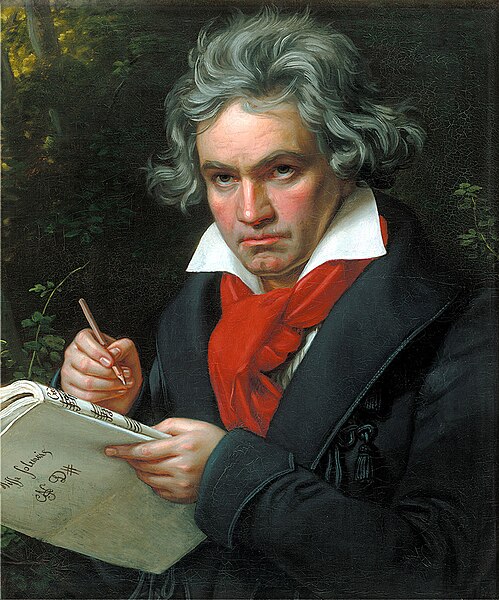
I used a Public Domain painting of Beethoven for the Beethoven character, which is by Joseph Karl Stieler. Who photographed the painting? Who digitized the photograph? Is credit due here?
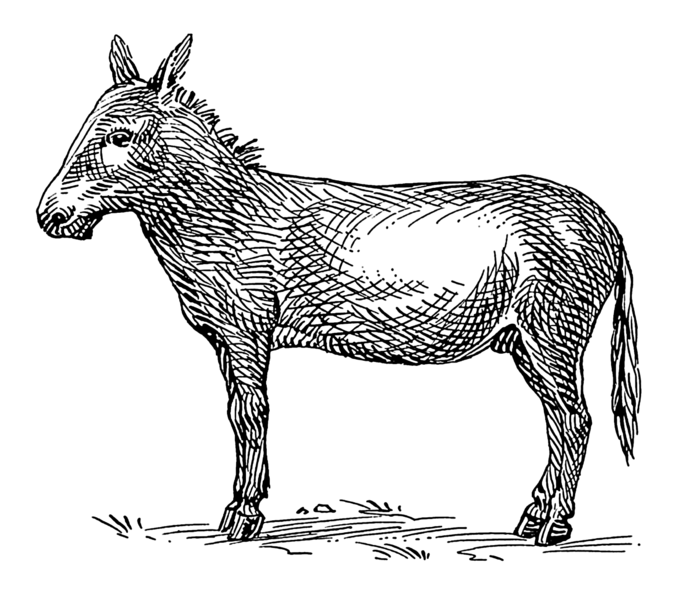
The ass drawing also came from Wikimedia Commons, where it’s credited to Pearson Scott Foresman. But who actually drew it? I have no idea. I doubt that Pearson Scott Foresman could even legally claim the copyright on it to "donate" to Wikimedia in the first place, but there they are, getting credit for it instead of an artist. That’s because copyright is only concerned with "ownership," not authorship.
Then there’s the software I used, good old pre-Adobe Macromedia Flash. Should I credit the software? What about the programmers who contributed to the software? I also used a Macintosh computer (I know, I know, when Free Software and Open Hardware come close to doing what my old system does, I’ll be the first to embrace it) and a Wacom Cintiq pen monitor. How many people deserve credit for these in my movie?
Mimi and Eunice themselves were "inspired" by many historical cartoons. Early Disney and Fleischer animations, the "rubber hose" style, Peanuts, this recent cartoon, and countless other sources I don’t even know the names of – but would be compelled to find out, if credit were in fact due. Is it?
And so on. It is possible to attribute ad absurdum. So where is credit due? It’s complicated, the rules are changing, and standards are determined organically by communities, not laws. I had to edit the song for brevity, but I kind of wish I hadn’t excised this line:
A citation shows us where we can get more of all the good culture that Free Culture’s for
Attribution is a way to help your neighbor. You share not only the work, but information about the work that helps them pursue their own research and maybe find more works to enjoy. How much one is expected to help their neighbor is determined by (often unspoken) community standards. People who don’t help their neighbors tend to be disliked. And those who go out of their way to deceive and defraud their neighbors – i.e. plagiarists – are hated and shunned. Plagiarism doesn’t affect works – works don’t have feelings, and what is done to one copy has no effect on other copies. Plagiarism affects communities, and it is consideration for such that determines where attribution is appropriate.
At least that’s the best I can come up with right now. Attribution is actually a very complicated concept; if you have more ideas about it, please share.
We recently mentioned the Dervaes Family, and its quixotic attempt to trademark “urban homesteading” and to get people to stop using the descriptive and generic phrase. The family has been lashing out (somewhat comically) on their blog, including a recent post by Justin Dervaes about plagiarism (which, it should be noted is an entirely different issue than trademark infringement — though it’s not clear the Dervaes understand this).
Either way, you had to know what was coming up next. Cathy Gellis points us to a report claiming that the Dervaes family blog plagiarized a number of items from another garden blogger, who methodically presents a variety of evidence to bolster his claim. He’s now asking the family for royalties (including late fees). Of course, I find it pretty silly (and kind of petty) to ask for royalties in such a situation, but you have to admit it looks even worse for the family to be moralizing about plagiarism while doing it themselves.
This one is just bizarre. Romenesko points us to the news that the director of the University of Utah’s Middle East Center, Dr. Bahman Baktiari, who regularly writes op-ed pieces for various newspapers, has been accused of plagiarism. His defense? He claims he had no idea he was supposed to attribute the content he copied. Plagiarism cases turn up here and there, but I think this may be the first time I’ve seen someone — especially from an academic setting — claim that they didn’t even realize they were supposed to make it clear they did not write the content. And, it’s not even like he picked obscure publications to copy. What brought this all to light was an op-ed he wrote for the Salt Lake City Tribune, which used at least four unattributed sources, including both the NY Times and the Economist. I guess that means if you’re a student in one of his classes, you’re now off the hook to copy at will without attribution…
PrometheeFeu alerts us to a fascinating situation happening in France. Apparently, a successful French author, Michel Houellebecq, recently came out with a novel, La Carte et Le Territoire. However, it turns out that Houellebecq copied decent chunks of three separate Wikipedia articles in the novel, without any credit or indication that he was quoting another source. This is what is normally referred to as plagiarism — or, in some views, sampling. This isn’t all that surprising, and we hear stories of plagiarism in books all the time. In fact, we tend to think that people get way too upset over such things in books. After being called on it, Houellebecq appears to have admitted to copying those sections.
However, what makes this case more interesting, is what came next. Some folks realized that Wikipedia articles are licensed via a CC-BY-SA license, which in real terms says that you are free to share and remix the work, so long as it’s with attribution and (most importantly):
“If you alter, transform, or build upon this work, you may distribute the resulting work only under the same or similar license to this one.”
If you’re paying attention, you’ll realize that it appears Houellebecq’s La Carte et Le Territoire appears to “build upon” the Wikipedia works, which would then mean that his work, as well, must also be available under such a license. Thus, they’ve created a PDF version of the book — with the proper Wikipedia references added back in — and put it up for download under the very same CC-BY-SA license.
The question now is whether or not the author or his publisher will take legal action — and whether or not the reading of the Wikipedia CC-BY-SA license is accurate. It certainly seems like a pretty strong argument can be made in favor of those now sharing the work. The terms of the Wikipedia content are clear, and thus, in using that content, it does appear that Houellebecq and his publisher may be required to abide by the terms of the license. Of course, there are other questions raised by this as well: such as the enforceability of a license that the person might not have read or understood. Before people automatically assume those posting the PDF are in the right here, remember all those stories we’ve discussed in the past about questionable end user license agreements that people agree to on websites without ever having actually seen them. In those cases, many of us feel that such licenses should not be enforceable. Is the same thing true for a Creative Commons license?
Update: As noted in the comments, the publisher has said it will take legal action against those who posted the work, though it’s unclear if such proceedings have started yet.
A guy named Charles Harris, who wrote a political booklet about the process by which America elects Presidents, is apparently suing Oprah Winfrey for copyright infringement, saying that she “plagiarized” his work, when she quoted it on her TV show, without crediting him. Basically, the guy had sent copies of the booklet to Winfrey, hoping to get some free publicity out of it. However, on one show she apparently (he alleges) directly read aloud some questions from his booklet, but did so without crediting him. Of course, plagiarism, by itself, isn’t against the law, so he’s trying to twist this into a copyright lawsuit, saying she had no license to read the questions aloud. You can see the filing below:
It’s hard to see how he can legitimately claim that Oprah reading the questions has caused him “substantial injury, loss and damage to his property” or that it’s “damage” for his “business reputation and goodwill.” And, not surprisingly, he’s asking for the maximum statutory rate of $150,000. Of course, you could (and many probably will) argue that the guy knows the lawsuit is bogus, and that there’s no “damage,” but is using the lawsuit to get publicity for his booklet…