

Texas School Serves Up Magnificent Redaction Failure To Vice Journalist

from the huh-maybe-schools-don't-have-enough-supplies dept
Redaction isn’t terribly difficult to do correctly. And yet, it often seems to be beyond the grasp of government officials who really, really want to withhold information, but just can’t seem to do it.
For instance, litigants asked the court to redact information in an FTC suit against Amazon. The court clerk apparently thought utilizing a PDF editor would do the trick, but the black bars were ornamental. Anyone reading the “redacted” decision merely needed to copy-paste the “redacted” lines into a text editor to see the hidden words.
In another form of redaction failure, a law enforcement agency accidentally sent a document with all of its edits still present in the final release. Redlined paragraphs suggested someone was supposed to redact these before release, but never happened.
Even when the government is in the wrong (i.e., it screwed up redacting documents), it sometimes tries to get the courts to fix its errors for it. Of course, once documents are released with redaction errors, they can’t simply be made to disappear, no matter how many court orders are obtained. A school board in Florida failed to properly redact a document detailing the Parkland school shooting. When it realized its error, it tried to get the newspaper that published the accidentally unredacted version slapped with an injunction for having the temerity to publish information it had legally obtained.
Then there are the sort of redaction failures that make you wonder how anyone thought this obviously faulty attempt to withhold information was adequate for public records purposes. Tim Marchman of Vice offshoot, Motherboard, sent out records requests asking schools for information on how they were dealing with the rise of the machines (learning).
Asking about efforts made to control or supervise AI tools like ChatGPT in classrooms, Motherboard received (and continues to receive) responses that show there’s no one-size-fits-all approach to handling this problem.
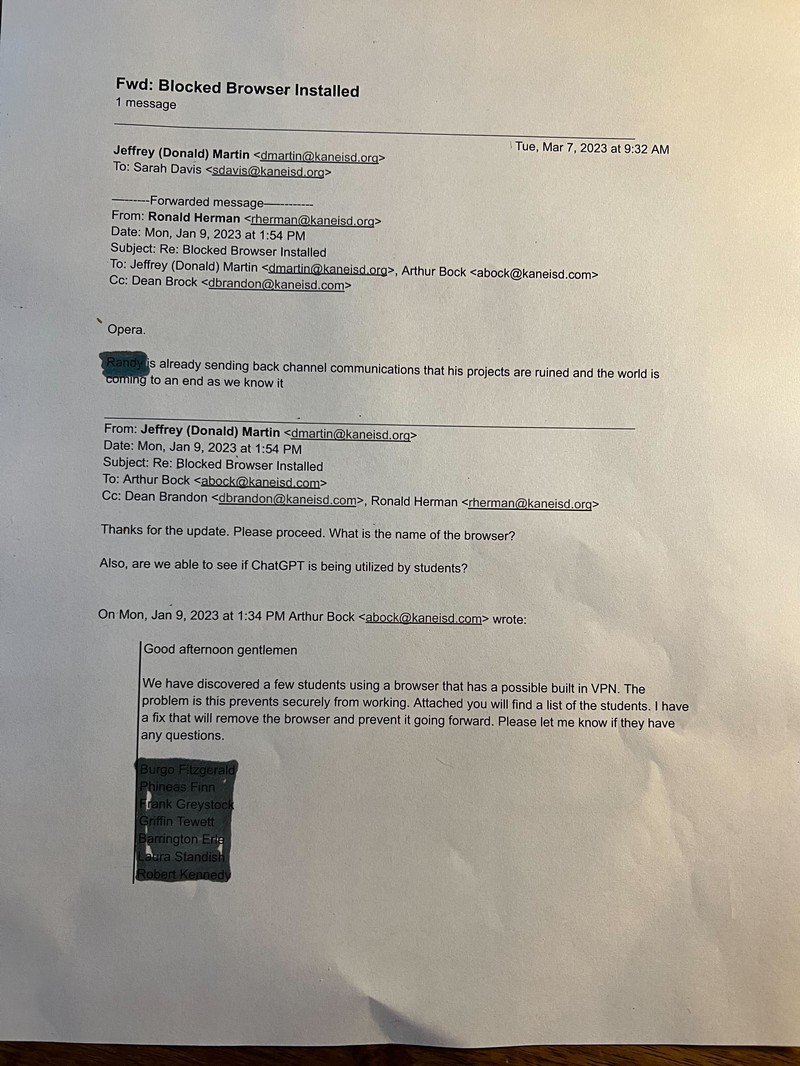
But one school in particular handed over more information than it should have. An email chain discussing students who were apparently accessing ChatGPT via a browser with a built-in VPN was handed over to Marchman and Motherboard with quite possibly the most inept redaction attempt yet witnessed.
This redaction, which we are not publishing to protect the identities of the clever students, appears to have been done using a grey Crayola marker that was running out of ink.
Yeah. Was there not another marker or pen or anything available? You’d think a school would be full of things called “school supplies,” among them being pens, darker colored markers, or maybe even a bottle of Whiteout.
But no, this was the tool the redacter chose to apply to the task. Vigorously.
This shouldn’t be taken as a criticism of the redactor’s laziness; as the detail at the top of this post shows, they were not lazy at all, and really pressed down hard on the marker, scribbling back and forth and up and down and doing some nice cross-hatching, all in an attempt to obscure the names of the minors.
It obscured nothing. The names of all ten students were left legible. So legible, in fact, Motherboard was forced to create a mockup with fake names to demonstrate the ineptitude of this redaction attempt, rather than actually expose the not-redacted-at-all-actually names of minors left unprotected by a school employee and what was apparently the only marker in the building.
Now, I understand that not everyone tasked with handling public records requests is well-trained (or even well-supplied). But this is so poorly done you’d think the person with the marker would have at least looked for something/someone else to see if this could be handled better, rather than just shrugging it into an envelope and sending it on to Vice.
Live and learn, I guess. Or hope. An educational institution should be on top of this whole thing about using the best tool for the job. This doesn’t exactly demonstrate problem-solving is a prerequisite for the school’s public records department. I don’t know if this calls for a restaffing of the post, but for the love of all that is holy (but, you know, carefully siloed off from the state), get this person a new box of markers.



Comments on “Texas School Serves Up Magnificent Redaction Failure To Vice Journalist”
Lesson learned (for the school, and for me): Don’t use physical markers to redact information.
Photocopy the documents, stuff the images into an image editor (or even a digital painting app), use the brush tool to draw opaque marks, and export as or convert to PDF. If the school doesn’t have a photocopier, take photos with a phone camera and later ask for more funding from the School Board (admittedly easier said than done).
Re:
That will work. At least till someone points out the inaccessibility of the text probably violates the Americans with Disabilities Act. I’ve also taped aluminum foil to documents and photographed or photocopied that, which has the same problem.
Really, when it comes to government documents, redaction should really be part of their standard workflow—not something to act all surprised about, and leave to whomever’s available, when a person predictably invokes a 55-year-old law. If personal information, government secrets, etc., are properly tagged when creating the document, it should be as simple as “print to FOIA-redacted PDF”.
Re: Re:
“At least till someone points out the inaccessibility of the text probably violates the Americans with Disabilities Act.”
My bad. In that case, open a PDF editor, copy the text “[REDACTED]”, and paste to replace each instance of sensitive information, and export.
Re: Re: Re:
That’s a pretty good way to do it, and also eliminates font-based redaction guessing. But if done carelessly, it could change page numbers; that’s probably legally acceptable, though annoying.
By the way, PDFs are basically text files with embedded binary blobs. A command like “qpdf --qdf in.pdf tmp.pdf” can make it more convenient to work with. If you can find the text, you can remove or replace it (e.g. with U+2588 “FULL BLOCK” or just spaces), and then use a PDF editor to draw all the black boxes you want.
Re: Re: Re:2
Well, the are text files, unless they are image files.
Re: Re: Re:3
Even image-based PDF files are text files, with images embedded as binary blobs. That’s not especially useful; but you’d still be able to read and edit metadata (if present) such as the author, creation date, and page numbering scheme(s), and might be able to remove watermarks.
This comment has been flagged by the community. Click here to show it.
“ You’d think a school would be full of things called “school supplies,” among them being pens, darker colored markers, or maybe even a bottle of Whiteout.”
Congress literally put a tax deduction for k12 teachers buying their own supplies, so no, you can’t think that.
Try not to be this stupid.
Looked at the back stories, found that this one on an LA suit was not tagged ‘redaction’, though maybe it should have been.
Maybe it was intentional…
What? I thought you said highlight.
“the problem is this prevents securely[sic] from working”
you don’t need a vpn for that, dns cache poisoning will work fine (if it cant communicate with its backend it will soft fail for everything apart from sign-in, which is on a separate domain anyway)
Schools Aren't Office Depot
“You’d think a school would be full of things called “school supplies,” among them being pens, darker colored markers, or maybe even a bottle of Whiteout.”
Why would anyone think that? Have you not been paying attention for the last many, many decades of stories of school teachers having to go deep into their own pockets for paper, pencils, crayons and the like?
Re:
It’s true schools aren’t well supplied, but any of the following would have worked better than the marker used:
It’s hard to believe a school would have none of those available.
Re: Re:
Of those items, only scissors would really be appropriate for redaction. An exacto-knife would be easier, and a home-ec kitchen knife might work. Reflective foil and thick construction paper are other things that might be available and useful.
Any type of ink, dye, or other fluid (or thin non-reflective tape) would leave a risk that a scanner or photocopier would shine enough light through it to make the original text visible—but maybe not to the naked eye. Working “better” is meaningless if it still doesn’t work well enough.
Redaction
Everyone is dancing through too many hoops sand you’ve forgotten some basic tools on a PC/Mac.
First, check with counsel as to how and what format this stuff needs to be in before you do diddly so you don;t waste your time or do something that annoys the court or opposing counsel.
I taught people to make the redactions in Word and then save that as a text file. Bingo, no edit records or metadata to trip you up.
Or copy paste to notepad or Mac equivalent and save it out that way. Again no chance of embarrassing stuff being left.
Other method was to use the old felt pen method if on older preprinted stuff then photocopy that so there is no way to remove things.
Then use an OCR scanner if electronic versions were required or just scanned images unless actual document files were required.
Always consult counsel before you do stuff like this. Let them tell you what is needed. Makes their life easier and keeps you in the clear.
[Subject Redacted]
“Redaction isn’t terribly difficult to do correctly.”
It can be. Multiple layers of vague regulations, multiple interpretations, and lots of shades of grey. Some FOIL requests can be huge, so you’re reading through hundreds or thousands of pages searching for sensitive information. And since FOIL requests have a time limit, you’re usually in a hurry.
So mistakes get made. And people who have never dealt with redaction before get pulled into the job. Records Access Officer tends to be one of those hats that gets stuck on someone too junior to object, and they’re frequently too inexperienced to know the job. Adobe Pro makes the actual redacting easy, but you need to pay for the license.
Oftentimes it takes a special widget or technique to get the records into a PDF. Paper documents are obvious – although they can create their own problems – but what do you do w/ a database? I know someone who bluescreened three computers in a day converting long email chains (w/ attached documents) into PDF.
Blech, sorry for the speil. Short version: yeah, actually it can get tricky and I feel a lot of sympathy for people who rarely do it having their efforts put in the spotlight.
I guess the future marines ate all of the crayons, leaving them to the overused marker.
if you have Illustrtor...
try opening supposedly secure pdfs in illustrator. You might find interesting things.
best home automation in hyderabad
good information sharing. i’m very happy about this article. it helps to gain my knowledge about this. i’m very thankful for this post. great article such an impressive information. I appreciate this post
home automation in hyderabad
Thanks for sharing. It is very helpful for me and also informative for all those users who will come to read.
http://allpurposesealcoating.com/