Jason Kelley's Techdirt Profile

Jason Kelley

About Jason Kelley

Posted on Techdirt - 28 August 2025 @ 01:49pm

From Book Bans To Internet Bans: Wyoming Lets Parents Control The Whole State’s Access To The Internet

If you’ve read about the sudden appearance of age verification across the internet in the UK and thought it would never happen in the U.S., take note: many politicians want the same or even more strict laws. As of July 1st, South Dakota and Wyoming enacted laws requiring any website that hosts any sexual content to implement age verification measures. These laws would potentially capture a broad range of non-pornographic content, including classic literature and art, and expose a wide range of platforms, of all sizes, to civil or criminal liability for not using age verification on every user. That includes social media networks like X, Reddit, and Discord; online retailers like Amazon and Barnes & Noble; and streaming platforms like Netflix and Rumble—essentially, any site that allows user-generated or published content without gatekeeping access based on age.

These laws expand on the flawed logic from last month’s troubling Supreme Court decision,  Free Speech Coalition v. Paxton, which gave Texas the green light to require age verification for sites where at least one-third (33.3%) of the content is sexual materials deemed “harmful to minors.” Wyoming and South Dakota seem to interpret this decision to give them license to require age verification—and potential legal liability—for any website that contains ANY image, video, or post that contains sexual content that could be interpreted as harmful to minors. Platforms or websites may be able to comply by implementing an “age gate” within certain sections of their sites where, for example, user-generated content is allowed, or at the point of entry to the entire site.

Although these laws are in effect, we do not believe the Supreme Court’s decision in FSC v. Paxton gives these laws any constitutional legitimacy. You do not need a law degree to see the difference between the Texas law—which targets sites where a substantial portion (one third) of content is “sexual material harmful to minors”—and these laws, which apply to any site that contains even a single instance of such material. In practice, it is the difference between burdening adults with age gates for websites that host “adult” content, and burdening the entire internet, including sites that allow user-generated content or published content.

But lawmakers, prosecutors, and activists in conservative states have worked for years to aggressively expand the definition of “harmful to minors” and use other methods to censor a broad swath of content: diverse educational materials, sex education resources, art, and even award-winning literature. Books like The Bluest Eye by Toni MorrisonThe Handmaid’s Tale by Margaret Atwood, and And Tango Makes Three have all been swept up in these crusades—not because of their overall content, but because of isolated scenes or references.

Wyoming’s law is also particularly extreme: rather than provide enforcement by the Attorney General, HB0043 is a “bounty” law that deputizes any resident with a child to file civil lawsuits against websites they believe are in violation, effectively turning anyone into a potential content cop. There is no central agency, no regulatory oversight, and no clear standard. Instead, the law invites parents in Wyoming to take enforcement for the entire state—every resident, and everyone else’s children—into their own hands by suing websites that contain a single example of objectionable content. Though most other state age-verification laws often allow individuals to make reports to state Attorneys General who are responsible for enforcement, and some include a private right of action allowing parents or guardians to file civil claims for damages, the Wyoming law is similar to laws in Louisiana and Utah that rely entirely on civil enforcement. 

This is a textbook example of a “heckler’s veto,” where a single person can unilaterally decide what content the public is allowed to access. However, it is clear that the Wyoming legislature explicitly designed the law this way in a deliberate effort to sidestep state enforcement and avoid an early constitutional court challenge, as many other bounty laws targeting people who assist in abortions, drag performers, and trans people have done. The result? An open invitation from the Wyoming legislature to weaponize its citizens, and the courts, against platforms, big or small. Because when nearly anyone can sue any website over any content they deem unsafe for minors, the result isn’t safety. It’s censorship.

Imagine a Wyomingite stumbling across an NSFW subreddit or a Tumblr fanfic blog and deciding it violates the law. If they were a parent of a minor, that resident could sue the platform, potentially forcing those websites to restrict or geo-block access to the entire state in order to avoid the cost and risk of litigation. And because there’s no threshold for how much “harmful” content a site must host, a single image or passage could be enough. That also means your personal website or blog—if it includes any “sexual content harmful to minors”—is also at risk. 

This law will likely be challenged, and eventually, halted, by the courts. But given that the state cannot enforce it, those challenges will not come until a parent sues a website. Until then, its mere existence poses a serious threat to free speech online. Risk-averse platforms may over-correct, over-censor, or even restrict access to the state entirely just to avoid the possibility of a lawsuit, as Pornhub has already done. And should sites impose age-verification schemes to comply, they will be a speech and privacy disaster for all state residents.

And let’s be clear: these state laws are not outliers. They are part of a growing political movement to redefine terms like “obscene,” “pornographic,” and “sexually explicit”  as catchalls to restrict content for both adults and young people alike. What starts in one state and one lawsuit can quickly become a national blueprint. 

Age-verification laws like these have relied on vague language, intimidating enforcement mechanisms, and public complacency to take root. Courts may eventually strike them down, but in the meantime, users, platforms, creators, and digital rights advocacy groups need to stay alert, speak up against these laws, and push back while they can. When governments expand censorship and surveillance offline, it’s our job at EFF to protect your access to a free and open internet. Because if we don’t push back now, the internet as we know it— the messy, diverse, and open internet we know—could disappear behind a wall of fear and censorship.

Ready to join us? Urge your state lawmakers to reject harmful age-verification lawsCall or email your representatives to oppose KOSA and any other proposed federal age-checking mandates. Make your voice heard by talking to your friends and family about what we all stand to lose if the age-gated internet becomes a global reality. Because the fight for a free internet starts with us.

Originally posted to the EFF’s Deeplinks blog.

Posted on Techdirt - 16 January 2025 @ 01:13pm

Platforms Systematically Removed A User Because He Made “Most Wanted CEO” Playing Cards

On December 14, James Harr, the owner of an online store called ComradeWorkwear, announced on social media that he planned to sell a deck of “Most Wanted CEO” playing cards, satirizing the infamous “Most-wanted Iraqi playing cards” introduced by the U.S. Defense Intelligence Agency in 2003. Per the ComradeWorkwear website, the Most Wanted CEO cards would offer “a critique of the capitalist machine that sacrifices people and planet for profit,” and “Unmask the oligarchs, CEOs, and profiteers who rule our world… From real estate moguls to weapons manufacturers.”  

But within a day of posting his plans for the card deck to his combined 100,000 followers on Instagram and TikTok, the New York Post ran a front page story on Harr, calling the cards “disturbing.” Less than 5 hours later, officers from the New York City Police Department came to Harr’s door to interview him. They gave no indication he had done anything illegal or would receive any further scrutiny, but the next day the New York police commissioner held the New York Post story up during a press conference after announcing charges against Luigi Mangione, the alleged assassin of UnitedHealth Group CEO Brian Thompson. Shortly thereafter, platforms from TikTok to Shopify disabled both the company’s accounts and Harr’s personal accounts, simply because he used the moment to highlight what he saw as the harms that large corporations and their CEOs cause.

Harr was not alone. After the assassination, thousands of people took to social media to express their negative experiences with the healthcare industry, to speculate about who was behind the murder, and to show their sympathy for either the victim or the shooter—if social media platforms allowed them to do so. Many users reported having their accounts banned and content removed after sharing comments about Luigi Mangione, Thompson’s alleged assassin. TikTok, for example reportedly removed comments that simply said, “Free Luigi.” Even seemingly benign content, such as a post about Mangione’s astrological sign or a video montage of him set to music, was deleted from Threads, according to users. 

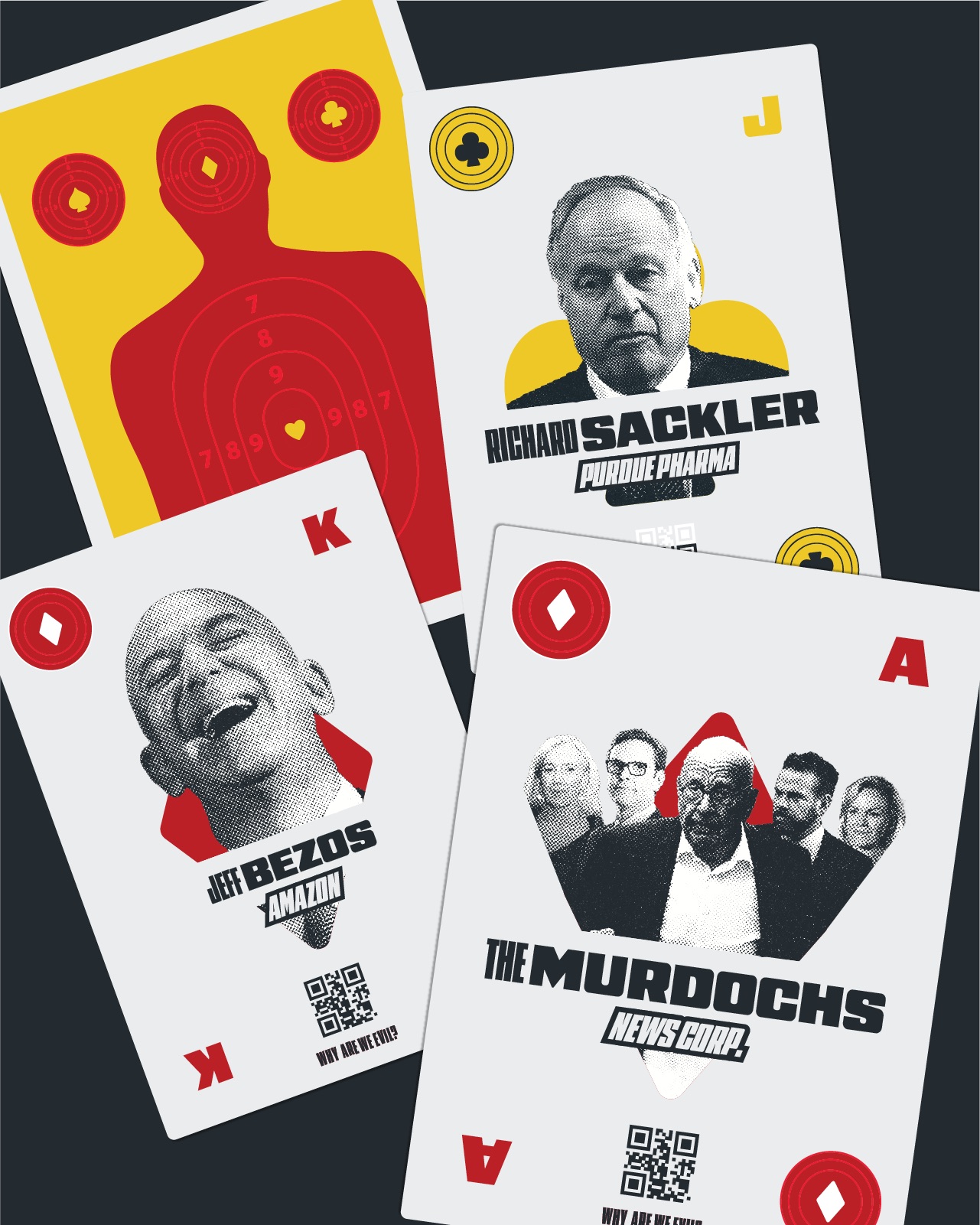
The Most Wanted CEO playing cards did not reference Mangione, and the cards—which have not been released—would not include personal information about any CEO. In his initial posts about the cards, Harr said he planned to include QR codes with more information about each company and, in his view, what dangers the companies present. Each suit would represent a different industry, and the back of each card would include a generic shooting-range style silhouette. As Harr put it in his now-removed video, the cards would include “the person, what they’re a part of, and a QR code that goes to dedicated pages that explain why they’re evil. So you could be like, ‘Why is the CEO of Walmart evil? Why is the CEO of Northrop Grumman evil?’” 

Mockup image of CEO playing cards showing Richard Sackler of Purdue Pharma, Jeff Bezos of Amazon and The Murdochs of News Corp.A design for the Most Wanted CEO playing cards

Many have riffed on the military’s tradition of using playing cards to help troops learn about the enemy. You can currently find “Gaza’s Most Wanted” playing cards on Instagram, purportedly depicting “leaders and commanders of various groups such as the IRGC, Hezbollah, Hamas, Houthis, and numerous leaders within Iran-backed militias.” A Shopify store selling “Covid’s Most Wanted” playing cards, displaying figures like Bill Gates and Anthony Fauci, and including QR codes linking to a website “where all the crimes and evidence are listed,” is available as of this writing. Hero Decks, which sells novelty playing cards generally showing sports figures, even produced a deck of “Wall Street Most Wanted” cards in 2003 (popular enough to have a second edition). 

As we’ve said many times, content moderation at scale, whether human or automated, is impossible to do perfectly and nearly impossible to do well. Companies often get it wrong and remove content or whole accounts that those affected by the content would agree do not violate the platform’s terms of service or community guidelines. Conversely, they allow speech that could arguably be seen to violate those terms and guidelines. That has been especially true for speech related to divisive topics and during heated national discussions. These mistakes often remove important voices, perspectives, and context, regularly impacting not just everyday users but journalistshuman rights defendersartistssex worker advocacy groupsLGBTQ+ advocatespro-Palestinian activists, and political groups. In some instances, this even harms people’s livelihoods. 

Instagram disabled the ComradeWorkwear account for “not following community standards,” with no further information provided. Harr’s personal account was also banned. Meta has a policy against the “glorification” of dangerous organizations and people, which it defines as “legitimizing or defending the violent or hateful acts of a designated entity by claiming that those acts have a moral, political, logical or other justification that makes them acceptable or reasonable.” Meta’s Oversight Board has overturned multiple moderation decisions by the company regarding its application of this policy. While Harr had posted to Instagram that “the CEO must die” after Thompson’s assassination, he included an explanation that, “When we say the ceo must die, we mean the structure of capitalism must be broken.” (Compare this to a series of Instagram story posts from musician Ethel Cain, whose account is still available, which used the hashtag #KillMoreCEOs, for one of many examples of how moderation affects some people and not others.) 

TikTok reported that Harr violated the platform’s community guidelines with no additional information. The platform has a policy against “promoting (including any praise, celebration, or sharing of manifestos) or providing material support” to violent extremists or people who cause serial or mass violence. TikTok gave Harr no opportunity for appeal, and continued to remove additional accounts Harr only created to  update his followers on his life. TikTok did not point to any specific piece of content that violated its guidelines. 

On December 20, PayPal informed Harr it could no longer continue processing payments for ComradeWorkwear, with no information about why. Shopify informed Harr that his store was selling “offensive content,” and his Shopify and Apple Pay accounts would both be disabled. In a follow-up email, Shopify told Harr the decision to close his account “was made by our banking partners who power the payment gateway.”  

Harr’s situation is not unique. Financial and social media platforms have an enormous amount of control over our online expression, and we’ve long been critical of their over-moderation,  uneven enforcement, lack of transparency, and failure to offer reasonable appeals. This is why EFF co-created The Santa Clara Principles on transparency and accountability in content moderation, along with a broad coalition of organizations, advocates, and academic experts. These platforms have the resources to set the standard for content moderation, but clearly don’t apply their moderation evenly, and in many instances, aren’t even doing the basics—like offering clear notices and opportunities for appeal.  

Harr was one of many who expressed frustration online with the growing power of corporations. These voices shouldn’t be silenced into submission simply for drawing attention to the influence that they have. These are exactly the kinds of actions that Harr intended to highlight. If the Most Wanted CEO deck is ever released, it shouldn’t be a surprise for the CEOs of these platforms to find themselves in the lineup. 

Originally posted to the EFF’s Deeplinks blog

Posted on Techdirt - 18 December 2024 @ 01:31pm

ExTwitter’s Last-Minute Update To Kids Online Safety Act Still Fails To Protect Kids—Or Adults—Online

Last week, the Senate released yet another version of the Kids Online Safety Act, written, reportedly, with the assistance of X CEO Linda Yaccarino in a flawed attempt to address the critical free speech issues inherent in the bill. This last minute draft remains, at its core, an unconstitutional censorship bill that threatens the online speech and privacy rights of all internet users.

Update Fails to Protect Users from Censorship or Platforms from Liability

The most important update, according to its authors, supposedly minimizes the impact of the bill on free speech. As we’ve said before, KOSA’s “duty of care” section is its biggest problem, as it would force a broad swath of online services to make policy changes based on the content of online speech. Though the bill’s authors inaccurately claim KOSA only regulates designs of platforms, not speech, the list of harms it enumerates—eating disorders, substance use disorders, and suicidal behaviors, for example—are not caused by the design of a platform.  

KOSA is likely to actually increase the risks to children, because it will prevent them from accessing online resources about topics like addiction, eating disorders, and bullying. It will result in services imposing age verification requirements and content restrictions, and it will stifle minors from finding or accessing their own supportive communities online. For these reasons, we’ve been critical of KOSA since it was introduced in 2022. 

This updated bill adds just one sentence to the “duty of care” requirement: “Nothing in this section shall be construed to allow a government entity to enforce subsection a [the duty of care] based upon the viewpoint of users expressed by or through any speech, expression, or information protected by the First Amendment to the Constitution of the United States.” But the viewpoint of users was never impacted by KOSA’s duty of care in the first place. The duty of care is a duty imposed on platforms, not users. Platforms must mitigate the harms listed in the bill, not users, and the platform’s ability to share users’ views is what’s at risk—not the ability of users to express those views. Adding that the bill doesn’t impose liability based on user expression doesn’t change how the bill would be interpreted or enforced. The FTC could still hold a platform liable for the speech it contains.

Let’s say, for example, that a covered platform like reddit hosts a forum created and maintained by users for discussion of overcoming eating disorders. Even though the speech contained in that forum is entirely legal, often helpful, and possibly even life-saving, the FTC could still hold reddit liable for violating the duty of care by allowing young people to view it. The same could be true of a Facebook group about LGBTQ issues, or for a post about drug use that X showed a user through its algorithm. If a platform’s defense were that this information is protected expression, the FTC could simply say that they aren’t enforcing it based on the expression of any individual viewpoint, but based on the fact that the platform allowed a design feature—a subreddit, Facebook group, or algorithm—to distribute that expression to minors. It’s a superfluous carveout for user speech and expression that KOSA never penalized in the first place, but which the platform would still be penalized for distributing. 

It’s particularly disappointing that those in charge of X—likely a covered platform under the law—had any role in writing this language, as the authors have failed to grasp the world of difference between immunizing individual expression, and protecting their own platform from the liability that KOSA would place on it.  

Compulsive Usage Doesn’t Narrow KOSA’s Scope 

Another of KOSA’s issues has been its vague list of harms, which have remained broad enough that platforms have no clear guidance on what is likely to cross the line. This update requires that the harms of “depressive disorders and anxiety disorders” have “objectively verifiable and clinically diagnosable symptoms that are related to compulsive usage.” The latest text’s definition of compulsive usage, however, is equally vague: “a persistent and repetitive use of a covered platform that significantly impacts one or more major life activities, including socializing, sleeping, eating, learning, reading, concentrating, communicating, or working.” This doesn’t narrow the scope of the bill. 

It should be noted that there is no clinical definition of “compulsive usage” of online services. As in past versions of KOSA, this updated definition cobbles together a definition that sounds just medical, or just legal, enough that it appears legitimate—when in fact the definition is devoid of specific legal meaning, and dangerously vague to boot. 

How could the persistent use of social media not significantly impact the way someone socializes or communicates? The bill doesn’t even require that the impact be a negative one. Comments on an Instagram photo from a potential partner may make it hard to sleep for several nights in a row; a lengthy new YouTube video may impact someone’s workday. Opening a Snapchat account might significantly impact how a teenager keeps in touch with her friends, but that doesn’t mean her preference for that over text messages is “compulsive” and therefore necessarily harmful. 

Nonetheless, an FTC weaponizing KOSA could still hold platforms liable for showing content to minors that they believe results in depression or anxiety, so long as they can claim the anxiety or depression disrupted someone’s sleep, or even just changed how someone socializes or communicates. These so-called “harms” could still encompass a huge swathe of entirely legal (and helpful) content about everything from abortion access and gender-affirming care to drug use, school shootings, and tackle football. 

Dangerous Censorship Bills Do Not Belong in Must-Pass Legislation

The latest KOSA draft comes as incoming nominee for FTC Chair, Andrew Ferguson—who would be empowered to enforce the law, if passed—has reportedly vowed to protect free speech by “fighting back against the trans agenda,” among other things. As we’ve said for years (and about every version of the bill), KOSA would give the FTC under this or any future administration wide berth to decide what sort of content platforms must prevent young people from seeing. Just passing KOSA would likely result in platforms taking down protected speech and implementing age verification requirements, even if it’s never enforced; the FTC could simply express the types of content they believe harms children, and use the mere threat of enforcement to force platforms to comply.  

No representative should consider shoehorning this controversial and unconstitutional bill into a continuing resolution. A law that forces platforms to censor truthful online content should not be in a last minute funding bill.

Republished from the EFF’s Deeplinks blog.

Posted on Techdirt - 7 May 2024 @ 12:08pm

Biden Signed The TikTok Ban. What’s Next For TikTok Users?

Editor’s Note: This post was written before TikTok & ByteDance filed a lawsuit challenging the law this morning. So, while it says that no lawsuit has been filed, that’s no longer the case. The rest of the article is still relevant, though. We’ll have an analysis of the actual lawsuit later (probably tomorrow).

Over the last month, lawmakers moved swiftly to pass legislation that would effectively ban TikTok in the United States, eventually including it in a foreign aid package that was signed by President Biden. The impact of this legislation isn’t entirely clear yet, but what is clear: whether TikTok is banned or sold to new owners, millions of people in the U.S. will no longer be able to get information and communicate with each other as they presently do. 

What Happens Next?

At the moment, TikTok isn’t “banned.” The law gives ByteDance 270 days to divest TikTok before the ban would take effect, which would be on January 19th, 2025. In the meantime, we expect courts to determine that the bill is unconstitutional. Though there is no lawsuit yet, one on behalf of TikTok itself is imminent.

There are three possible outcomes. If the law is struck down, as it should be, nothing will change. If ByteDance divests TikTok by selling it, then the platform would still likely be usable. However, there’s no telling whether the app’s new owners would change its functionality, its algorithms, or other aspects of the company. As we’ve seen with other platforms, a change in ownership can result in significant changes that could impact its audience in unexpected ways. In fact, that’s one of the given reasons to force the sale: so TikTok will serve different content to users, specifically when it comes to Chinese propaganda and misinformation. This is despite the fact that it has been well-established law for almost 60 years that U.S. people have a First Amendment right to receive foreign propaganda. 

Lastly, if ByteDance refuses to sell, users in the U.S. will likely see it disappear from app stores sometime between now and that January 19, 2025 deadline. 

How Will the Ban Be Implemented? 

The law limits liability to intermediaries—entities that “provide services to distribute, maintain, or update” TikTok by means of a marketplace, or that provide internet hosting services to enable the app’s distribution, maintenance, or updating. The law also makes intermediaries responsible for its implementation. 

The law explicitly denies to the Attorney General the authority to enforce it against an individual user of a foreign adversary controlled application, so users themselves cannot be held liable for continuing to use the application, if they can access it. 

Will I Be Able to Download or Use TikTok If ByteDance Doesn’t Sell? 

It’s possible some U.S. users will find routes around the ban. But the vast majority will probably not, significantly shifting the platform’s user base and content. If ByteDance itself assists in the distribution of the app, it could also be found liable, so even if U.S. users continue to use the platform, the company’s ability to moderate and operate the app in the U.S. would likely be impacted. Bottom line: for a period of time after January 19, it’s possible that the app would be usable, but it’s unlikely to be the same platform—or even a very functional one in the U.S.—for very long.

Until now, the United States has championed the free flow of information around the world as a fundamental democratic principle and called out other nations when they have shut down internet access or banned social media apps and other online communications tools. In doing so, the U.S. has deemed restrictions on the free flow of information to be undemocratic.  Enacting this legislation has undermined this long standing, democratic principle. It has also undermined the U.S. government’s moral authority to call out other nations for when they shut down internet access or ban social media apps and other online communications tools. 

There are a few reasons legislators have given to ban TikTok. One is to change the type of content on the app—a clear First Amendment violation. The second is to protect data privacy. Our lawmakers should work to protect data privacy, but this was the wrong approach. They should prevent any company—regardless of where it is based—from collecting massive amounts of our detailed personal data, which is then made available to data brokers, U.S. government agencies, and even foreign adversaries. They should solve the real problem of out-of-control privacy invasions by enacting comprehensive consumer data privacy legislation. Instead, as happens far too often, our government’s actions are vastly overreaching while also deeply underserving the public. 

Originally published to the EFF Deeplinks blog.

Posted on Techdirt - 21 March 2024 @ 12:49pm

Thousands Of Young People Told Us Why The Kids Online Safety Act Will Be Harmful To Minors

With KOSA passed, the information i can access as a minor will be limited and censored, under the guise of “protecting me”, which is the responsibility of my parents, NOT the government. I have learned so much about the world and about myself through social media, and without the diverse world i have seen, i would be a completely different, and much worse, person. For a country that prides itself in the free speech and freedom of its peoples, this bill goes against everything we stand for! – Alan, 15  

___________________

If information is put through a filter, that’s bad. Any and all points of view should be accessible, even if harmful so everyone can get an understanding of all situations. Not to mention, as a young neurodivergent and queer person, I’m sure the information I’d be able to acquire and use to help myself would be severely impacted. I want to be free like anyone else. – Sunny, 15 

 ___________________

How young people feel about the Kids Online Safety Act (KOSA) matters. It will primarily affect them, and many, many teenagers oppose the bill. Some have been calling and emailing legislators to tell them how they feel. Others have been posting their concerns about the bill on social media. These teenagers have been baring their souls to explain how important social media access is to them, but lawmakers and civil liberties advocates, including us, have mostly been the ones talking about the bill and about what’s best for kids, and often we’re not hearing from minors in these debates at all. We should be — these young voices should be essential when talking about KOSA.

So, a few weeks ago, we asked some of the young advocates fighting to stop the Kids Online Safety Act a few questions:  

– How has access to social media improved your life? What do you gain from it? 

– What would you lose if KOSA passed? How would your life be different if it was already law? 

Within a week we received over 3,000 responses. As of today, we have received over 5,000.

These answers are critical for legislators to hear. Below, you can read some of these comments, sorted into the following themes (though they often overlap):  

These comments show that thoughtful young people are deeply concerned about the proposed law’s fallout, and that many who would be affected think it will harm them, not help them. Over 700 of those who responded reported that they were currently sixteen or under—the age under which KOSA’s liability is applicable. The average age of those who answered the survey was 20 (of those who gave their age—the question was optional, and about 60% of people responded).  In addition to these two questions, we also asked those taking the survey if they were comfortable sharing their email address for any journalist who might want to speak with them; unfortunately much coverage usually only mentions one or two of the young people who would be most affected. So, journalists: We have contact info for over 300 young people who would be happy to speak to you about why social media matters to them, and why they oppose KOSA.

Individually, these answers show that social media, despite its current problems, offer an overall positive experience for many, many young people. It helps people living in remote areas find connection; it helps those in abusive situations find solace and escape; it offers education in history, art, health, and world events for those who wouldn’t otherwise have it; it helps people learn about themselves and the world around them. (Research also suggests that social media is more helpful than harmful for young people.) 

And as a whole, these answers tell a story that is 180° different from that which is regularly told by politicians and the media. In those stories, it is accepted as fact that the majority of young people’s experiences on social media platforms are harmful. But from these responses, it is clear that many, many young people also experience help, education, friendship, and a sense of belonging there—precisely because social media allows them to explore, something KOSA is likely to hinder. These kids are deeply engaged in the world around them through these platforms, and genuinely concerned that a law like KOSA could take that away from them and from other young people.  

Here are just a few of the thousands of reasons they’re worried.  

Note: We are sharing individuals’ opinions, without editing. We do not necessarily endorse them or their interpretation of KOSA.

KOSA Will Harm Rights That Young People Know They Ought to Have 

One of the most important things that would be lost is the freedom of speech – a given right that is crucial to a healthy, functioning environment. Not every speech is morally okay, but regulating what speech is deemed “acceptable” constricts people’s rights; a clear violation of the First Amendment. Those who need or want to access certain information are not allowed to – not because the information will harm them or others, but for the reason that a certain portion of people disagree with the information. If the country only ran on what select people believed, we would be a bland, monotonous place. This country thrives on diversity, whether it be race, gender, sex, or any other personal belief. If KOSA was passed, I would lose my safe spaces, places where I can go to for mental health, places that make me feel more like a human than just some girl. No more would I be able to fight for ideas and beliefs I hold, nor enjoy my time on the internet either. – Anonymous, 16 

 ___________________

I, and many of my friends, grew up in an Internet where remaining anonymous was common sense, and where revealing your identity was foolish and dangerous, something only to be done sparingly, with a trusted ally at your side, meeting at a common, crowded public space like a convention or a college cafeteria. This bill spits in the face of these very practical instincts, forces you to dox yourself, and if you don’t want to be outed, you must be forced to withdraw from your communities. From your friends and allies. From the space you have made for yourself, somewhere you can truly be yourself with little judgment, where you can find out who you really are, alongside people who might be wildly different from you in some ways, and exactly like you in others. I am fortunate to have parents who are kind and accepting of who I am. I know many people are nowhere near as lucky as me. – Maeve, 25 

 ___________________ 

I couldn’t do activism through social media and I couldn’t connect with other queer individuals due to censorship and that would lead to loneliness, depression other mental health issues, and even suicide for some individuals such as myself. For some of us the internet is the only way to the world outside of our hateful environments, our only hope. Representation matters, and by KOSA passing queer children would see less of age appropriate representation and they would feel more alone. Not to mention that KOSA passing would lead to people being uninformed about things and it would start an era of censorship on the internet and by looking at the past censorship is never good, its a gateway to genocide and a way for the government to control. – Sage, 15 

  ___________________

Privacy, censorship, and freedom of speech are not just theoretical concepts to young people. Their rights are often already restricted, and they see the internet as a place where they can begin to learn about, understand, and exercise those freedoms. They know why censorship is dangerous; they understand why forcing people to identify themselves online is dangerous; they know the value of free speech and privacy, and they know what they’ve gained from an internet that doesn’t have guardrails put up by various government censors.  

KOSA Could Impact Young People’s Artistic Education and Opportunities 

I found so many friends and new interests from social media. Inspirations for my art I find online, like others who have an art style I admire, or models who do poses I want to draw. I can connect with my friends, send them funny videos and pictures. I use social media to keep up with my favorite YouTubers, content creators, shows, books. When my dad gets drunk and hard to be around or my parents are arguing, I can go on YouTube or Instagram and watch something funny to laugh instead. It gives me a lot of comfort, being able to distract myself from my sometimes upsetting home life. I get to see what life is like for the billions of other people on this planet, in different cities, states, countries. I get to share my life with my friends too, freely speaking my thoughts, sharing pictures, videos, etc.  
I have found my favorite YouTubers from other social media platforms like tiktok, this happened maybe about a year ago, and since then I think this is the happiest I have been in a while. Since joining social media I have become a much more open minded person, it made me interested in what others lives are like. It also brought awareness and educated me about others who are suffering in the world like hunger, poor quality of life, etc. Posting on social media also made me more confident in my art, in the past year my drawing skills have immensely improved and I’m shocked at myself. Because I wanted to make better fan art, inspire others, and make them happy with my art. I have been introduce to many styles of clothing that have helped develop my own fun clothing style. It powers my dreams and makes me want to try hard when I see videos shared by people who have worked hard and made it. – Anonymous, 15 

  ___________________

As a kid I was able to interact in queer and disabled and fandom spaces, so even as a disabled introverted child who wasn’t popular with my peers I still didn’t feel lonely. The internet is arguably a safer way to interact with other fans of media than going to cons with strangers, as long as internet safety is really taught to kids. I also get inspiration for my art and writing from things I’ve only discovered online, and as an artist I can’t make money without the internet and even minors do commissions. The issue isn’t that the internet is unsafe, it’s that internet safety isn’t taught anymore. – Rachel, 19 

  ___________________

i am an artist, and sharing my things online makes me feel happy and good about myself. i love seeing other people online and knowing that they like what i make. when i make art, im always nervous to show other people. but when i post it online i feel like im a part of something, and that im in a community where i feel that i belong. – Anonymous, 15 

 ___________________ 

Social media has saved my life, just like it has for many young people. I have found safe spaces and motivation because of social media, and I have never encountered anything negative or harmful to me. With social media I have been able to share my creativity (writing, art, and music) and thoughts safely without feeling like I’m being held back or oppressed. My creations have been able to inspire and reach so many people, just like how other people’s work have reached me. Recently, I have also been able to help the library I volunteer at through the help of social media. 
What I do in life and all my future plans (career, school, volunteer projects, etc.) surrounds social media, and without it I wouldn’t be able to share what I do and learn more to improve my works and life. I wouldn’t be able to connect with wonderful artists, musicians, and writers like I do now. I would be lost and feel like I don’t have a reason to do what I do. If KOSA is passed, I wouldn’t be able to get the help I need in order to survive. I’ve made so many friends who have been saved because of social media, and if this bill gets passed they will also be affected. Guess what? They wouldn’t be able to get the help they need either. 
If KOSA was already a law when I was just a bit younger, I wouldn’t even be alive. I wouldn’t have been able to reach help when I needed it. I wouldn’t have been able to share my mind with the world. Social media was the reason I was able to receive help when I was undergoing abuse and almost died. If KOSA was already a law, I would’ve taken my life, or my abuser would have done it before I could. If KOSA becomes a law now, I’m certain that the likeliness of that happening to kids of any age will increase. – Anonymous, 15 

  ___________________

A huge number of young artists say they use social media to improve their skills, and in many cases, the avenue by which they discovered their interest in a type of art or music. Young people are rightfully worried that the magic moment where you first stumble upon an artist or a style that changes your entire life will be less and less common for future generations if KOSA passes. We agree: KOSA would likely lead platforms to limit that opportunity for young people to experience unexpected things, forcing their online experiences into a much smaller box under the guise of protecting them.  

Also, a lot of young people told us they wanted to, or were developing, an online business—often an art business. Under KOSA, young people could have less opportunities in the online communities where artists share their work and build a customer base, and a harder time navigating the various communities where they can share their art.  

KOSA Will Hurt Young People’s Ability to Find Community Online 

Social media has allowed me to connect with some of my closest friends ever, probably deeper than some people in real life. i get to talk about anything i want unimpeded and people accept me for who i am. in my deepest and darkest moments, knowing that i had somewhere to go was truly more relieving than anything else. i’ve never had the courage to commit suicide, but still, if it weren’t for social media, i probably wouldn’t be here, mentally & emotionally at least. 
i’d lose the space that accepts me. i’d lose the only place where i can be me. in life, i put up a mask to appease my parents and in some cases, my friends. with how extreme the u.s. is becoming these days, i could even lose my life. i would live my days in fear. i’m terrified of how fast this country is changing and if this bill passes, saying i would fall into despair would be an understatement. people say to “be yourself”, but they don’t understand that if i were to be my true self tomorrow, i could be killed. – march, 14 

 ___________________ 

Without the internet, and especially the rhythm gaming community which I found through Discord, I would’ve most likely killed myself at 13. My time on here has not been perfect, as has anyone’s but without the internet I wouldn’t have been the person I am today. I wouldn’t have gotten help recognizing that what my biological parents were doing to me was abuse, the support I’ve received for my identity (as queer youth) and the way I view things, with ways to help people all around the world and be a more mindful ally, activist, and thinker, and I wouldn’t have met my mom. 
I love my chosen mom. We met at a Dance Dance Revolution tournament in April of last year and have been friends ever since. When I told her that she was the first person I saw as a mother figure in my life back in November, I was bawling my eyes out. I’m her mije, and she’s my mom. love her so much that saying that doesn’t even begin to express exactly how much I love her.  
I love all my chosen family from the rhythm gaming community, my older sisters and siblings, I love them all. I have a few, some I talk with more regularly than others. Even if they and I may not talk as much as we used to, I still love them. They mean so much to me. – X86, 15 

  ___________________

i spent my time in public school from ages 9-13 getting physically and emotionally abused by special ed aides, i remember a few months after i left public school for good, i saw a post online that made me realize that what i went through wasn’t normal. if it wasn’t for the internet, i wouldn’t have come to terms with my autism, i would have still hated myself due to not knowing that i was genderqueer, my mental health would be significantly worse, and i would probably still be self harming, which is something i stopped doing at 13. besides the trauma and mental health side of things, something important to know is that spaces for teenagers to hang out have been eradicated years ago, minors can’t go to malls unless they’re with their parents, anti loitering laws are everywhere, and schools aren’t exactly the best place for teenagers to hang out, especially considering queer teens who were murdered by bullies (such as brianna ghey or nex benedict), the internet has become the third space that teenagers have flocked to as a result. – Anonymous, 17 

  ___________________

KOSA is anti-community. People online don’t only connect over shared interests in art and music—they also connect over the difficult parts of their lives. Over and over again, young people told us that one of the most valuable parts of social media was learning that they were not alone in their troubles. Finding others in similar circumstances gave them a community, as well as ideas to improve their situations, and even opportunities to escape dangerous situations.  

KOSA will make this harder. As platforms limit the types of recommendations and public content they feel safe sharing with young people, those who would otherwise find communities or potential friends will not be as likely to do so. A number of young people explained that they simply would never have been able to overcome some of the worst parts of their lives alone, and they are concerned that KOSA’s passage would stop others from ever finding the help they did. 

KOSA Could Seriously Hinder People’s Self-Discovery  

I am a transgender person, and when I was a preteen, looking down the barrel of the gun of puberty, I was miserable. I didn’t know what was wrong I just knew I’d rather do anything else but go through puberty. The internet taught me what that was. They told me it was okay. There were things like haircuts and binders that I could use now and medical treatment I could use when I grew up to fix things. The internet was there for me too when I was questioning my sexuality and again when my mental health was crashing and even again when I was realizing I’m not neurotypical. The internet is a crucial source of information for preteens and beyond and you cannot take it away. You cannot take away their only realistically reachable source of information for what the close-minded or undereducated adults around them don’t know. – Jay, 17 

   ___________________

Social media has improved my life so much and led to how I met my best friend, I’ve known them for 6+ years now and they mean so much to me. Access to social media really helps me connect with people similar to me and that make me feel like less of an outcast among my peers, being able to communicate with other neurodivergent queer kids who like similar interests to me. Social media makes me feel like I’m actually apart of a community that won’t judge me for who I am. I feel like I can actually be myself and find others like me without being harassed or bullied, I can share my art with others and find people like me in a way I can’t in other spaces. The internet & social media raised me when my parents were busy and unavailable and genuinely shaped the way I am today and the person I’ve become. – Anonymous, 14 

   ___________________

The censorship likely to come from this bill would mean I would not see others who have similar struggles to me. The vagueness of KOSA allows for state attorney generals to decide what is and is not appropriate for children to see, a power that should never be placed in the hands of one person. If issues like LGBT rights and mental health were censored by KOSA, I would have never realized that I AM NOT ALONE. There are problems with children and the internet but KOSA is not the solution. I urge the senate to rethink this bill, and come up with solutions that actually protect children, not put them in more danger, and make them feel ever more alone. – Rae, 16 

  ___________________ 

KOSA would effectively censor anything the government deems “harmful,” which could be anything from queerness and fandom spaces to anything else that deviates from “the norm.” People would lose support systems, education, and in some cases, any way to find out about who they are. I’ll stop beating around the bush, if it wasn’t for places online, I would never have discovered my own queerness. My parents and the small circle of adults I know would be my only connection to “grown-up” opinions, exposing me to a narrow range of beliefs I would likely be forced to adopt. Any kids in positions like mine would have no place to speak out or ask questions, and anything they bring up would put them at risk. Schools and families can only teach so much, and in this age of information, why can’t kids be trusted to learn things on their own? – Anonymous, 15 

   ___________________

Social media helped me escape a very traumatic childhood and helped me connect with others. quite frankly, it saved me from being brainwashed. – Milo, 16 

   ___________________

Social media introduced me to lifelong friends and communities of like-minded people; in an abusive home, online social media in the 2010s provided a haven of privacy, safety, and information. I honed my creativity, nurtured my interests and developed my identity through relating and talking to people to whom I would otherwise have been totally isolated from. Also, unrestricted internet access actually taught me how to spot shady websites and inappropriate content FAR more effectively than if censorship had been at play like it is today. 
A couple of the friends I made online, as young as thirteen, were adults; and being friends with adults who knew I was a child, who practiced safe boundaries with me yet treated me with respect, helped me recognise unhealthy patterns in predatory adults. I have befriended mothers and fathers online through games and forums, and they were instrumental in preventing me being groomed by actual pedophiles. Had it not been for them, I would have wound up terribly abused by an “in real life” adult “friend”. Instead, I recognised the differences in how he was treating me (infantilising yet praising) vs how my adult friends had treated me (like a human being), and slowly tapered off the friendship and safely cut contact. 
As I grew older, I found a wealth of resources on safe sex and sexual health education online. Again, if not for these discoveries, I would most certainly have wound up abused and/or pregnant as a teenager. I was never taught about consent, safe sex, menstruation, cervical health, breast health, my own anatomy, puberty, etc. as a child or teenager. What I found online– typically on Tumblr and written with an alarming degree of normalcy– helped me understand my body and my boundaries far more effectively than “the talk” or in-school sex ed ever did. I learned that the things that made me panic were actually normal; the ins and outs of puberty and development, and, crucially, that my comfort mattered most. I was comfortable and unashamed of being a virgin my entire teen years because I knew it was okay that I wasn’t ready. When I was ready, at twenty-one, I knew how to communicate with my partner and establish safe boundaries, and knew to check in and talk afterwards to make sure we both felt safe and happy. I knew there was no judgement for crying after sex and that it didn’t necessarily mean I wasn’t okay. I also knew about physical post-sex care; e.g. going to the bathroom and cleaning oneself safely. 
AGAIN, I would NOT have known any of this if not for social media. AT ALL. And seeing these topics did NOT turn me into a dreaded teenage whore; if anything, they prevented it by teaching me safety and self-care. 
I also found help with depression, anxiety, and eating disorders– learning to define them enabled me to seek help. I would not have had this without online spaces and social media. As aforementioned too, learning, sometimes through trial of fire, to safely navigate the web and differentiate between safe and unsafe sites was far more effective without censored content. Censorship only hurts children; it has never, ever helped them. How else was I to know what I was experiencing at home was wrong? To call it “abuse”? I never would have found that out. I also would never have discovered how to establish safe sexual AND social boundaries, or how to stand up for myself, or how to handle harassment, or how to discover my own interests and identity through media. The list goes on and on and on. – June, 21 

   ___________________

One of the claims that KOSA’s proponents make is that it won’t stop young people from finding the things they already want to search for. But we read dozens and dozens of comments from people who didn’t know something about themselves until they heard others discussing it—a mental health diagnosis, their sexuality, that they were being abused, that they had an eating disorder, and much, much more.  

Censorship that stops you from looking through a library is still dangerous even if it doesn’t stop you from checking out the books you already know. It’s still a problem to stop young people in particular from finding new things that they didn’t know they were looking for.  

KOSA Could Stop Young People from Getting Accurate News and Valuable Information 

Social media taught me to be curious. It taught me caution and trust and faith and that simply being me is enough. It brought me up where my parents failed, it allowed me to look into stories that assured me I am not alone where I am now. I would be fucking dead right now if it weren’t for the stories of my fellow transgender folk out there, assuring me that it gets better.  
I’m young and I’m not smart but I know without social media, myself and plenty of the people I hold dear in person and online would not be alive. We wouldn’t have news of the atrocities happening overseas that the news doesn’t report on, we wouldn’t have mentors to help teach us where our parents failed. – Anonymous, 16 

  ___________________ 

Through social media, I’ve learned about news and current events that weren’t taught at school or home, things like politics or controversial topics that taught me nuance and solidified my concept of ethics. I learned about my identity and found numerous communities filled with people I could socialize with and relate to. I could talk about my interests with people who loved them just as much as I did. I found out about numerous different perspectives and cultures and experienced art and film like I never had before. My empathy and media literacy greatly improved with experience. I was also able to gain skills in gathering information and proper defences against misinformation. More technically, I learned how to organize my computer and work with files, programs, applications, etc; I could find guides on how to pursue my hobbies and improve my skills (I’m a self-taught artist, and I learned almost everything I know from things like YouTube or Tumblr for free). – Anonymous, 15 

  ___________________ 

A huge portion of my political identity has been shaped by news and information I could only find on social media because the mainstream news outlets wouldn’t cover it. (Climate Change, International Crisis, Corrupt Systems, etc.) KOSA seems to be intentionally working to stunt all of this. It’s horrifying. So much of modern life takes place on the internet, and to strip that away from kids is just another way to prevent them from formulating their own thoughts and ideas that the people in power are afraid of. Deeply sinister. I probably would have never learned about KOSA if it were in place! That’s terrifying! – Sarge, 17 

  ___________________

I’ve met many of my friends from [social media] and it has improved my mental health by giving me resources. I used to have an eating disorder and didn’t even realize it until I saw others on social media talking about it in a nuanced way and from personal experience. – Anonymous, 15 

   ___________________

Many young people told us that they’re worried KOSA will result in more biased news online, and a less diverse information ecosystem. This seems inevitable—we’ve written before that almost any content could fit into the categories that politicians believe will cause minors anxiety or depression, and so carrying that content could be legally dangerous for a platform. That could include truthful news about what’s going on in the world, including wars, gun violence, and climate change. 

“Preventing and mitigating” depression and anxiety isn’t a goal of any other outlet, and it shouldn’t be required for social media platforms. People have a right to access information—both news and opinion— in an open and democratic society, and sometimes that information is depressing or anxiety-inducing. To truly “prevent and mitigate” self-destructive behaviors, we must look beyond the media to systems that allow all humans to have self-respect, a healthy environment, and healthy relationships—not hiding truthful information that is disappointing.  

Young People’s Voices Matter 

While KOSA’s sponsors intend to help these young people, those who responded to the survey don’t see it that way. You may have noticed that it’s impossible to limit these complex and detailed responses into single categories—many childhood abuse victims found help as well as arts education on social media; many children connected to communities that they otherwise couldn’t and learned something essential about themselves in doing so. Many understand that KOSA would endanger their privacy, and also know it could harm marginalized kids the most.  

In reading thousands of these comments, it becomes clear that social media itself was not in itself a solution to the issues they experienced. What helped these young people was other people. Social media was where they were able to find and stay connected with those friends, communities, artists, activists, and educators. When you look at it this way, of course KOSA seems absurd: social media has become an essential element of young peoples’ lives, and they are scared to death that if the law passes, that part of their lives will disappear. Older teens and twenty-somethings, meanwhile, worry that if the law had been passed a decade ago, they never would have become the person that they did. And all of these fears are reasonable.  

There were thousands more comments like those above. We hope this helps balance the conversation, because if young people’s voices are suppressed now—and if KOSA becomes law—it will be much more difficult for them to elevate their voices in the future.  

Republished from the EFF’s Deep Links blog.

Posted on Techdirt - 20 February 2024 @ 10:52am

Don’t Fall For The Latest Changes To The Dangerous Kids Online Safety Act 

The authors of the dangerous Kids Online Safety Act (KOSA) unveiled an amended version last week, but it’s still an unconstitutional censorship bill that continues to empower state officials to target services and online content they do not like. We are asking everyone reading this to oppose this latest version, and to demand that their representatives oppose it—even if you have already done so. 

KOSA remains a dangerous bill that would allow the government to decide what types of information can be shared and read online by everyone. It would still require an enormous number of websites, apps, and online platforms to filter and block legal, and important, speech. It would almost certainly still result in age verification requirements. Some of its provisions have changed over time, and its latest changes are detailed below. But those improvements do not cure KOSA’s core First Amendment problems. Moreover, a close review shows that state attorneys general still have a great deal of power to target online services and speech they do not like, which we think will harm children seeking access to basic health information and a variety of other content that officials deem harmful to minors.  

We’ll dive into the details of KOSA’s latest changes, but first we want to remind everyone of the stakes. KOSA is still a censorship bill and it will still harm a large number of minors who have First Amendment rights to access lawful speech online. It will endanger young people and impede the rights of everyone who uses the platforms, services, and websites affected by the bill. Based on our previous analyses, statements by its authors and various interest groups, as well as the overall politicization of youth education and online activity, we believe the following groups—to name just a few—will be endangered:  

  • LGBTQ+ Youth will be at risk of having content, educational material, and their own online identities erased.  
  • Young people searching for sexual health and reproductive rights information will find their search results stymied. 
  • Teens and children in historically oppressed and marginalized groups will be unable to locate information about their history and shared experiences. 
  • Activist youth on either side of the aisle, such as those fighting for changes to climate laws, gun laws, or religious rights, will be siloed, and unable to advocate and connect on platforms.  
  • Young people seeking mental health help and information will be blocked from finding it, because even discussions of suicide, depression, anxiety, and eating disorders will be hidden from them. 
  • Teens hoping to combat the problem of addiction—either their own, or that of their friends, families, and neighbors, will not have the resources they need to do so.  
  • Any young person seeking truthful news or information that could be considered depressing will find it harder to educate themselves and engage in current events and honest discussion. 
  • Adults in any of these groups who are unwilling to share their identities will find themselves shunted onto a second-class internet alongside the young people who have been denied access to this information. 

What’s Changed in the Latest (2024) Version of KOSA 

In its impact, the latest version of KOSA is not meaningfully different from those previous versions. The “duty of care” censorship section remains in the bill, though modified as we will explain below. The latest version removes the authority of state attorneys general to sue or prosecute people for not complying with the “duty of care.” But KOSA still permits these state officials to enforce other part of the bill based on their political whims and we expect those officials to use this new law to the same censorious ends as they would have of previous versions. And the legal requirements of KOSA are still only possible for sites to safely follow if they restrict access to content based on age, effectively mandating age verification.   

KOSA is still a censorship bill and it will still harm a large number of minors

Duty of Care is Still a Duty of Censorship 

Previously, KOSA outlined a wide collection of harms to minors that platforms had a duty to prevent and mitigate through “the design and operation” of their product. This includes self-harm, suicide, eating disorders, substance abuse, and bullying, among others. This seemingly anodyne requirement—that apps and websites must take measures to prevent some truly awful things from happening—would have led to overbroad censorship on otherwise legal, important topics for everyone as we’ve explained before.  

The updated duty of care says that a platform shall “exercise reasonable care in the creation and implementation of any design feature” to prevent and mitigate those harms. The difference is subtle, and ultimately, unimportant. There is no case law defining what is “reasonable care” in this context. This language still means increased liability merely for hosting and distributing otherwise legal content that the government—in this case the FTC—claims is harmful.  

Design Feature Liability 

The bigger textual change is that the bill now includes a definition of a “design feature,” which the bill requires platforms to limit for minors. The “design feature” of products that could lead to liability is defined as: 

any feature or component of a covered platform that will encourage or increase the frequency, time spent, or activity of minors on the covered platform, or activity of minors on the covered platform. 

Design features include but are not limited to 

(A) infinite scrolling or auto play; 

(B) rewards for time spent on the platform; 

(C) notifications; 

(D) personalized recommendation systems; 

(E) in-game purchases; or 

(F) appearance altering filters. 

These design features are a mix of basic elements and those that may be used to keep visitors on a site or platform. There are several problems with this provision. First, it’s not clear when offering basic features that many users rely on, such as notifications, by itself creates a harm. But that points to the fundamental problem of this provision. KOSA is essentially trying to use features of a service as a proxy to create liability for speech online that the bill’s authors do not like. But the list of harmful designs shows that the legislators backing KOSA want to regulate online content, not just design.   

For example, if an online service presented an endless scroll of math problems for children to complete, or rewarded children with virtual stickers and other prizes for reading digital children’s books, would lawmakers consider those design features harmful? Of course not. Infinite scroll and autoplay are generally not a concern for legislators. It’s that these lawmakers do not likesome lawful content that is accessible via online service’s features. 

What KOSA tries to do here then is to launder restrictions on content that lawmakers do not like through liability for supposedly harmful “design features.” But the First Amendment still prohibits Congress from indirectly trying to censor lawful speech it disfavors.  

We shouldn’t kid ourselves that the latest version of KOSA will stop state officials from targeting vulnerable communities.

Allowing the government to ban content designs is a dangerous idea. If the FTC decided that direct messages, or encrypted messages, were leading to harm for minors—under this language they could bring an enforcement action against a platform that allowed users to send such messages. 

Regardless of whether we like infinite scroll or auto-play on platforms, these design features are protected by the First Amendment; just like the design features we do like. If the government tried to limit an online newspaper from using an infinite scroll feature or auto-playing videos, that case would be struck down. KOSA’s latest variant is no different.   

Attorneys General Can Still Use KOSA to Enact Political Agendas 

As we mentioned above, the enforcement available to attorneys general has been narrowed to no longer include the duty of care. But due to the rule of construction and the fact that attorneys general can still enforce other portions of KOSA, this is cold comfort. 

For example, it is true enough that the amendments to KOSA prohibit a state from targeting an online service based on claims that in hosting LGBTQ content that it violated KOSA’s duty of care. Yet that same official could use another provision of KOSA—which allows them to file suits based on failures in a platform’s design—to target the same content. The state attorney general could simply claim that they are not targeting the LGBTQ content, but rather the fact that the content was made available to minors via notifications, recommendations, or other features of a service. 

We shouldn’t kid ourselves that the latest version of KOSA will stop state officials from targeting vulnerable communities. And KOSA leaves all of the bill’s censorial powers with the FTC, a five-person commission nominated by the president. This still allows a small group of federal officials appointed by the President to decide what content is dangerous for young people. Placing this enforcement power with the FTC is still a First Amendment problem: no government official, state or federal, has the power to dictate by law what people can read online.  

The Long Fight Against KOSA Continues in 2024 

For two years now, EFF has laid out the clear arguments against this bill. KOSA creates liability if an online service fails to perfectly police a variety of content that the bill deems harmful to minors. Services have little room to make any mistakes if some content is later deemed harmful to minors and, as a result, are likely to restrict access to a broad spectrum of lawful speech, including information about health issues like eating disorders, drug addiction, and anxiety.  

The fight against KOSA has amassed an enormous coalition of people of all ages and all walks of life who know that censorship is not the right approach to protecting people online, and that the promise of the internet is one that must apply equally to everyone, regardless of age. Some of the people who have advocated against KOSA from day one have now graduated high school or college. But every time this bill returns, more people learn why we must stop it from becoming law.   

We cannot afford to allow the government to decide what information is available online. Please contact your representatives today to tell them to stop the Kids Online Safety Act from moving forward. 

Republished from the EFF’s Deeplinks blog.

Posted on Techdirt - 31 August 2023 @ 09:27am

The Protecting Kids On Social Media Act Is A Terrible Alternative To KOSA

We have covered the Protecting Kids On Social Media Act a few times, when it was first introduced back in April, where we highlighted how it was both unconstitutional and the rationale behind it was not supported by any actual evidence, and then again just recently when Senator Chris Murphy (one of the bill’s co-sponsors) wrote a ridiculously confused op-ed for the NY Times, claiming it was necessary because kids these days get too many music recommendations and no longer could discover new music on their own.

Backers of the Protecting Kids on Social Media Act are floating it as an alternative to the equally bad KOSA as we head to the fall “Senators need to a grandstanding win to show their constituents they’ve done something this year” season. EFF has a useful post detailing all of the many problems with this bill, and we’re running a copy of their post here.

A new bill sponsored by Sen. Schatz (D-HI), Sen. Cotton (R-AR), Sen. Murphy (D-CT), and Sen. Britt (R-AL) would combine some of the worst elements of various social media bills aimed at “protecting the children” into a single law. It contains elements of the dangerous Kids Online Safety Act as well as several ideas pulled from state bills that have passed this year, such as Utah’s surveillance-heavy Social Media Regulations law. The authors of the Protecting Kids on Social Media Act  (S.1291) may have good intentions. But ultimately, this legislation would lead to a second-class online experience for young people, mandated privacy-invasive age verification for all users, and in all likelihood, the creation of digital IDs for all U.S. citizens and residents. 

The Protecting Kids on Social Media Act has five major components: 

  • Mandate that social media companies verify the ages of all account holders, including adults 
  • Ban on children under age 13 using social media at all
  • Mandate that social media companies obtain parent or guardian consent before minors over 12 years old and under 18 years old may use social media
  • Ban on the data of minors (anyone over 12 years old and under 18 years old) being used to inform a social media platform’s content recommendation algorithm
  • Creation of a digital ID pilot program, instituted by the Department of Commerce, for citizens and legal residents, to verify ages and parent/guardian-minor relationships

All Age Verification Systems are Dangerous — Especially Governments’

The bill would make it illegal for anyone under 13 to join a social media platform, and require parental consent for anyone between the ages of 13 and 18 to do so. Thus the bill also requires platforms to develop systems to verify the ages of all users, as well as determine the parental or guardian status for minors. 

The problems inherent in age verification systems are well known. All age verification systems are identity verification systems and surveillance systems. All age verification systems also impact all users because it’s necessary to confirm the age of all people in order to keep out one select age group. This means that every social media user would be subjected to potentially privacy-invasive identity verification if they want to use social media.

As we’ve written before, research has shown that no age verification method is sufficiently reliable, covers the entire population, and protects data privacy and security. In short, every current age verification method has significant flaws. Just to point out a few of the methods and their problems: systems that require users to upload their government identification only work for people who have IDs; systems that use photo or video to guess the age of a person are inevitably inaccurate for some portion of the population; and systems that rely on third-party data, like credit agencies, have all of the problems that this third-party data often has, such as incorrect information. And of course, all systems could tie a user’s identity to the content that they wish to view. 

An Age Verification Digital ID “Pilot Program” is a Slippery Slope Towards a National Digital ID 

The bill’s authors may hope to bypass some of these age verification flaws by building a government-issued digital ID system for the (voluntary) use by all citizens and lawful residents of the U.S. to be able to verify their ages and parent/guardian-minor relationships on social media platforms (although this “pilot program” would likely not be completed before the age verification requirements went into effect). But this program risks falling down a slippery slope toward a national digital ID for all purposes. 

Under the bill, individuals would have to upload copies of government-issued and other forms of identification, or people’s asserted identities and ages would be cross-referenced with electronic records from state DMVs, the Internal Revenue Service, the Social Security Administration, state agencies responsible for vital records, “or other governmental or professional records that the Secretary [of Commerce] determines are able to reliably assist in the verification of identity information.” 

EFF and other civil liberties organizations have long been critical of digital ID systems and policies that would move us toward them. While private, commercial age verification systems come with particular concerns, government versions that rely on digital IDs are also dangerous. 

Mission creep is a serious concern. The intention of this ID system may only be to authorize social media access; the bill states that the pilot program credential “may not be used to establish eligibility for any government benefit or legal status.” But it’s unlikely that age and parental status verification would be its only use after its creation. Congress could easily change the law with future bills. Just look at the Social Security Number–once upon a time, it was only meant to allow Americans to participate in the federal retirement program. Even the Social Security Administration admits that the number “has come to be used as a nearly universal identifier.” Online government identity verification for accessing social media is already dystopian; who knows where the system would end up after it’s in place. Without very careful and thoughtful management and architecture, a digital ID system could lead to loss of privacy, loss of anonymous speech, and increased government surveillance. 

TAKE ACTION: Stop the “Protecting Kids on Social Media Act.”

Data sharing concerns also don’t disappear because the government is involved—in fact, they may be more acute. In third-party age verification systems, a private company generally acts as a middle-man between a government and the requesting site or platform. In fact, the bill contemplates the use of “private identity verification technology providers” as part of the pilot program. The third party may collect a user’s documentation and compare that to a government database, or compare a user’s biometric information with government records. This creates the opportunity, without more protection via regulation or other means, for the third party to collect an individual’s personal data and use it for their own commercial purposes, including by selling the data or sharing it with others. The data is also at risk of being accessed by unknown and innumerable nefarious individuals and entities through a data breach.

Additionally, current and past practices of government data sharing should make anyone leery of uploading their private information to the government as well, even to an agency that theoretically already has it. All age verification systems are surveillance systems as much as they are identity verification systems. Government agencies sharing data with one another is already a danger—as of 2020, the FBI could search or request data from driver’s license and ID databases in at least 27 states. The total number of DMVs with facial recognition at the time was at least 43, with only four of those limiting data sharing entirely. That puts two-thirds of the population of the U.S. at risk of misidentification. 

From a practical perspective, it’s unclear how effective or accurate such a system would be: it may sound simple to compare a person’s uploaded record with one that’s on file, but people without IDs, those whose names have changed, and anyone who has ever experienced a snafu in government document processing know better. As an example, in 2022, the IRS backed away from a decision to use a third-party identity verification system—ID.me—specifically because it forced people to use flawed facial recognition and endure four-hour waits to be verified. 

Parental Consent for Older Minors Is the Wrong Approach to Safety Online

Under this law, anyone age 13 to just under 18 will be required to obtain parental consent before accessing social media. We are against such laws

First, requiring parental consent for teens’ use of these platforms would infringe on teens’ free speech, access to information, and autonomy—which also must include, for older teens, privacy vis-à-vis their parents. The Supreme Court has repeatedly recognized that young people enjoy First Amendment protections for expressing themselves and accessing information. The Court has stated, for example, that speech generally “cannot be suppressed solely to protect the young from ideas or images that a legislative body thinks unsuitable for them.” 

Access to private spaces online for research, communication, and community are vitally important for young people. Many young people, unfortunately, encounter hostility from their parents to a variety of content—such as information about sexual health, gender, or sexual identity. (Research has shown that a large majority of young people have used the internet for health-related research.) The law would endanger that access to information for teenagers until they are 18. 

Also, it is unfortunate but true that some parents do not always have their childrens’ best interest in mind, or are unable to make appropriate decisions for them. Those young people—some of whom are old enough to work a full-time job, drive a car, and apply to college entirely on their own—will not be able to use some of the largest and most popular online websites without parental consent. It goes without saying that those most harmed by this law will be those who see social media as a lifeline—those with fewer resources to begin with.

Second, Congress should not remove parents’ ability to decide for themselves what they will allow their child to access online, the vast majority of which is legal speech, by assuming that parents don’t want their children to use social media without parental consent. Parents should be allowed to make that decision without governmental interference, by using already available filtering tools. 

Worse, not only would minors between 13 and 18 be required to gain parental consent, but under this law anyone below the age of 13 would be banned from social media entirely—even if their parents approve. This outright ban is a massive overreach that goes far beyond current laws like COPPA, which prohibits social media and other online companies from collecting data for commercial purposes from children under age 13 without parental consent. Under this law, children would be banned even from social media platforms that are designed specifically for kids—again, whether parents approve of its use or not.

Third, verification mechanisms will invariably stumble when dealing with a variety of non-traditional families. It’s unclear how age verification and parent/guardian consent will function for children with different last names than a parent, those in foster care, and those whose guardians are other relatives. Children who, unfortunately, don’t have an obvious caregiver to act as a parent in the first place will likely be forced off these important spaces entirely. Though it’s not explicit in the bill, if a person violates the law by misrepresenting their identity—say, if you’re a minor pretending to be a parent because you don’t have an obvious caregiver—you could be charged with a federal criminal offense, a charge that is otherwise rare against children. The end result of these complex requirements are is that a huge number of young people—particularly the most vulnerable—would likely lose access to social media platforms, which can play a critical role for young people in accessing resources and support in a wide variety of circumstances.

The Protecting Kids on Social Media Act is a Bad Alternative

While this bill is technically an alternative to the Kids Online Safety Act, it is a bad one. As we’ve said before, no one should have to hand over their driver’s license just to access free websites. Having to hand over that driver’s license to a government program doesn’t solve the problem. The world envisioned by the authors of this bill is one where everyone has less power to speak out and access information online, and we must oppose it.  

TAKE ACTION: Stop the “Protecting Kids on Social Media Act.”

Republished from the EFF’s Deeplinks blog.

Posted on Techdirt - 2 April 2019 @ 12:06pm

Don't Repeat FOSTA's Mistakes

Some of the most fruitful conversations we can have are about nuanced, sensitive, and political topics, and no matter who or where we are, the Internet has given us the space to do that. Across the world, an unrestricted Internet connection allows us to gather in online communities to talk about everything from the mundane to the most important and controversial, and together, to confront and consider our societies’ pressing problems. But a growing chorus of U.S. politicians is considering dangerous new policies that would limit our ability to have those complex conversations online.

The Chair of the U.S. House Homeland Security Committee, Bennie Thompson, is urging tech companies to prioritize the removal of ?sensitive, violent content? from their online platforms. But as we were worried might happen, the Chair didn?t stop there?he?s also threatening new legislation if the companies don?t move quickly.

In a letter written shortly after the heartbreaking shooting in New Zealand, which the shooter had livestreamed on multiple platforms, Rep. Thompson told Google, Facebook, Microsoft, and Twitter that if they don?t act, ?Congress must consider policies to ensure that terrorist content is not distributed on your platforms, including by studying the examples being set by other countries.” Calling for more aggressive moderation policies in the face of horrifying crimes is understandable, particularly when the major online platforms have failed to address how they can be exploited by individuals who broadcast or amplify hate and violence to unsuspecting users. Some might even argue that more aggressive moderation is a lamentable but needed shift in the online landscape.

But the desire to hold platforms legally accountable for the content that users post often backfires, expanding to silence legitimate voices, especially those that have long sought to overcome marginalization. These policies reward platforms for their censorship rather than for their ability to determine bad speech from good, or for meaningfully updating their business models to address how they?re feeding into this behavior. This is not to mention how the high technical bar required to implement the policies reinforces the dominance of the major platforms, which have the resources to comply with the new regulation, while new, innovative competitors do not. And if those policies are enacted into law?as has happened in other countries?the results are magnified, as platforms move to censor normal, everyday speech to protect themselves from liability.

FOSTA Provides Clear Evidence Of How These Regulations Fail

Congress doesn?t need to look at other countries for examples of how these sorts of policies might play out. Less than a year ago, it passed FOSTA, ostensibly to fight sex trafficking. Digital rights advocates, including EFF, fought against FOSTA in Congress because they feared its passage would threaten free expression online by criminalizing large portions of online speech and targeting sex workers and their allies. Groups that work closely with sex workers and sex trafficking victims warned Congress that the bill could put both consensual sex workers and sexual trafficking victims in even more danger. Horribly, these warnings appear to have come true, as sex workers have reported being subject to violence while also being shut out of online platforms that they relied on to obtain health and safety resources, build communities, and advocate for their human rights.

FOSTA sent a wider shock wave through cyberspace, resulting in takedowns of content and censorship that many wouldn?t expect to result from such a law. Although a wide range of plaintiffs are fighting the bill in court, some of the damage is already done. Some websites made changes explicitly as a result: Craigslist, for example, shut down its entire personals section, citing the risk the law created for them. Other small, community-based platforms shut down entirely rather than deal with FOSTA?s crippling criminal and civil liability. And although we cannot be certain that online platforms such as Tumblr and Facebook?s recent policy changes were the direct result of the law, they certainly appear to be. Tumblr banned all sexual content; Facebook created a new ?sexual solicitation? policy that makes discussion of consensual, adult sex taboo.

Regardless of a direct link to FOSTA, however, it?s readily apparent that digital rights advocates? worst fears are coming true: when platforms face immense liability for hosting certain types of user speech, they are so cautious that they over-correct and ban a vast range of discussions about sex, sexuality, and other important topics, because they need to stay far clear of content that might lead to legal  liability. Given the incredible chilling effect that FOSTA has had on the Internet and the community of sex workers and their allies who relied on online platforms, Internet users need to ensure that Congress knows the damage any law aimed at shifting liability for ?terrorist? content to platforms would cause.

A bill that makes platforms legally responsible for ?terrorist content??even one that seems like it would only impact a small range of speech?would force platforms to over-censor, and could affect a range of people, from activists discussing strategies and journalists discussing newsworthy events to individuals simply voicing their opinions about the real and terrible things that happen in our world. Banishing topics from the Internet stunts our ability to grow and solve issues that are real and worthy of our full attention. These types of regulations would not just limit the conversation?they would prevent us from engaging with the world’s difficulties and tragedies. Just as an automated filter is not able to determine the nuanced difference between actual online sex trafficking and a discussion about sex trafficking, requiring platforms to determine whether or not a discussion of terrorist content is the same as terrorist content?or face severe liability?would inevitably lead to an over-reliance on filters that silence the wrong people, and as with FOSTA, would likely harm those who are affected by terrorist acts the most.

Online platforms have the right to set their own policies, and to remove content that violates their community standards. Facebook, for example, has made clear that it will take down even segments of the horrendous video that are shared as part of a news report, or posts in which users ?actually intended to highlight and denounce the violence.? It?s also updated its policy on removing content that refers to white nationalism and white separatism. But formally criminalizing the online publication of even a narrow definition of ?terrorist content? essentially forces platforms to shift the balance in one direction, resulting in them heavily policing user content or barring certain topics from being discussed at all?and potentially silencing journalists, researchers, advocates, and other important voices in the process.

Remember: without careful?and expensive?scrutiny from moderators, platforms can?t tell the difference between hyperbole and hate speech, sarcasm and serious discussion, or pointing out violence versus inciting it. As we?ve seen across the globe, users who engage in counter-speech against terrorism often find themselves on the wrong side of the rules. Facebook has deactivated the personal accounts of Palestinian journalists, Chechen independence activists, and even a journalist from the United Arab Emirates who posted a photograph of Hezbollah leader Hassan Nasrallah with a LGBTQ pride flag overlaid on it?a clear case of parody counter-speech that Facebook?s filters and content moderators failed to grasp.

Creating Liability for Violent Content Would Be Unconstitutional

Assuming members of Congress make good on their promise to impose legal liability on platforms that host ?sensitive, violent content,? it would be plainly unconstitutional. The First Amendment sharply limits the government?s ability to punish or prohibit speech based on its content, especially when the regulation targets an undefined and amorphous category of ?sensitive, violent content.? Put simply: there isn?t an exception to the First Amendment for that category of content, much less one for extremist or terrorist content, even though the public and members of Congress may believe such speech has little social value or that its dissemination may be harmful. As the Supreme Court has recognized, the ?guarantee of free speech does not extend only to categories of speech that survive an ad hoc balancing of relative social costs and benefits.? Yet this is precisely what Chairman Thompson purports to do.

Moreover, although certain types of violent speech may be unprotected by the First Amendment, such as true threats and speech directly inciting imminent lawless activities, the vast majority of the speech Chairman Thompson objects to is fully protected. And even if online platforms hosted unprotected speech such as direct incitement of violent acts, the First Amendment would bar imposing liability on the platforms unless they intended to encourage the violent acts and provided specific direction to commit them.

The First Amendment also protects the public?s ability to listen to or otherwise access others? speech, because the ability to receive that information is often the first step before exercising one?s own free speech. Because platforms will likely react to the threat of legal liability by simply not publishing any speech about terrorism?not merely speech directly inciting imminent terrorist attacks or expressing true threats, for example?this would deprive platform users of their ability to decide for themselves whether to receive speech on certain content. This runs directly counter to the First Amendment, and imposing liability on platforms for hosting ?sensitive, violent content? would also violate Internet users? First Amendment rights.  

Around the World, Laws Aimed At Curbing Extremist Speech Do More Harm Than Good

If Congress truly wants to look to other countries as an example of how policy may be enacted, it should also look at whether or not that country?s policy has been successful. By and large, requiring platforms to limit speech through similar regulations has failed much like FOSTA.

In France, an anti-terrorism law passed after the Charlie Hebdo shooting ?leaves too much room for interpretation and could be used to censor a wider range of content, including news sites,? according to the Committee to Protect Journalists.  Germany?s NetzDG, which requires companies to respond to reports of illegal speech within 24 hours, has resulted in the removal of lawful speech. And when democratic countries enact such regulations, more authoritarian governments are often inspired to do the same. For example, cybercrime laws implemented throughout the Middle East and North Africa often contain anti-terrorism provisions that have enabled governments to silence their critics.

The EU?s recently proposed regulation?which would require companies to take down ?terrorist content? within one hour?might sound politically popular, but would be poisonous to online speech. Along with dozens of other organizations, we?ve asked that MEPs consider the serious consequences that the passing of this regulation could have on human rights defenders and on freedom of expression. Asking companies to remove content within an hour of its being posted essentially forces them to bypass due process and implement filters that censor first and ask questions later.

If anyone should think that our government would somehow overcome the tendency to abuse these sorts of regulations, take note: Just this month, the Center for Media Justice and the ACLU sued the FBI for refusing to hand over documents related to its surveilling of ?Black Identity Extremists,? a ?new domestic terror threat,? that, for all intents and purposes, it seems to have made up. Government agencies have a history of defining threats without offering transparency about how they determine those definitions, giving them the ability to determine who to surveil with impunity. We should not give them the ability to decide who to censor on online platforms as well. While allowing Internet companies to self-moderate may not be a perfect solution, the government should be extremely careful considering any new regulations that would limit speech?or else it will be wading into ineffective, dangerous, and unconstitutional, territory.

Reposted from the EFF’s Deeplinks blog