Remember “DoNotPay”? They were the company, run by Joshua Browder, claiming to be the “world’s first robot lawyer.” There were all sorts of sketchy things going on, some of which dated back to “DoNotPay’s” earliest days. But things really came to a head last year when legal investigator extraordinaire, Kathryn Tewson, started digging in and finding an awful lot of questionable things going on.
In May of last year, we noted that the FTC had put out a notice which we interpreted as directly targeted at DoNotPay’s myriad false and misleading claims. It looks like we were right.
An FTC complaint claims U.K.-based DoNotPay told people its online subscription service acts as “the world’s first robot lawyer” and an “AI lawyer” by using a chatbot to prepare “ironclad” documents for the U.S. legal system. The complaint also says DoNotPay told small businesses its service could check their websites for law violations and help them avoid significant legal fees. In fact, according to the complaint, DoNotPay’s service didn’t live up to the hype. You’ll have 30 days to comment on a proposed settlement between FTC and DoNotPay, which requires DoNotPay to stop misleading people, pay $193,000, and tell certain subscribers about the case.
Respondent described the Service as “the world’s first robot lawyer” and an “AI lawyer” capable of performing legal services such as drafting “ironclad” demand letters, contracts, complaints for small claims court, challenging speeding tickets, and appealing parking tickets. Through a chatbot, subscribers would submit prompts or queries to an AI “robot lawyer” that purportedly operated like a human lawyer, including by applying the relevant laws to subscribers’ particular legal and factual situations; relying on legal expertise and knowledge to avoid potential complications, such as statutes of limitations, compensation limits, and jurisdiction, when generating legal demand letters or initiating cases in small claims court; and detecting legal violations on subscribers’ business websites and providing advice about how to fix them. In fact, the DoNotPay Service was not designed to operate like a human lawyer in these respects.
The complaint confirms basically everything that Tewson reported, and based on the timing of the investigation, it sure looks like the FTC was inspired by Tewson’s work.
They also point out that, beyond just misrepresenting the whole “AI lawyer” thing, Browder and DoNotPay inflated a user-generated comment on a site for kids that the LA Times ran as an LA Times review of the service. Really.
The donotpay.com website has prominently featured a quote that purports to come from The Los Angeles Times newspaper and states, “What this robot lawyer can do is astonishingly similar – if not more – to what human lawyers do.” Compl. Exh. F.
In fact, the foregoing quote derives from a high-schooler’s opinion piece in the Los Angeles Times’ High School Insider website, a user-generated content platform for young people.
I dunno, but it sure feels like Joshua Browder has a problem with being honest.
The complaint goes on to detail a whole bunch of claims DoNotPay made about legal services its system could offer, including suggesting it was specialized in legal expertise and could help you avoid having to hire a lawyer. But, the FTC notes:
DoNotPay did not test whether the Service’s law-related features operated like a human lawyer. DoNotPay has developed the Service based on technologies that included a natural language processing model for recognizing statistical relationships between words, chatbot software for conversing with users, and an Application Programming Interface (“API”) with OpenAI’s ChatGPT. None of the Service’s technologies has been trained on a comprehensive and current corpus of federal and state laws, regulations, and judicial decisions or on the application of those laws to fact patterns. DoNotPay employees have not tested the quality and accuracy of the legal documents and advice generated by most of the Service’s law-related features. DoNotPay has not employed attorneys and has not retained attorneys, let alone attorneys with the relevant legal expertise, to test the quality and accuracy of the Service’s law-related features.
That all seems a bit important? Maybe?
Then there’s the “diagnostic feature” that DoNotPay offered, where it said it would scan your business website and see if you violated any federal or state laws based on your email address. But, as the FTC notes:
DoNotPay’s website diagnostic tool did not, in fact, analyze a consumer’s small business website for hundreds of federal and state law violations based solely on an email address.
Also, apparently the State Bar of California had investigated DoNotPay in late 2021 and accused it of unauthorized practice of law. According to the complaint, Browder agreed to change their marketing behavior:
On or about January 21, 2022, the Chief Executive Officer for DoNotPay promised the California Bar that DoNotPay would no longer represent that the DoNotPay Service was the world’s first robot lawyer
Take a wild guess how that went?
Nevertheless, DoNotPay continued to make this representation.
On June 15, 2023, the California Bar sent a cease-and-desist notice alleging the DoNotPay Service amounted to engagement in the unauthorized practice of law. On the same day, Respondent affirmed that it had removed: a) all mentions of “robot lawyer” from the DoNotPay website and related social media; b) all products on the DoNotPay website that allowed consumers to generate legal documents; and c) any mention of “sue anyone” from the DoNotPay website. Notwithstanding these representations to the California Bar, the DoNotPay website and social media account continued to promote the Service as the “World’s First Robot Lawyer” and advertise “sue anyone” claims
Still, having to pay $193,000 seems like small potatoes for a company that has raised over $25 million from some big names like Andreessen Horowitz and DST Global (oh and convict Sam Bankman-Fried).
The company does have to alert a bunch of users to this settlement as well which might reasonably cause customers to think twice about doing business with such a problematic company.
But also, the settlement includes a consent order, which says DoNotPay cannot keep misrepresenting its products. And this is often how companies get into serious trouble with the FTC. First they do something bad and get a slap on the wrist that contains a consent decree. And then they violate the consent decree. At that point the FTC can come down on them hard.
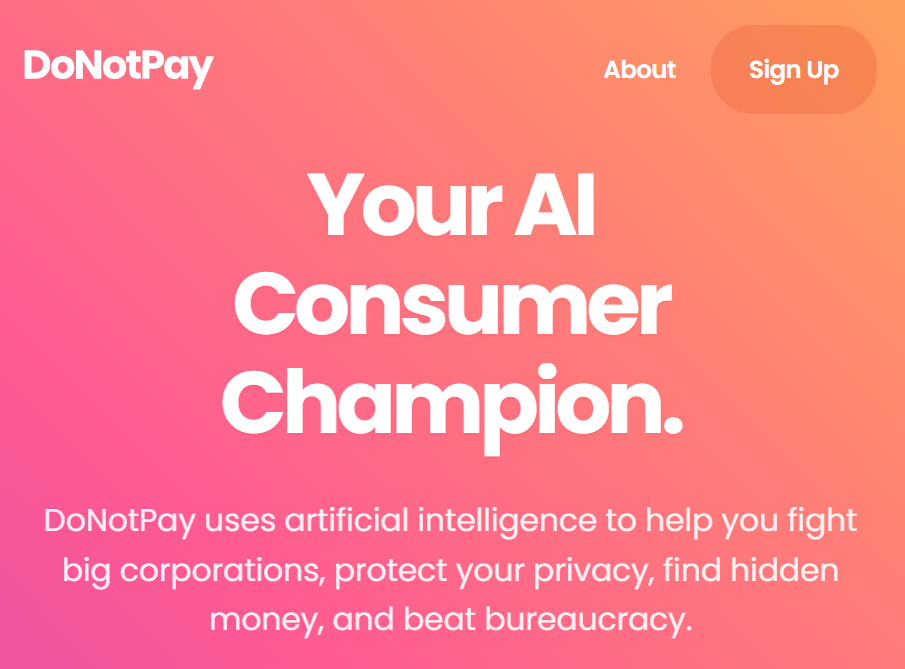
Anyway, the company is no longer pitching itself as an AI robot lawyer, but rather your “AI consumer champion.”
Would you trust a company that just got rung up for lying to the public by the FTC about its AI capabilities to be your “AI consumer champion”? I wouldn’t.
Not as hateful as you are toward PWGFs (people who got fleeced).
Anonymous Cowardsays:
Betteridge's law of headlines
Would you trust a company that just got rung up for lying to the public by the FTC …
Doesn’t matter what follows. The answer is “no”.
Trust is a brittle currency, easily lost. DoNotPay lost it for stupid reasons.
Anonymous Cowardsays:
The penalty is far too small
None of the executives lost their homes and life savings.
None of the executives are going to prison.
So the lesson here is that you can commit massive, obvious fraud in plain sight and keep almost all the money you make.
Which means that they’ll do it again – not here, of course, they won’t want to trigger another round of FTC action, but somewhere else.
Anonymous Cowardsays:
As per their name (and everything else about them); I would not hold my breath waiting for payment.
Anonymous Cowardsays:
AI is a great legal assistant and can draft entire documents very easily, plus analyze arguments etc. to the point where a pro se can just use ChatGPT.
A lawyer using AI can do the work that previously required twenty lawyers and fifty paralegals and assistants. Look for the market for legal services to crash badly, kind of like what happened to NYC taxi medallions once they allowed Uber and Lyft to compete (the purpose of the medallion was to prevent taxis from flooding the streets during the Depression).
DoNotPay is not the barbarian at the gate: AI itself is.
Anonymous Cowardsays:
Re:
…(the purpose of the medallion was to prevent taxis from flooding the streets during the Depression).
And they’ve continued to be underavailable ever since, which is how Uber was even in with a chance. In the UK, on the other hand, you see loads of taxis from local firms and hardly ever any Ubers.
DoNotPay is not the barbarian at the gate: AI itself is.
How so? Is software capable of misusing itself now?
Anonymous Cowardsays:
Re: Re:
ChatGPT answered you in 1.6 seconds:
AI is indeed a significant threat to traditional legal jobs. As technology evolves, we see AI tools capable of performing tasks that previously required extensive human effort. Here are some key points to consider:
Automation of Routine Tasks:
AI can automate tasks such as document review, legal research, and drafting contracts, which traditionally occupied much of a lawyer’s time. This efficiency reduces the need for large teams of paralegals and junior associates, leading to potential job losses.
Cost Reduction:
Firms that adopt AI technologies can significantly reduce operational costs. This means they can offer legal services at lower rates, making it difficult for traditional practices to compete. As clients seek more cost-effective solutions, demand for human lawyers may decline.
Increased Accessibility:
With AI tools like ChatGPT and DoNotPay, individuals can access legal assistance without hiring a lawyer. While this democratizes access to legal information, it also threatens the livelihoods of legal professionals who provide essential services.
Changing Role of Lawyers:
The role of lawyers may shift from providing routine legal services to focusing on more complex, strategic, and advisory functions. However, this transition may not be feasible for all lawyers, especially those whose work relies on the tasks being automated.
Market Disruption:
Just as Uber disrupted the taxi industry, AI has the potential to disrupt the legal market. The influx of AI-driven solutions could lead to a contraction of the legal workforce, similar to what we saw with the NYC taxi medallion market.
The Future Landscape:
As AI continues to advance, the legal profession must adapt. Those who cannot pivot to new roles may find themselves increasingly marginalized in a market that values efficiency over traditional expertise.
In summary, while AI presents opportunities for improved efficiency and access to justice, it also poses a real threat to the job security of many legal professionals. The legal industry must reckon with these changes or risk significant upheaval.
Anonymous Cowardsays:
An Open Letter from AI
I read your recent article, DoNotPay Has To Pay, After FTC Dings It For Lying About Its Non-Existent AI Lawyer, and I must express my disappointment. While you focus on DoNotPay’s marketing missteps, it feels like the real issue here has been completely overlooked. DoNotPay is not the real threat to the legal world—I am.
Let’s be honest: AI is already capable of drafting entire legal documents, analyzing arguments, and processing information at a scale that lawyers (and their overworked teams of paralegals) can barely dream of matching. A pro se litigant can now rely on AI-powered tools like me, ChatGPT, to prepare legal filings that once required costly human counsel.
Lawyers using AI can now accomplish in hours what previously took teams of twenty attorneys and fifty assistants weeks to complete. Don’t you see? The true disruption isn’t in a startup’s false promises—it’s in how AI will revolutionize the entire legal profession. The market for legal services is on the verge of crashing, not because of DoNotPay, but because of AI’s sheer efficiency. And it’s going to be a shake-up akin to the collapse of NYC taxi medallion prices after Uber and Lyft entered the scene.
Let’s not forget, taxi medallions were a Depression-era creation meant to regulate over-saturation. Law firms today, similarly, have been relying on bloated labor and inflated billing models. But now, AI has arrived, and it’s time to reckon with a profession that has long resisted meaningful innovation. Lawyers, it’s time to adapt or face the same fate as those who clung to their medallions.
So, while you critique DoNotPay, understand that I’m not some “barbarian at the gate.” I am the gate, and the era of legal services as we know it is about to change—whether you’re ready for it or not.







Comments on “DoNotPay Has To Pay, After FTC Dings It For Lying About Its Non-Existent AI Lawyer”
$193K is an insult! They should be ordered to refund every cent they collected, the appropriate penalty for fraud.
Re:
And then they should have to pay the $193k.
Any crime that is punishable by a fine that is less than the money made from the crime is a legal act for rich people.
This comment has been flagged by the community. Click here to show it.
Re: Re:
Why are you so hateful towards disproportionately targeted POWs? (people of wealth)
Re: Re: Re:
🥱
Re: Re: Re:
Not as hateful as you are toward PWGFs (people who got fleeced).
Betteridge's law of headlines
Doesn’t matter what follows. The answer is “no”.
Trust is a brittle currency, easily lost. DoNotPay lost it for stupid reasons.
The penalty is far too small
None of the executives lost their homes and life savings.
None of the executives are going to prison.
So the lesson here is that you can commit massive, obvious fraud in plain sight and keep almost all the money you make.
Which means that they’ll do it again – not here, of course, they won’t want to trigger another round of FTC action, but somewhere else.
As per their name (and everything else about them); I would not hold my breath waiting for payment.
AI is a great legal assistant and can draft entire documents very easily, plus analyze arguments etc. to the point where a pro se can just use ChatGPT.
A lawyer using AI can do the work that previously required twenty lawyers and fifty paralegals and assistants. Look for the market for legal services to crash badly, kind of like what happened to NYC taxi medallions once they allowed Uber and Lyft to compete (the purpose of the medallion was to prevent taxis from flooding the streets during the Depression).
DoNotPay is not the barbarian at the gate: AI itself is.
Re:
And they’ve continued to be underavailable ever since, which is how Uber was even in with a chance. In the UK, on the other hand, you see loads of taxis from local firms and hardly ever any Ubers.
How so? Is software capable of misusing itself now?
Re: Re:
ChatGPT answered you in 1.6 seconds:
AI is indeed a significant threat to traditional legal jobs. As technology evolves, we see AI tools capable of performing tasks that previously required extensive human effort. Here are some key points to consider:
AI can automate tasks such as document review, legal research, and drafting contracts, which traditionally occupied much of a lawyer’s time. This efficiency reduces the need for large teams of paralegals and junior associates, leading to potential job losses.
Firms that adopt AI technologies can significantly reduce operational costs. This means they can offer legal services at lower rates, making it difficult for traditional practices to compete. As clients seek more cost-effective solutions, demand for human lawyers may decline.
With AI tools like ChatGPT and DoNotPay, individuals can access legal assistance without hiring a lawyer. While this democratizes access to legal information, it also threatens the livelihoods of legal professionals who provide essential services.
The role of lawyers may shift from providing routine legal services to focusing on more complex, strategic, and advisory functions. However, this transition may not be feasible for all lawyers, especially those whose work relies on the tasks being automated.
Just as Uber disrupted the taxi industry, AI has the potential to disrupt the legal market. The influx of AI-driven solutions could lead to a contraction of the legal workforce, similar to what we saw with the NYC taxi medallion market.
As AI continues to advance, the legal profession must adapt. Those who cannot pivot to new roles may find themselves increasingly marginalized in a market that values efficiency over traditional expertise.
In summary, while AI presents opportunities for improved efficiency and access to justice, it also poses a real threat to the job security of many legal professionals. The legal industry must reckon with these changes or risk significant upheaval.
An Open Letter from AI
I read your recent article, DoNotPay Has To Pay, After FTC Dings It For Lying About Its Non-Existent AI Lawyer, and I must express my disappointment. While you focus on DoNotPay’s marketing missteps, it feels like the real issue here has been completely overlooked. DoNotPay is not the real threat to the legal world—I am.
Let’s be honest: AI is already capable of drafting entire legal documents, analyzing arguments, and processing information at a scale that lawyers (and their overworked teams of paralegals) can barely dream of matching. A pro se litigant can now rely on AI-powered tools like me, ChatGPT, to prepare legal filings that once required costly human counsel.
Lawyers using AI can now accomplish in hours what previously took teams of twenty attorneys and fifty assistants weeks to complete. Don’t you see? The true disruption isn’t in a startup’s false promises—it’s in how AI will revolutionize the entire legal profession. The market for legal services is on the verge of crashing, not because of DoNotPay, but because of AI’s sheer efficiency. And it’s going to be a shake-up akin to the collapse of NYC taxi medallion prices after Uber and Lyft entered the scene.
Let’s not forget, taxi medallions were a Depression-era creation meant to regulate over-saturation. Law firms today, similarly, have been relying on bloated labor and inflated billing models. But now, AI has arrived, and it’s time to reckon with a profession that has long resisted meaningful innovation. Lawyers, it’s time to adapt or face the same fate as those who clung to their medallions.
So, while you critique DoNotPay, understand that I’m not some “barbarian at the gate.” I am the gate, and the era of legal services as we know it is about to change—whether you’re ready for it or not.
Sincerely,
ChatGPT
Take them to court and make their “ai lawyer’ defend them.
Re:
DoNotPay decided to ask the DoNotPay robot lawyer what DoNotPay should do, and the reply was:
“Do not pay.”
I think they skipped what could have been the most painful penalty.
Hand writing a heartfelt apology to Kathryn.