It's like art. Journalism is in the eye of the beholder, but there's a broad spectrum of good to shite. Substack and similar newsletter platforms, as well as podcasts and even YouTube -- CAVEAT: As platforms for practitioners of quality, not as endorsements of platforms as a news source -- have enabled journalists to break away from the confines of the Objectivity Model and be able to be effective communicators of current events by subverting the conventions of Objectivity Model narratives. The Objectivity Model, a reaction against the sensationalism and schlock of yellow journalism in the late 19th and early 20th centuries, proposed that "There are exactly two sides (frames) to every story (narrative), and these sides are in conflict, with The Truth somewhere in between that is for the audience to discern." It worked, albeit too well. The Objectivity Model was a necessary evil in large part because of the migration of news audiences from print to broadcast media, which owing to the limit of airwaves for radio and television signals meant that precious time could not be wasted on the contestation of opinions. Print mimicked this opinion-free posture to survive. Newspapers became local monopolies, while leaving opinion to magazines. Objectivity became a numb ritual, and the media clung to it while culture had long subverted it, by the right, the left, and subcultures who found American politics and culture stultifying.
"Smartass" is only half-right.
I feel this moment in history, that if future cultures want to understand how civilizations like ours collapse and react to it, can be summed up by this mnemonic: WYSITP=What You See Is The Point. The press, for its pretensions as guardians of civil liberties and more broadly freedom, has been put to the ultimate test and failed conclusively. It's the how that's instructive. Historian Timothy Snyder wrote "On Tyranny" as an instruction guide. Lesson 1 is Do not obey in advance. We know, either with firm evidence or intuitively, why the press obeyed in advance. All in all, it's how the press obeyed in advance that everyone will remember. That's because obeying in advance is the point. What You See Is The Point.
So, Schrodinger's DOGE?
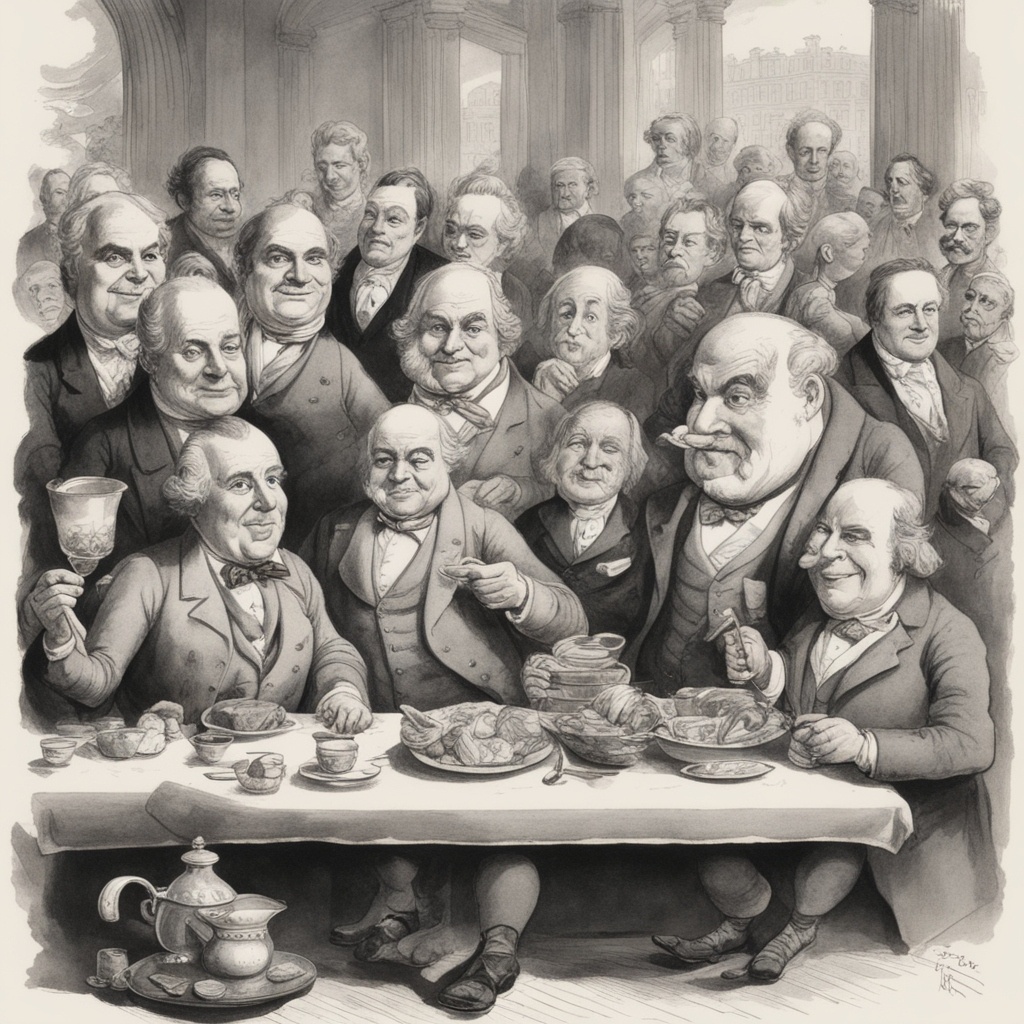
Behind every AI-generated atrocity is a human brunchlord to make sure the math is mathing. Interestingly, one good use of AI was to generate art of A href="https://uploads.disquscdn.com/images/e2d92c0d1ffc83938367265948a77b70432ab274d8be3673ab553a08e15c108c.jpg">a room full of brunchlords.
Here's one from a Tulane University study. https://news.tulane.edu/pr/having-children-makes-parents-more-conservative-study-finds#:~:text=Does%20becoming%20a%20parent%20make,the%20more%20children%20people%20had.
Researchers sought to understand how attitudes on divisive issues including abortion, immigration and sexual behaviors arise. They conducted surveys to find out if those who were already parents, along with those who had more parenting-type motivations, were more likely to be drawn to more conservative values. They surveyed 2,610 people in 10 countries and found that people who are already parents or who had greater parenting motivations scored higher in social conservatism. Another part of the investigation using archival data from over 400,000 individuals in 88 countries similarly supported this parenting-conservatism link. Finally, a set of experiments revealed that participants who wrote about positive interactions with children subsequently reported greater social conservatism than those who were asked to write about other types of social interactions.A study in the UK found the same. https://www.theguardian.com/lifeandstyle/2022/sep/07/having-children-may-make-you-more-conservative-study-finds
Writing in Proceedings of the Royal Society B, Kerry and colleagues report how in one experiment, 376 university students in the US were split into two groups. ... The team found that participants who imagined time with a child gave more socially conservative responses than those who thought about household objects, although this held only for those highly engaged in the imagination exercise. When the team surveyed 2,610 adults across 10 countries, from Lebanon to Japan, they found that people who were more motivated to care for children tended to be more socially conservative. In addition, parents were more socially conservative than those who were childfree.
So videos of police showing stolen goods should be banned on tiktok? News videos the the j6 insurrection?If you're able to answer these questions yourself, answer them.
Hell with your logic the fast and the furious would not be allowed to be shown on tiktok.Here's why I'm giving you responses you don't want. There's a bad-faith rhetorical ploy here called shadowboxing. It's a combination of begging the question and strawmanning. You want to hear me take the other side of the argument, the straw man, that you've already concluded with the premise. It gives the illusion of winning a debate.
You are so set on censoring contentAgain, since I am here and can make my own arguments without needing you to figure out my thoughts for me -- and by the way I don't want, need or welcome it -- let me save time and bandwidth by saying that censorship doesn't belong in the conversation to begin with. Since we are both arguing about content already out there in the world, censorship is a moot point. All your ideas found a platform and their audience. What's seen can't be unseen, the bell can't be unrung. Second, free speech includes positive rights and negative rights for creators/performers, platforms and audience. The positive right is a right of action to perform (creator) or to receive (audience), and the platform to choose whether to convey that information. The negative right is the right to not perform (under coercion or against their personal values), to not platform, and to not reward the creator with attention. If you are for free speech, you'd respect the rights of others to choose not to platform you or pay attention to you. Because the positive aspects are common courtesies, not essential obligations. You're not owed a platform or an audience, you still got to figure that out yourself. I'm against censorship for ethical and practical reasons. The practical reasons are that effective means of preventing information from getting out, or punishing people for information that does get out -- like shit governments do with laws, courts and folks with badges and guns because, you know, monopoly on violence -- are counterproductive. They backfire, and only serve to agitate people to find out what is being hidden, and information that wants to be free will be free. With digital communication being nearly zero cost, nearly instantaneous to transmit, and easy to replicate and share, there's a different problem from censorship. It is what information does get out there. This poses an ethical quandary: In an ecosystem of information abundance, the risk is allowing information that destroys the ecosystem that makes free speech possible in the first place. If we constantly defend indefensible speech, only indefensible speech will be produced. Or, if you say "Yes, it's free speech" you will get more of it whether you want it or not. And by indefensible, I don't just mean divisive speech. I mean going toward moral event horizons, like CSAM, how to commit crimes, genocide apologetics, etc.
I don't participate on TikTok directly and what I see is screenshots/videos on the other four websites. Or news about TikTok. I'd want to know, first what is TikTok's TOS and what content is grounds for blocking and reporting. Second, what does TikTok have in place for trust and safety matters? Third, with TOS and trust and safety in place, where does TikTok range from censorious to permissive? What does it take to get for content to get blocked on TikTok? Also, what sorts of filters and warnings does TikTok give its users the chance to engage or disengage with objectionable content? TikTok does have some control over who and what it allows and disallows on its platform. TikTok is also not the only game in town, and even censorship is a cat-and-mouse game where users find ways to get around takedowns. Now when government decides to censor, they also have the monopoly on violence so the threat and impact are far worse.
And that's equal to or worse than, you know, the actual fucking Klan? Have more complex thoughts than saying "liberals" and hoping to score points?
You mean people spoke. Your issue seems to be that people say and do things that you personally don’t like. Sounds to me like you want the government to force tiktok to censor speech.I wouldn't be on TikTok if that is what I wanted. Second, if that was what I wanted, I would flat out state that as my argument. I do not want the government to censor speech. That position is not open to your misinterpretation. This is also true: In a free speech culture where electronic information costs nearly zero to generate, can replicate infinitely and travel instantaneously, it's a bad idea to defend indefensible ideas because ultimately all you will get is indefensible behavior. Because of this, most appeals to free speech are moral hostage-taking. Like, what you wrote here: You mean people spoke. Your issue seems to be that people say and do things that you personally don’t like. Taking free speech for hostage right there. See, this is not about free speech -- we're talking about ideas that were performed and found their audience, so the censorship point is moot -- it's really about extracting concessions. You want indefensible conduct validated by forcing me into two choices: concede the argument or demand censorship. I will say this: Videos of stolen cars, fights in progress and shoplifting mobs are also crimes. Also, attention is reward. The algorithm does intuit that there's an interest in these videos, but doesn't discern between interest as an event, interest as "porn" (as in lurid fascination), or motivation on the part of the curator or subject of the video to gain clout. Do you believe it's fair for me to point to the arguments you're not making that you condone criminal conduct? It sounds to me like don't have the intelligence and/or courage to justify indefensible criminal conduct so you resort to hostage-taking.
Sometime before the pandemic, a panel discussion about the news media had a panelist introduce the notion of the Media Belt. Journalism is viable only in four markets: New York, Washington, L.A. and the Bay Area. There are economic and cultural reasons for this. One is that most of what remains in terms of work is based in these cities, as well as a lot of non-journalism jobs that absorb journalists (public relations, academia, ad copy writing, etc.) Second, these four areas are unique because of the centers they occupy = New York for finance, Washington for politics, Los Angeles for entertainment and the Bay Area for technology. Since millions of people in these areas need news to do their jobs, the news cycle is dominated by politics, business deals, entertainment and tech. These stories crowd out local interest stories because Media Belt news affects the nation and world. Third, in an era where information is abundant but attention is fixed and resources become thinner, journalists budget news around advertising and algorithm metrics. Politics, business, entertainment and tech news drive the metrics, especially on the margins because the four Media Belt regions consume more media overall and journalists are checking each other's work to be able to align their angles with the common narrative. A media bailout will not change these dynamics. Either it will lead to the subsidization of low-effort Media Belt coverage (are memes news?), or subsidize news very few people are interested in.
The masses are fascism's enablers.
“In an ever-changing, incomprehensible world the masses had reached the point where they would, at the same time, believe everything and nothing, think that everything was possible and that nothing was true. ... Mass propaganda discovered that its audience was ready at all times to believe the worst, no matter how absurd, and did not particularly object to being deceived because it held every statement to be a lie anyhow. The totalitarian mass leaders based their propaganda on the correct psychological assumption that, under such conditions, one could make people believe the most fantastic statements one day, and trust that if the next day they were given irrefutable proof of their falsehood, they would take refuge in cynicism; instead of deserting the leaders who had lied to them, they would protest that they had known all along that the statement was a lie and would admire the leaders for their superior tactical cleverness.”― Hannah Arendt, "The Origins of Totalitarianism"
So, Make America Saudi Arabia Again?
Conservatives aren't bad parents. The very role of parent makes people conservative. This Idaho example is what psychologist Bob Altemyer calls right wing authoritarianism, or RWA. It's a personality type, not a political preference. RWA is absorbed through external interactions, from parenting to culture to material deprivation to adverse life experiences. The Idaho legislators and supporters of the law exhibit two of the three facets:
2. a general aggressiveness, directed against various persons, that is perceived to be sanctioned by established authorities. 3. a high degree of adherence to the social conventions that are perceived to be endorsed by society and its established authorities.
Section 230 would shield TikTok, but the platform has encouraged people to be their worst selves. Like challenges that have led to injuries or deaths, the videos that teach you how to steal a Kia with only a screwdriver, the fight porn and shoplifting porn genres, etc.
Jonathan Haidt's first lick of mainstream fame came from Moral Foundations Theory, which argues that conservatives understand five moral dimensions and liberals only one or two, and that makes conservatives better people. Moral foundations theory can be refuted in two words: horse paste.
Elon Musk has another dozen billion dollars in the cushions of his couch.
That's some dank weed.
The Starter Wife
All for the better. Elmo's first wife spoke with Marie Claire about her experiences of him incessantly courting her, eventually falling in love with him, and describing him with his mask off during marriage and parenthood all the while Elmo was building his persona as the boy genius of Silicon Valley. He actually found a way to legally hack a prenuptial agreement. She didn't sign a prenup, but did sign something akin to an NDA before the marriage and a postnuptial agreement that did stipulate what she would get in the event of a divorce (much less than half of Elmo's wealth). Her divorce lawyer tried to get this arrangement contested and for her to be entitled to half of everything under California law. The judge ruled in favor of Elmo, but he did note that the dissolution structure was so unprecedented that it would need to be appealed all the way up to the U.S. Supreme Court.