If you’ve been following the Kickstarter campaign for our new card game, One Billion Users, then you know we’re not quite on track on to hit our goal — but we haven’t given up! We’ve now passed the halfway mark in funds raised, and we’re doing everything we can to make a final push before the campaign this week. So if you’ve been hesitating, now is the time! Please head on over to Kickstarter and become a backer to secure your copy of this fast, fun, competitive cared game about building the biggest and best social network.
For those who have already backed the campaign, don’t give up hope! Tell your friends, spread it around, and keep your fingers crossed — we really want to get this game out into the world, and we’ll be working hard to drum up support here on the home stretch. Also, in case you missed it, we’ve also added a new tier for superbackers who want to give us some extra support.
We do have other plans if the campaign fails to hit its goal this time around (we won’t be giving up!) but for now we’re focused on these remaining five days. Thanks again to everyone who has already contributed, and with a little luck you’ll soon be able to play One Billion Users.
As part of our final push to get our Kickstarter campaign for our new card game over the line, we’ve added a new limited tier for backers who want to show their support while getting more involved. We’re inviting 5 superbackers to work with us to co-design new cards that will be included in the game. This is your chance to make a permanent mark on One Billion Users!
When you back us at the new Design a Card tier, we’ll work with you directly to brainstorm a new card, figure out its gameplay rules, and craft a fresh visual design. You’ll be able to choose one of three types of cards:
An Influencer card, with a brand new personality, to go alongside our existing slate of Influencers like The Investor and The Contrarian. They’ll have their own unique name, custom emoji-based portrait, and rules for choosing which network they join in the game.
A Network card, used for advanced play to give each player unique powers and constraints, to go alongside our existing Networks like TapTap, EnvyGram and Friendlink. It could be based on another real-life social network, or perhaps a fresh invention of the kind of network you’d like to see. It will have a name and custom-designed logo art, and a set of brand new rules.
An Event card, which comes up randomly during the game. It could be an ongoing event (like the existing Tech Bubble or Regulation events) or a one-time event (like the Social Shuffle or Troll Trouble events). Event cards don’t have unique artwork, but they are a great opportunity if you’re interested in game design, with lots of leeway for crafting interesting rules that will become very important to the game.
Whatever you choose, it will be a collaborative design process where you’re involved at every step (or, if you prefer, you can just give us your idea and we’ll run with it!) You’ll also get an acknowledgement in the rulebook, and we’ll throw in ten copies of the finished boxed game, so you can show off your contribution to your friends. Head on over to Kickstarter to learn more.
We’re past the halfway point of our Kickstarter campaign for One Billion Users, a new competitive card game about building the biggest and best social media network. We’re very excited to get this game into people’s hands, but we won’t be able to do it without your support! If you want to try your hand at building a social media network, please back the campaign and secure your copy before it’s too late.
The game is nearly ready to produce, with a beautiful deck of over 120 cards, and we’ve got our manufacturing plans all sorted out — all we need now is some help to get the Kickstarter over the line. So please, back the campaign and tell your friends, and get ready to build a social media network with One Billion Users.
As you likely know by now, we are running a Kickstarter to fund the release of One Billion Users, our new card game about building the biggest and best social media network. Earlier this week, Mike wrote about the game’s roots in Touring and Mille Bornes and explained some of the new mechanics we’ve added, including the concept of Influencers who move around between the competing social networks and bring their audiences with them. Today, I want to introduce you to just a few of them.
The Investor
Some Influencers just want to chase the biggest possible audience, and The Investor is one of them. You know the type: brimming with advice on how to get rich, and often a lot of other opinions too, which attracts followers who aren’t the most toxic in the world of social media, but hardly the least toxic either.
The Trendsetter
Other Influencers go in the opposite direction, like The Trendsetter, who likes to stay fresh by joining the platform that has the fewest users — with a large and unproblematic following in tow. In the game, this card can serve as a catch-up mechanic when a player is falling behind, but is also a prime target for a well-timed Push card (which allows a player to steal an Influencer).
The Contrarian
Not all Influencers make their decision based on audience size. Some are interested in other things, like The Contrarian, who loves to debate (productively or… otherwise) and thus prefers the network with the most toxic, combative environment. Since The Contrarian’s loyal fanbase is itself pretty toxic, this card threatens to make things worse for players who let their platform’s toxicity get out of hand.
The Troll
And then there’s The Troll, who is a different kind of “influencer”. Rather than bringing a following, The Troll operates alone, counting as only one user (which can do nothing more than break certain rare ties) and yet massively increasing the toxicity of a platform. And since they like to cause as much trouble as possible, they always target the biggest network. A player who is ahead in the race for Users, but struggling to keep Toxicity under control, might find themselves constantly trying to swat away The Troll.
Last week we launched the Kickstarter for our amazing new card game, One Billion Users. It’s a fast, fun card game where players try to build up the biggest and best social media network, while simultaneously trying to undermine the networks the other players are trying to build.
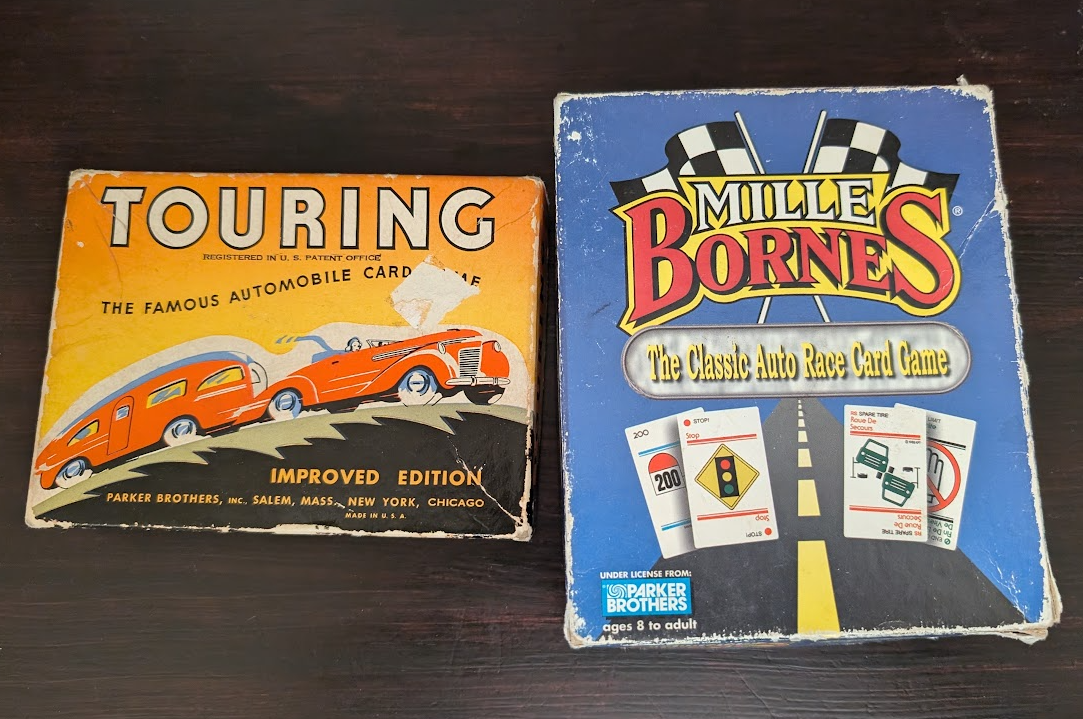
In the campaign, we mentioned a couple of historical card games that the game was loosely based on: 1906’s Touring and 1954’s Mille Bornes. I mentioned that Mille Bornes has been wildly popular at times since its launch, and over on Bluesky many people have been expressing their fond nostalgia for Mille Bornes.
It’s true that Mille Bornes is a fantastic game for friends and family, involving trying to win a car race while throwing up various hazards in front of your opponents. But I wanted to make clear that One Billion Users is not just a “re-skinned Mille Bornes” about social media.
It’s much better.
In fact, we’ve made several key improvements and additions that make One Billion Users a deeper, more strategic, and ultimately more engaging game than its predecessors.
Some of the most notable changes include:
A new “toxicity” mechanic that adds risk and consequences to your social media growth
Unique Influencer cards that have a mind of their own, making their own platform choices that can help or hinder your progress
Random Event cards that shake up the gameplay and force you to adapt your strategy
I wanted to talk a little bit about why we chose to build on the basic mechanics from Mille Bornes and Touring. I also wanted to discuss the limitations we found that they had, and how we sought to make a much better game building off of those mechanics.
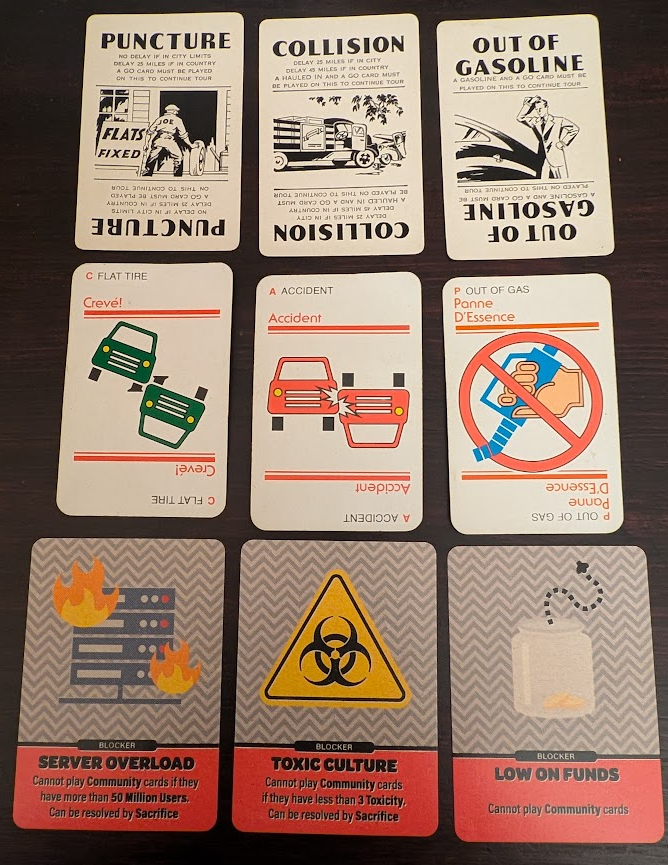
First off, it’s important to note that Mille Bornes is an almost exact replica of Touring. If you know how to play Mille Bornes, you already know how to play Touring. Both involve the same basic mechanics, though the mile distances in Touring are slightly smaller, and rather than the “Speed Limit” card in Mille Bornes, in Touring that’s replaced by a “Country” or “City Limits” card which determine their speed. Touring also has the concept of having to “discard” some mileage cards to get rid of a hazard (which we sorta brought back in One Billion Users) and isn’t in Mille Bornes.
The only really “different” mechanic found in Mille Bornes is the so-called “Safeties” or what many people call the “Coup Fourré” cards. In One Billion Users, we retain these cards (called Safeguards), but they’re not as powerful as they are in Mille Bornes, where they can dominate a round.
We chose to build off the basic mechanics in these games for a few reasons. First, we knew that they’re fun to play. The reason there’s so much nostalgia for Mille Bornes is because people enjoy it! We wanted to make sure that this game was, first and foremost, super fun to play with your friends and family.
With our last card game, CIA: Collect it All, we received some complaints (and some negative Boardgame Geek reviews!) saying that the game was just okay and wasn’t as captivating as other modern card games. But that’s because the game was designed primarily to be a teaching tool for incoming CIA analysts to better understand the tools at their disposal to analyze a global crisis.
During that campaign, we asked some backers if they wanted us to make a more “fun” version of the game or keep it as close as possible to the original. We heard loud and clear that most backers wanted it as close as possible to the CIA’s version.
With this new game, we wanted to make sure that its main guiding factor was that it be a fun game for friends and family, and that it be especially replayable. While we don’t mind slipping in some educational elements to our games if they fit, that was always secondary to making the game as fun as possible.
Starting with the Touring/Mille Bornes framework gave us a starting point that we knew was fun and which millions of people around the globe already know is fun.
While we loved the core gameplay loop of drawing cards, playing mileage, and dealing with hazards, we felt that both Mille Bornes and Touring were missing some key elements that could make the experience more dynamic and interactive. That’s where our new mechanics come in.
The biggest complaint we heard with Mille Bornes is that it’s entirely possible to get “stuck” for most of the game. If you get hit with a hazard where you don’t have the matching remedy, you can play an entire round that is pure frustration.
We attempted to solve this by offering up alternative methods for dealing with “blockers” (the equivalent of hazards in Mille Bornes). Some of the cards let you “sacrifice” some of your community cards to rid yourself of the blocker, though what the sacrifice is may depend on the issue.
Too much toxicity (more on that below)? You can choose to ban a toxic community. Servers overloaded? Get rid of some of your users. Also, we have an alternative resolution of blockers where in each turn that you don’t proactively play a card, you can sacrifice one of your hand cards to “work” on fixing the blocker. Once you’ve spent three turns doing so, it is now fixed.
The second complaint about Mille Bornes is that there isn’t that much strategy to it. At best, your choices tend to be “offense” (playing more miles) or “defense” (playing a hazard to stop an opponent).
But beyond that, there isn’t much to decide. If you’re playing offense, you automatically play the highest mileage card. If you’re playing defense, it doesn’t really matter which hazard you play on opponents, so long as they don’t have the relevant safety card.
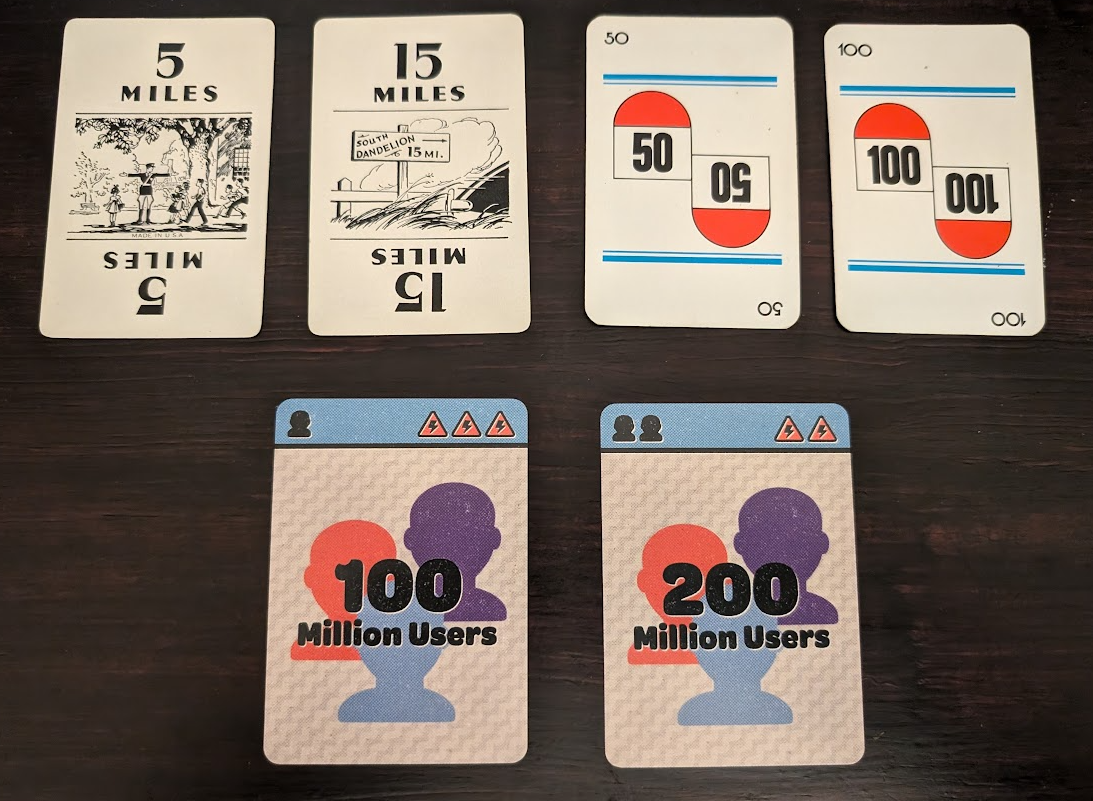
With One Billion Users, we’ve added the concept of “toxicity.” Each community card represents not only how many millions of users have joined your social media network, but also how much toxicity they bring with them, designated by the warning symbols in the upper right-hand corner. If you have too much toxicity, you may be limited in some of the cards you can play and also, at the end of the game, you can lose a lot of points.
This adds a very fun strategy element to the game. Players can decide to go for it, not care about the toxicity and just try to build up as big a site as possible, but if they’re not careful the toxicity can really tank their score at the end. Other times, players may decide to be much more careful and avoid playing overly toxic cards unless they have no other choice.
Another complaint that we heard regarding Mille Bornes is that some felt it wasn’t all that replayable, because the basic elements of the game are pretty much the same every time. I know some people (myself included!) don’t mind this aspect, but it is true that each time you play the game is pretty similar.
We’ve added three additional elements to the game: Influencers, Events, and Push/Poke cards, to change things up even more.
The Influencers are (obviously!) an element that fits perfectly within the theme of “social media.” Influencer cards are shuffled throughout the deck, and when a player picks one on their turn, instead of going into their hand, it immediately joins the network it prefers as designated on the card. This could be the biggest network… or the smallest. It could be the most toxic… or the least.
Influencer cards bring with them millions of users, but also varying degrees of toxicity. Some are certainly better than others. And lurking out there somewhere is the infamous Troll card, which brings with it a ton of toxicity, but barely any users at all. You want to avoid the Troll as much as you can.
Of course, Influencers can be fickle, and they can change which network they go to as social media sites change over time. One way they can move is via the Push and Poke cards. Push cards let whoever played the card move any influencer to any other social media network. Often this can be used to “steal” an Influencer and their community to your own network, but it can also be used strategically against others (especially with the Troll).
The “Poke” card nudges the Influencer to reconsider their choices by looking at the current state of the platforms. So, maybe The Investor prefers the network with the most users. But that can change over time. Perhaps you realize that your network now has more users than the one The Investor joined initially. You can “Poke” The Investor to look again and jump ship to you. And, in the process, the Investor’s community can pick up some more users to bring along to your network.
Finally, we have the “Event” cards, which are a way to add a lot more variety and challenging situations to the game. Event cards are shuffled into the deck and serve to create “global” conditions that can impact how you play. Sometimes, they allow you to do more (such as the “Move Fast” card that allows you to pick an extra card each round until it’s replaced) and sometimes they can limit what you do (such as the “Break Things” card that says you can’t play certain Safeguard cards while it’s in effect).
Some events stay in effect until the next Event card is drawn, and some have an immediate, one-time impact. For example, the “Troll Trouble” card means the player with the most toxicity has to move their Community Card with the least toxicity to the network with the least toxicity, representing users fleeing the toxic environment for a better one. Or the “Social Shuffle” card that causes all Influencers to reevaluate which network they’ve joined to see if there’s a different network that better matches their preferences.
All of these new elements — the toxicity mechanic, the Influencers, the Events, and the Push/Poke cards — come together to create a game that is familiar yet fresh, easy to learn but with layers of strategy to explore. One Billion Users takes the basic framework that made Mille Bornes a classic and builds on it to create a modern card game perfectly suited for the social media era.
Whether you’re a fan of the original auto racing card games or completely new to the genre, we think you’ll find One Billion Users to be a unique and captivating gaming experience. The added depth and player interaction make every playthrough feel different, as you navigate the ever-shifting landscape of social networks, influential figures, and online communities.
We’re hoping to release a copy of the rulebook and possibly a basic “Let’s Play” video before the campaign ends, to give folks a better sense of the game play.
But, for now, hopefully you can see why if you are nostalgic for Mille Bornes, you’ll absolutely love playing One Billion Users.
Many of you probably remember our first Kickstarted card game, CIA: Collect It All, which was based on a real CIA training game created by the government and obtained via a FOIA request. This time, we’ve drawn inspiration from a different public domain source: the 1906 card game Touring, which in turn inspired the 1950s hit Mille Bornes. But One Billion Users goes well beyond those games, with lots of new mechanics that add new layers of strategy and increased replayability.
In One Billion Users, players compete to get as many people as possible onto their platforms. That means drawing in communities of regular users while navigating various obstacles, but it also means competing to attract influencers with huge followings. What’s more, not all users are created equal: they bring with them varying levels of toxicity that can hamper your growth and hurt your final score.
On top of that, the game also lets you try on the shoes of the big social networks you know and love (or hate). Will you play as TapTap, which benefits from its highly effective algorithm but is a prime target for political moral panics? Maybe you’ll play as HireMe, which aims to maintain a professional tone, or as Friendlink, which gets a head start from being around for so long but isn’t exactly considered cool by today’s influencers. And then, of course, there’s a certain Hellsite that has recently undergone some big changes…
Throughout the game, you’ll be trying to slow the growth of your rivals by hitting them with various blockers — maybe they run out of money, or their servers get overloaded, or the toxic culture of their platform starts repelling potential new users. And of course you’ll have to deal with these blockers yourself — seeking out new advertisers (if your platform isn’t too toxic), rolling out server upgrades, and putting the mods to work.
One Billion Users contains over 120 cards and is designed for 2-4 players, with games taking about 30 minutes. We’re very excited to get this game into people’s hands, but that’s only going to happen if we hit our crowdfunding goal. We don’t plan to produce and sell this game after the initial Kickstarter run, so if you want to get a copy, backing our campaign is your only chance! We’ll have more teasers and more details about gameplay to show you over the next couple weeks, but for now please check the game out on Kickstarter and secure your copy before it’s too late.
We’re excited to announce the launch of the crowdfunding campaign for our new card game: One Billion Users. In this fast-paced and entertaining card game, you take on the role of a social media mogul competing to build the most successful social network. We’ve spent much of this year designing, testing, and refining the game and it’s almost ready to hit the presses — so now we need your help. If you want to try your hand at running a social media network, please back our Kickstarter campaign and secure your copy of One Billion Users.
In One Billion Users, your goal is simple: gain users and attract influencers to grow your platform. But watch out: other players will try to slow you down by playing cards that create obstacles in your path. And you’ll have to be careful about the communities you attract — the toxicity they bring could hurt your platform in the long run.
This game is a follow-up to CIA: Collect It All, which we successfully Kickstarted a few years back. That game was based on public domain material created by the US government to train CIA analysts about the surveillance tools at their disposal. One Billion Users is also based on a public domain game: 1906’s Touring from William Janson Roche, which was a card game involving racing cars to see who could get the furthest distance, while overcoming obstacles placed by opposing players. It’s widely considered the first card game using the “Take That” game mechanic.
In the 1950s, a game based on Touring, called Mille Bornes, briefly became the best-selling game in the US. If you’ve played Mille Bornes or Touring, the basics of One Billion Users will be familiar to you, but we’ve introduced many updates to modernize the game and to make it fit with the social media theme.
In One Billion Users, you’re trying to build up your userbase rather than chasing miles on the road. But all users are not equal: they bring different levels of toxicity with them, and that toxicity can overwhelm your network and limit your opportunities to grow or find advertisers. Other players can try to stop you with various blockers like overloading your servers or causing you to be low on funds.
We’ve also added a new twist: the concept of influencers who want to join particular networks. During the game, there are opportunities to steal influencers (and their legions of followers) away from other networks, but that means they can be stolen from you as well.
On top of that, a variety of events can occur throughout the game that can impact all players. Some events, like a tech bubble that blocks bad press, can be helpful. But others, like regulations that limit how much toxicity you can play, can seriously limit your growth options and force you to rethink your strategy.
One Billion Users delivers whether you’re a social media aficionado, a tabletop gaming enthusiast, or just looking for a fun new game to enjoy with friends and family. It’s designed to be not only entertaining and engaging, but also highly replayable, ensuring hours of enjoyment.
Also, backing this project will help support Techdirt and our reporting. So, rather than just joining yet another premium tier for a news website, you’ll be getting a fun game you can play for years to come!