We’re past the halfway point of our Kickstarter campaign for One Billion Users, a new competitive card game about building the biggest and best social media network. We’re very excited to get this game into people’s hands, but we won’t be able to do it without your support! If you want to try your hand at building a social media network, please back the campaign and secure your copy before it’s too late.
The game is nearly ready to produce, with a beautiful deck of over 120 cards, and we’ve got our manufacturing plans all sorted out — all we need now is some help to get the Kickstarter over the line. So please, back the campaign and tell your friends, and get ready to build a social media network with One Billion Users.
Last week we launched the Kickstarter for our amazing new card game, One Billion Users. It’s a fast, fun card game where players try to build up the biggest and best social media network, while simultaneously trying to undermine the networks the other players are trying to build.
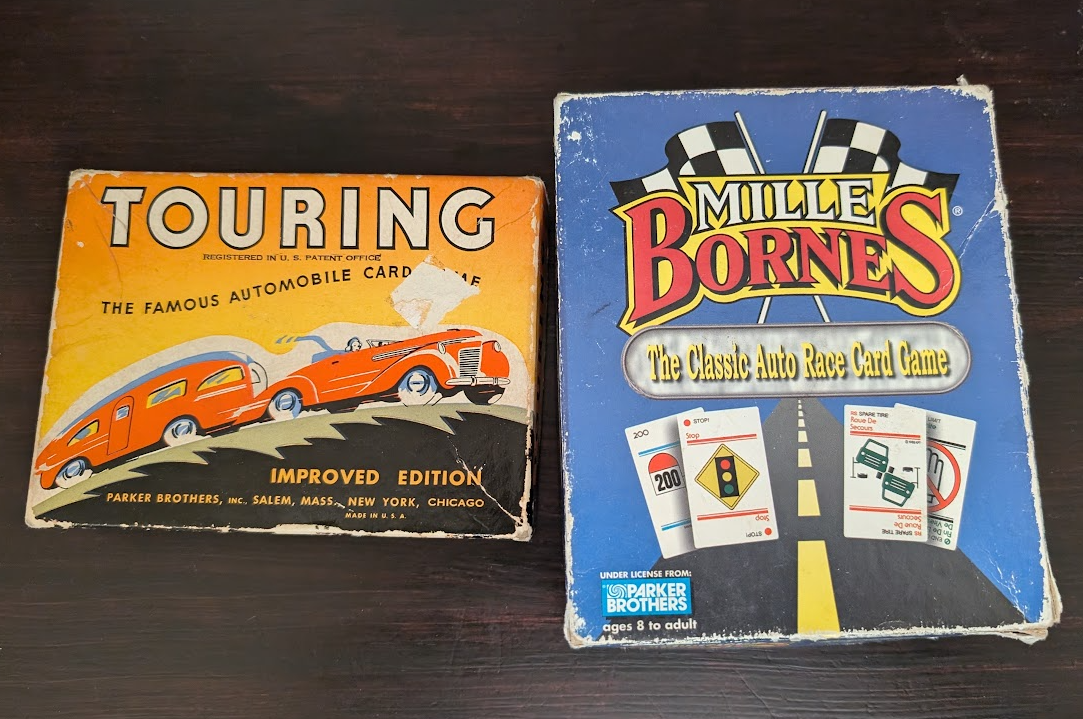
In the campaign, we mentioned a couple of historical card games that the game was loosely based on: 1906’s Touring and 1954’s Mille Bornes. I mentioned that Mille Bornes has been wildly popular at times since its launch, and over on Bluesky many people have been expressing their fond nostalgia for Mille Bornes.
It’s true that Mille Bornes is a fantastic game for friends and family, involving trying to win a car race while throwing up various hazards in front of your opponents. But I wanted to make clear that One Billion Users is not just a “re-skinned Mille Bornes” about social media.
It’s much better.
In fact, we’ve made several key improvements and additions that make One Billion Users a deeper, more strategic, and ultimately more engaging game than its predecessors.
Some of the most notable changes include:
A new “toxicity” mechanic that adds risk and consequences to your social media growth
Unique Influencer cards that have a mind of their own, making their own platform choices that can help or hinder your progress
Random Event cards that shake up the gameplay and force you to adapt your strategy
I wanted to talk a little bit about why we chose to build on the basic mechanics from Mille Bornes and Touring. I also wanted to discuss the limitations we found that they had, and how we sought to make a much better game building off of those mechanics.
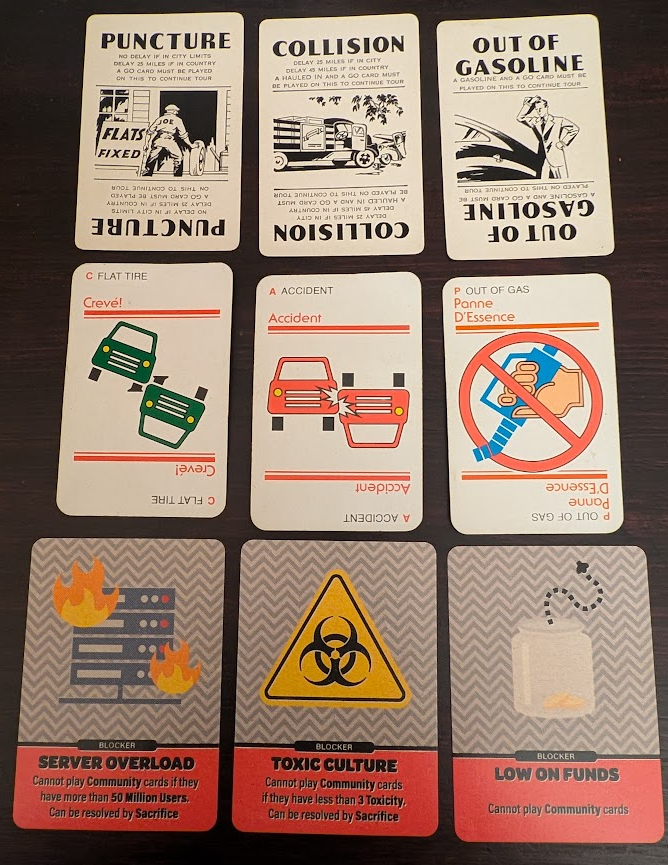
First off, it’s important to note that Mille Bornes is an almost exact replica of Touring. If you know how to play Mille Bornes, you already know how to play Touring. Both involve the same basic mechanics, though the mile distances in Touring are slightly smaller, and rather than the “Speed Limit” card in Mille Bornes, in Touring that’s replaced by a “Country” or “City Limits” card which determine their speed. Touring also has the concept of having to “discard” some mileage cards to get rid of a hazard (which we sorta brought back in One Billion Users) and isn’t in Mille Bornes.
The only really “different” mechanic found in Mille Bornes is the so-called “Safeties” or what many people call the “Coup Fourré” cards. In One Billion Users, we retain these cards (called Safeguards), but they’re not as powerful as they are in Mille Bornes, where they can dominate a round.
We chose to build off the basic mechanics in these games for a few reasons. First, we knew that they’re fun to play. The reason there’s so much nostalgia for Mille Bornes is because people enjoy it! We wanted to make sure that this game was, first and foremost, super fun to play with your friends and family.
With our last card game, CIA: Collect it All, we received some complaints (and some negative Boardgame Geek reviews!) saying that the game was just okay and wasn’t as captivating as other modern card games. But that’s because the game was designed primarily to be a teaching tool for incoming CIA analysts to better understand the tools at their disposal to analyze a global crisis.
During that campaign, we asked some backers if they wanted us to make a more “fun” version of the game or keep it as close as possible to the original. We heard loud and clear that most backers wanted it as close as possible to the CIA’s version.
With this new game, we wanted to make sure that its main guiding factor was that it be a fun game for friends and family, and that it be especially replayable. While we don’t mind slipping in some educational elements to our games if they fit, that was always secondary to making the game as fun as possible.
Starting with the Touring/Mille Bornes framework gave us a starting point that we knew was fun and which millions of people around the globe already know is fun.
While we loved the core gameplay loop of drawing cards, playing mileage, and dealing with hazards, we felt that both Mille Bornes and Touring were missing some key elements that could make the experience more dynamic and interactive. That’s where our new mechanics come in.
The biggest complaint we heard with Mille Bornes is that it’s entirely possible to get “stuck” for most of the game. If you get hit with a hazard where you don’t have the matching remedy, you can play an entire round that is pure frustration.
We attempted to solve this by offering up alternative methods for dealing with “blockers” (the equivalent of hazards in Mille Bornes). Some of the cards let you “sacrifice” some of your community cards to rid yourself of the blocker, though what the sacrifice is may depend on the issue.
Too much toxicity (more on that below)? You can choose to ban a toxic community. Servers overloaded? Get rid of some of your users. Also, we have an alternative resolution of blockers where in each turn that you don’t proactively play a card, you can sacrifice one of your hand cards to “work” on fixing the blocker. Once you’ve spent three turns doing so, it is now fixed.
The second complaint about Mille Bornes is that there isn’t that much strategy to it. At best, your choices tend to be “offense” (playing more miles) or “defense” (playing a hazard to stop an opponent).
But beyond that, there isn’t much to decide. If you’re playing offense, you automatically play the highest mileage card. If you’re playing defense, it doesn’t really matter which hazard you play on opponents, so long as they don’t have the relevant safety card.
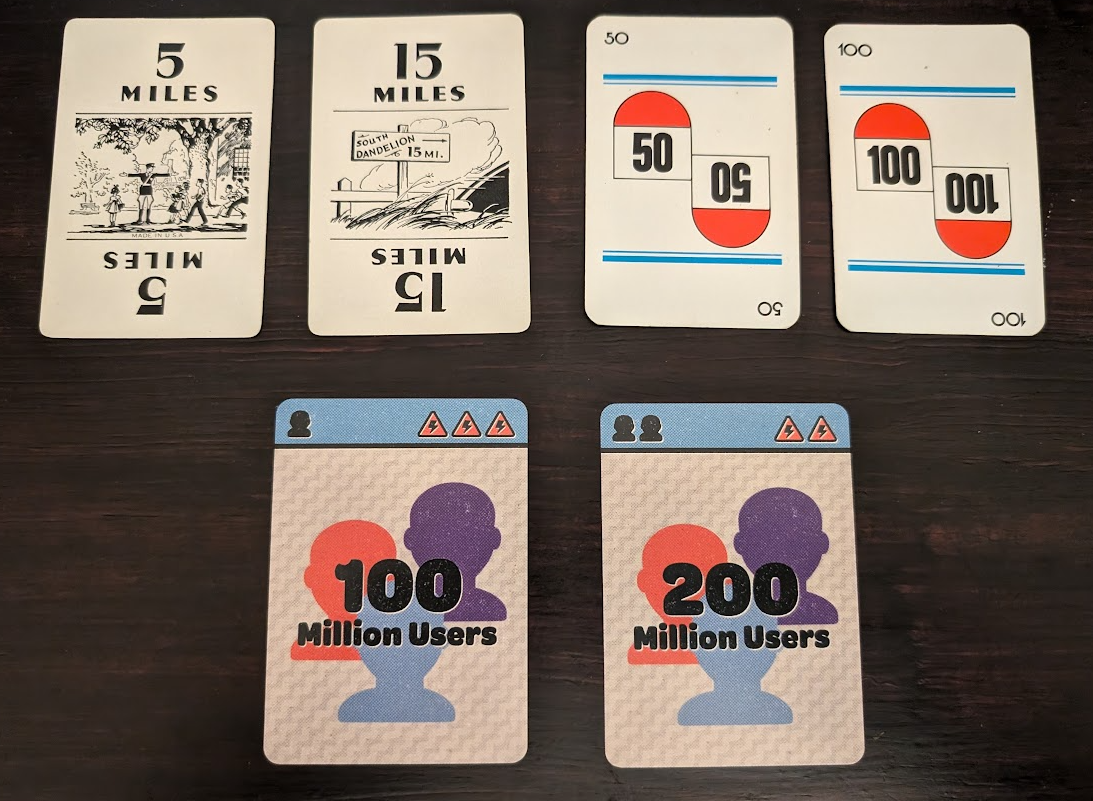
With One Billion Users, we’ve added the concept of “toxicity.” Each community card represents not only how many millions of users have joined your social media network, but also how much toxicity they bring with them, designated by the warning symbols in the upper right-hand corner. If you have too much toxicity, you may be limited in some of the cards you can play and also, at the end of the game, you can lose a lot of points.
This adds a very fun strategy element to the game. Players can decide to go for it, not care about the toxicity and just try to build up as big a site as possible, but if they’re not careful the toxicity can really tank their score at the end. Other times, players may decide to be much more careful and avoid playing overly toxic cards unless they have no other choice.
Another complaint that we heard regarding Mille Bornes is that some felt it wasn’t all that replayable, because the basic elements of the game are pretty much the same every time. I know some people (myself included!) don’t mind this aspect, but it is true that each time you play the game is pretty similar.
We’ve added three additional elements to the game: Influencers, Events, and Push/Poke cards, to change things up even more.
The Influencers are (obviously!) an element that fits perfectly within the theme of “social media.” Influencer cards are shuffled throughout the deck, and when a player picks one on their turn, instead of going into their hand, it immediately joins the network it prefers as designated on the card. This could be the biggest network… or the smallest. It could be the most toxic… or the least.
Influencer cards bring with them millions of users, but also varying degrees of toxicity. Some are certainly better than others. And lurking out there somewhere is the infamous Troll card, which brings with it a ton of toxicity, but barely any users at all. You want to avoid the Troll as much as you can.
Of course, Influencers can be fickle, and they can change which network they go to as social media sites change over time. One way they can move is via the Push and Poke cards. Push cards let whoever played the card move any influencer to any other social media network. Often this can be used to “steal” an Influencer and their community to your own network, but it can also be used strategically against others (especially with the Troll).
The “Poke” card nudges the Influencer to reconsider their choices by looking at the current state of the platforms. So, maybe The Investor prefers the network with the most users. But that can change over time. Perhaps you realize that your network now has more users than the one The Investor joined initially. You can “Poke” The Investor to look again and jump ship to you. And, in the process, the Investor’s community can pick up some more users to bring along to your network.
Finally, we have the “Event” cards, which are a way to add a lot more variety and challenging situations to the game. Event cards are shuffled into the deck and serve to create “global” conditions that can impact how you play. Sometimes, they allow you to do more (such as the “Move Fast” card that allows you to pick an extra card each round until it’s replaced) and sometimes they can limit what you do (such as the “Break Things” card that says you can’t play certain Safeguard cards while it’s in effect).
Some events stay in effect until the next Event card is drawn, and some have an immediate, one-time impact. For example, the “Troll Trouble” card means the player with the most toxicity has to move their Community Card with the least toxicity to the network with the least toxicity, representing users fleeing the toxic environment for a better one. Or the “Social Shuffle” card that causes all Influencers to reevaluate which network they’ve joined to see if there’s a different network that better matches their preferences.
All of these new elements — the toxicity mechanic, the Influencers, the Events, and the Push/Poke cards — come together to create a game that is familiar yet fresh, easy to learn but with layers of strategy to explore. One Billion Users takes the basic framework that made Mille Bornes a classic and builds on it to create a modern card game perfectly suited for the social media era.
Whether you’re a fan of the original auto racing card games or completely new to the genre, we think you’ll find One Billion Users to be a unique and captivating gaming experience. The added depth and player interaction make every playthrough feel different, as you navigate the ever-shifting landscape of social networks, influential figures, and online communities.
We’re hoping to release a copy of the rulebook and possibly a basic “Let’s Play” video before the campaign ends, to give folks a better sense of the game play.
But, for now, hopefully you can see why if you are nostalgic for Mille Bornes, you’ll absolutely love playing One Billion Users.
It’s been a while since we’ve mentioned our version of the CIA’s internal training card game, that we Kickstarted back in April. For those who backed it, you’ve been receiving all the various updates on it — including allowing everyone to download the rulebook. And now the game is officially in production — which also means this may be your last chance to purchase a physical copy. While we’re printing up some extra copies beyond what’s already been ordered, at this point we’re only doing this one printing of the game, and that’ll be it. You can still pre-order the game here, and as we get closer to selling out the initial run we’ll turn it off.
If you don’t recall, this project grew out of the CIA telling the world about some of the internal training card and board games it had developed, leading to some FOIA requests that revealed the heavily redacted details of some of these games. We picked one of them — which the CIA calls Collection Deck — and turned it into our own game, entitled: CIA: Collect It All. It’s a fast paced card game, in which players take on the role of CIA analysts, trying to collect enough information, using a variety of different spycraft techniques, to deal with various crises. Of course, as with the real world, other forces seek to get in the way and block the analysts from collecting all of the information they need.
For our version of the game, we had to fill in a whole bunch of redacted cards, completely redo the design, and add in some other fun aspects to the game — including an entirely different “storytelling” variant which allows you to use the same cards for a very different kind of game (still based on the CIA).
After completing the redesign, filling in all of the redacted bits, adding new rules, rewriting the entire rulebook from scratch and more, we finally received our first prototype, and have approved it going into full production. We’ve initially ordered more than we sold via Kickstarter, but not a huge amount, so if you want a physical copy, it makes sense to put your order in soon.
I suppose because too many of my fellow citizens in America have devolved into hyper-partisan rage-beacons, I have to issue the following stupid caveat that I shouldn’t have to issue at all: this post is not a commentary on Trump’s border wall policy. Great. I’m sure that will keep our comments free and clear of anyone insisting otherwise. With that being said, a common topic we discuss here is how one of the chief benefits of the internet is how it has removed gatekeepers that have long stood in the way of new businesses, or have governed how established businesses do their business. Typically, we have focused on the former, detailing how the internet has allowed for new players in everything from the entertainment industry to products that would have previously existed solely at the pleasure of brick and mortar retail stores.
But this post is about the latter. You may have heard about the viral video making the rounds from the folks behind the hit card game Cards Against Humanity. If you haven’t, here it is.
But it’s also true that a campaign that essentially trolls the sitting American President by buying a piece of land where his proposed border wall is going to go and then vowing to defend that land legally for as long as possible is controversial to say the least. Some not inconsequential percentage of Americans — and, likely, our readers — think that the border wall is good policy. Some other percentage do not. Whatever you might think, it should be clear that this campaign is likely to piss off some decent chunk of the company’s potential customer base. Why the company wants to do this is a valid question, but I’d like to point out why they can do this.
Given the nature of the game, the company has no problem being a bit brash, and because they are self-owned, and don’t rely on big box stores to push their product, the company can get away with a bit more.
That’s putting it mildly. It’s nearly impossible to envision the company taking so staunch a political stance as this were it forced to rely on traditional retail stores, which would likewise feel backlash from supporters of the border wall. You likely have already imagined how many calls there would be on retailers to drop the product if this happened, except it’s more likely that the folks behind Cards Against Humanity never would have done this in the first place, save for their ability to sell directly to consumers via the internet.
Political stances are also not a new habit for the company. It’s even addressed on the company’s FAQ page on its website.
On its FAQ page for the new expansion, one question asks: I don’t like that you’re getting political. Why don’t you just stick to card games?
Their answer? “Why don’t you stick to seeing how many Hot Wheels cars you can fit up your asshole?”
My kind of people, obviously. Again, whatever your political leanings, it’s worth recognizing how any company is now more free to engage in controversial behavior like this simply because the gatekeepers are gone and the internet reigns.