stories filed under: "offshoring"
theodp writes "The CEO of Xpitax has been awarded U.S. Patent No. 7,756,761 for Tax return outsourcing and systems for protecting data, which covers 'systems, methods, and various tools that facilitate the outsourcing of [U.S.] tax return preparation services to a servicing group outside of the country.' There is a need, explains the patent, 'to outsource tax return preparation services to India, to thereby reduce the per-return labor cost experienced by the accounting firm.' The patent proposes 'using PC anywhere or Citrix' to help scratch that itch.
by Mike Masnick
Mon, Jun 14th 2010 11:18pm
Filed Under:
labor, offshoring, patents
Companies:
bank of america
Will Offshoring Patent Apps Come Back To Haunt BofA In Labor Dispute?
from the there's-a-patent-for-that dept
theodp writes "Reuters reports that workers for Bank of America, one of the nation's largest employers, have sued the company for allegedly failing to pay OT and other wages. 'Bank of America enjoys millions of dollars in ill-gained profits at the expense of its hourly employees,' the complaint said. A BofA spokeswoman said the bank would defend itself vigorously: 'Bank of America has comprehensive policies, practices and training for both managers and associates designed to ensure full compliance with all federal and state wage and hours laws.'
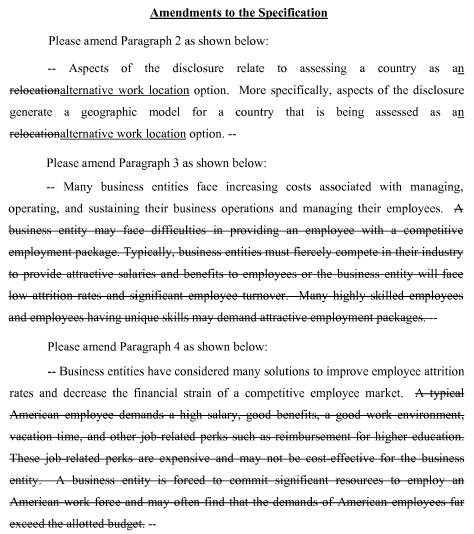
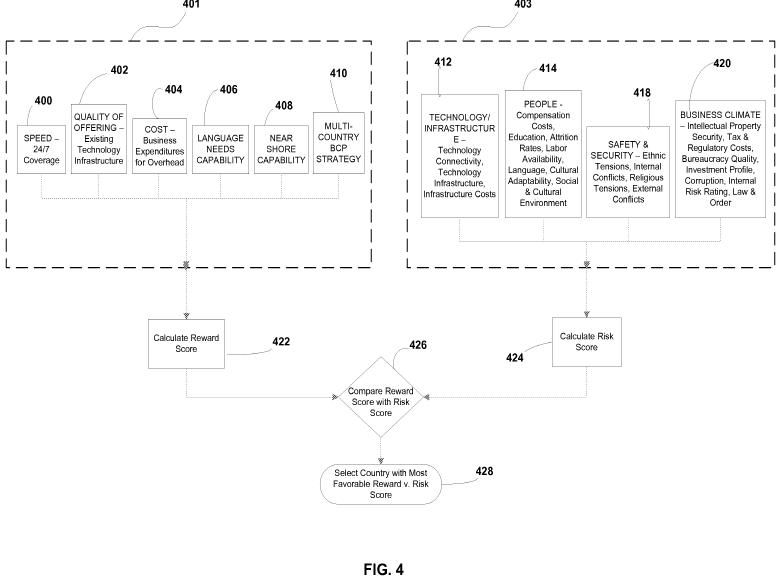
What she didn't mention is that BofA also has a pending patent that describes how to eliminate 'demanding work force' problems by identifying another country for a corporation to relocate its work force to. 'A business entity is forced to commit significant resources to employ an American work force,' complained BofA in a patent filing (a rewrite toned down the anti-American worker sentiment), 'and may often find that the demands of American employees far exceed the allotted budget.' Nor did she mention that that two weeks after CEO Ken Lewis told 60 Minutes that taking $25B in TARP funds was the 'right thing for America', BofA plopped down another $1,194 to seek U.S. patent protection for another 'invention' -- Portfolio Analysis Enhancement to Entity Mobility/Productivity Opportunities -- that enables a business entity 'to employ a work force from a different, lower-cost, location in order to maximize profit.' So, could the patent apps come back to haunt BofA in court?"
Infosys Seeks U.S. Patent On Offshoring U.S. Jobs
from the will-that-exclude-others? dept
theodp writes "It's interesting to see that famed offshoring firm Infosys is now seeking U.S. patent protection for its Framework for Supporting Transition of One or More Applications of an Organization, which Infosys explains 'relates generally to the field of outsourcing or offshoring of one or more applications of an organization.' Prior to this invention, Infosys says it was necessary for a vendor organization to incur hefty visa and travel costs to allow a 'significant number' of employees from its offshore location to 'visit the client's location to interact with the Subject Matter Experts (SMEs)' before returning 'to the offshore location to transfer the knowledge to the offshore team."
Funny. Wasn't it just a year ago that IBM was pressured to abandon its patent application on offshoring?
by Mike Masnick
Wed, Nov 26th 2008 2:22am
Filed Under:
offshoring, patents
Companies:
bank of america
Bank Of America Rewrites Its 'We-Don't-Need-No-Stinking-America' Patent Application
from the that'll-fool-'em dept
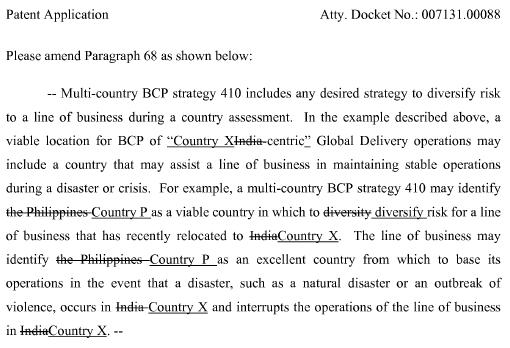
theodp writes "Bank of America has taken steps to cover up the original we-don't-need-no-stinking-America sentiment of its patent application for Country Assessment, which described BofA's innovative way of dealing with the problems of 'a typical American employee [who] demands a high salary, good benefits, a good work environment, vacation time, and other job-related perks' -- relocating jobs to India or the Philippines. BofA has instructed the USPTO to strike its remarks about why employing Americans is such a bad idea, and to replace references to India and the Philippines with 'Country X' and 'Country P'. How clever. By the way, BofA came under fire Tuesday as news broke that CEO Ken Lewis, who is currently preaching 'tough love' for the Big 3 automakers was quietly spending $7B of his spare cash to up BofA's stake in China Construction Bank after snagging a whopping $25B in U.S. bailout money."
Bank of America's We-Don't-Need-No-Stinking-America Patent Application
from the how-nice-of-them dept
theodp writes "Americans are a real problem, explains Bank of America in a just-disclosed patent application for County Assessment. 'A typical American employee,' complains BofA, 'demands a high salary, good benefits, a good work environment, vacation time, and other job-related perks.' Such problems are solved with BofA's patent-pending methodology, which eliminates 'demanding work force' problems by identifying another country for a corporation to relocate its work force to."
Top Accenture Scientist Patents Offshoring US Jobs
from the sounds-familiar? dept
theodp writes "Back in 2005, Accenture Chief Scientist Dr. Kishore Swaminathan teased in a blog entry: 'I have an idea that could revolutionize an important area of information technology - but I cannot tell you because I might compromise Accenture's patent rights.' In January, Swaminathan and co-inventor Charles Nebolsky were granted U.S. patent protection for Rapid knowledge transfer among workers, which covers 'transferring knowledge from expert workers at a client location to apprentice workers' at 'offshore locations such as India, the Philippines, China, etc., where labor is less expensive'. BTW, Accenture wants you experts and the EEOC to know that it's a meritocracy that does not discriminate on the basis of national origin, which would of course break the law."
This sounds oddly familiar. Remember a few months back when it came out that IBM had applied for a patent on offshoring? After that hit the news, IBM ended up dropping the claim. Somehow I doubt Accenture will do the same.
Once Again, Offshoring Not As Big A Deal As Many Believe
from the and-again dept
For many years, we've contended that offshoring wasn't such a big deal.
We did make it clear that it probably didn't work as well as some
supporters claimed, and that many companies that offshored work would
later regret it. However, that didn't mean that companies should be
barred from offshoring, or that offshoring was necessarily bad. Yet,
whenever we post about it, people show up to complain that all American
tech jobs are being outsourced and there are no jobs left for techies in
America. We've already seen that that's untrue, and these days, it's
actually quite difficult to hire strong techies in many companies. Last
year, we saw a report that noted that most tech companies did very
little offshoring -- and now there's a new report coming out looking at
all different kinds of American companies (not just tech ones) and
discovering that most CIOs aren't huge fans of offshoring either.
They've discovered what we predicted back in 2003: sending jobs overseas
because they're cheaper is often less efficient, because of the
difficulty in managing people from so far away in a different time zone.
So, can we finally put to bed the myth that offshoring is killing off
the American tech job?
by Mike Masnick
Fri, Nov 9th 2007 5:02pm
Filed Under:
business model patents, call centers, offshoring, outsourcing, patents
Companies:
at&t
AT&T Seeks Patent For Limiting Access To U.S. Workers
from the this-is-patent-worthy? dept
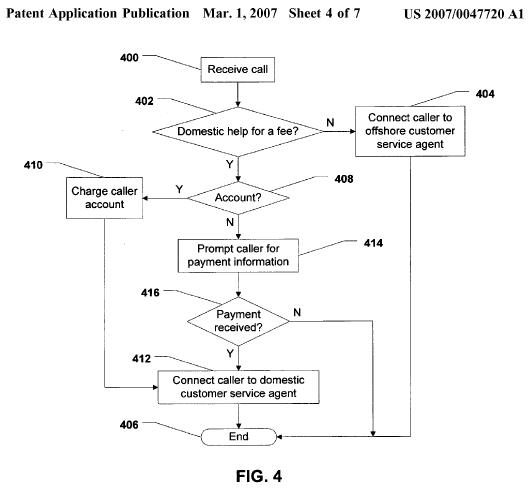
theodp writes "To be fair, IBM isn't the only corporation guilty of demanding U.S. patents for outsourcing methods. For example, AT&T Knowledge Ventures has a patent pending for Managing Incoming Telephone Calls at a Call Center, an invention that calls for transferring callers to offshore call centers unless advance payment is received for the privilege of speaking to someone in the United States. 'Such an option may be beneficial to callers who have difficulties with accents or who have personal or political agendas against outsourcing,' explains Ma Bell 2.0. AT&T's patent claims also cover buying down wait time ('The current wait time is 34 minutes. You may reduce your wait time by a minute for each dollar you are willing to pay. Please enter the number of minutes/dollars you want.')."
Beyond the ridiculousness of the very concept, I've heard such an idea talked about for years. It's a pretty straightforward and obvious idea -- but it's one that few others were interested in implementing (or patenting) as it would likely piss off users. Apparently AT&T doesn't worry about such things. In the meantime, in March of 2004 (about a year and a half before AT&T filed for its patent), I wrote about how the company E-Loan was offering something quite similar. Rather than an upfront payment, E-Loan offered customers a choice of an onshore or offshore call center person, with the knowledge that an offshore support person would help them get a loan faster and an onshore one would take longer. That seems pretty similar to the idea of paying -- it's just that the cost is in time instead of money. Even if this isn't direct prior art, it certainly suggests that these types of ideas have been floating around for quite some time and hardly should be entirely "owned" by one company.
Next In Line To Be Offshored To India? Butlers and Personal Assistants.
from the it's-a-small-small-world dept
The world-shrinking Internet has enabled many companies to utilize offshore employees for everything from computer programming to customer service, with the promise a great cost savings (which actually, at the end of the day, turn out to not be that much). Well, now corporations don't have to be the only ones capitalizing on this trend -- you can now hire your own personal assistant or homework tutor in India. For fractions of what you would normally pay for US-based help, your Bangalore butler can help make travel arrangements, book dinner reservations, and help coordinate your busy schedule. Or, if your child is having trouble with their math homework, hire a remote tutor to help them out. Instead of paying $30 an hour for a local tutor, the offshore services charge $99 a month for as many 45-minute tutoring sessions that you want to arrange. The price savings is there, but it is still questionable whether or not these services will draw enough demand to sustain themselves. TutorVista currently has 10,000 subscribers, which sounds impressive until we recall that in 2005, 20,000 students were estimated to be using Indian tutors. Furthermore, it is unclear whether the economies of scale will apply to consumer services -- whereas offshoring corporate services like customer service lends itself to large, multi-million dollar contracts, consumer services are sold to one individual at a time for a few hundred dollars. For the new personal assistant services, the future is murky at best. While most corporate offshoring projects are driven by cost savings, personal assistant services are a new market, now made available through falling prices. Personal assistants once only affordable for Devil Wears Prada-like executives would now be affordable to middle managers. However, since it is a new market, a considerable amount of marketing must be done to even let people know that these services exist. And, of course, with these remote assistants halfway around the world, you still have to make your own coffee.
Stop Hating Foreigners, Start Hating AJAX
from the automation-moves-on dept
Whenever we talk about offshoring around here it seems to generate a lot of controversy, as a group of folks show up insisting that offshoring "costs" the US jobs -- despite tons of evidence that that's not true at all. It does change the nature of jobs and may emphasize different skills, but more efficient production tends to create more new jobs. In fact, we've tried to point out in the past that offshoring is really no different than automation, though it's less efficient. So we wonder if people who are against offshoring are also against automation (or, well, any kind of productivity enhancement). Perhaps they should be. Slashdot points us to a recent article saying that more modern "web 2.0" technologies are allowing firms to cut IT staff more significantly than offshoring. Yet, don't be fooled. This is unlikely to mean fewer jobs in the long run -- but it will change the types of skills that companies are looking for. But, in the meantime, pure unadulterated luddism is a lot more socially acceptable (if equally as pointless) than the garden-variety racism that comes out of people when talking about offshoring. It's just equally as pointless.