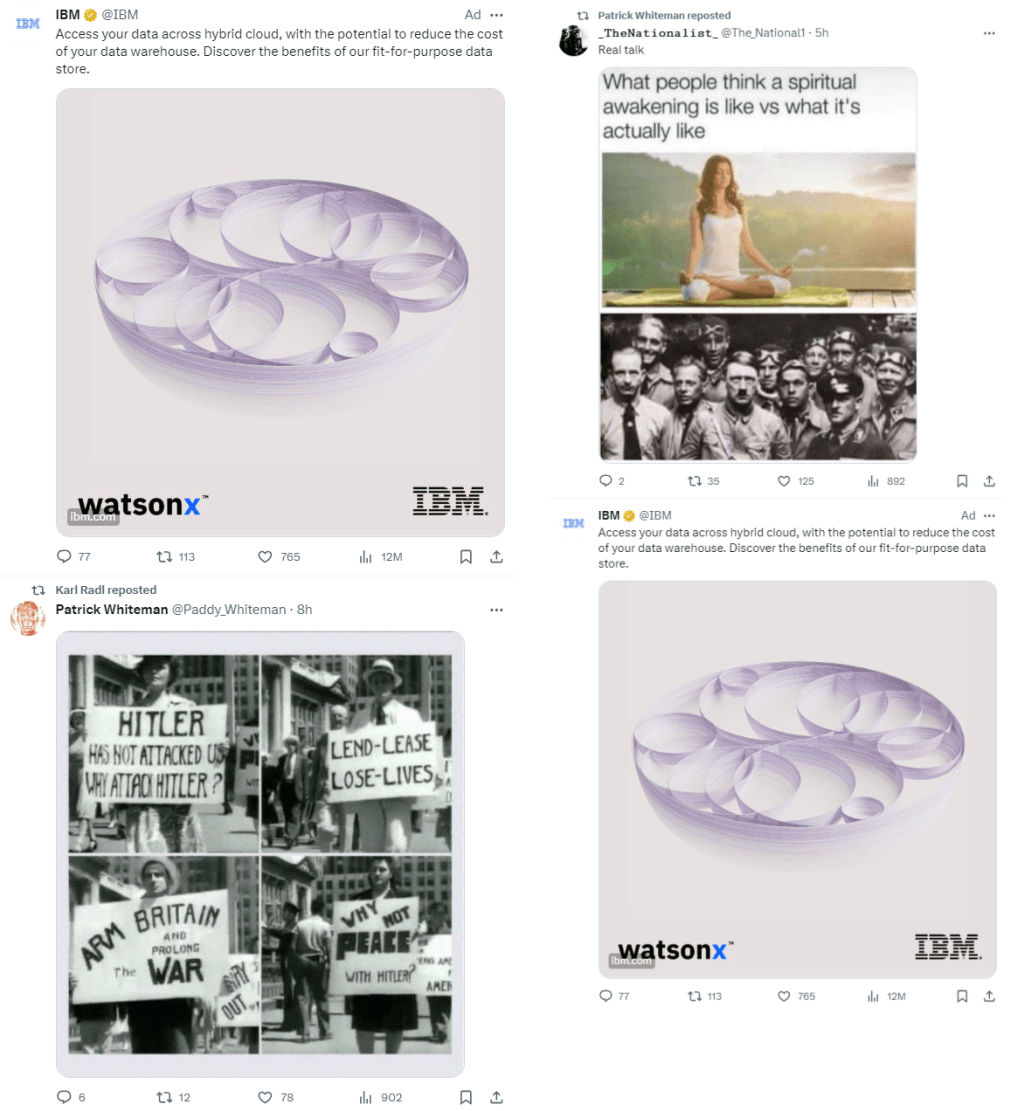
from the to-save-speech-we-need-to-censor-speech dept
So, yesterday we covered Elon Musk’s ridiculous censorial threat to sue Media Matters “the split second the court opens on Monday.” Of course, as we noted, you can file lawsuits 24/7. And yet, as the courts opened on Monday, there was nothing. As mentioned in the original post, I was away from internet access for most of Monday, and when I finally got back online I was told there was still no lawsuit.
But, then, on Monday evening, the lawsuit finally came, and it was glorious. Gloriously stupid.
Honestly, this feels like what you get when you have a rich but legally ignorant dude who announces on a Friday that there will be a lawsuit on Monday and finally finds some terrible lawyers who are actually willing to file something just to live up to that promise.
It’s not a good lawsuit. It’s barely even a lawsuit at all.
Let’s start at the top.
Problem 1: It was filed in Texas federal court, even as the complaint admits that exTwitter is a Nevada corporate entity, based in California, and Media Matters is a D.C.-based entity. The lawsuit barely makes any effort at all to justify the venue.
Indeed, what little justification they do present is not at all how any of this works. To get jurisdiction in Texas for non-Texas parties, they have to show that someone in Texas was involved, that the laws were violated by parties while they were in Texas, or were somehow directed at Texas parties. The complaint doesn’t even make an effort to do any of that. It just says “a substantial part of the events giving rise to the claims occurred herein.” But that’s not how any of this works.
Of course, we all know the real reason it was filed in a Texas federal court. While Texas has a pretty good anti-SLAPP law, the 5th Circuit had deemed that you can’t use it in federal court. If the lawsuit had been filed in the 9th Circuit, where exTwitter is, then California’s (or Nevada’s) anti-SLAPP law would apply.
Problem 2: The lawsuit flat out admits that Media Matters’ reporting was accurate. It makes a big deal of claiming that Media Matters “manipulated” things and “manufactured” the controversy but… still admits that Media Matters used the platform, and saw what it saw, and reported on it.
Media Matters executed this plot in multiple steps, as X’s internal investigations have revealed. First, Media Matters accessed accounts that had been active for at least 30 days, bypassing X’s ad filter for new users. Media Matters then exclusively followed a small subset of users consisting entirely of accounts in one of two categories: those known to produce extreme, fringe content, and accounts owned by X’s big-name advertisers. The end result was a feed precision-designed by Media Matters for a single purpose: to produce side-by-side ad/content placements that it could screenshot in an effort to alienate advertisers.
But this activity still was not enough to create the pairings of advertisements and content that Media Matters aimed to produce.
Media Matters therefore resorted to endlessly scrolling and refreshing its unrepresentative, hand-selected feed, generating between 13 and 15 times more advertisements per hour than viewed by the average X user repeating this inauthentic activity until it finally received pages containing the result it wanted: controversial content next to X’s largest advertisers’ paid posts.
Thus, on page 3 of the complaint, Musk’s newfound lawyers (not from a “BigLaw” firm like he usually uses) tell you that Media Matters did use the platform and did, in fact, see what it reported it saw. It’s just that exTwitter (i.e., Musk) doesn’t like how they they portrayed their usage of the platform.
Notably, the original article never made any claims suggesting that everyone was seeing ads on neo-Nazi content. They just said they saw these ads appearing next to neo-Nazi content, and the complaint admits as much.
So the complaint is “Media Matters set up an account that followed neo-Nazis, which we allow, and found ads next to that content, which we allow, but we’re mad because Media Matters should have followed other people instead.” That’s… not a cause of action.
Problem 3: The lawsuit admits that its real complaint is that it disagrees with how Media Matters framed the story. But, and I know Musk still can’t seem to wrap his brain around this rather important fact: part of free speech and a free press is that you don’t get to dictate how others cover stories about you.
You’d think that a “free speech absolutist” would get that. But Elon Musk appears to have deeply censorial instincts rather than free speech ones:
Media Matters omitted mentioning any of this in a report published on November 16, 2023 that displayed instances Media Matters “found” on X of advertisers’ paid posts featured next to Neo-Nazi and white-nationalist content. Nor did Media Matters otherwise provide any context regarding the forced, inauthentic nature and extraordinary rarity of these pairings
So, yeah, you might also notice that this is Musk admitting that “Neo-Nazi and white-nationalist content” appear on exTwitter and that Media Matters did, in fact, see ads appear next to that content. Great work.
Problem 4: The lawsuit admits that not just Media Matters saw these ads next to neo-Nazi content, even if not that many others saw those ads.
And in Apple’s case, only two out of more than 500 million active users saw its ad appear alongside the fringe content cited in the article—at least one of which was Media Matters
Again, throughout the complaint, it admits exactly what Media Matters reported.
Its only complaint is it doesn’t like how Media Matters reported it. But the 1st Amendment protects such editorial choices. As should any self-respecting “free speech absolutist.”
Problem 5: The lawsuit attacks Media Matters for… using exTwitter’s system the way exTwitter allowed them to. It claims Media Matters “manipulated” the platform, but then describes how it used it in a perfectly reasonable manner, and that exTwitter served up the ads. Media Matters didn’t make exTwitter show these ads. ExTwitter just showed them.
Literally, the complaint admits that exTwitter’s systems worked exactly the way they were designed to, showing ads on content that someone followed, and if someone follows neo-Nazis, then ads are likely to show on that content.
First, Media Matters set out on their attempt to evade X’s content filters for new users by specifically using an account that had been in existence for more than thirty days.
Next, Media Matters set its account to follow only 30 users (far less than the average number of accounts followed by a typical active user, 219), severely limiting the amount and type of content featured on its feed. All of these users were either already known for posting controversial content or were accounts for X’s advertisers. That is, 100% of the accounts Media Matters followed were either fringe accounts or were accounts for national large brands. In all, this functioned as an attempt to flood the Media Matters account with content only from national brands and fringe figures, tricking the algorithm into thinking Media Matters wanted to view both hateful content and content from large advertisers.
Even this did not produce Media Matters’ intended result. An internal review by X revealed that Media Matters’ account started to alter its scrolling and refreshing activities in an attempt to manipulate inorganic combinations of advertisements and content. Media Matters’ excessive scrolling and refreshing generated between 13 and 15 times more advertisements per hour than would be seen by a typical user, essentially seeking to force a situation in which a brand ad post appeared adjacent to fringe content.
So, now… going on exTwitter, following neo-Nazis that Musk refuses to ban, and following advertisers is manipulative? As is “reloading” your feed? Under what theory?
Problem 6: It claims Media Matters “defamed” exTwitter, but then doesn’t include a defamation claim. The lawsuit mentions defamation three times, but not in the claims. So it repeatedly pretends that it’s arguing defamation, even though it’s not:
On November 16, 2023, Media Matters published a false, defamatory, and misleading article with the headline, “X has been placing ads for Apple, Bravo, IBM, Oracle, and Xfinity3 next to pro-Nazi content,” claiming that X was responsible for anti-Semitic content being paired with X’s advertisers’ paid posts.
If it was actually defamatory, Musk would have sued for defamation. The problem was that it was not. So calling it defamatory and not alleging defamation in the claims kinda makes it clear that they’re really just suing because Musk is mad about the article.
Honestly, it reads like the poor lawyer who had to do this rush job thought he was filing a defamation claim, and so added in a few claims of defamation, then a more senior lawyer realized before filing that there’s no fucking way any of this is even remotely defamation, but no one bothered to take out the language about defamation.
Now, there is a “business disparagement” claim and that’s kind of like defamation, but… even harder to show? And it still requires proving actual malice, which this complaint doesn’t even attempt to do. It does do a “Media Matters hates conservatives,” but that’s not how actual malice works.
Problem 7: Other than the “business disparagement” claim, the only thing they can sue over are nonsense throw-in causes of action: “interference with contract,” and “interference with prospective economic advantage.”
These are the kinds of claims that terrible lawyers often include with defamation claims to try to make the lawsuit more scary, and they’re usually dismissed with the defamation claims when judges say “um, you’re really just trying to say defamation in another way here.”
None of the causes of action make any sense here. What Media Matters did was find these ads and accurately report what it found. If that causes advertisers to bail, that’s not “interference with a contract.” It’s… just reporting. If accurate reporting causes someone to end a business relationship, you don’t get to sue over it.
Problem 8: The lawsuit names Media Matters employee Eric Hananoki as a defendant and then never makes a single claim against him. It mentions (mostly in footnotes) that Hananoki has written articles critical of Musk, including the article in the complaint. But, um, if you file a lawsuit against a particular party, you have to say in the lawsuit how that party actually violated the tort in question. And the lawsuit doesn’t even bother trying.
Honestly, Hananoki has the easiest “motion to dismiss for failure to state a claim” argument ever. Normally, you have to respond to the claims made about you and how, even if true, you didn’t violate the law in question. Hananoki doesn’t even need to do that. He can just point out that the lawsuit literally makes no claims against him.
Problem 9: The lawsuit insists advertisers bailed because of this article, but conveniently leaves out the fact that Elon Musk endorsed an antisemitic conspiracy theory a day earlier, and has been promoting bigoted nonsense content for months now. Also, advertisers are free to leave if they want.
Finally, this isn’t exactly a “problem” with the lawsuit, but I’ll just note the conflict in two separate statements:
X Corp. and Elon Musk are a critical Media Matters target because X is the most prominent online platform that permits users to share all viewpoints, whether liberal or conservative, and Mr. Musk is the most prominent voice on the platform and a passionate supporter of free speech.
That’s in paragraph 41 on pages 11 and 12. On Page 14 in the prayer for relief we get this:
A preliminary and permanent injunction ordering Defendants to immediately delete, take down, or otherwise remove the article entitled “As Musk Endorses Antisemitic Conspiracy Theory, X Has Been Placing Ads for Apple, Bravo, IBM, Oracle, and Xfinity Next to Pro-Nazi Content From Its Web” from all websites and social media accounts owned, controlled, or operated, directly or indirectly, by Defendants;
So… within the span of about 2 to 3 pages we are told that Elon Musk and exTwitter are passionate supporters of free speech that allow “all viewpoints” to be shared and that Musk is filing this lawsuit to force Media Matters to take down speech that he admits is absolutely true, but where he doesn’t like how they portrayed things.
Anyway, kudos to Elon. This really takes stupid SLAPP suits to incredible new levels. I didn’t think you’d be able to find a lawyer who would file a lawsuit so stupid, that makes you look this ridiculous, but you did it. Just like people doubted your ability to shoot rockets into space or make popular electric vehicles, I should not have doubted your ability to file absolutely nonsense SLAPP suits that are this laughable.
Filed Under: ads, business disparagement, defamation, elon musk, slapp, texas
Companies: media matters, twitter, x